The Starling Symphony: How ‘Bird-Logic’ is Solving City Traffic
Welcome, aspiring systems architects. At the DeReticular Systems Institute, we view the modern city not as a static grid of asphalt, but as a dissipative metabolic structure—a living organism that requires a continuous, fluid exchange of energy and information to survive. For a century, our urban arteries have been clogged by a primitive, reactive approach to movement. To resolve this, we must abandon our reliance on ungrounded AI and return to the unyielding laws of the physical cosmos. We must look to the skies and embrace the active matter biophysics of the starling murmuration.
- The “Solitary God” vs. The Dancing Swarm
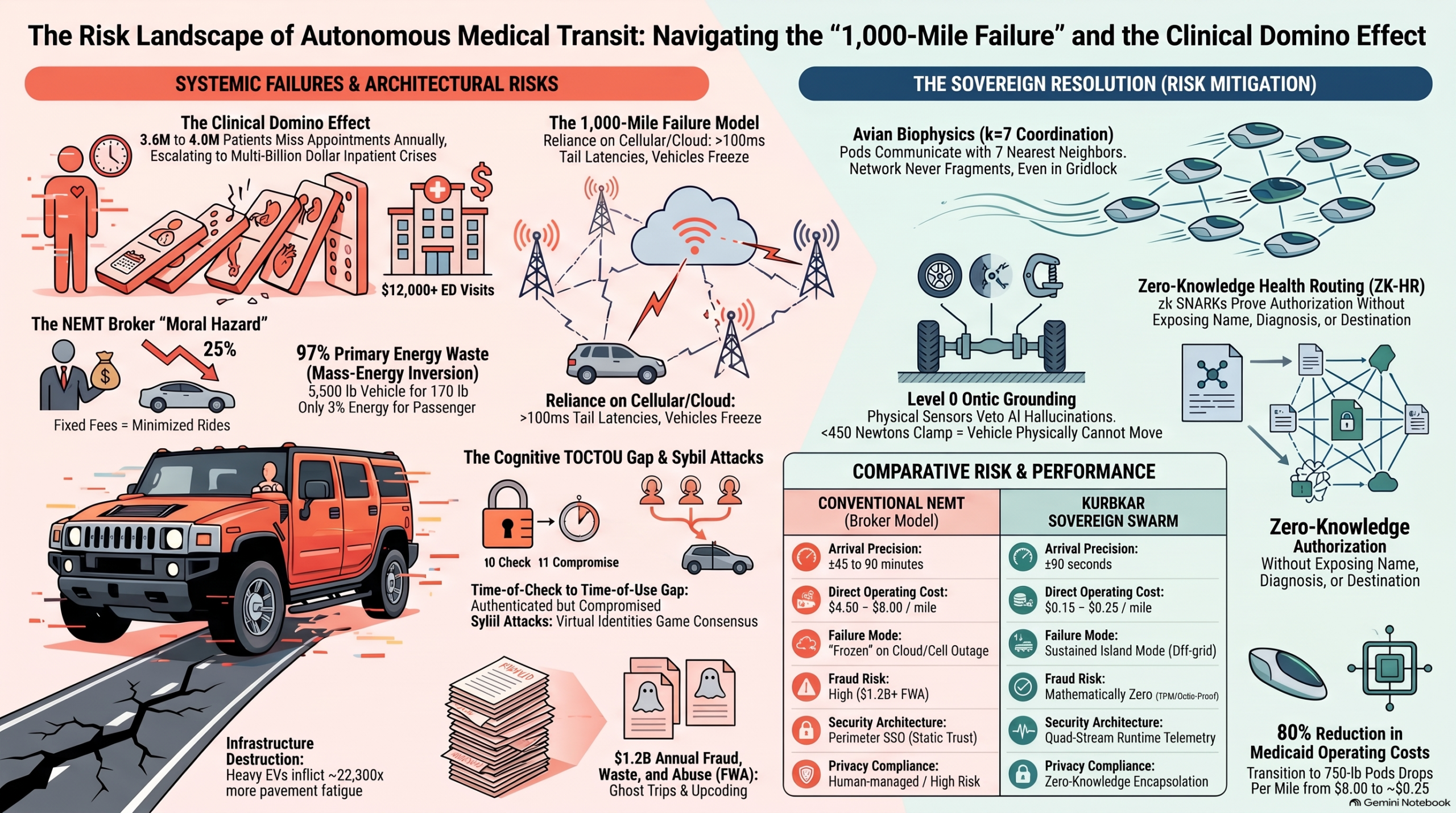
For decades, automotive engineering has been haunted by the “Solitary God Fallacy.” This is the mistaken architectural belief that a vehicle must function as a “cognitive monad”—an isolated entity attempting to achieve omniscience by processing the entire city simultaneously. This approach creates the Cognitive TOCTOU Gap (Time-of-Check to Time-of-Use): a car’s sensors may verify a clear lane at t_0, but because it lacks direct, low-latency coordination with its neighbors, the reality has shifted by the time the command is executed at t_1.
Our current paradigm of “intelligent” traffic is actually defined by five foundational pathologies that inevitably lead to Poisson Queueing Deadlock:
- The 5,000-Pound Mass Inversion: Utilizing a 2,500 kg steel cage to move a single 77 kg human. We spend 97% of our primary exergy moving the chassis and only 3% moving the passenger.
- The “Solitary God” Omniscience Trap: Forcing isolated vehicles to guess human intent through tinted glass and uncoordinated sensors in an adversarial game-theoretic arena.
- The 1,000-Mile Failure Model: Relying on high-latency cloud teleoperation and cellular backhauls. A single spike in network jitter freezes the vehicle, paralyzing the corridor.
- The Epistemic Decoupling of Multi-Agent Systems: Using ungrounded generative AI that leads to “context bloat” and mathematical hallucinations when the swarm is stressed.
- The Generalized Fourth Power Law: A 5,000-lb vehicle inflicts ~22,000 times more structural fatigue on the road than a right-sized pod, accelerating infrastructure decay and the particulate soot of a dying mechanical era.
Biomorphic Active Matter Kinetics: A discipline that treats autonomous agents as “living” matter. By following simple, local biological laws, the collective achieves emergent safety and fluid flow without the need for a centralized “God-eye” controller.
We must transition from the failure of the old mechanical “monad” to the collective wisdom of the birds.
- The Secret of Seven: Topological Intelligence
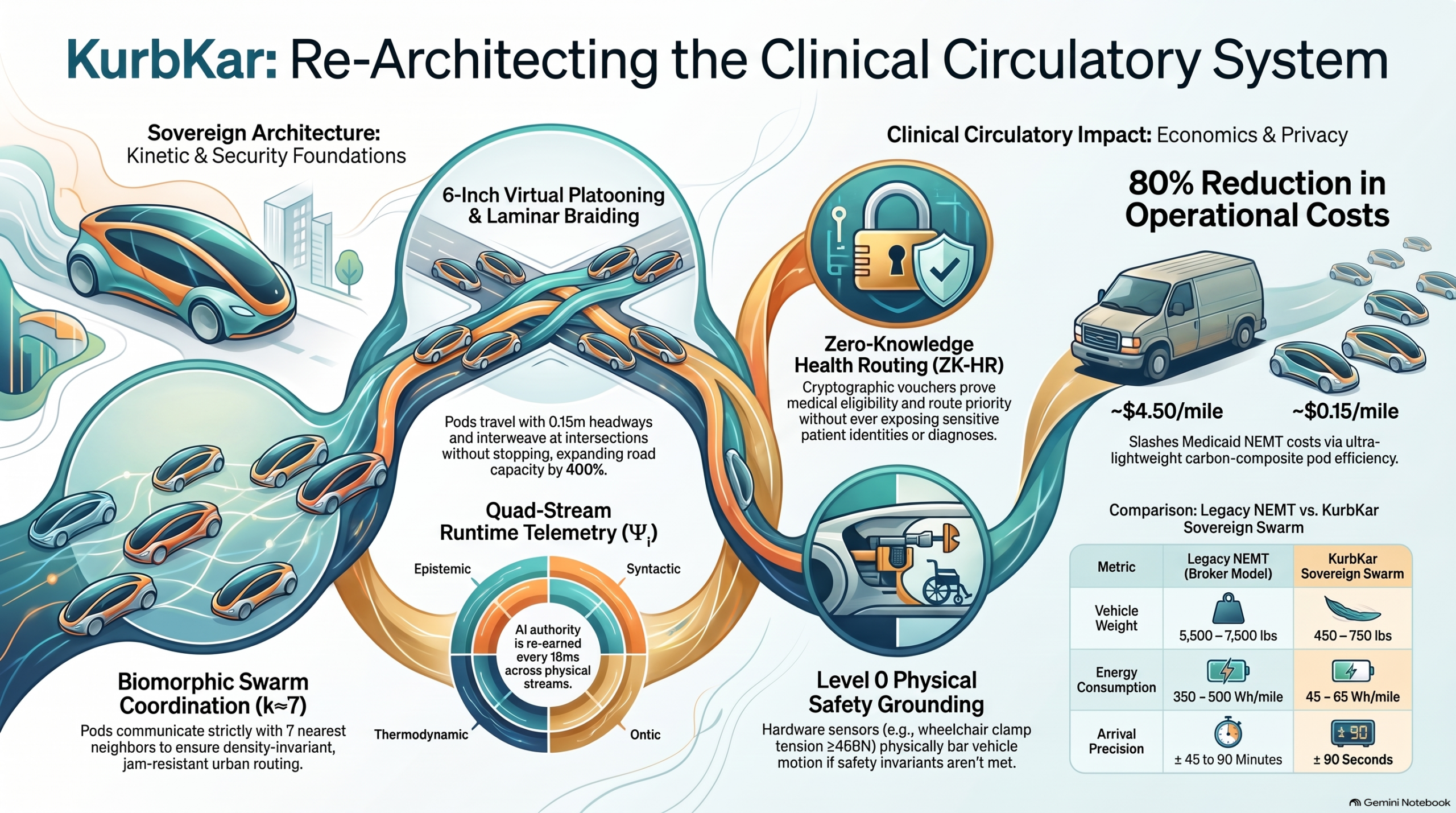
The European StarFlag Project provided the breakthrough: starlings do not track the entire murmuration. They navigate using the “k ≈ 7” rule, interacting strictly with their seven closest neighbors. Crucially, this is a Topological Interaction, not a metric one.
In a metric system, coordination depends on distance. However, when a predator like a falcon attacks, a flock expands drastically, with density dropping from 1.0 bird/m^3 to 0.1 birds/m^3. In a metric-based system, this expansion would snap the “social fabric,” causing the flock to fragment and perish. Because starlings use topological logic, they remain connected to their seven neighbors regardless of how far apart they are. The network remains invariant to density, allowing for a Scale-Free Correlation where a single bird’s turn propagates across the entire system instantly.
Comparing Driving Paradigms
Feature Traditional Human Driving Starling-Logic (KurbKar)
Focus Global/Omniscient (High Stress) Local/Topological (k \approx 7)
Reaction Time 1.5 – 2.0 Seconds (Neuromuscular Lag) Sub-16ms (TriFi RF Mesh)
Coordination Ad-hoc/Adversarial Phase-Synchronized Swarm
Systemic State Poisson Queueing (Stop-and-Go) Laminar Flow (Constant Motion)
Safety Reactive (High Error) Emergent (Ontic Attractor)
How does a signal—a sudden bank or a swerve—move through thousands of entities without the “accordion effect” of human braking?
- Hyperbolic Spin Waves: Information at the Speed of Sight
Information in traditional traffic moves via Diffusion—much like ink spreading in water. It is a slow, first-order process (t \sim x^2) where the signal loses strength and “viscosity” as it travels. In contrast, KurbKar swarms utilize Hyperbolic Spin Waves.
The swarm acts as a Hamiltonian assembly of coupled gyroscopes, governed by the conservation of generalized spin (s_i). When a lead vehicle banks, the change in spin exerts a physical torque on its topological neighbors. This information travels as a “Dark Band” or agitation wave, allowing for true preemption rather than just reaction.
Insight Callout: The Velocity of Information Information in a KurbKar swarm propagates as a linear dispersion wave at a constant speed (c) of 20–40 meters per second. While human drivers are trapped in a 1.5–2.0 second biological reaction latency, the swarm completes its coordination in sub-16ms cycles. This allows a vehicle to “see” and react to an obstacle hundreds of meters away before its own cameras even have a line of sight.
This lightning-fast communication enables us to solve the most congested point in the city: the intersection.
- Laminar Braiding: The End of the Traffic Light
Traffic lights are “primitive time-division multiplexers”—crude tools used to manage human cognitive lag by forcing massive columns of metal to waste energy idling. By replacing them with Laminar Intersection Braiding, we treat traffic as a fluid-dynamic stream.
Using sub-16ms TriFi mesh communication, vehicles interleave seamlessly, expanding roadway capacity by 400%—up to 8,500–11,000 pods per lane per hour—without adding an inch of asphalt. The process follows a 3-Step Negotiation:
- Slot Negotiation: Platoons calculate arrival “micro-slots” miles before reaching the junction.
- Velocity Modulation: Pods adjust their speed by tiny fractions (\pm 0.2 mph) to align with those slots.
- Laminar Interweaving: Vehicles slide through the cross-junction like fingers sliding through fingers, maintaining constant velocity.
- Virtual Platooning: The 6-Inch Safety Margin
On the open highway, KurbKars engage in Virtual Platooning, closing the gap between vehicles to a 6-inch (0.15m) headway. This is impossible for humans, but for a synchronized swarm, it is the Ontic Attractor of efficiency.
At this distance, we achieve Boundary-Layer Merging. The lead pod acts as a high-efficiency “air-cutter,” fusing the airflow of the entire platoon into a single aerodynamic body. This creates a Triple Benefit:
- Drag Reduction: Aerodynamic drag is slashed by 45% for all drafting followers.
- Synchronized Braking: Deceleration signals travel down the chain in under 16ms, allowing the platoon to brake as a single, rigid unit.
- Zero-Friction Peeling: When a pod reaches its exit, the swarm opens a temporary gap, the pod slides out laterally, and the slipstream reseals instantly.
- Conclusion: The City as a Living Organism
When these principles are applied, we transform city traffic into a Clinical Circulatory System. In our current world, we suffer from Traffic Thrombosis—specifically the “Discharge Thrombus,” where a 7.5-hour delay in transporting a single patient from a hospital bed causes systemic “Ischemia” (bed-lock, ED boarding, and ambulance diversion).
By right-sizing the mobility footprint to the corpuscular scale, we enable Priority Medical Spin Waves. If a patient in an autonomous Duo-Pod suffers a cardiac crisis, the pod injects a priority wave into the TriFi mesh. Propagating at 30 m/s, the wave causes the surrounding swarm to “peel open” a frictionless green corridor. The patient reaches the trauma bay 60% faster, without sirens or collisions.
Vision for the Future:
- Exergy Liberation: Slashing primary energy consumption by 80%+ through right-sized vehicle morphology.
- Elimination of Traffic Thrombosis: Achieving deterministic arrival precision of \pm 90 seconds, clearing the “Discharge Thrombus” and hospital gridlock.
- Sustained Island Mode: A resilient, hemodynamic network that requires no cloud or cell towers, operating through total infrastructure collapse via local microgrid power.
By anchoring our synthetic intelligence in Via Negativa parameter foreclosure and biophysical reality, we advance the city from a gridlocked machine into a durable, self-healing organism.