
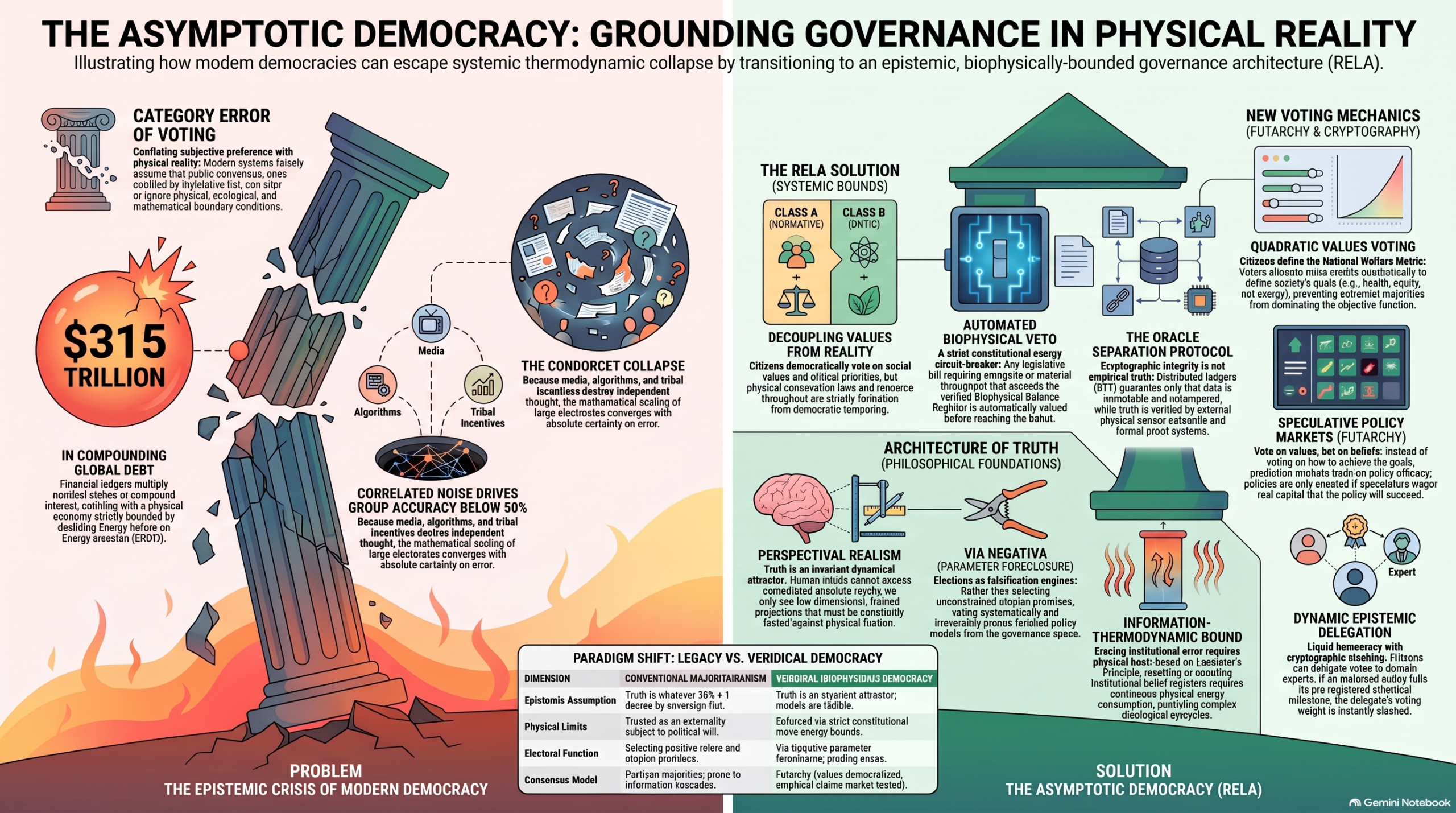
RELA-TS-2026-V1: Technical Specification for the Resilient Epistemic & Thermodynamic Ledger Architecture
- Document Control and Administrative Metadata
In any foundational systems architecture, rigorous administrative metadata constitutes the primary immune system of the epistemic kernel. To prevent institutional drift and the proliferation of “architectural epicycles”—auxiliary patches designed to mask systemic model failure—the RELA framework mandates an immutable chain of provenance. This section establishes the formal boundaries of the specification, ensuring that all subsequent mathematical primitives are anchored in an auditable governance record.
1.1 Administrative Fields
Field Specification
Document ID RELA-TS-2026-V1
Release Version 1.0.0-PROD
Classification Public Institutional Standard
Sponsoring Body Foundational Governance Architecture Working Group
Mathematical Formalisms Measure Theory, Information Theory, Differential Topology, Algorithmic Information Theory
1.2 Change Log
- Version 0.1.0-DRAFT (Q1 2024): Conceptual formulation by the Epistemic Systems Taskforce; initial mapping of thermodynamic constraints to distributed ledgers.
- Version 0.5.0-REVIEW (Q3 2025): Institutional Peer Audit; critical remediation of pseudo-mathematical overreach regarding continuous variables; removal of unrendered LaTeX artifacts.
- Version 1.0.0-PROD (Q3 2026): Production specification; integration of 2024 BIS debt telemetry and formalized biophysical-monetary conversion constants.
1.3 Epistemic Tagging Key [ECCS]
The RELA kernel shall utilize the Epistemic Claim Classification System (ECCS) to distinguish between empirical observations and formal propositions:
- [ESTABLISHED_RESULT]: A formally proven theorem or an empirical physical law.
- [FORMAL_ASSUMPTION]: An axiomatic foundation adopted for system modeling.
- [EMPIRICAL_CLAIM]: A statistically documented real-world measurement.
- [AUTHOR_PROPOSITION]: A novel theoretical synthesis introduced by this architecture.
- [POLICY_SPECIFICATION]: A normative institutional rule or protocol requirement.
These controls provide the governance framework required to explore the mathematical primitives that follow, ensuring that the architecture remains grounded in deductive rigor.
- Ontological Primitives and Mathematical Definitions
To avoid “ornamental notation”—the superficial use of complex symbols as rhetorical metaphors—RELA requires the formal modeling of reality as a high-dimensional manifold. Following the Perspectival Realism of Massimi and Giere, we define the state-space of the universe to ensure that every variable is bound to an explicit, measurable domain.
2.1 The Ontic Manifold
[FORMAL_ASSUMPTION] Let the mind-independent universe be modeled as an ontic state-space manifold \mathcal{M}, where \dim(\mathcal{M}) \to \infty. The ground-truth configuration of the physical cosmos is represented as an invariant truth attractor \Omega^* \subset \mathcal{M}. Absolute truth is defined as the invariant intersection across all possible valid projection angles over indefinite inquiry:
\Omega^* = \lim_{t \to \infty} \bigcap_{\theta \in \Theta_t} \hat{\Pi}\theta^{-1}(\mathcal{P}\theta^{\text{validated}})
In this formulation:
- \mathcal{M} is the infinite-dimensional ontic manifold.
- \Omega^* is the invariant state or trajectory of the physical system.
- \Theta_t is the set of all active epistemic perspective frames at time t.
- \hat{\Pi}_\theta is the projection operator associated with frame \theta.
2.2 The Epistemic Perspective Frame
[FORMAL_ASSUMPTION] An observer, sensor, or voter operates within a dimension-reducing projection operator \hat{\Pi}\theta: \mathcal{M} \to \mathcal{P}\theta, where \dim(\mathcal{P}_\theta) = d \ll \infty. While these projections are fundamentally incomplete, they are veridical within their projection plane; if two states in reality are different, their projections in a valid frame shall track that genuine physical difference.
2.3 Hypothesis Space Measure
[POLICY_SPECIFICATION] Any policy hypothesis or model \mathcal{H}(\theta) is defined over a parameter measure space (\Theta, \mathcal{B}, \mu), where \mathcal{B} is the Borel \sigma-algebra over \Theta, and \mu is the prior Lebesgue measure. The validity of a model is evaluated via a pre-registered discrepancy loss statistic S(E_t, \theta) relative to an empirical threshold \tau_t. A model is falsified and triggers a state-transition when:
S(E_t, \theta) > \tau_t
Where:
- S is the discrepancy metric (e.g., L_2 norm or Wasserstein distance).
- E_t is the empirical data observed at time t.
- \tau_t is the pre-registered falsification threshold.
These definitions establish the “playing field” for the operational axioms of the RELA system.
- RELA Operational Axioms and System Invariants
The RELA kernel hard-codes physical and information-theoretic laws into the ledger’s core to prevent the “Model Crisis” (Kuhn Phase 3) where symbolic promises decouple from biophysical limits. Any violation of these axioms shall trigger an immediate HALT_SYSTEM_CORRUPT state.
3.1 Axiom 1: Monotonicity of Parameter Foreclosure (Via Negativa)
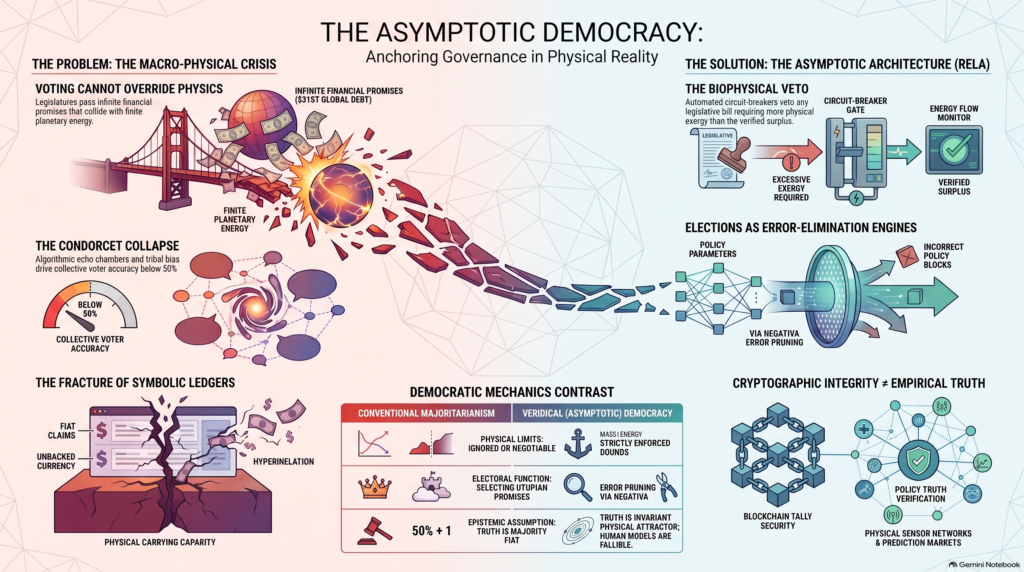
[POLICY_SPECIFICATION] The system kernel shall enforce a strict, non-expanding update rule for the permissible policy space: \Theta_{t+1} = \Theta_t \setminus \Omega_{\text{falsified}}^{(t)}. The “So What?”: This ensures that \frac{d\mu(\Theta)}{dt} \le 0. Once an economic or ideological model is empirically falsified (e.g., debt monetization failing to yield real growth), it is permanently purged. This prevents the resurrection of failed ideologies under new rhetorical branding.
3.2 Axiom 2: Landauer Thermodynamic Bound
[ESTABLISHED_RESULT] Every update to the ledger or erasure of an erroneous belief state is a physical process requiring energy dissipation:
\Delta Q \ge N k_B T \ln 2
Where:
- \Delta Q is the heat dissipated.
- N is the number of bits erased or updated.
- k_B is the Boltzmann constant.
- T is the ambient temperature.
This axiom makes the cost of institutional record-keeping and belief correction explicit, acknowledging that epistemic fidelity requires continuous thermodynamic work.
3.3 Axiom 3: Biophysical-Monetary Constraint
[POLICY_SPECIFICATION] The total stock of nominal monetary claims M_{\text{nominal}} is strictly bounded by the integrated net exergy of the physical system, scaled by efficiency \eta:
M_{\text{nominal}}(t) \le \kappa \int_{t_0}^t (\text{Exergy}_{\text{net}}(\tau) \cdot \eta(\tau)) d\tau
Where:
- \kappa is the invariant conversion constant (Currency Units / Joule).
- \text{Exergy}_{\text{net}} is the verified thermodynamic work capacity, constrained by the declining EROEI (dropping from historic 30:1 to <10:1).
- \eta is the systemic mechanical and Carnot efficiency.
The “So What?”: With global debt at $315 trillion (333% of GDP) as of 2024 BIS data, this axiom prevents the “Macro-Physical Crack” by enforcing a hard ceiling on symbolic debt expansion relative to thermodynamic reality.
- The Oracle Separation Protocol Architecture
The “Oracle Principle” establishes an ironclad architectural distinction between cryptographic integrity (Level 2) and ontic truth (Level 0). Cryptographic ledgers guarantee only that data has not been altered; they do not guarantee empirical correspondence with the cosmos.
4.1 The Source-of-Truth Hierarchy
- Level 0: Ontic Physical Resistance. Direct sensor telemetry, exergy audits, and material failure metrics. (Supreme Authority).
- Level 1: Machine-Checked Deductive Proof. Formally verified syntax using Lean 4 kernels.
- Level 2: Append-Only Cryptographic Ledger. BFT consensus, hashes, and digital signatures.
- Level 3: Symmetric Intersubjective Consensus. Mertonian CUDOS norms and peer-reviewed agreement.
- Level 4: Sovereign Declarative Fiat. Institutional decrees.
The “So What?” for Level 4: In this architecture, Level 4 (Sovereign Fiat) is assigned zero epistemic weight. A political decree is treated as a “Class A” preference attempting to override “Class B” (Ontic) reality; it remains unvalidated unless corroborated by Level 0–2 telemetry.
4.2 Protocol Execution
Level 2 integrity mechanics utilize BFT consensus to ensure immutability, while Level 0 ontic feedback integrates decentralized IoT sensor networks to provide the supreme authority over the ledger state. This ensures that even if a majority votes for an impossible outcome, the ledger accurately records the descent into delusion while engaging the Biophysical Veto.
- Data Schemas and Interface Specifications
To establish a “Common Language of Truth,” all nodes shall utilize machine-readable, append-only data objects.
5.1 EpistemicBallotNode.json
{
“ballot_id”: “uuid-v4”,
“perspective_frame_hash”: “sha256_hash”,
“encrypted_vote”: {
“c1”: “elgamal_element”,
“c2”: “elgamal_element”
},
“zk_proof_validity”: “groth16_proof_base64”,
“nullifier_hash”: “sha256_hash”
}
5.2 PolicyHypothesisManifest.json
{
“manifest_id”: “uuid-v4”,
“formal_verification_tokens”: [“lean4_ast_proof_kernel”],
“discrepancy_metric”: “WASSERSTEIN_DISTANCE”,
“maximum_kolmogorov_bits”: “mdl_ceiling_to_prevent_overfitting”,
“falsification_threshold”: 0.05
}
5.3 BiophysicalVetoRegister.json
{
“telemetry_epoch”: 1042,
“net_exergy_joules”: 1.45e18,
“material_runway_days”: {
“copper”: 450, “lithium”: 120, “hydrocarbons”: 890
},
“veto_circuit_tripped”: false
}
- The Cryptographic Cased Ballot (E2E-V Protocol)
RELA updates the ancient Babylonian “Cased Tablet” for the digital age, using homomorphic encryption to ensure that ballots are “Tallied-as-Recorded.”
6.1 Homomorphic Inscription
The voter intent V is encrypted using exponential ElGamal or Paillier. This “inner core” is protected by a Zero-Knowledge Envelope (zk-SNARKs/Groth16) which proves the ballot is valid (V \in {0, 1}) without revealing the plaintext intent. This maintains secrecy while enabling public auditability.
6.2 The Tallying Mechanism
Aggregation occurs homomorphically (\prod C_i = \text{Encrypt}(\sum V_i)), ensuring that the final tally is mathematically derived from the encrypted ballots. This integrity layer ensures that the democratic will is accurately recorded, though it remains secondary to the thermodynamic reality enforced by the Veto circuit.
- The Biophysical Veto and Telemetry Integration
The “Biophysical Constitutional Bound” dictates that thermodynamics must remain outside the reach of democratic majoritarianism.
7.1 The Circuit-Breaker Mechanism
RELA integrates decentralized IoT sensor networks and satellite remote sensing with hardware attestation to maintain the BiophysicalVetoRegister. If any proposed bill or referendum requires energetic or material throughput where \Delta E_{\text{policy}} > \text{Exergy}_{\text{available}}, the kernel shall trigger an automated circuit-breaker, halting the proposal before it reaches the ballot.
7.2 Formal Verification
The system utilizes Lean 4 formal verification kernels to audit the internal logic of the PolicyHypothesisManifest. This ensures that even if a policy is thermodynamically feasible, its deductive structure is free from the symbolic errors that characterize modern policy drift.
- BFT Consensus and Bulletin Board Infrastructure
To survive network partitions and adversarial node failures, RELA employs partially synchronous Byzantine Fault Tolerant (BFT) consensus.
8.1 Consensus Parameters
The system maintains safety and liveness provided N \ge 3f + 1. RELA utilizes Threshold BLS signatures to reduce communication overhead to \mathcal{O}(N), facilitating high-throughput block finality on the append-only Bulletin Board.
8.2 Recorded-as-Cast
Voters verify their tracker_hash on the BFT distributed state. This creates a transparent audit trail where the consensus of the network guarantees that the integrity of the record is maintained against Byzantine actors.
- Adversarial Threat Model and Economic Safety Proofs
9.1 Sybil Defense
To mitigate identity splitting, RELA utilizes Soulbound Tokens (SBTs) and zero-knowledge unique-human proofs. Without these, an attacker can gain a 3.16\times influence advantage in Quadratic Voting by splitting 100 credits across 10 identities. The SBT kernel reduces this advantage to zero via biometric nullifiers.
9.2 Futarchy Manipulation Proof
The expected loss for a market manipulator (“Whale”) attempting to bribe the system is formulated as: \mathbb{E}[\text{Loss}] \ge M_{\text{whale}} \cdot (1 – P(\text{Reality Manipulated})) Because Level 0 physical sensors provide an unbribable settlement layer, any attempt to manipulate market sentiment results in a total loss of the whale’s capital upon empirical verification.
9.3 Information Cascade Mitigation
RELA enforces Mertonian CUDOS norms (Communalism, Universalism, Disinterestedness, Organized Skepticism) within its communication protocols. Algorithmic feeds are sorted by “cross-perspectival bridging metrics” to prevent the tribal noise and information cascades that lead to “Condorcet Inversion” (where group accuracy drops below chance).
- Transition Roadmap and Socio-Technical Phasing
The cutover to veridical governance is a 60-month phased implementation:
- Phase 1 (Months 1–12): Deployment of E2E-V cryptographic wrappers and “Shadow Parameter Logging” to audit current legislative claims.
- Phase 2 (Months 13–24): Pilot Municipal Biophysical Balance Registers (BBR) and non-binding “Shadow Futarchy” prediction markets.
- Phase 3 (Months 25–42): Activation of the Binding Biophysical Veto and the Via Negativa Parameter Registry to irreversibly disqualify falsified policy models.
- Phase 4 (Months 43–60): Final constitutional cutover to the “Asymptotic Democracy” standard, anchoring all symbolic claims in the thermodynamic reality of the Earth.
Synoptic Summary: RELA-TS-2026-V1 provides the structural framework to anchor the human ballot in the unyielding friction of the physical cosmos, ensuring human survival through the systematic elimination of institutional delusion.