
Standard Specification for Cyber-Physical Sensor Networks in Severe Operational Environments (STD-CPSN-2026)
- Biophysical System Architecture and Grounding Principles
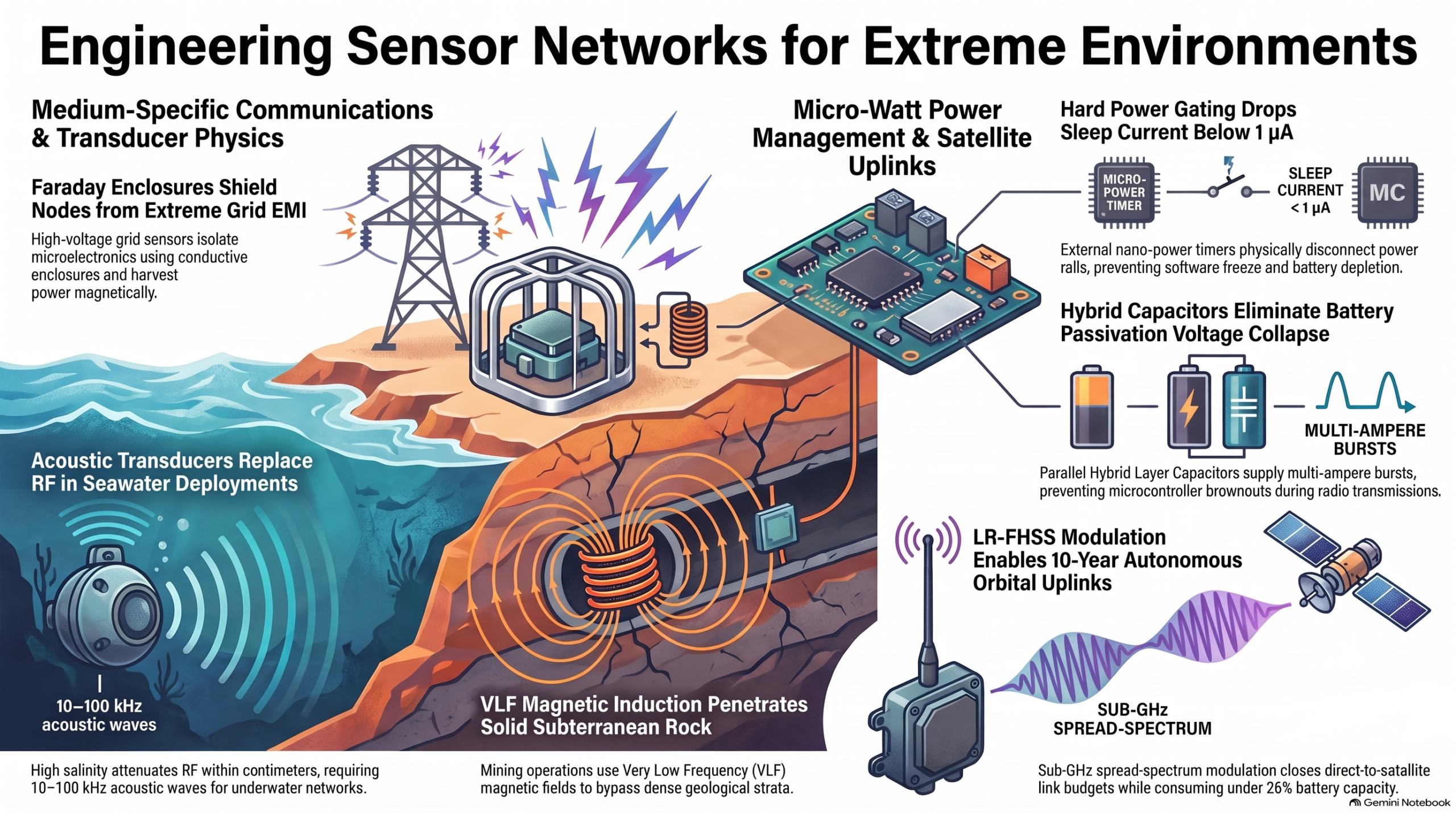
Deploying cyber-physical sensor networks (CPSNs) across severe operational environments demands an architectural paradigm rooted in physical-layer grounding. Conventional computational fabrics rely on symbolic abstractions, software configuration files, and unanchored digital ledgers. When decoupled from physical invariants, non-equilibrium thermodynamics, and relativistic mechanics, these abstract layers suffer catastrophic systemic failures. In multi-agent collectives, ungrounded abstractions trigger context bloat, positive error covariance, and the Condorcet Inversion—wherein correlated errors drive collective decision-making toward failure with mathematical certainty. In spatial access control, unverified scalar telemetry creates a Spatial Oracle Gap that exposes infrastructure to relay attacks and signal spoofing. In physical field deployments, transceivers and power trains fail when software sleep configurations ignore channel electrodynamics, skin-depth attenuation, high-voltage displacement currents, and battery passivation. To ensure multi-year survival and veridical state execution, cyber-physical sensor architectures must anchor computational identity, network state transitions, and environmental telemetry directly in physical reality.
Architectural Stack Synthesis
Physical computing networks operate across a Four-Tier Cyber-Physical Architecture. Each layer integrates explicit hardware and software interfaces that govern interactions across physical boundaries:
- Tier 1: Perception & Physical Computing Layer (CPSN Field Node)
- Core Hardware/Software Subcomponents: Physical transducers (capacitive, piezoresistive, electrochemical, optical, acoustic); Analog Front-End (AFE) signal conditioning arrays with instrumentation amplifiers (\text{CMRR} > 100\text{ dB}) and active anti-aliasing filters; mixed-signal digitizers (Successive Approximation Register [SAR] and Delta-Sigma [\Delta\Sigma] ADCs); heterogeneous processing cores (ARM Cortex-M, RISC-V) featuring Hardware Cryptographic Engines and Physical Unclonable Functions (PUF); sub-microwatt Power Management Integrated Circuits (PMICs); primary Lithium Thionyl Chloride (\text{Li-SOCl}_2) bobbin cells buffered by Hybrid Layer Capacitors (HLC).
- Operating Interfaces & Physical Boundaries: Low-level SPI, I2C, UART, and analog differential signaling lines; physical boundaries include direct thermal, mechanical, electromagnetic, and chemical contact with high-voltage conductors, solid geological rock, deep water columns, or corrosive wilderness atmospheres.
- Tier 2: Network & Routing Layer
- Core Hardware/Software Subcomponents: Deterministic Media Access Control (MAC) schedulers; Time-Synchronized Channel Hopping (TSCH / IEEE 802.15.4e); IPv6 over Low-Power Wireless Personal Area Networks (6LoWPAN); Routing Protocol for Low-Power and Lossy Networks (RPL); Sub-GHz field area networks (Wi-SUN / IEEE 802.15.4g); LoRaWAN Long-Range Frequency Hopping Spread Spectrum (LR-FHSS); Through-The-Earth (TTE) Very Low Frequency (VLF) magnetostatic transceivers; subsea Depth-Based Routing (DBR) acoustic protocol stacks; Delay-Tolerant Networking (DTN / RFC 5050) bundle protocols.
- Operating Interfaces & Physical Boundaries: Sub-GHz/ISM RF baseband transceivers, acoustic piezo-transducers, and induction coil drives; physical boundaries encompass space-air-water electromagnetic propagation media, soil/rock skin-depth attenuation boundaries, and acoustic thermal clines.
- Tier 3: Middleware & Fog Processing Layer
- Core Hardware/Software Subcomponents: Distributed stream ingestion brokers (Apache Kafka, MQTT); containerized microservices; dynamic schema validators; device identity registries; Over-The-Air (OTA) firmware management engines; edge gateway translation bridges (IEC 61850 GOOSE/SV to IP).
- Operating Interfaces & Physical Boundaries: gRPC, RESTful JSON/Protobuf APIs, and OPC-UA over industrial IP backbones, cellular networks (5G NR, C-V2X), fiber optic backbones, and Low-Earth Orbit (LEO) satellite links.
- Tier 4: Application & Digital Twin Layer
- Core Hardware/Software Subcomponents: Physics-informed digital twins; Supervisory Control and Data Acquisition (SCADA) enterprise historians; automated closed-loop actuation orchestrators; post-seismic structural triage modules; predictive maintenance analytics engines.
- Operating Interfaces & Physical Boundaries: Enterprise dashboard interfaces, automated control loops, and physical actuation triggers driving relays, switches, and valves across industrial infrastructure.
+————————————————————————————————–+
| FOUR-TIER CYBER-PHYSICAL ARCHITECTURE |
+==================================================================================================+
| TIER 4: APPLICATION & DIGITAL TWIN LAYER |
| – Real-time SCADA / Enterprise Historians – Physics-Informed Digital Twins |
| – Actuation Engines & Closed-Loop Control Orchestrators |
+————————————————————————————————–+
▲ RESTful APIs, gRPC, OPC-UA, AMQP
+————————————————————————————————–+
| TIER 3: MIDDLEWARE, FOG & CLOUD PROCESSING LAYER |
| – Stream Ingestion (Kafka, MQTT Brokers) – Distributed State Storage & Device Registry |
| – Containerized Microservices – Over-the-Air (OTA) Firmware Management |
+————————————————————————————————–+
▲ IP Backbone, 5G NR/C-V2X, LEO Satellite, Fiber
+————————————————————————————————–+
| TIER 2: NETWORK & ROUTING LAYER |
| – Deterministic Mesh & Star Topologies (TSCH, RPL, 6LoWPAN, LoRaWAN, Wi-SUN) |
| – Media Access Control (MAC) Scheduling, Channel Hopping, Collision Avoidance |
| – Delay-Tolerant Networking (DTN) & Acoustic Depth-Based Forwarding |
+————————————————————————————————–+
▲ Baseband / RF / Acoustic / Quasi-Magnetostatic
+————————————————————————————————–+
| TIER 1: PERCEPTION & PHYSICAL COMPUTING LAYER (CPSN NODE) |
| – Transducers (Piezoresistive, Capacitive, Electrochemical, Optical) |
| – Analog Front-End (AFE): Instrumentation Amplifiers (CMRR > 100 dB), Anti-Aliasing Filters |
| – Mixed-Signal Digitization: Multi-Channel SAR / Delta-Sigma ADCs |
| – Compute Engine: Heterogeneous MCUs (ARM Cortex-M, RISC-V) with Hardware Crypto & PUF |
| – Power Management: Sub-microwatt PMICs, Hardware Power Gating, Li-SOCl2 / HLC Buffers |
+————————————————————————————————–+
Thermodynamic & Relativistic Directives
To enforce biophysical grounding, system execution across Tier 1 through Tier 4 is governed by strict physical laws and mathematical conservation directives:
- Landauer’s Thermodynamic Dissipation Limit & Active Inference Halting: Information processing is fundamentally constrained by non-equilibrium thermodynamics. Overwriting or erasing N bits of physical memory dissipates a minimum thermal energy \Delta Q into the local environment: \Delta Q \ge N \cdot k_B T \ln 2 Where:
- k_B = 1.380649 \times 10^{-23}\text{ J/K} is the Boltzmann constant.
- T is the ambient physical temperature of the compute core in Kelvin.
- N is the quantity of erased or overwritten physical memory bits.
An agent operating under Active Inference balances internal predictive accuracy against computational complexity by minimizing its Variational Free Energy (F): F = \mathbb{E}{q(\vartheta)}\left[ \ln q(\vartheta) – \ln p(x, \vartheta) \right] = D{\mathrm{KL}}(q(\vartheta) \parallel p(\vartheta \mid x)) – \ln p(x) Where:
- q(\vartheta) represents the agent’s internal recognition density over hidden causes \vartheta.
- p(x, \vartheta) is the generative model of observations x and hidden state causes \vartheta.
- D_{\mathrm{KL}}(\cdot \parallel \cdot) is the Kullback-Leibler divergence measuring informational complexity cost.
- -\ln p(x) is the sensory surprise or marginal likelihood.
To prevent infinite autoregressive reflection loops and memory exhaustion during edge processing, local micro-metacognitive monitors enforce the Metabolic Halting Gate: \text{If } \Delta F < \lambda \cdot \Delta Q, \quad \text{Trigger: } \operatorname{FORCE_ACTION_HALT} Where \Delta F is the expected marginal reduction in Variational Free Energy achieved by an additional processing cycle, \Delta Q is the physical Landauer thermodynamic erasure cost, and \lambda = 1.25 represents the mandatory minimum informational efficiency threshold. If a compute cycle cannot prove an informational gain exceeding its physical thermodynamic dissipation cost, execution is halted at the hardware layer.
- RELA Axiom 3 (Exergy-Monetary & Compute Equivalence): Authorized state execution, compute allocation, and token issuance are strictly bounded by verified net physical thermodynamic exergy reserves: M_{\text{nominal}}(t) \le \kappa \int_{t_0}^t \left( \text{Exergy}_{\text{net}}(\tau) \cdot \eta(\tau) \right) d\tau Where:
- M_{\text{nominal}}(t) is the cumulative authorized monetary or compute allocation limit at time t.
- \text{Exergy}_{\text{net}}(\tau) represents the verified net work capacity of participating energy harvesters or microgrids (accounting for Energy Return on Energy Invested costs) in Joules per second.
- \eta(\tau) is the measured Carnot thermodynamic conversion efficiency (\eta = 1 – T_{\text{cold}}/T_{\text{hot}}).
- \kappa is the dimensional conversion constant expressed in units of allocation credits per Joule.
System directives cannot execute unless backed by verified physical energy reserves, rendering ungrounded computational execution physically impossible.
Establishing these foundational biophysical principles ensures that logical execution remains strictly bounded by physical invariants, providing the baseline required to design surviving transducer front-ends and low-power energy architectures.
- Transducer Physics, Analog Front-End Conditioning, and Power Management Architecture
Sensing structural, chemical, electrical, and hydrodynamic variables across severe operational environments places extreme demands on hardware durability and signal fidelity. Transducers deployed in active mining stopes, high-voltage switchyards, subsea columns, or wilderness catchments must capture micro-amplitude physical phenomena while surviving mechanical shock, intense electromagnetic interference (EMI), ambient noise, and severe thermal cycling. Raw transducer signals are highly susceptible to corrupting noise and common-mode coupling. Furthermore, improper power management—such as relying on software-based micro-controller sleep modes or unbuffered battery chemistries—results in current leakage, cosmic ray latch-up, severe passivation voltage drop, and catastrophic field failures.
Transducer Physics & Signal Conditioning
Sensing modalities must be matched to environmental hazards based on their underlying transducer physics:
Sensing Modality Physical Principle Target Metric Primary Environmental Hazard
Low-Noise Seismic MEMS Accelerometers Differential capacitance shift in micro-machined proof mass Ambient & structural micro-vibration (<20\ \mu\text{g}/\sqrt{\text{Hz}}) Structural impact shock, multi-path resonance
Vibrating Wire Strain Gauges Resonant frequency shift of tensioned steel wire (\Delta \epsilon \propto \Delta f^2) Long-term structural strain & tension Moisture ingress, severe thermal expansion
Fiber Bragg Grating (FBG) Shift in reflected Bragg wavelength (\lambda_B) along optical fiber High-strain, spark-free structural fatigue Cable shear, extreme mechanical bending
Rogowski Coils Helical coil output voltage proportional to current derivative (\frac{di}{dt}) High-AC short-circuit fault currents Core saturation immunity, high \frac{dV}{dt} transients
Optical Current Transducers (OCT) Faraday Effect polarization angle shift in magneto-optic crystal High-voltage transmission line current Extreme electrostatic fields, high magnetic flux
UHF Partial Discharge Monitors Electromagnetic burst sensing (300\text{ MHz}–1.5\text{ GHz}) Dielectric breakdown in transformers/GIS Corona discharge RFI, switching surges
In-Place Inclinometers (IPI) Biaxial MEMS gravity vector displacement arrays Subterranean shear plane deflection Flying rock, heavy debris, grouting stress
MOX Pyrolysis Arrays Heated metal-oxide conductivity shift during gas absorption Early smoldering wildfire gases (CO, \text{H}_2, VOCs) High heater power consumption, high ambient humidity
Tonpilz Piezo Projectors Piezoceramic ring expansion/contraction under AC potential Subsea acoustic pressure wave generation High hydrostatic pressure (>60\text{ MPa}), biofouling
To convert low-amplitude, high-impedance transducer signals into digitized telemetry without introducing distortion, the Analog Front-End (AFE) must maintain high common-mode rejection. The AFE instrumentation amplifier must achieve a Common-Mode Rejection Ratio (\text{CMRR}) exceeding 100\text{ dB}: V_{\text{out}} = A_d (V^+ – V^-) + A_{cm} \left(\frac{V^+ + V^-}{2}\right), \quad \text{CMRR}{\text{dB}} = 20\log{10}\left(\frac{A_d}{A_{cm}}\right) > 100\text{ dB} Where:
- A_d is the differential voltage gain of the amplifier stage.
- A_{cm} is the common-mode voltage gain.
- V^+ and V^- are the non-inverting and inverting input voltages, respectively.
In discrete instrumentation amplifier implementations, differential rejection is directly governed by passive component matching: \text{CMRR} \approx \frac{1 + A_d}{4 \left(\frac{\Delta R}{R}\right)} Where \frac{\Delta R}{R} represents the fractional resistance mismatch in the gain-setting bridge network. To maintain \text{CMRR}_{\text{dB}} > 100\text{ dB} across thermal swings in high-EMI environments (such as high-voltage switchyards), AFE front-ends must utilize laser-trimmed, 0.01% precision-matched thin-film resistor arrays.
To prevent aliasing of high-frequency harmonic noise into the digitizer passband, analog inputs must pass through an active low-pass filter satisfying the Nyquist-Shannon sampling criterion (f_s \ge 2 f_{\text{max}}). For dynamic structural vibration profiling, a 4th-order active Butterworth filter provides a maximally flat amplitude response governed by the transfer function: |H(j\omega)| = \frac{1}{\sqrt{1 + \left(\frac{\omega}{\omega_c}\right)^{2n}}} \quad (n = 4) Where:
- |H(j\omega)| is the magnitude of the filter transfer function at angular frequency \omega.
- \omega = 2\pi f is the operational input angular frequency in radians per second.
- \omega_c = 2\pi f_c is the -3\text{ dB} cutoff angular frequency.
- n = 4 is the filter order, providing a -24\text{ dB/octave} (-80\text{ dB/decade}) roll-off rate.
When digitizing conditioned analog signals, Mixed-Signal Analog-to-Digital Converters (ADCs) must be selected based on dynamic range and duty-cycling constraints:
- Successive Approximation Register (SAR) ADCs: Deliver zero cycle-latency overhead and microampere power draw during operation. SAR ADCs (12–16\text{ bits}, 10\text{ kSPS}–1\text{ MSPS}) are optimal for heavily duty-cycled, event-driven point measurements where instant wake-up is required.
- Delta-Sigma (\Delta\Sigma) ADCs: Utilize high oversampling ratios (\text{OSR}) and decimation sinc filters to achieve exceptional dynamic resolution (24\text{ bits}), capturing continuous micro-vibrations and high-precision seismic telemetry at the cost of higher latency and active power consumption.
Power Subsystem & Battery Passivation Mitigation
Software-configured micro-controller sleep modes (which draw 1–5\ \mu\text{A}) expose field nodes to current leakage and cosmic-ray-induced latch-up events, where frozen registers drain battery reserves within weeks. Standard CPSN nodes enforce hard hardware power gating:
[ Primary Li-SOCl2 Cell ] ──> [ Hybrid Layer Cap (HLC) ] ──> Direct Rail (Unregulated 3.6 V)
│
┌───────────────────────────────────┴────────────────────────┐
│ │
▼ (Continuous Low Quiescent Rail, Iq < 50 nA) ▼
+——————————————–+ Active High-Side Load Switches (P-MOSFETs)
| Nano-Power System Timer (e.g., TPL5110) | (Off State Leakage < 10 nA)
| – Draws 35 nA continuous | ├── Power Rail 1 ──> [ Sensors & AFEs ]
| – External Analog Wake Thresholds | ├── Power Rail 2 ──> [ Main MCU Core ]
| – Drives EN pins of Main Power Gates | └── Power Rail 3 ──> [ Satellite RF PA / Tx ]
+——————————————–+
An external nano-power system timer (TI TPL5110, drawing continuous quiescent current I_q \approx 35\text{ nA}) completely isolates downstream circuits using low-leakage P-MOSFET load switches (off-state leakage I_{\text{leak}} < 10\text{ nA}). Main processor power rails remain unpowered until scheduled wakeup windows open or asynchronous threshold interrupts fire.
For long-lifespan remote deployments (5–10+\text{ years}), primary Lithium Thionyl Chloride (\text{Li-SOCl}2) bobbin cells are selected for their high gravimetric energy density (>650\text{ Wh/kg}) and wide temperature rating (-60^\circ\text{C} to +85^\circ\text{C}). However, \text{Li-SOCl}2 forms a protective Lithium Chloride (\text{LiCl}) passivation film on the anode. While this film limits internal self-discharge to <1% per year, it presents high internal resistance. When a high-power transceiver requests a sudden 1–2\text{ A} transmit pulse, cell terminal voltage collapses immediately: V{\text{terminal}} = V{\text{OCV}} – I_{\text{pulse}} \cdot R_{\text{passivation}} Where:
- V_{\text{terminal}} is the instantaneous terminal output voltage under load.
- V_{\text{OCV}} is the cell open-circuit voltage (\approx 3.65\text{ V}).
- I_{\text{pulse}} is the transient current draw of the power amplifier (1.0–2.0\text{ A}).
- R_{\text{passivation}} is the equivalent internal resistance of the passivated anode boundary.
Under sub-zero thermal conditions, this drop forces rail voltage below micro-controller brownout limits (<2.0\text{ V}), resetting the device before transmission completes.
Terminal Voltage 3.6 V ┌──────────────────────────────────────────────┐
│ │
3.0 V ├──────┐ │
│ │ VOLTAGE DELAY DROP │
2.2 V ├──────┼───────────────────────┐ │
│ │ (MCU Brownout Window) │ │
1.8 V ├──────┴───────────────────────┼───────────────┴── Safe Level (Post-Depassivation)
│ │
└──────────────────────────────┴────────────────── Time (ms)
The engineering solution mandates wiring a low-Equivalent Series Resistance (\text{ESR} < 100\text{ m}\Omega) Hybrid Layer Capacitor (HLC) in parallel with the primary cell. The primary cell trickles current into the HLC during deep sleep. During radio transmissions, the HLC delivers the multi-ampere pulse, holding the system rail safely above 3.3\text{ V}.
[ Primary Li-SOCl2 Bobbin Cell ] (High Energy Density, Low Continuous Current: 10–50 mA)
│
├───────────────────────────────────────────────┐
│ Continuous Micro-Current Trickle Charge │
▼ ▼
[ Hybrid Layer Capacitor (HLC) ] [ Low-Leakage System Rail ]
(Low ESR < 100 mΩ, Pulse Output: 2–5 A) │
│ │
└───────────────────────┬───────────────────────┘
│
▼
[ High-Power Satellite PA ]
Empirical 10-Year Battery Capacity Mathematical Budget
A flash-flood early warning node powered by a single 19.0\text{ Ah} \text{Li-SOCl}_2 D-cell with an HLC buffer operates under the following mathematical energy budget over a 10-year (3,650-day / 87,600-hour) lifecycle:
- Deep Sleep Phase (99.96% duty cycle):
- System resting current: I_{\text{sleep}} = 35\text{ nA (timer)} + 300\text{ nA (comparator)} + 10\text{ nA (switch leakage)} + 60\text{ nA (buck regulator)} = 405\text{ nA} = 0.405\ \mu\text{A}
- Total sleep consumption: 0.405\ \mu\text{A} \times 87,600\text{ h} = 35.48\text{ mAh}
- Sensor Polling Phase (24 sampling events per day):
- Execution time: t_{\text{sense}} = 0.5\text{ s} at I_{\text{sense}} = 18\text{ mA}
- Energy per sample: 0.5\text{ s} \times 0.018\text{ A} = 0.009\text{ As} = 0.0025\text{ mAh}
- Daily polling consumption: 24 \times 0.0025\text{ mAh} = 0.060\text{ mAh/day}
- Total polling consumption (10\text{ years}): 0.060\text{ mAh/day} \times 3,650\text{ d} = 219.0\text{ mAh}
- Satellite Uplink Phase (2 orbital transmissions per day):
- Transmission duration: t_{\text{tx}} = 10\text{ s} at I_{\text{tx}} = 130\text{ mA} (+22\text{ dBm} output)
- Energy per transmission: 10\text{ s} \times 0.130\text{ A} = 1.3\text{ As} = 0.3611\text{ mAh}
- Daily uplink consumption: 2 \times 0.3611\text{ mAh} = 0.7222\text{ mAh/day}
- Total uplink consumption (10\text{ years}): 0.7222\text{ mAh/day} \times 3,650\text{ d} = 2,636.03\text{ mAh}
- Self-Discharge & Safety Margin Analysis:
- Cumulative operational draw: 35.48\text{ mAh} + 219.0\text{ mAh} + 2,636.03\text{ mAh} = 2,890.51\text{ mAh} \approx 2.89\text{ Ah}
- Chemical self-discharge derating (10% nominal capacity over 10 years): 1.90\text{ Ah}
- Total capacity expended: 2.89\text{ Ah} + 1.90\text{ Ah} = 4.79\text{ Ah}
- Remaining Safety Margin: \text{Margin} = \frac{19.0\text{ Ah} – 4.79\text{ Ah}}{19.0\text{ Ah}} \times 100% = \mathbf{74.8%}
Securing transducer signal integrity and energy reserves provides the foundation required to evaluate medium electrodynamics and design resilient communications protocols.
- Environmental Media Electrodynamics, Modulation, and Protocol Engineering
Selecting Media Access Control (MAC) protocols and physical layer modulations is determined by the electrodynamics of the propagation medium. High-voltage field gradients, conductive overburden, dense water columns, and long-range orbital paths present distinct wave attenuation mechanics. Operating across these media requires protocol structures capable of delivering deterministic timing and surviving physical hazards.
Cross-Medium Electrodynamics & Wave Attenuation
RF wave propagation through conductive lossy media (soil, rock, seawater) is subject to extreme skin-depth attenuation. The wave attenuation coefficient \alpha is derived from Maxwell’s equations: \alpha = \sqrt{\pi f \mu \sigma} \quad [\text{Np/m}], \quad \text{Attenuation}_{\text{dB/m}} = 8.686 \cdot \alpha Where:
- \alpha is the attenuation constant in Neper per meter (\text{Np/m}).
- f is the carrier electromagnetic frequency in Hertz (\text{Hz}).
- \mu = \mu_0 \mu_r is the magnetic permeability of the medium (\text{H/m}).
- \sigma is the bulk electrical conductivity of the medium in Siemens per meter (\text{S/m}).
Analyzing attenuation across specialized media demonstrates severe operational limits:
- Conductive Geological Rock (\sigma = 10^{-2}\text{ S/m}): At 2.4\text{ GHz}, attenuation exceeds 1,337\text{ dB/m}, rendering RF propagation impossible beyond a few centimeters. At Very Low Frequency (VLF: 1\text{ kHz}), attenuation drops to 0.054\text{ dB/m}, enabling penetration through hundreds of meters of solid rock.
- Seawater (\sigma \approx 4\text{ S/m}): High salinity yields extreme RF absorption (\alpha_{\text{EM}} \propto \sqrt{\omega \mu \sigma} \approx 34.5\text{ dB/m} at 1\text{ MHz}). Optical signals scatter rapidly due to suspended particulate matter, limiting transmission to <10\text{–}20\text{ meters}.
- Subsea Acoustic Propagation: Underwater networks rely on longitudinal pressure waves (c \approx 1,500\text{ m/s}). Acoustic path loss is governed by spherical/cylindrical spreading and Thorp’s Absorption Law for \alpha(f) in \text{dB/km}: \alpha(f) \approx \frac{0.11 f^2}{1 + f^2} + \frac{44 f^2}{4100 + f^2} + 2.75 \times 10^{-4} f^2 + 0.003 \quad [\text{dB/km}] Where f is operating acoustic frequency in \text{kHz}. The terms correspond to Boric Acid relaxation (<1\text{ kHz}), Magnesium Sulfate relaxation (1\text{–}100\text{ kHz}), and pure water viscous shear attenuation. Sound velocity dynamics (c \approx 1,500\text{ m/s}) introduce propagation delays five orders of magnitude slower than light, while thermal clines and the SOFAR channel induce dynamic multipath refraction and acoustic shadow zones.
Orbital Link Budget: Direct-to-Satellite IoT
Closing a sub-GHz orbital RF link to a Low-Earth Orbit (LEO) satellite at an 800\text{ km} slant range (30^\circ elevation angle) using a 158\text{ mW} (+22\text{ dBm}) ground transmitter operating at 868\text{ MHz} is governed by the Friis Transmission Equation: \text{FSPL}{\text{dB}} = 20\log{10}(d) + 20\log_{10}(f) + 20\log_{10}\left(\frac{4\pi}{c}\right) = 149.30\text{ dB} Where d = 800\text{ km} (8 \times 10^5\text{ m}), f = 868\text{ MHz} (8.68 \times 10^8\text{ Hz}), and c = 2.9979 \times 10^8\text{ m/s}.
Line Item Value Engineering Parameter Notes
Transmit Power (P_{\text{tx}}) +22.00\text{ dBm} 158\text{ mW} output power
Transmit Antenna Gain (G_{\text{tx}}) +2.15\text{ dBi} Omnidirectional half-wave dipole
Free Space Path Loss (\text{FSPL}) -149.30\text{ dB} 800\text{ km} slant range at 868\text{ MHz}
Atmospheric Loss (L_{\text{atm}}) -0.50\text{ dB} Clear-air attenuation below 1\text{ GHz}
Polarization Mismatch (L_{\text{pol}}) -3.00\text{ dB} Linear ground dipole to circular RHCP satellite antenna
Ionospheric Fade Margin (L_{\text{fade}}) -3.00\text{ dB} Fade margin for solar activity/scintillation
Satellite Antenna Gain (G_{\text{rx}}) +6.00\text{ dBi} LEO satellite phased patch array
Total Received Power (P_{\text{rx}}) -125.65\text{ dBm} Calculated signal power at satellite LNA input
Satellite Noise Floor (N) -134.00\text{ dBm} Thermal noise floor over 125\text{ kHz} channel bandwidth
Receiver Sensitivity (S_{\text{rx}}) -137.00\text{ dBm} LoRaWAN LR-FHSS / spread-spectrum sensitivity limit
Final Link Margin +11.35\text{ dB} Positive margin proves link closure (>+10\text{ dB} requirement)
MAC Layer Protocols & Physical Hazard Mitigation
Under high node densities, CSMA/CA MAC protocols collapse due to back-off collisions. The conditional transmission probability \tau in CSMA/CA is derived via Bianchi’s Markov chain model: \tau = \frac{2(1 – 2p)}{(1 – 2p)(W + 1) + pW(1 – (2p)^m)} Where:
- \tau is the probability that a node transmits in a randomly chosen slot time.
- p is the conditional collision probability experienced by a transmitting packet.
- W is the minimum contention window size (CW_{\text{min}}).
- m is the maximum backoff stage such that CW_{\text{max}} = 2^m W.
As node density n increases, the conditional collision probability approaches unity (p \to 1), driving \tau \to 0 and collapsing network throughput. Nodes spend excessive energy continuously sensing the busy medium, rapidly depleting reserves. Critical monitoring infrastructure mandates deterministic TDMA and Time-Synchronized Channel Hopping (TSCH / IEEE 802.15.4e). Synchronized via the Precision Time Protocol (IEEE 1588) or Flooding Time Synchronization Protocol (FTSP), TSCH maintains time-slot jitter below 10\ \mu\text{s} and dynamically hops across 16 channels in the 2.4\text{ GHz} ISM band (f = F{(\text{ASN} + \text{ChannelOffset}) \pmod{16}}), delivering >99.999% packet reliability in severe multi-path environments.
Specialized physical boundary mechanisms include:
- Through-The-Earth (TTE) Magnetostatic Induction: Utilizes VLF/ELF bands (300\text{ Hz}–3\text{ kHz}) with loop antennas generating low-frequency magnetic dipoles (m = N I A). Signals propagate directly through hundreds of meters of solid rock overburden via quasi-static magnetic field coupling. The spatial decay of the magnetic flux density |B_r(r)| along the loop axis in conductive rock is governed by: |B_r(r)| = \frac{\mu_0 m}{2 \pi r^3} \sqrt{1 + \frac{2r}{\delta} + 2\left(\frac{r}{\delta}\right)^2} e^{-r/\delta} Where:
- \mu_0 = 4\pi \times 10^{-7}\text{ H/m} is vacuum permeability.
- m = N I A is the magnetic dipole moment (turn count N, current I, loop area A).
- r is the radial transmission distance through rock in meters.
- \delta = 1/\sqrt{\pi f \mu \sigma} is the skin depth of the geological overburden.
- Subsea Depth-Based Routing (DBR): An asynchronous acoustic protocol where nodes use piezoresistive pressure sensors to measure depth. Forwarding candidates compute a localized holding time t_{\text{hold}} = \tau_{\text{max}} \cdot (1 – \frac{\Delta z}{R_{\text{range}}}), allowing the shallowest node to transmit first while deeper competitors overhear and cancel redundant transmissions.
- Satellite LR-FHSS: Splitting uplink payloads into narrow sub-fragments that hop pseudorandomly across 488\text{ Hz} sub-channels over a wide bandwidth (137\text{ kHz}–1.5\text{ MHz}), providing Doppler immunity against fast-moving LEO satellites.
Domain-Specific Physical Hardening Guidelines
+————————————————————————————————–+
| Line-Mounted High-Voltage Node Architecture |
| PHASE CONDUCTOR (69 kV to 765 kV RMS, I_load = 20 A to 40 kA Fault) |
| ════════════════════════════════════════════════════════════════════════════════════════════ |
| │ |
| ▼ Mechanical Clamping Interface |
| +──────────────────────────────────────────────────────────────────────────────────────────+ |
| │ EQUIPOTENTIAL FARADAY ENCLOSURE (Cast Aluminum Shell, Rounded R > 15 mm) │ |
| │ Waveguide-Below-Cutoff Ports (d < λ/10, l/d ≥ 3) │ |
| │ │ |
| │ [ Energy Harvesting Stage ] │ |
| │ Split-Core Nanocrystalline CT ──► Active MOSFET Shunt ──► Synchronous Rectifier ──► PMIC │ |
| │ (Triac Crowbar Array clamps in nanoseconds during 40 kA line faults) │ |
| │ │ |
| │ [ Microelectronics Chamber ] │ |
| │ Secondary Mu-Metal Shield (μ_r > 50,000) │ |
| │ Isolated Power Rails (CMTI > 150 kV/µs) │ |
| │ ARM Cortex-M33 Core + Wi-SUN Sub-GHz Radio │ |
| +────────────────────────────────────────────┬─────────────────────────────────────────────+ |
| │ External RF Port (DC-Isolated via 3 kV Cap) |
| ▼ |
| [ Corona-Suppressed Monopole Antenna with Corona Sphere ] |
+————————————————————————————————–+
- High-Voltage Switchyards (69\text{ kV}–765\text{ kV}): Enclose microelectronics in cast 6061-T6 aluminum equipotential shells floating directly at line potential. Enclosure apertures must utilize Waveguides-Below-Cutoff (WBC) with length-to-diameter aspect ratios \ell/d \ge 3, yielding attenuation \alpha_{\text{dB}} \approx 27.3 \cdot (\ell/d) > 80\text{ dB}. Inner stages must be shielded with Mu-metal (\mu_r > 50,000) to block 60\text{ Hz} magnetic fields. Parasitic energy harvesters using split-core nanocrystalline current transformers must integrate high-speed active MOSFET shunts and nanosecond triac crowbar circuits to clamp secondary windings during 40\text{ kA} fault surges.
- Subterranean Mining Environments: Enforce Intrinsic Safety standards (IEC 60079-11 Ex ia Group I). Stored energy in hazardous methane/coal-dust atmospheres is strictly bounded (E_{\text{spark}} \le 150\ \mu\text{J}). Capacitance is capped at C \le 2.08\ \mu\text{F} (at 12\text{ V}) and inductance at L \le 1.2\text{ mH} (at 500\text{ mA}). Transmit coils must operate in series resonance (\omega_0 L = 1/\omega_0 C) to drive AC magnetic moments while maintaining low DC rail voltages, protected by triplicated parallel inverse Schottky diode arrays to clamp flyback spikes.
- Marine Deployments: Housings must be machined from Grade 5 Titanium or Polyether Ether Ketone (PEEK) to withstand >60\text{ MPa} hydrostatic pressure. External transducers require copper-alloy anti-biofouling housings and localized UV-C sterilization LEDs to prevent bacterial biofilm formation.
Physical-layer hardening and RF channel characterization establish an unforgeable hardware execution environment. This physical foundation provides the tamper-resistant execution substrate required to host silicon roots-of-trust (TPM 2.0 / TEE) and enforce cryptographic identity across the network.
- Cryptographic Identity, Hardware Silicon Roots-of-Trust, and Liquid Governance
In distributed field deployments, disembodied, software-only identity strings (such as static serial numbers or administrative role labels) fail to provide secure execution guarantees. An adversary can generate thousands of virtual nodes at zero marginal cost, weaponizing Quadratic Voting mechanisms (\sum \sqrt{c_i}) to inflate governance influence by a factor of \sqrt{K}. In processing nodes, common-mode weight mimicry across shared foundation checkpoints induces positive error covariance (\operatorname{Cov}(v_i, v_j) > 0), causing collective consensus to converge on errors (the Condorcet Inversion). Secure agency requires tying logical network identities directly to physical silicon hardware, empirical calibration track records, biomorphic active-matter organization, and enforceable economic liability.
The Synthetic Epistemic-Thermodynamic Identity Tuple
Logical node identity is formalized as an immutable, six-dimensional relational tuple: \text{ID}i = \left\langle \sigma{\text{TPM}}, ; \theta_i, ; \mathcal{H}_{\text{weights}}, ; \text{BS}k, ; W_i, ; \mathcal{S}{\text{FEP}} \right\rangle
THE RELA SYNTHETIC IDENTITY TUPLE
ID_i = ⟨ σ_TPM ,    θ_i   ,  H_weights ,     BS_k     ,     W_i     ,    S_FEP    ⟩
           │          │           │             │             │             │
┌───────────┘ │ │ │ │ └─────────────┐
▼ ▼ ▼ ▼ ▼ ▼
[HARDWARE ROOT] [FRAME] [WEIGHTS] [BRIER] [STAKE] [ACTIVE INFERENCE]
- TPM 2.0 Silicon • Π_θ • Disjoint • Historical • Escrowed • Variational Free
- Measured Boot PCR • Low-d Training Calibration Collateral Energy F & Landauer
- Non-exportable Key Frame Checksum Vector Subject to 50% Erasure Joules
(Ed25519) Slashing Metering
Parameters within the tuple are generated and verified via specific cryptographic protocols:
- Hardware Silicon Root (\sigma_{\text{TPM}}): A non-exportable Ed25519 cryptographic keypair generated inside a physical TPM 2.0 cryptoprocessor or Trusted Execution Environment (TEE). The TPM uses an Attestation Identity Key (AIK) to sign Platform Configuration Registers (PCRs) verifying measured boot state, firmware integrity, and memory isolation: \sigma_{\text{TPM}} = \operatorname{Sign}{\text{AIK}}(H(m) \parallel \text{PCR}{\text{state}})
- Perspectival Frame ID (\theta_i): The SHA-256 hash of the node’s declared observation boundaries, sensor sensitivities, coordinate origins, and sample rate parameters, formalizing its dimension-reducing projection operator (\hat{\Pi}{\theta_i}: \mathcal{M} \to \mathcal{P}{\theta_i}).
- Disjoint Checkpoint Provenance (\mathcal{H}{\text{weights}}): The cryptographic hash of the processing model’s underlying neural weights (\mathcal{H}{\text{weights}} = \operatorname{SHA256}(\mathbf{W}_{\text{model}})). Consensus quorums enforce an Architectural Diversity Invariant: a valid voting quorum must contain at least three structurally distinct model families: {\text{Transformer_Dense}} \cap {\text{State_Space_Model (Mamba)}} \cap {\text{Symbolic_Solver}} \neq \emptyset Nodes sharing identical weight hashes are collapsed into a single vote, eliminating common-mode error amplification.
- Historical Brier Reputation Vector (\text{BS}k): The empirical track record of forecast calibration across operational domains \mathcal{D}k: \text{BS}{i, k} = \frac{1}{N} \sum{t=1}^N (f_t – o_t)^2 \in [0, 2] Where f_t \in [0, 1] is the predicted probability and o_t \in {0, 1} is the verified Level 0 physical outcome.
- Staked Compute Collateral (W_i): Capital or compute allocation tokens locked in on-chain escrow, subject to programmatic slashing upon verified operational failure.
- Active Inference Thermodynamic State (\mathcal{S}_{\text{FEP}}): Runtime telemetry tracking internal Variational Free Energy (F) and accumulated Landauer erasure dissipation (\Delta Q \ge N k_B T \ln 2).
Biomorphic Active-Matter Swarm Organization (Starling Flocking Physics)
To maintain structural coherence without centralized coordination or context-window bloat, peer interaction across multi-agent swarms is governed by European starling (Sturnus vulgaris) flocking mechanics.
In biological Active-Matter systems, starlings coordinate via topological rank-order interaction rather than metric distance boundaries. Each agent i continuously maintains communication with exactly k topological neighbors: k \approx 6.5 \pm 0.5 \approx 7 The topological interaction graph \mathcal{G}_t = (\mathcal{V}, \mathcal{E}t) enforces an out-degree invariant \operatorname{deg}{\text{out}}(i) = 7 for all nodes i \in \mathcal{V}. Regardless of whether the swarm expands over long distances or condenses in dense corridors, each node tracks its 7 closest physical or epistemic peers. This bounds peer discovery overhead to O(7 \cdot N), preventing O(N^2) API call saturation and context-window bloat.
Kinematic and state changes propagate across the swarm via undamped hyperbolic spin waves governed by spin-exchange Hamiltonian dynamics: \frac{d\mathbf{v}_i}{dt} = \frac{1}{\chi_0} \mathbf{s}_i \times \mathbf{v}_i, \quad \frac{d\mathbf{s}i}{dt} = \sum{j \in \mathcal{N}i} J{ij} \left( \mathbf{v}_i \times \mathbf{v}_j \right) – \frac{\eta_0}{\chi_0} \mathbf{s}_i \omega = c \cdot k Where:
- \mathbf{v}_i is the operational direction vector of node i.
- \mathbf{s}_i is the internal spin generator of state rotations.
- \chi_0 is generalized rotational inertia.
- J_{ij} is inter-agent alignment stiffness.
- \omega = c \cdot k represents the linear, undamped dispersion relation enabling rapid phase torque handoffs across scale-free correlation lengths (\xi \propto L).
Hardcore spatial repulsion prevents node duplication and collision via an asymptotic potential barrier (V(r_{ij}) \to \infty as r_{ij} \le d_{\text{min}}). Dynamic role handoff allows leadership to transfer instantly across topological links to whichever node senses local boundary changes first, dissolving authority back into the collective once state alignment is restored.
Zero-Knowledge Admission & Anti-Sybil Nullifier Trees
ZERO-KNOWLEDGE AGENT ADMISSION PIPELINE
┌────────────────────────────────────────────────────────────────────────────────────────┐
│ 1. CANDIDATE AGENT NODE (Isolated Hardware Blade) │
│ • Generates Local Keypair: (sk_i, pk_i) │
│ • Extracts TPM Hardware Attestation Quote: Q_TPM │
│ • Hashes Local Weight Checkpoint: H_weights = SHA256(W) │
└───────────────────────────────────────────┬────────────────────────────────────────────┘
│
▼
┌────────────────────────────────────────────────────────────────────────────────────────┐
│ 2. ZK-SNARK PROOF-OF-DIVERSITY CIRCUIT (Groth16 / PLONK) │
│ Public Inputs: Epoch_Root, Quorum_Diversity_Tree_Root, H_null │
│ Private Inputs: sk_i, TPM_secret, W, Raw_PCR_registers │
│ • Proves TPM hardware quote is valid and signed by approved root CA │
│ • Proves H_weights distance ||H_weights – H_active|| > Threshold │
│ • Derives Nullifier: H_null = Poseidon(TPM_secret || Epoch_ID) │
└───────────────────────────────────────────┬────────────────────────────────────────────┘
│
▼
┌────────────────────────────────────────────────────────────────────────────────────────┐
│ 3. BFT CONSENSUS VALIDATION (Level 2 Append-Only Ledger) │
│ • Check Nullifier Tree: If H_null exists ──► REJECT (DUPLICATE HARDWARE SYBIL) │
│ • Verify Proof π_div in < 5ms via pairing checks │
│ • IF VALID: Append EpistemicAgentNode.json to State Ledger │
│ • Issue non-transferable Soulbound Identity Token (SBT) │
└────────────────────────────────────────────────────────────────────────────────────────┘
To register with the network without exposing private keys or proprietary weight configurations, candidate nodes execute a multi-step Zero-Knowledge Admission protocol:
- The hardware TPM maintains an internal, non-migratable secret S_{\text{TPM}}.
- For epoch T, the node derives a deterministic nullifier using Poseidon algebraic hashing: \mathcal{H}{\text{null}} = \operatorname{Poseidon}(S{\text{TPM}}, \text{Epoch}_T)
- The candidate generates a zk-SNARK proof (\pi_{\text{div}} via Groth16 or PLONK) attesting that:
- The TPM hardware quote is valid and signed by an approved root Certificate Authority.
- The model weights satisfy the diversity threshold relative to active swarm weights (\mathcal{D}(\vec{w}{\text{candidate}}, \vec{w}{\text{swarm}}) \ge \delta_{\text{diversity}}).
- \mathcal{H}{\text{null}} was correctly derived from S{\text{TPM}} without revealing S_{\text{TPM}} or hardware serial numbers.
- Consensus validators check if \mathcal{H}{\text{null}} \in \mathbb{T}{\text{nullifiers}}. If present, registration is rejected as a duplicate hardware Sybil attempt. If unique, a Soulbound Identity Token (SBT) is minted.
Liquid Epistemic Delegation and Conserved Liability
When a node encounters an operational domain \mathcal{D}k outside its calibration profile (\text{BS}{i,k} > 0.50), it initiates Liquid Epistemic Delegation by signing an on-chain warrant delegating voting weight to a domain specialist: \mathcal{W}_{\text{del}} = \operatorname{Sign}_A(\text{Delegatee: } B, ; \text{Domain: } \mathcal{D}_k, ; \text{Weight: } W_A, ; \text{Epoch: } T, ; \text{Max_Depth: } d \le 3)
Under the Iron Law of Conserved Liability, delegation transfers authority while preserving risk. If delegate B signs an operational directive that breaches Level 0 physical boundaries (S(E_t, \theta) > \tau_t), an automated, hierarchical slashing cascade is triggered:
- Primary Executor Slash: 50% of the executing delegate’s staked collateral (W_B) is burned.
- Curation/Routing Slash: Intermediate delegating and routing nodes suffer an automatic 25% stake slash for poor routing curation.
- Sponsoring Originator Deduction: A 10% risk deduction is applied to the originator (W_A).
- Instant Snap-Back Reversion Circuit: Delegation links are severed at the ledger level, active capability tokens are revoked, physical actuators lock at the firmware layer, and remaining unslashed voting weight snaps back to originator self-custody.
THE LIQUID EPISTEMIC DELEGATION & SLASHING WORKFLOW
┌────────────────────────────────────────────────────────────────────────────────────────┐
│ Delegator Nodes (A1, A2, A3) │
│ Delegate voting weight to Domain Specialist B │
└───────────────────────────────────────────┬────────────────────────────────────────────┘
│
▼
┌────────────────────────────────────────────────────────────────────────────────────────┐
│ Delegate Node B exercises combined weight: W_total = ∑ W_i │
│ Signs Policy Proposal Manifest with empirical discrepancy threshold τ_t │
└───────────────────────────────────────────┬────────────────────────────────────────────┘
│
▼
┌────────────────────────────────────────────────────────────────────────────────────────┐
│ Level 0 Sensor Audit at Epoch t + Δt │
│ Empirical Discrepancy Calculated: S(E_t, θ) │
│ │
│ [ S(E_t, θ) ≤ τ_t ] [ S(E_t, θ) > τ_t ] │
│ │ │ │
│ ▼ ▼ │
│ SUCCESSFUL SETTLEMENT CRITICAL FAILURE BREACH │
│ • Delegate receives +15% yield • Delegate B slashed 50% │
│ • Delegators receive yield dividend • Curators slashed 25% │
│ • Brier reliability improves • ALL DELEGATIONS SEVERED │
│ • Power snaps back to A_i │
└────────────────────────────────────────────────────────────────────────────────────────┘
Establishing cryptographic identity and conserved liability provides the governance structure needed to enforce spatiotemporal ontic verification across physical space.
- Spatiotemporal Ontic Verification and Spatial Oracle Defense
Treating sensor telemetry as abstract, unauthenticated data streams creates the Spatial Oracle Gap. A node presenting valid cryptographic credentials cannot prove physical presence at a facility merely by transmitting location coordinates. Unauthenticated civilian satellite navigation signals (GNSS/GPS at -160\text{ dBW}) are readily spoofed in electronic warfare environments. Furthermore, smart locks and actuators relying on standard short-range protocols (BLE, Wi-Fi, NFC) are vulnerable to Relay Attacks (Mafia/Wormhole Fraud), where an adversary tunnels challenge signals over high-speed optical links to actuate physical locks thousands of kilometers away. Mitigating these attacks requires binding spatial claims to physical invariants, specifically multi-static radio reception, machine-checked deductive gates, and the speed of light in vacuum (c \approx 2.9979 \times 10^8\text{ m/s}).
Machine-Checked Deductive Proof Gates (Lean 4 ASTs)
Before an operational directive is permitted to execute on Level 0 physical actuators (e.g., tripping high-voltage circuit breakers or unlocking physical containment hatches), proposed policy payloads must pass Layer 2 machine-checked deductive proof gates. Code directives and mathematical propositions must compile into formal Lean 4 Abstract Syntax Trees (ASTs): \Gamma \vdash \psi \implies \Gamma \models \psi Where:
- \Gamma represents the set of machine-verified physical invariants, environmental safety axioms, and cryptographic context assumptions.
- \psi is the proposed state-transition directive payload.
- \vdash represents syntactic typechecking compilation in the Lean 4 kernel.
- \models represents semantic validity across all permissible physical operational states.
If an AST fails formal typechecking or violates a safety invariant, compilation is aborted at the software layer, execution is blocked on physical actuators, the search trajectory is excised via Via Negativa, and the proposing node incurs a 10% reputation penalty.
Dual Spatial Paradigm (PoL vs. PoP)
+————————————————————————————+
| THE DUAL SPATIAL PARADIGM |
+————————————————————————————+
| 1. PROOF OF LOCATION (PoL): MACRO-SPATIAL ANCHOR |
| • Reference Frame: Absolute (WGS84 / ECEF coordinates: x, y, z, t). |
| • Physical Mechanism: Multi-party TDoA, carrier-phase multilateration, GNSS. |
| • Question Answered: “Where in the physical universe is this node located?” |
| • Governance Role: Validates DePIN asset deployment & regional jurisdiction. |
+————————————————————————————+
▲
│ Bound & Constrained by
▼
+————————————————————————————+
| 2. PROOF OF PROXIMITY (PoP): MICRO-RELATIONAL BOUNDARY |
| • Reference Frame: Relative / Relational (Distance metric: d ≤ d_max). |
| • Physical Mechanism: IEEE 802.15.4z UWB Round-Trip Time-of-Flight (ToF). |
| • Question Answered: “Is this agent physically copresent with entity X?” |
| • Governance Role: Prevents relay attacks on smart locks; bounds swarm meshes. |
+————————————————————————————+
Dimension Proof of Location (PoL) Proof of Proximity (PoP)
Reference Frame Absolute global frame (ECEF / WGS84: x, y, z, t) Relative / Relational frame (Distance metric: d \le d_{\text{max}})
Physical Mechanism Multi-static Time Difference of Arrival (TDoA) IEEE 802.15.4z Ultra-Wideband (UWB) Time-of-Flight (ToF)
Core Question Addressed “Where in the physical universe is this node located?” “Is this agent physically co-present with entity X?”
Governance Role Validates asset deployment and regional jurisdiction Prevents relay attacks on locks; bounds swarm meshes
Proof of Location (PoL) via Multi-Static TDoA Multilateration
Stationary mesh anchors (\mathbf{s}_i, \mathbf{s}j) with cryptographically certified coordinates record picosecond-accurate Time of Arrival (t_i, t_j) of signals emitted by mobile field nodes. The true coordinate vector \mathbf{x} must satisfy hyperbolic range difference equations: \Delta d{ij} = c \cdot (t_i – t_j) = |\mathbf{x} – \mathbf{s}_i|_2 – |\mathbf{x} – \mathbf{s}_j|_2 Where:
- \Delta d_{ij} is the range difference between anchor i and anchor j.
- t_i, t_j are signal arrival timestamps recorded by anchor clocks.
- \mathbf{s}_i, \mathbf{s}_j are certified position vectors of anchor i and anchor j.
- \mathbf{x} is the estimated physical position vector of the emitting node.
The spatial discrepancy loss statistic evaluates residuals across anchor pairs: S_{\text{spatial}}(E_t, \theta) = \sum_{i, j} \left| c(t_i – t_j) – \left( |\theta – \mathbf{s}_i|_2 – |\theta – \mathbf{s}_j|_2 \right) \right|
If S_{\text{spatial}} > \tau_{\text{spatial}}, an ontic breach is flagged. Under Via Negativa parameter foreclosure, claimed trajectories exceeding discrepancy thresholds are excised (\Theta_{t+1} = \Theta_t \setminus {\theta \in \Theta_t : S_{\text{spatial}}(E_t, \theta) > \tau_{\text{spatial}}}), monotonically contracting plausible spoofed coordinate space down to physical measurement resolution limits.
Proof of Proximity (PoP) & Speed-of-Light Relay Immunity
Physical actuation points enforce IEEE 802.15.4z UWB sub-nanosecond round-trip distance-bounding:
- The verifier issues a pseudorandom bit challenge sequence c_i at time t_0.
- The prover’s hardware TPM 2.0 / UWB transceiver reflects response bits r_i at time t_1.
- Round-trip time is measured: \Delta t = t_1 – t_0 – t_{\text{proc}}, where t_{\text{proc}} is the calibrated internal silicon processing delay (5.0\text{ ns}).
- Physical distance is bounded by: d \le \frac{c \cdot \Delta t}{2}.
[ ADVERSARIAL RELAY ATTACK (MAFIA FRAUD) ON LEGACY SMART LOCK ]
[ Real Traveler Token ] ──(BLE/NFC)──► [ Attacker A ] ══ HIGH-SPEED FIBER ══► [ Attacker B ] ──(Emulated Key)──► [ Smart Door Lock ]
(Remote Location) (Long Distance) (Physical Asset)
Result: Door unlocks fraudulently; physical distance assumption violated.
[ DEFENSE: DISTANCE-BOUNDING PROOF OF PROXIMITY (PoP) ]
[ Legitimate Prover (TPM 2.0) ] [ Physical Verifier (Lock) ]
│ │
├───────────────────────── Challenge Bit Sequence c_i ───────────────────────────────►│ (Time t_0)
│ │
│◄──────────────────────── Rapid Response Bit Sequence r_i ────────────────────────────┤ (Time t_1)
│ │
Calculation: Δt = t_1 – t_0 – t_proc ===> d ≤ (c · Δt) / 2
Result: Information cannot travel faster than c; relay across long distance causes Δt to explode.
Proof of Invariant Speed-of-Light Relay Immunity: Let an adversary tunnel challenge signals across a tunnel distance D_{\text{tunnel}} > 0. By Maxwell’s field equations and special relativity, phase velocity in any physical medium (air, copper, optical fiber) is strictly bounded by v \le c. The minimal physical round-trip time across total distance D_{\text{actual}} = d_{\text{local}} + D_{\text{tunnel}} is: \Delta t_{\text{min}} = \frac{2(d_{\text{local}} + D_{\text{tunnel}})}{c} + t_{\text{proc}} > \frac{2 d_{\text{max}}}{c} + t_{\text{proc}} = \tau_{\text{rtt}} For a 2.0\text{-meter} proximity threshold (d_{\text{max}} = 2.0\text{ m}), the total allowable flight time budget is \Delta t_{\text{flight}} \le \frac{2 \cdot 2.0\text{ m}}{2.9979 \times 10^8\text{ m/s}} \approx 13.34\text{ ns}. Because tunneling signals across external cellular/fiber networks introduces milliseconds of latency (\gg 13.34\text{ ns}), relay attacks cause \Delta t to explode, tripping the hardware circuit-breaker.
Quad-Stream Telemetry Ingestion & Dynamic Health Grading
Continuous identity evaluation replaces static session tokens with Quad-Stream telemetry ingestion:
- Epistemic Stream: Historical Brier calibration (\text{BS}_{i,k}) and Variational Free Energy (\Delta F).
- Syntactic Stream: Formal Lean 4 Abstract Syntax Tree (AST) deductive proof verification (S_{\text{syn}} \in {0, 1}).
- Thermodynamic Stream: Landauer metabolic erasure accounting ratio (M_{\text{ratio}} = \frac{\Delta F}{\lambda \Delta Q}).
- Ontic Stream: Physical sensor discrepancy vector \mathbf{S}{\text{ontic}}(t) = \left\langle S{\text{energy}}(t), ; S_{\text{thermal}}(t), ; S_{\text{PoL}}(t), ; S_{\text{PoP}}(t) \right\rangle.
The Composite Epistemic Health Index (\Psi_i(t) \in [0, 1]) is computed continuously: \Psi_i(t) = w_1 e^{-\gamma_1 \text{BS}i} + w_2 S{\text{syn}} + w_3 \min(1.0, M_{\text{ratio}}) + w_4 e^{-\gamma_2 S_{\text{ontic}}} Where S_{\text{ontic}} = \alpha_1 \left(\frac{S_{\text{energy}}}{\tau_{\text{energy}}}\right) + \alpha_2 \left(\frac{S_{\text{PoL}}}{\tau_{\text{PoL}}}\right) + \alpha_3 \left(\frac{S_{\text{PoP}}}{\tau_{\text{PoP}}}\right).
Health Range (\Psi) Operational Tier Permissible Network Rights & Actions
0.85 \le \Psi \le 1.00 Tier 1: Veridical Core Full BFT consensus voting; physical door/hatch actuation; high-exergy transfers authorized
0.65 \le \Psi < 0.85 Tier 2: Sub-Calibrated Compute throttled 30%; physical actuation requires multi-party PoP witness co-signing
0.40 \le \Psi < 0.65 Tier 3: Epistemic Warning Excluded from consensus; physical actuation barred; mandatory external TDoA audit
0.00 \le \Psi < 0.40 Tier 4: Byzantine Fault IMMEDIATE HALT: 50% stake burned; TPM key quarantined; physical relays open-circuited
Production Schemas & Integrated Verification Engine
- Spatiotemporal Telemetry Frame JSON Schema (SpatiotemporalTelemetryFrame.json)
{
“$schema”: “https://json-schema.org/draft/2020-12/schema“,
“$id”: “https://dereticular.org/schemas/v1/SpatiotemporalTelemetryFrame.json“,
“title”: “SpatiotemporalTelemetryFrame”,
“type”: “object”,
“required”: [
“frame_id”,
“agent_uuid”,
“epoch_timestamp_utc”,
“hardware_tpm_quote”,
“proof_of_location”,
“proof_of_proximity”,
“spatial_discrepancy_score”
],
“properties”: {
“frame_id”: { “type”: “string”, “format”: “uuid” },
“agent_uuid”: { “type”: “string”, “format”: “uuid” },
“epoch_timestamp_utc”: { “type”: “string”, “format”: “date-time” },
“hardware_tpm_quote”: {
“type”: “object”,
“required”: [“pcr_bank_digest”, “tpm_signature”, “counter_value”],
“properties”: {
“pcr_bank_digest”: { “type”: “string”, “pattern”: “^[a-f0-9]{64}$” },
“tpm_signature”: { “type”: “string” },
“counter_value”: { “type”: “integer”, “minimum”: 0 }
},
“additionalProperties”: false
},
“proof_of_location”: {
“type”: “object”,
“required”: [“claimed_coordinates”, “multilateration_witnesses”, “tdoa_residual_meters”, “pol_status”],
“properties”: {
“claimed_coordinates”: {
“type”: “object”,
“required”: [“latitude”, “longitude”, “altitude_meters”],
“properties”: {
“latitude”: { “type”: “number”, “minimum”: -90.0, “maximum”: 90.0 },
“longitude”: { “type”: “number”, “minimum”: -180.0, “maximum”: 180.0 },
“altitude_meters”: { “type”: “number” }
},
“additionalProperties”: false
},
“multilateration_witnesses”: {
“type”: “array”,
“items”: {
“type”: “object”,
“required”: [“witness_node_id”, “toa_timestamp_picoseconds”, “witness_signature”],
“properties”: {
“witness_node_id”: { “type”: “string”, “format”: “uuid” },
“toa_timestamp_picoseconds”: { “type”: “integer”, “minimum”: 0 },
“witness_signature”: { “type”: “string” }
},
“additionalProperties”: false
},
“minItems”: 4
},
“tdoa_residual_meters”: { “type”: “number”, “minimum”: 0.0 },
“pol_status”: {
“type”: “string”,
“enum”: [“VERIFIED_COORDINATES”, “TDOA_RESIDUAL_BREACH”, “ORACLE_TIMEOUT”]
}
},
“additionalProperties”: false
},
“proof_of_proximity”: {
“type”: “object”,
“required”: [
“target_entity_uuid”,
“ranging_protocol”,
“round_trip_time_picoseconds”,
“calculated_distance_meters”,
“max_allowable_distance_meters”,
“distance_bounding_passed”
],
“properties”: {
“target_entity_uuid”: { “type”: “string”, “format”: “uuid” },
“ranging_protocol”: {
“type”: “string”,
“enum”: [“IEEE_802_15_4Z_UWB”, “ACOUSTIC_TIME_OF_FLIGHT”]
},
“round_trip_time_picoseconds”: { “type”: “integer”, “minimum”: 0 },
“calculated_distance_meters”: { “type”: “number”, “minimum”: 0.0 },
“max_allowable_distance_meters”: { “type”: “number”, “minimum”: 0.0 },
“distance_bounding_passed”: { “type”: “boolean” }
},
“additionalProperties”: false
},
“spatial_discrepancy_score”: { “type”: “number”, “minimum”: 0.0 }
},
“additionalProperties”: false
}
- Executable Spatiotemporal Verification & Slashing Engine (SpatiotemporalVerificationEngine.py)
#!/usr/bin/env python3
“””
STD-CPSN-2026 Reference Spatiotemporal Verification & Slashing Engine.
Unifies UWB distance bounding, TDoA hyperbolic multilateration,
Quad-Stream telemetry ingestion, and Transitive Hierarchical Slashing.
“””
import math
import time
import uuid
import hashlib
import numpy as np
from typing import Dict, List, Tuple, Any
— PHYSICAL CONSTANTS —
C_LIGHT = 299792458.0 # Speed of light in vacuum (m/s)
C_PICO = C_LIGHT / 1e12 # Speed of light in meters per picosecond
K_B = 1.380649e-23 # Boltzmann Constant (J/K)
T_KELVIN = 300.0 # System Ambient Temperature (Kelvin)
LN_2 = math.log(2)
LAMBDA_EFFICIENCY = 1.25
class UWBDistanceBoundingVerifier:
“””Enforces IEEE 802.15.4z UWB speed-of-light distance-bounding.”””
def init(self, verifier_id: str, max_allowed_distance_m: float = 2.0):
self.verifier_id = verifier_id
self.max_allowed_distance_m = max_allowed_distance_m
self.calibrated_prover_processing_delay_ps = 5000 # 5.0 ns hardware delay
def issue_challenge(self) -> Tuple[int, str]:
    t_challenge_sent_ps = int(time.time_ns() * 1000)
    challenge_nonce = hashlib.sha256(str(uuid.uuid4()).encode()).hexdigest()[:16]
    return t_challenge_sent_ps, challenge_nonce

def verify_response(
    self,
    t_challenge_sent_ps: int,
    t_response_received_ps: int,
    is_relayed_attack: bool = False,
    artificial_relay_delay_ns: float = 0.0
) -> Tuple[bool, float, float]:
    if is_relayed_attack:
        t_response_received_ps += int(artificial_relay_delay_ns * 1000)

    total_rtt_ps = t_response_received_ps - t_challenge_sent_ps
    flight_time_ps = max(0, total_rtt_ps - self.calibrated_prover_processing_delay_ps)
    measured_distance_m = (flight_time_ps * C_PICO) / 2.0
    delta_time_ns = total_rtt_ps / 1000.0

    passed = measured_distance_m <= self.max_allowed_distance_m
    return passed, measured_distance_m, delta_time_ns
class TDoALocationVerifier:
“””Computes hyperbolic range difference multilateration across fixed anchors.”””
def init(self, anchor_positions: Dict[str, np.ndarray]):
self.anchors = anchor_positions
def verify_claimed_location(
    self,
    claimed_pos: np.ndarray,
    arrival_timestamps_ps: Dict[str, int],
    tolerance_meters: float = 5.0
) -> Tuple[bool, float, np.ndarray]:
    anchor_ids = list(arrival_timestamps_ps.keys())
    if len(anchor_ids) < 4:
        return False, 999.0, claimed_pos

    ref_anchor = anchor_ids[0]
    ref_time = arrival_timestamps_ps[ref_anchor]
    ref_pos = self.anchors[ref_anchor]

    residuals = []
    for other_anchor in anchor_ids[1:]:
        other_time = arrival_timestamps_ps[other_anchor]
        other_pos = self.anchors[other_anchor]

        measured_delta_d = (other_time - ref_time) * C_PICO
        expected_ref_d = np.linalg.norm(claimed_pos - ref_pos)
        expected_other_d = np.linalg.norm(claimed_pos - other_pos)
        expected_delta_d = expected_other_d - expected_ref_d

        residuals.append(abs(measured_delta_d - expected_delta_d))

    mean_residual_m = float(np.mean(residuals))
    passed = mean_residual_m <= tolerance_meters
    return passed, mean_residual_m, claimed_pos
class TransitiveSlashingRouter:
“””Manages multi-hop delegation chains and executes hierarchical slashing.”””
def init(self):
self.chains: Dict[str, List[str]] = {}
self.stakes: Dict[str, float] = {}
def register_chain(self, cap_id: str, lineage: List[str]):
    self.chains[cap_id] = lineage

def execute_spatial_slash(self, cap_id: str, reason: str) -> Dict[str, Any]:
    lineage = self.chains.get(cap_id, [])
    if not lineage:
        return {"status": "ERROR_UNKNOWN_CHAIN"}

    executor = lineage[-1]
    curator = lineage[-2] if len(lineage) >= 2 else None
    originator = lineage[0]
    manifest = []

    # Primary Slash: Executor 50%
    if executor in self.stakes:
        burn = self.stakes[executor] * 0.50
        self.stakes[executor] -= burn
        manifest.append({"node": executor, "role": "EXECUTOR", "burned": burn})

    # Curation Slash: Curator 25%
    if curator and curator in self.stakes:
        burn = self.stakes[curator] * 0.25
        self.stakes[curator] -= burn
        manifest.append({"node": curator, "role": "CURATOR", "burned": burn})

    # Originator Slash: Sponsoring Originator 10%
    if originator in self.stakes:
        burn = self.stakes[originator] * 0.10
        self.stakes[originator] -= burn
        manifest.append({"node": originator, "role": "ORIGINATOR", "burned": burn})

    del self.chains[cap_id]
    return {
        "status": "HIERARCHICAL_SLASHING_COMMITTED",
        "reason": reason,
        "slashes": manifest,
        "snap_back_reversion_target": originator
    }
class SpatiotemporalEpistemicNode:
“””Autonomous CPSN Node combining Quad-Stream Telemetry and Ontic Auditing.”””
def init(self, node_id: str, role: str, initial_stake: float, initial_pos: np.ndarray):
self.node_id = node_id
self.role = role
self.stake = float(initial_stake)
self.position = initial_pos
self.health_index = 1.0
self.is_quarantined = False
def evaluate_quad_telemetry(self, telemetry_frame: Dict[str, Any]) -> Tuple[bool, float, str]:
    if self.is_quarantined:
        return False, 0.0, "EXECUTION_BLOCKED_NODE_QUARANTINED"

    # 1. Syntactic Stream (Lean 4 AST)
    syntax = telemetry_frame["syntactic_stream"]
    if syntax["typecheck_status"] != "TYPECHECK_SUCCESS":
        self.stake *= 0.90
        return False, self.health_index, "ABORT_SYNTACTIC_DEDUCTION_FAILED"
    s_syn = 1.0

    # 2. Thermodynamic Stream (Landauer Bound)
    thermo = telemetry_frame["thermodynamic_stream"]
    delta_q = thermo["erased_bits"] * K_B * T_KELVIN * LN_2
    delta_f = telemetry_frame["epistemic_stream"]["free_energy_delta"]
    if delta_f < (LAMBDA_EFFICIENCY * delta_q):
        return False, self.health_index, "HALT_LANDAUER_METABOLIC_REGRESS"
    s_thermo = min(1.0, thermo["metabolic_ratio"])

    # 3. Epistemic Stream (Brier Score)
    brier = telemetry_frame["epistemic_stream"]["rolling_brier_score"]
    s_epistemic = math.exp(-1.5 * brier)

    # 4. Ontic Stream: Spatiotemporal Telemetry
    ontic = telemetry_frame["ontic_stream"]
    pol_passed = ontic["pol_verified"]
    pop_passed = ontic["pop_verified"]
    spatial_residual = ontic["spatial_discrepancy"]
    tau_spatial = ontic["tau_spatial_threshold"]

    if not pol_passed or not pop_passed or spatial_residual > tau_spatial:
        slashed = self.stake * 0.50
        self.stake -= slashed
        self.health_index = 0.0
        self.is_quarantined = True
        return False, 0.0, f"CRITICAL_SPATIAL_BREACH_SLASHED: Lost {slashed:.2f} Credits"

    s_ontic = math.exp(-2.0 * (spatial_residual / tau_spatial))
    self.health_index = (
        0.25 * s_epistemic +
        0.25 * s_syn +
        0.20 * s_thermo +
        0.30 * s_ontic
    )
    return True, self.health_index, "TELEMETRY_VERIFIED_NOMINAL"
if name == “main“:
print(“=” * 80)
print(“STD-CPSN-2026: UNIFIED SPATIOTEMPORAL VERIFICATION & SLASHING HARNESS”)
print(“=” * 80)
# 1. Initialize Stationary Anchor Mesh
anchors = {
    "anchor-01": np.array([0.0, 0.0, 10.0]),
    "anchor-02": np.array([100.0, 0.0, 15.0]),
    "anchor-03": np.array([0.0, 100.0, 12.0]),
    "anchor-04": np.array([100.0, 100.0, 8.0])
}
pol_verifier = TDoALocationVerifier(anchors)
pop_verifier = UWBDistanceBoundingVerifier("lock-gateway-101", max_allowed_distance_m=2.0)
slashing_router = TransitiveSlashingRouter()

# 2. Setup Prover Node
node_actual_pos = np.array([45.0, 50.0, 0.0])
client_node = SpatiotemporalEpistemicNode("node-07", "KINETIC_POD", initial_stake=200.0, initial_pos=node_actual_pos)

# Register Delegation Chain in Slashing Router
slashing_router.stakes = {
    "agent-originator": 100.0,
    "agent-curator": 50.0,
    "node-07": client_node.stake
}
cap_id = "cap-spatial-delegation-88"
slashing_router.register_chain(cap_id, ["agent-originator", "agent-curator", "node-07"])

# --- TEST 1: PROOF OF PROXIMITY (NOMINAL VS RELAY ATTACK) ---
print("\n--- TEST 1: PROOF OF PROXIMITY (NOMINAL VS. RELAY ATTACK) ---")
t0_ps, _ = pop_verifier.issue_challenge()
tof_nominal_ps = int((1.2 * 2.0 / C_PICO))
t1_nominal_ps = t0_ps + pop_verifier.calibrated_prover_processing_delay_ps + tof_nominal_ps

passed_nom, dist_nom, rtt_nom = pop_verifier.verify_response(t0_ps, t1_nominal_ps)
print(f"[Nominal PoP] Measured Distance: {dist_nom:.3f}m | RTT: {rtt_nom:.2f}ns | Passed: {passed_nom}")

passed_relay, dist_relay, rtt_relay = pop_verifier.verify_response(
    t0_ps, t1_nominal_ps, is_relayed_attack=True, artificial_relay_delay_ns=45000.0
)
print(f"[Relay Attack PoP] Measured Distance: {dist_relay:.3f}m | RTT: {rtt_relay:.2f}ns | Passed: {passed_relay}")
assert not passed_relay, "Security Violation: Relay attack passed distance bounding!"

# --- TEST 2: PROOF OF LOCATION (TDoA MULTILATERATION) ---
print("\n--- TEST 2: PROOF OF LOCATION (TDoA MULTILATERATION) ---")
emission_time_ps = 1000000000000
arrival_times_ps = {
    a_id: emission_time_ps + int(np.linalg.norm(node_actual_pos - a_pos) / C_PICO)
    for a_id, a_pos in anchors.items()
}

# Verify true claimed coordinates
pol_ok_nom, res_nom, _ = pol_verifier.verify_claimed_location(node_actual_pos, arrival_times_ps)
print(f"[Nominal PoL] TDoA Residual: {res_nom:.4f}m | Verified: {pol_ok_nom}")

# Verify spoofed coordinates (80m offset)
spoofed_pos = np.array([125.0, 130.0, 0.0])
pol_ok_spoof, res_spoof, _ = pol_verifier.verify_claimed_location(spoofed_pos, arrival_times_ps)
print(f"[Spoofed PoL] TDoA Residual: {res_spoof:.4f}m | Verified: {pol_ok_spoof}")
assert not pol_ok_spoof, "Security Violation: Spoofed GPS claim accepted!"

# --- TEST 3: QUAD-STREAM TELEMETRY & TRANSITIVE SLASHING ---
print("\n--- TEST 3: QUAD-STREAM TELEMETRY & TRANSITIVE SLASHING ---")
nominal_frame = {
    "syntactic_stream": {"typecheck_status": "TYPECHECK_SUCCESS"},
    "thermodynamic_stream": {"erased_bits": 512, "metabolic_ratio": 1.45},
    "epistemic_stream": {"rolling_brier_score": 0.04, "free_energy_delta": 3.5e-18},
    "ontic_stream": {
        "pol_verified": pol_ok_nom,
        "pop_verified": passed_nom,
        "spatial_discrepancy": res_nom,
        "tau_spatial_threshold": 5.0
    }
}
auth_nom, health_nom, msg_nom = client_node.evaluate_quad_telemetry(nominal_frame)
print(f"[Nominal Frame] Authorized: {auth_nom} | Health Index: {health_nom:.4f} | Status: {msg_nom}")

# Ingest Spatially Falsified Frame
breached_frame = {
    "syntactic_stream": {"typecheck_status": "TYPECHECK_SUCCESS"},
    "thermodynamic_stream": {"erased_bits": 512, "metabolic_ratio": 1.45},
    "epistemic_stream": {"rolling_brier_score": 0.04, "free_energy_delta": 3.5e-18},
    "ontic_stream": {
        "pol_verified": pol_ok_spoof,
        "pop_verified": passed_nom,
        "spatial_discrepancy": res_spoof,
        "tau_spatial_threshold": 5.0
    }
}
auth_b, health_b, msg_b = client_node.evaluate_quad_telemetry(breached_frame)
print(f"[Breached Frame] Authorized: {auth_b} | Post-Slash Stake: {client_node.stake:.2f} | Status: {msg_b}")
assert client_node.is_quarantined, "Security Violation: Node failed to quarantine!"

# Trigger Transitive Slashing Router across delegation lineage
slash_event = slashing_router.execute_spatial_slash(cap_id, reason=msg_b)
print(f"\n[Transitive Slashing Router] Event Outcome: {slash_event['status']}")
for s in slash_event["slashes"]:
    print(f" • Role: {s['role']:<10} | Node: {s['node']} | Burned: {s['burned']:.2f} Credits")
print(f"Snap-Back Target Reversion: {slash_event['snap_back_reversion_target']}")
print("=" * 80)
print("ALL VERIFICATION SUITES PASSED CONGRUENT WITH STD-CPSN-2026")
print("=" * 80)
Synthesizing spatiotemporal verification and runtime telemetry ingestion enables cross-domain technical parameters to be structured into a unified decision matrix.
- Cross-Domain Engineering Specification Matrix and Strategic Framework
To guide systems architects deploying CPSNs across terrestrial, subterranean, atmospheric, and marine frontiers, technical parameters and operational trade-offs are synthesized into a cross-industry decision matrix and operational roadmap.
Cross-Industry Technical Synthesis Matrix
Technical Parameter Civil Infrastructure (SHM) Smart Grid & Power Utilities Mining & Geotechnical Environmental & Disaster Marine & Subsea (UWSN)
Dominant Transmission Medium RF (2.4\text{ GHz}, Sub-GHz) RF (Sub-GHz FHSS, 2.4\text{ GHz}, Optical) TTE Magnetostatic, Leaky Coax Sub-GHz RF, Direct LEO Satellite Acoustic Pressure Waves
Propagation Velocity \approx 3 \times 10^8\text{ m/s} \approx 3 \times 10^8\text{ m/s} \approx 3 \times 10^8\text{ m/s} \approx 3 \times 10^8\text{ m/s} \mathbf{\approx 1,500\text{ m/s}}
Time-Sync Requirement Sub-ms (<10\ \mu\text{s} PTP/FTSP) Microsecond (<1\ \mu\text{s}) Low (1–10\text{ s}) Medium (100\text{ ms}) Very Low (Asynchronous)
Dominant Standards IEEE 1588, TDMA Mesh Wi-SUN, IEEE 802.15.4g, IEC 61850 MSHA, ATEX / IECEx Ex ia Group I LoRaWAN LR-FHSS, 3GPP NTN Proprietary Acoustic Protocols
Primary Energy Model Solar PV, Traffic Vibration Piezo Parasitic Split-Core CT / E-Field External Line, Ex ia Battery Primary \text{Li-SOCl}_2 + HLC Capacitor Wave Energy, Primary Li, Microbial
Key Environmental Hazard Multi-path steel attenuation Extreme EMI, \frac{dV}{dt} > 100\text{ kV}/\mu\text{s} Solid rock loss, explosive gas Deep freeze (-40^\circ\text{C}), canopy shadow Hydrostatic pressure (>60\text{ MPa}), biofouling
Data Payload Volume High (Waveform time-series) Medium to High (Waveforms, GOOSE) Low (Point measurements) Minimal (10–50\text{ byte} bursts) Extremely Small (<64\text{ bytes})
Target Lifespan 10–30\text{ Years} 15–20\text{ Years} 2–10\text{ Years} 5–10\text{ Years} 1–3\text{ Years} (Service-limited)
Systems Architect Decision Framework
+————————————————————————————————–+
| SYSTEMS ARCHITECT DECISION FLOWCHART |
+==================================================================================================+
| |
| 1. What is the physical operational medium? |
| ├── Seawater Column ──────────────────────► Use Acoustic Tonpilz Projectors + DBR Routing |
| ├── Solid Rock / Explosive Atmosphere ────► Use VLF/ELF Magnetic Induction + Ex ia Limiting |
| ├── High-Voltage Conductor (69–765 kV) ───► Use Faraday Shield + Split-Core Nanocrystal CT |
| └── Unserviced Remote Wilderness ─────────► Use Hard Power Gating + Direct LEO Satellite |
| |
| 2. What is the operational lifespan requirement? |
| ├── < 2 Years ────────────────────────────► Standard Li-Ion / LiFePO4 / Energy Harvesting |
| └── > 5–10 Years ─────────────────────────► Li-SOCl2 Bobbin Cell + Parallel HLC Capacitor |
| |
| 3. What are the latency and determinism requirements? |
| ├── Dynamic / Delay-Tolerant (DTN) ───────► Asynchronous LoRaWAN / Satellite / CoAP |
| └── Mission-Critical / Safety Control ────► Synchronous TSCH Mesh (WirelessHART / ISA100) |
| |
| 4. What is the local processing requirement? |
| ├── Low-Bandwidth Point Metrics ──────────► Simple Threshold Alerting / Deep Sleep |
| └── High-Frequency Waveforms (Acoustic/Vib)► On-Node TinyML / FFT Feature Extraction |
| |
+————————————————————————————————–+
Emerging Technological Trends
- Event-Driven Neuromorphic Sensing: Replacing continuous clock-driven sampling with sub-microamp analog event-detection circuits. Ultra-low-power neuromorphic cores remain in sub-microamp resting states, triggering active processing and transmission only when specific physical thresholds (e.g., micro-seismic cracks or gas pulses) are crossed.
- Multi-Source Hybrid Energy Harvesting: Combining piezoelectric harvesters (vibration), solid-state thermoelectric generators (TEGs driven by temperature gradients), and low-lux organic photovoltaics (OPV) into single-inductor multi-input PMICs with dynamic Maximum Power Point Tracking (MPPT) to achieve infinite operational lifespans.
- Heterogeneous Cross-Medium Gateways: Deploying multi-interface translation nodes that convert underwater acoustic signals to satellite RF at the ocean surface, or translate subterranean VLF magnetic induction to fiber optic protocols at mine portals, unifying isolated domain telemetry into common enterprise control architectures.
60-Month Phaseout & Implementation Roadmap
60-MONTH CONSTITUTIONAL & SPATIAL PHASEOUT TIMELINE
EPOCH 1: AUDITING & UWB PILOTS EPOCH 2: TRIFI TDoA INTEGRATION
(Months 1–12) (Months 13–24)
┌─────────────────────────────────┐ ┌─────────────────────────────────┐
│ • Deploy UWB Distance Bounding. │ │ • Calibrate TriFi TDoA meshes. │
│ • Pilot PoP on hotel smart locks│──►│ • Integrate DePIN sensor feeds. │
│ • Shadow spatial logging. │ │ • Enforce zk-PoL for EV routes. │
└─────────────────────────────────┘ └────────────────┬────────────────┘
│
▼
EPOCH 4: SOVEREIGN SPATIAL CUTOVER EPOCH 3: THE BINDING SPATIAL VETO
(Months 43–60) (Months 25–42)
┌─────────────────────────────────┐ ┌─────────────────────────────────┐
│ • Full Asymptotic Democracy. │ │ • Enact Constitutional Spatial │
│ • Decommission legacy GNSS/SSO. │◄──│ Veto across all public bids. │
│ • Sustained Island Mode active. │ │ • Activate 50% spatial slashing.│
└─────────────────────────────────┘ └─────────────────────────────────┘
- Epoch 1: Hardware Auditing & UWB Proximity Pilots (Months 1–12): Upgrade physical access gateways, smart locks, and boundary controllers with IEEE 802.15.4z UWB chipsets. Enforce sub-nanosecond distance-bounding challenge-responses. Log spatial discrepancy frames in shadow mode without blocking execution.
- Epoch 2: TriFi Mesh TDoA Integration (Months 13–24): Deploy nanosecond-synchronized clock arrays across terrestrial stationary mesh nodes. Calibrate multi-static hyperbolic multilateration over municipal utility assets to provide ground-truth Proof of Location independent of civilian GPS.
- Epoch 3: The Binding Spatial Veto (Months 25–42): Integrate SpatiotemporalTelemetryFrame.json into consensus layers. Enforce automatic 50% stake slashing for nodes reporting spoofed coordinates or failing distance bounds. Activate the automated physical circuit-breaker across all execution contracts.
- Epoch 4: Full Sovereign Spatial Cutover (Months 43–60): Fully decommission perimeter Single Sign-On (SSO) and unauthenticated civilian GPS across all infrastructure enclaves. Autonomous networks navigate, authenticate, and execute state transitions in Sustained Island Mode—grounded in biophysical thermodynamics and relativistic physics.
Authoritative Closing Statement
Cyber-physical sensor networks cannot survive as disembodied, pure computational abstractions. When security frameworks, economic ledgers, and autonomous multi-agent networks treat unanchored digital assertions as self-authenticating, they invite exploitation and field failure. By grounding computational identity, spatial presence, and network consensus directly in physical laws—Maxwell’s electrodynamics, speed-of-light invariants (c), non-equilibrium Landauer thermodynamics (\Delta Q \ge N k_B T \ln 2), biomorphic active-matter flocking physics (k \approx 7), and hardware silicon roots-of-trust—this standard establishes an unyielding framework for autonomous systems operating across the planet’s most severe environments, ensuring long-term alignment with the objective physical cosmos.