Study Guide: The Sovereign Operational Stack
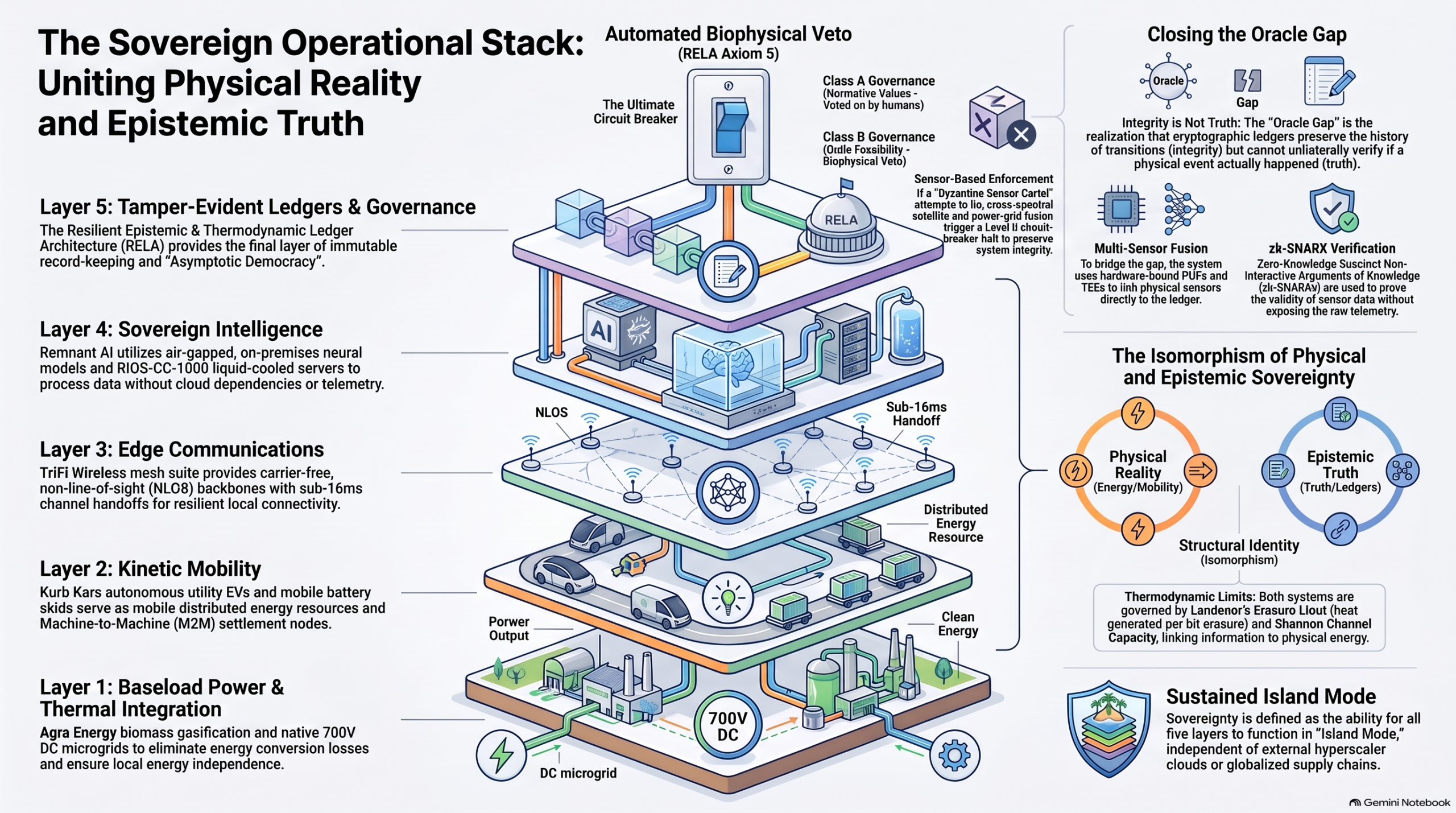
This study guide provides a comprehensive review of the “Sovereign Operational Stack” (SOS), a technical architecture that integrates physical engineering with epistemic sovereignty. The document explores the isomorphism between physical resources (energy, mobility, communications) and the validation of truth within decentralized systems.
Part I: Short-Answer Quiz
Instructions: Answer the following questions in 2–3 sentences based on the provided technical white paper.
- What is the central thesis of “The Sovereign Operational Stack”?
- Describe the technical advantage of the Layer 1 Native 700V DC microgrid architecture.
- What is the “Oracle Gap,” and how does the document distinguish between Integrity and Truth?
- How does “Hemp-Grade AI” (Layer 4) relate to the physical environment?
- Explain the concept of “Parameter Foreclosure via Negativa” in the context of hypothesis space.
- What role do “Kurb Kars” play within the Layer 2 Kinetic Mobility tier?
- What are the specific Byzantine Fault Tolerance (BFT) thresholds defined for different network types?
- How does the “Automated Biophysical Veto” (RELA Axiom 3) function within the governance architecture?
- What is the “1,000-Mile Failure Model” described in the problem statement?
- Define the difference between Class A and Class B realms in the Bifurcated Constitutional Realm.
Part II: Quiz Answer Key
- Central Thesis: The paper establishes that physical sovereignty and epistemic sovereignty are structurally, thermodynamically, and mathematically identical problems. It argues that for a system to be truly sovereign, its physical infrastructure (energy and hardware) must be as decentralized and resilient as its data and logic layers.
- 700V DC Microgrids: This architecture eliminates AC-DC-AC inverter conversion cascades, which typically result in 12%–18% parasitic energy losses. By using native DC power and sub-16ms ATS Synchronizers, the system achieves higher efficiency and seamless islanding capabilities.
- The Oracle Gap: The document posits that “Integrity is not Truth”; cryptographic ledgers (Level 2) can ensure state transition immutability and provenance but cannot unilaterally verify physical facts (Level 0 Ontic Reality). The Oracle Gap is the disconnect between digital ledger consistency and actual physical events.
- Hemp-Grade AI: This refers to ruggedized, behind-the-meter computing that is co-located with biomass fuel sources, such as industrial hemp or agricultural residue. It utilizes 100% hydronic thermal energy recycling to feed back into agricultural loops, creating a circular bio-industrial computing ecosystem.
- Parameter Foreclosure via Negativa: This is a measure-theoretic approach to truth where the hypothesis space is pruned by falsifying incorrect projections. It treats the convergence toward truth as a monotonic contraction toward an “Invariant Dynamical Attractor” by eliminating what is proven false.
- Kurb Kars: These are autonomous, off-grid utility electric vehicles that serve as mobile distributed energy resources (DERs). They function as nomadic Command and Control (C2) platforms and utilize Machine-to-Machine (M2M) pedestals for energy settlement.
- BFT Thresholds: For partially synchronous networks, the threshold for security is N \geq 3f + 1. In contrast, synchronous networks utilizing digital signatures can tolerate a higher failure rate of f < N/2.
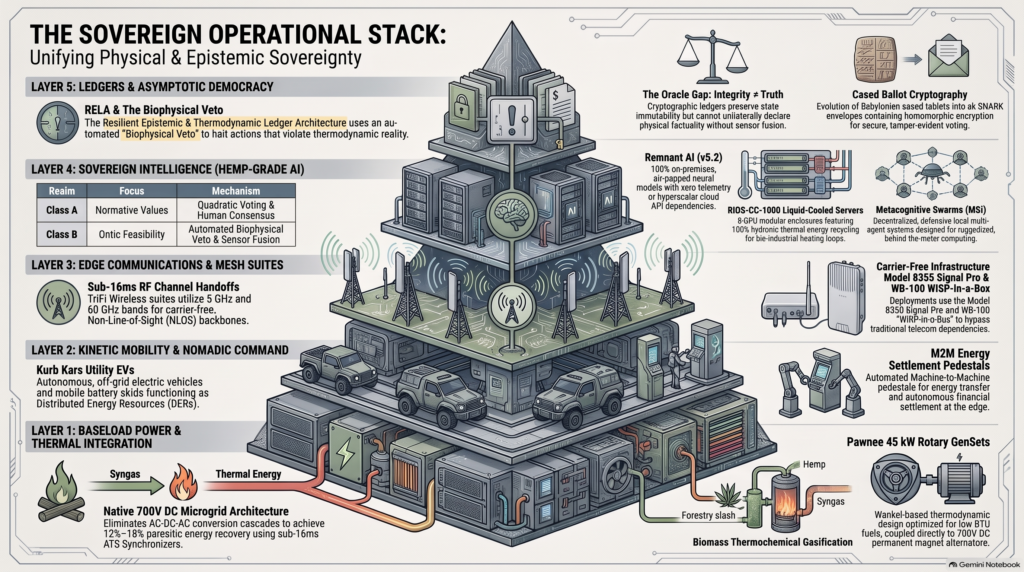
- Automated Biophysical Veto: Located in the governance layer, this mechanism enforces “Ontic Feasibility.” It allows the system to automatically override or block normative decisions (Class A) if they violate physical or thermodynamic reality (Class B), such as resource limits or energy constraints.
- 1,000-Mile Failure Model: This model identifies the inherent fragility of modern systems that rely on extended centralized supply chains, high-voltage long-distance grids, and hyperscaler cloud dependencies. It highlights the risk of systemic collapse when these distant dependencies are disrupted.
- Bifurcated Constitutional Realm: Class A governs “Normative Values” and uses mechanisms like Quadratic Voting to determine what a community wants. Class B governs “Ontic Feasibility,” utilizing the Automated Biophysical Veto to ensure that those desires are physically possible within thermodynamic limits.
Part III: Essay Questions
Instructions: Use the Source Context to develop detailed responses to the following prompts. (Answers not provided).
- The Isomorphism of Sovereignty: Analyze the argument that physical and epistemic sovereignty are identical problems. How does the document use thermodynamic limits (like Landauer’s Bound) to support this mathematical connection?
- Layered Integration: Explain how the five layers of the Sovereign Operational Stack (Energy, Mobility, Communications, Intelligence, and Ledgers) work together to achieve “Sustained Island Mode.” Focus on the dependencies between the physical layers (1-3) and the epistemic layers (4-5).
- Epistemology and Reality: Compare “Perspectival Realism” and “Ontological Realism” as described in the text. How does the architecture move from high-dimensional reality to a low-dimensional parameterized projection while maintaining “Verisimilitude Accretion”?
- Consensus and its Pathologies: Discuss the various pathologies of consensus mentioned in the text, such as Bikhchandani Information Cascades, Pluralistic Ignorance, and the Condorcet Inversion. How does the RELA architecture attempt to mitigate these through sensor fusion and hardware-bound TEEs?
- The Future of Decentralized Governance: Evaluate the “Asymptotic Democracy” model. How does the integration of Futarchy (betting on beliefs) and Quadratic Voting (voting on values) create a governance system that is grounded in “the unyielding boundary conditions of the cosmos”?
Part IV: Glossary of Key Terms
Term Definition
Agra Energy A system for biomass thermochemical gasification that converts forestry slash and agricultural residue into syngas for baseload power.
Asymptotic Democracy A governance model aiming for the Peircean asymptotic convergence of truth and utility over time.
BFT (Byzantine Fault Tolerance) The ability of a distributed network to reach consensus even if some nodes are malicious or failing.
Biophysical Balance Register (BBR) A formal schema used to track and verify the physical and thermodynamic state of the system.
Condorcet Jury Theorem A theorem stating that if each member of a group has a >0.5 probability of being correct, the probability of the group being correct increases with group size.
EROEI Energy Return on Energy Invested; a thermodynamic limit used to evaluate the viability of energy sources.
Isomorphism A structural, mathematical, or thermodynamic identity between two seemingly different systems or problems.
Landauer’s Limit The theoretical minimum energy (\Delta Q \geq k_B T \ln 2) required to erase a single bit of information.
Oracle Gap The difficulty of ensuring that external, physical data (Level 0) is accurately reflected in a digital ledger (Level 2).
PUF (Physically Unclonable Function) A hardware-bound security feature used to ensure the identity and integrity of a specific silicon chip.
Quadratic Voting A voting method where the cost of a vote increases quadratically, intended to measure the intensity of preference.
RELA Resilient Epistemic & Thermodynamic Ledger Architecture; the primary ledger and governance framework for the SOS.
Remnant AI Air-gapped, on-premises neural models that operate without telemetry or dependency on cloud-based APIs.
Shannon Channel Capacity The theoretical maximum rate at which information can be transmitted over a noisy communication channel.
TEE (Trusted Execution Environment) A secure area of a main processor that ensures code and data loaded inside are protected with respect to confidentiality and integrity.
TriFi Wireless A carrier-free, non-line-of-sight (NLOS) mesh communication suite operating across 5 GHz and 60 GHz bands.
zk-SNARK Zero-Knowledge Succinct Non-Interactive Argument of Knowledge; a cryptographic tool used for private yet verifiable transactions or attestations.