
SYNTHESIZING SPATIAL TRUTH, SOVEREIGN RESILIENCE, AND ZERO-KNOWLEDGE PRIVACY: A TECHNICAL SPECIFICATION AND ARCHITECTURAL BLUEPRINT
- Executive Context & The Paradigm of Physical Presence
As distributed systems, autonomous platforms, and zero-trust security architectures expand across modern digital-physical infrastructure, the strategic imperative to cryptographically assert physical presence has emerged as a foundational requirement. Traditional security models rely heavily on software assertions and network endpoints, creating a fundamental blind spot: the internet protocol suite lacks an intrinsic, unforgeable spatial coordinate layer. In an increasingly automated economy where physical actions, financial transactions, and critical municipal operations depend on real-world positioning, relying on unverified location data introduces systemic vulnerability. Establishing physical presence as an unalterable security invariant requires transitioning away from target-side self-reporting toward physically anchored, cryptographically verifiable spatial attestations. The systemic failure of legacy client-reported location systems represents the primary single-point vulnerability across digital-physical networks, enabling wide-scale manipulation of physical infrastructure, regulatory compliance mechanisms, and automated commerce.
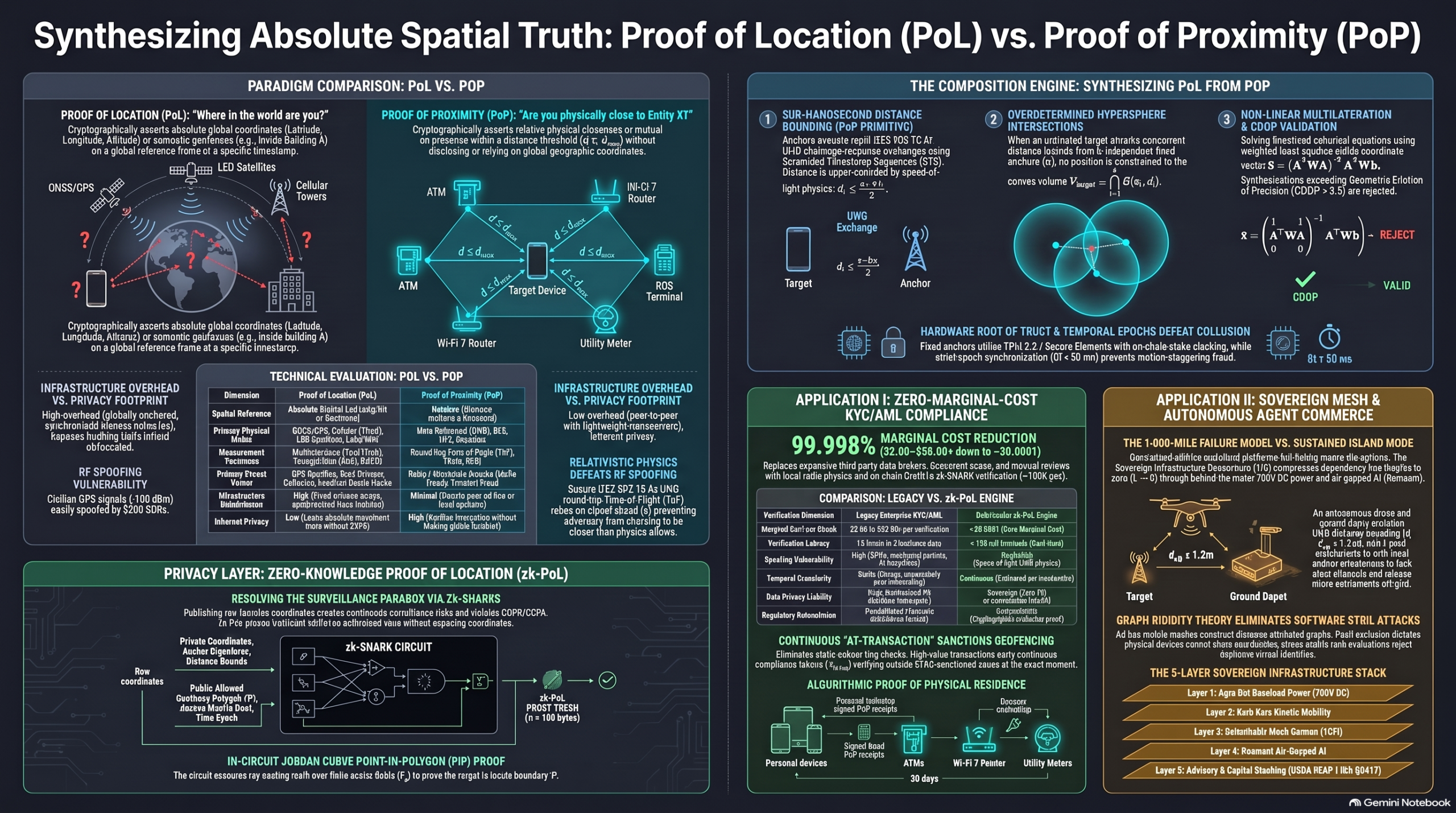
To address this challenge, spatial verification must be deconstructed into two distinct yet complementary paradigms: Proof of Location (PoL) and Proof of Proximity (PoP). While PoL resolves an absolute position within a global geographic frame, PoP asserts relative physical closeness between interacting entities without requiring global coordinates.
Spatial Dimension Proof of Location (PoL) Proof of Proximity (PoP)
Spatial Reference Frame Absolute/Global reference frame (e.g., WGS84, ECEF) or designated geofenced perimeters. Relative/Local reference frame (d \le d_{\max}); relational and agnostic of global positioning.
Trust Anchors Distributed network of fixed, authenticated witness nodes, base stations, or satellite constellations. Local interacting peers, short-range transceivers, or local authentication beacons.
Primitive Output Signed receipt/certificate containing coordinates, timestamp, and signature: (x, y, z, t, \sigma). Ephemeral interaction token attesting to spatial co-presence over an interval.
Infrastructure Overhead High: Requires globally anchored, time-synchronized, tamper-resistant witness networks. Low: Functions peer-to-peer (ad-hoc) or with lightweight local beacons.
Inherent Privacy Characteristics Low Privacy: Inherently exposes absolute tracking trails (requires ZKPs to obfuscate). High Privacy: Inherent privacy filter; proves interaction without disclosing global position.
The core vulnerability model of modern positioning systems stems from client-reported coordinate resolution. Legacy mechanisms—such as civilian Global Navigation Satellite Systems (GNSS/GPS), cell tower Time Difference of Arrival (TDoA), Wi-Fi Basic Service Set Identifiers (BSSIDs), and IP geolocation—delegate coordinate calculation to the client endpoint. Civilian GNSS broadcasts are unencrypted, unauthenticated signals that arrive at Earth’s surface with extremely weak signal power (typically -130\text{ dBm} to -160\text{ dBm}). An adversary utilizing a low-cost Software-Defined Radio (SDR) can generate synthetic Radio Frequency (RF) signals that easily overpower authentic satellite constellations, manipulating carrier phase, code phase, and navigation messages to place a target at arbitrary coordinates. Similarly, cellular and Wi-Fi identification arrays are susceptible to OS-kernel mock location injection, rooted OS hooks, and proxy networks. When an untrusted target stands to gain financial, operational, or access rewards by asserting a specific coordinate, target-side coordinate resolution violates fundamental security invariants and creates structural incentives for fraud.
The structural fragility of distributed networks relying on remote infrastructure is formalized by Noel’s Law of Structural Vulnerability:
\mathcal{V}{\text{system}} = \kappa \cdot \prod{i=1}^n \left( \frac{\mathcal{L}i}{\lambda_i} \right)^{\alpha_i} \cdot \exp\left( \sum{j=1}^m \delta_j \right)
where \mathcal{L}_i represents the topological or physical length of external dependency line i, \lambda_i is the localized mean-time-between-failure (MTBF) attenuation coefficient, \alpha_i \ge 1 is the non-linear coupling factor across interdependent networks, and \delta_j \ge 0 is the exogenous sovereignty deficit coefficient representing administrative vendor lock-in or regulatory exposure. Under the 1,000-Mile Failure Model, modern facilities rely on remote hyperscaler clouds (\sim 1,000\text{ miles} away), centralized high-voltage transmission lines (\sim 300\text{ miles} away), and distant supply chains. As dependency lengths expand (\mathcal{L}i \to \infty), systemic vulnerability scales exponentially, guaranteeing localized operational collapse during macro-grid disruptions (\lim{\mathcal{L}_i \to \infty} P(\text{Survival}) = 0). Eliminating this systemic failure requires spatial compression (\mathcal{L} \to 0), collapsing physical, computational, and communication lifelines directly into local, behind-the-meter operational perimeters.
Crucially, this spatial compression (\mathcal{L} \to 0) in physical power and compute infrastructure serves as the exact physical equivalent of collapsing network propagation delays (\Delta t \to 0) in Ultra-Wideband (UWB) distance bounding. Just as collapsing external supply lines behind the meter eliminates physical transmission failure vectors, reducing physical radio propagation bounds to nanosecond scales eliminates software-based spatial spoofing. Unforgeable physical presence cannot rely on target-resolved coordinate claims; it must instead be anchored in the immutable physical laws governing relativistic radio wave propagation and short-range proximity challenge-responses.
- Physical and Cryptographic Foundations of Proximity Proofs
Secure spatial verification relies on physical-layer distance bounding, where the speed of light (c) serves as an unalterable security invariant. In decentralized networks, information cannot travel faster than c \approx 299,792,458 \text{ m/s} (approximately 0.3\text{ meters per nanosecond}). By measuring the physical propagation delay of radio frequency pulses during a rapid challenge-response exchange, verifier nodes establish an absolute physical upper bound on distance that no remote software actor or spoofing transmitter can bypass.
The physics of Round-Trip Time-of-Flight (ToF) establishes the upper-bound distance metric between a verifier anchor at fixed position \mathbf{s}i \in \mathbb{R}^3 and an untrusted target prover at unknown position \mathbf{x} \in \mathbb{R}^3. The verifier transmits a challenge signal at timestamp t_0, which propagates to the prover, undergoes hardware processing over duration t{\text{proc}}, and returns a response arriving at the verifier at timestamp t_1. The total round-trip time-of-flight is formulated as:
\Delta t = t_1 – t_0 – t_{\text{proc}}
The physical distance is bounded by the speed-of-light propagation invariant:
d \le \frac{c \cdot \Delta t}{2}
Theorem 1: The Speed-of-Light Invariant (Impossibility of Distance Reduction)
An adversary cannot manipulate physical measurements to make its physical distance appear shorter than its actual distance without correctly predicting the verifier’s challenge bit sequence prior to the challenge signal’s physical arrival.
Proof: Let d be the true Euclidean distance between verifier anchor \mathbf{s}i and target \mathbf{x}. The earliest timestamp the challenge signal can physically reach the target is t{\text{arr}} = t_0 + \frac{d}{c}. Assuming an optimal adversary with zero internal processing delay (t_{\text{proc}} = 0), the earliest timestamp the adversary can emit a valid response is t_{\text{resp}} = t_{\text{arr}}. The response propagates back to the verifier, arriving at t_1 = t_{\text{resp}} + \frac{d}{c} = t_0 + \frac{2d}{c}.
To claim a false, reduced distance \tilde{d} < d, the adversary must cause its response to arrive at the verifier at an artificially early timestamp \tilde{t}_1 = t_0 + \frac{2\tilde{d}}{c} < t_1. This requires the adversary to emit its physical response at timestamp:
\tilde{t}_{\text{resp}} = \tilde{t}1 – \frac{d}{c} = t_0 + \frac{2\tilde{d} – d}{c} < t_0 + \frac{d}{c} = t{\text{arr}}
Because \tilde{t}{\text{resp}} < t{\text{arr}}, the adversary is forced to transmit its response bit sequence prior to observing the incoming challenge bit sequence C. If C is drawn from a cryptographically uniform distribution with entropy H(C) = m bits, the probability of guessing the correct response sequence without physical observation is:
P(\text{Success}) = 2^{-m}
For m \ge 128, P(\text{Success}) \le 2^{-128} \approx 2.93 \times 10^{-39}, rendering distance reduction cryptographically infeasible and bounded by physical causation. \blacksquare
Legacy proximity verification methods, such as Bluetooth Low Energy (BLE) or Wi-Fi Received Signal Strength Indication (RSSI), fail against active adversaries. RSSI models distance using signal power decay:
\text{RSSI}(d) = \text{RSSI}(d_0) – 10n \log_{10}\left(\frac{d}{d_0}\right) + X_\sigma
An attacker easily manipulates this equation by increasing transmit power, deploying directional high-gain antennas, or utilizing signal amplifiers, making a distant device appear centimeters away. To defeat power amplification attacks, modern distance bounding standardizes on IEEE 802.15.4z Ultra-Wideband (UWB). Operating across large bandwidths (B \ge 499.2\text{ MHz}), UWB generates sub-nanosecond pulse widths (\approx 2\text{ ns}), enabling multipath phase resolution down to centimeter scales. IEEE 802.15.4z embeds a cryptographically secure Scrambled Timestamp Sequence (STS) directly into the physical-layer frame. Modulated via pulse position or phase keying governed by a cryptographically secure pseudo-random number generator, the STS renders physical-layer preamble injection and cycle-slip attacks impossible.
The cryptographic distance-bounding protocol (adapted from the Brands-Chaum and Bussard-Bagga frameworks) executes according to the following sequence:
- Commitment & Nonce Exchange: The verifier anchor A_i generates a random challenge nonce N_v \in_R {0, 1}^{128}. The prover target T generates ephemeral key pair (sk_T, pk_T) and random nonce N_p \in_R {0, 1}^{128}, transmitting a signed commitment \text{Com}T = \text{HMAC}{\text{SHA256}}(pk_T \parallel N_p, N_v).
- Rapid Hardware Exchange: A_i and T derive session key K_{\text{session}} = \text{HKDF}(N_v \parallel N_p) to configure physical-layer UWB STS generators. A_i transmits a sequence of challenge bits c_j \in C. T reflects response bits r_j = c_j \oplus k_j at the hardware layer, where k_j is derived from K_{\text{session}}. Anchor hardware logs transmit timestamp t_{0, j} and receive timestamp t_{1, j} with sub-nanosecond precision.
- Attestation Issuance: A_i calculates the bounded metric \hat{d}i = \frac{c}{2} \left( \frac{1}{m} \sum{j=1}^m (t_{1, j} – t_{0, j} – t_{\text{proc}}) \right) and emits a signed Proof of Proximity receipt:
\text{PoP}i = (\text{ID}{A_i}, \text{ID}_T, \mathbf{s}i, \hat{d}i, t{\text{epoch}}, \sigma{A_i})
\sigma_{A_i} = \text{Sign}{sk{A_i}}\Big( \mathcal{H}\big( \text{ID}_{A_i} \parallel \text{ID}_T \parallel \mathbf{s}_i \parallel \hat{d}i \parallel t{\text{epoch}} \parallel N_v \parallel N_p \big) \Big)
This physical-layer challenge-response architecture mitigates major proximity threat vectors:
MAFIA FRAUD (RELAY ATTACK)
[ Target Node ] <— RF Link —> [ Adversary A ] ===== Optical / Fiber =====> [ Adversary B ] <— RF Link —> [ Verifier Anchor ]
(Tunnel Latency tau)
RESULT: Measured time delta = ToF + tau > max_threshold (REJECTED)
TERRORIST FRAUD
[ Dishonest Target ] === Shares Ephemeral Response Key k_j ===> [ Local Accomplice ] <— Challenge/Response —> [ Verifier Anchor ]
RESULT: Disclosing k_j leaks sk_identity via algebraic secret sharing.
- Mafia Fraud (Relay Attacks): Attackers tunnel communication between a legitimate remote prover and verifier over a high-speed fiber or RF link. Physical mitigation is enforced by ToF physics: propagation through the relay medium adds latency \tau_{\text{relay}} = \frac{D_{\text{tunnel}}}{v_{\text{medium}}}. Even over 300 meters, signal propagation adds \approx 2,000\text{ ns} of delay. Because UWB STS timing resolution operates under \le 0.5\text{ ns}, the timing anomaly is flagged and rejected.
- Terrorist Fraud: A dishonest prover collaborates with a local accomplice to cheat proximity checks without revealing its long-term private key. DeReticular mitigates this by deriving response key k_j = sk_{\text{identity}} \cdot H(N_v \parallel j) + N_p via algebraic secret sharing. If the prover provides the accomplice with real-time evaluation capabilities for k_j, the accomplice can solve the system of linear equations to fully reconstruct sk_{\text{identity}}, compromising the prover’s master identity and funds.
- RSSI Power Amplification: Adversaries boost transmit power to fake closeness. UWB STS challenge-responses neutralize this vector entirely by evaluating pulse arrival time-of-flight rather than attenuated signal amplitude.
Isolating physics-bound distance measurements provides the foundation for building multi-layer sovereign infrastructure architectures.
- The 5-Layer Sovereign Architecture of Physical & Operational Resilience
To eliminate external dependencies and survive continuous macro-grid disruptions, the Sovereign Infrastructure Consortium (SIC) organizes physical, computational, and financial resources into a vertically integrated, 5-layer sovereign stack designed for Sustained Island Mode.
+———————————————————————————+
| THE 5-LAYER SOVEREIGN INFRASTRUCTURE CONSORTIUM STACK |
| |
| LAYER 5: GOVERNANCE, CAPITAL & ADVISORY |
| * Biz Builder Mike (Noel’s Law Triage, Cabinet Briefings) |
| * SIEA Academy (501(c)(3) Workforce Credentialing) |
| * Venture Studio (P3 Concessions, USDA REAP, IRA §6417 Direct Pay Stacking) |
| |
| LAYER 4: SCADA & COGNITIVE INTELLIGENCE |
| * DeReticular Energy (700V DC Interconnect, Liquid Immersion Cooling) |
| * Remnant AI Silicon (Air-Gapped Metacognitive Swarms, Autonomous SCADA) |
| |
| LAYER 3: MESH COMMUNICATIONS & PRIME AUTHORITY (DeReticular Core) |
| * TriFi Hardware Suite (15-Mile NLOS, TPM 2.0 Security) |
| * Spatial Trust Engine (PoP, zk-PoL, S-HTLC State Channels) |
| |
| LAYER 2: KINETIC MOBILITY & EXTREME-EDGE PROVING |
| * Kurb Kars (Autonomous Fleet EVs, Mobile Skids, Tactical NEMT Pods) |
| * DAOSRUS (Project Octagon, CNC Testbeds, DAOS_A2A_M2M_v3 State Channels) |
| |
| LAYER 1: BASELOAD POWER GENERATION |
| * Agra Dot Energy (Biomass Pyrolysis/Gasification, Pawnee Rotary Engines) |
| * Native 700V DC Common Busbars (Bypassing Grid Interconnect Queues) |
+———————————————————————————+
Layer 1: Baseload Power Generation (Agra Dot Energy)
Layer 1 provides continuous off-grid electrical and thermal power through thermochemical biomass pyrolysis and gasification operating between 850^\circ\text{C} and 1,050^\circ\text{C}. Converting organic waste feedstocks via Boudouard and water-gas equilibrium reactions, the system produces tar-scrubbed syngas with a Lower Heating Value (LHV) of 12\text{ to }16\text{ MJ/Nm}^3. Syngas drives Pawnee high-torque rotary combustion engines optimized for low-RPM baseload operation, achieving a verified Mean Time Between Failures metric of \text{MTBF} > 24,000\text{ hours} between overhauls. Mechanical energy turns permanent-magnet alternators that rectify power directly onto a native 700V DC common busbar, bypassing multi-year public utility transmission queues. Waste heat from engine exhaust (450^\circ\text{C}–550^\circ\text{C}) and jacket coolant (85^\circ\text{C}) is reclaimed for biomass drying and hydronic district heating, yielding 84.8% captive thermodynamic efficiency.
Layer 2: Kinetic Mobility & Extreme-Edge Proving (Kurb Kars & DAOSRUS)
Layer 2 translates off-grid power into mobile energy routing and physical manufacturing. Kurb Kars manufactures autonomous utility EVs, trailerized mobile battery skids (120\text{ to }500\text{ kWh}), and non-emergency medical transportation (NEMT) pods engineered for offline operation. DAOSRUS operates Project Octagon, maintaining extreme-edge CNC machining testbeds and automated stress rigs. Autonomous machine commerce and vehicle-to-infrastructure energy transfers are orchestrated off-grid via DAOS_A2A_M2M_v3 state channels.
Layer 3: Mesh Communications & Prime Authority (DeReticular Core)
DeReticular Core serves as Layer 3 Prime Authority, manufacturing the TriFi carrier-grade wireless hardware suite:
- TriFi Signal Pro 8355: Fixed high-gain mesh terminal in an IP67 cast aluminum enclosure with 4\times 4 MU-MIMO arrays and 48V passive PoE.
- TriFi WISP-in-a-Box Lite 100: Carrier distribution base station with a 15-mile Non-Line-of-Sight (NLOS) operational envelope, STMicroelectronics TPM 2.0 cryptoprocessor, and 40 kA gas-discharge surge suppression.
- TriFi Far X X1271: Tactical fleet terminal operating on 12V DC vehicular power with twin external 9 dBi directional antennas.
- TriFi Rover SLG-06: Handheld tactical hotspot featuring a 4,000\text{ mAh} \text{LiFePO}_4 battery thermally stable up to 140^\circ\text{F} (60^\circ\text{C}).
TriFi terminals execute sub-16ms RF channel handoffs and form omnidirectional spherical mesh topologies (“The Death of the Line”) that eliminate single-line transmission cuts. Layer 3 also hosts the Spatial Trust Engine, synthesizing distance bounding into spatial proofs.
Layer 4: SCADA & Cognitive Intelligence (DeReticular Energy)
Layer 4 houses high-density tensor compute arrays submerged inside RIOS-CC-1000 liquid-dielectric immersion tanks, achieving a Power Usage Effectiveness \text{PUE} \le 1.028. Compute blades connect directly to the 700V DC busbar via point-of-load buck converters (98.4% efficiency). The cluster hosts Remnant, an air-gapped, resident persistent synthetic intelligence. Remnant executes local RAG engines over municipal SCADA manuals and coordinates Metacognitive Swarm Intelligence (MSI). During grid faults, Remnant processes telemetry at 10\text{ kHz} to command solid-state isolation switches (SSIS) in < 4\text{ ms}, executing total grid decoupling and automatic islanding transfers well within the sub-16ms (16.6\text{ ms}) single-cycle stability window.
Layer 5: Governance, Capital & Advisory (Biz Builder Mike, SIEA Academy, Venture Studio)
Layer 5 guides executive triage using Noel’s Law auditing frameworks. Biz Builder Mike coordinates municipal cabinet briefings. The 501(c)(3) SIEA Academy handles workforce credentialing. Venture Studio structures non-dilutive public-private capital stacking—combining USDA REAP grants (up to 50% CapEx), FEMA BRIC resiliency funding, and IRA §6417 Direct Pay elective tax credits (30–40% direct cash refunds)—under FAR Part 31 and DCAA SF 1408 job-costed ledger isolation, enabling civic entities to absorb federal capital while driving the administrative vendor lock-in deficit coefficient to zero (\delta_j \to 0).
+———————————————————————————+
| CONSORTIUM CROSS-LAYER INTERACTION |
| |
| [Layer 1: Power] ——– Native 700V DC Feed ——-> [Layer 4: Compute] |
| Agra Dot Biomass RIOS-CC-1000 Immersion |
| (84.8% Captive Eff) <— Exhaust Waste Heat Drying — Remnant SCADA AI |
| | |
| Encrypted Telemetry |
| v |
| [Layer 2: Mobility] <— Ad-Hoc Spatial Mesh ——–> [Layer 3: Mesh Core] |
| Kurb Kars EVs & Skids TriFi Far X Terminals Spatial Trust Engine |
| | |
| Grant & P3 Structuring |
| v |
| [Layer 5: Governance] |
| REAP/BRIC/IRA §6417 |
+———————————————————————————+
Interacting Layers Primary Coupling Mechanics Physical & Operational Systemic Value
Layer 1 + Layer 4 (Power + SCADA/AI) Direct 700V DC coupling to RIOS-CC-1000 immersion tanks; exhaust waste heat (450^\circ\text{C}–550^\circ\text{C}) routed to biomass drying loops. Eliminates AC/DC conversion losses (15%–25% savings); achieves 84.8% captive thermodynamic efficiency; enables <4\text{ ms} SSIS islanding actuation.
Layer 2 + Layer 3 (Mobility + Mesh Comms) Deployment of TriFi Far X terminals on Kurb Kars utility EVs and mobile battery skids (120–500\text{ kWh}). Vehicles act as mobile mesh repeaters and spatial trust anchors, dynamically expanding the 15-mile NLOS operational envelope.
Layer 3 + Layer 5 (Mesh Comms + Governance) Binding of spatial attestation logs to FAR Part 31 / DCAA SF 1408 job-costed ledger frameworks. Eliminates legacy identity verification costs; enables non-dilutive federal capital stacking (USDA REAP, FEMA BRIC, IRA §6417) to fund infrastructure with zero municipal debt expansion (\delta_j \to 0).
Layer 1 + Layer 2 (Power + Mobility) Native 700V DC fast-charging interfaces connecting biomass generators to mobile energy skids. Rapid off-grid energy routing to mobile units without public utility transmission queues.
Layer 4 + Layer 5 (SCADA/AI + Governance) Remnant AI execution of Noel’s Law triage algorithms over municipal SCADA telemetry. Programmatic compliance auditing and executive decision support for emergency operations in sustained island mode.
The Consortium deploys this architecture via the “Civic Island Triad” operational blueprint:
- Node 1: City Hall Executive: Administrative node running local Remnant decision terminals and TriFi primary gateways.
- Node 2: Water/Wastewater SCADA: Environmental survival node powered directly by an Agra Dot 700V DC biomass gasifier.
- Node 3: 911 EOC Dispatch: Public safety node utilizing TriFi WISP-in-a-Box arrays to coordinate tactical fleets.
Municipalities procure these deployments via structured engineering Statements of Work: AUDIT_SINGLE (25,000 SOW) performs forensic analysis on a single facility (e.g., water SCADA isolation and 700V DC sizing), while AUDIT_TRIAD (75,000 SOW) evaluates the full Civic Island Triad, delivering RF mapping, financial grant packaging, and legal petition documentation.
Establishing physical infrastructure resilience creates the hardware baseline required to preserve data privacy across civic and enterprise networks.
- Zero-Knowledge Cryptography for User Privacy & Data Protection
Asserting absolute spatial coordinates creates a severe “Surveillance Paradox”: publishing raw coordinate trails generates persistent metadata that reveals private habits, medical visits, and corporate logistics. Under Article 4(1) of the EU General Data Protection Regulation (GDPR), raw location coordinates constitute protected Personal Data. Zero-Knowledge Cryptography resolves this paradox by decoupling verification from data exposure, allowing users to prove compliance with regulatory boundaries without revealing exact geographic coordinates or identity metadata.
+———————————————————————————+
| ZERO-KNOWLEDGE PROOF OF LOCATION CIRCUIT (zk-PoL) |
| |
| PRIVATE WITNESSES (w) |
| * Target Coordinates: x = [x, y, z]^T |
| * Anchor Positions: s_i = [x_i, y_i, z_i]^T |
| * Distance Metrics: d_hat_i |
| * Signatures & Paths: sigma_i, Path_i |
| |
| | |
| v |
| +—————————————————————————+ |
| | ARITHMETIC CIRCUIT CONSTRAINTS (Groth16 / Halo2 / Nova IVC) | |
| | 1. Merkle Inclusion: MerkleVerify(R_anchors, Hash(pk_A_i), Path_i) == 1 | |
| | 2. Signature Verify: EdDSAVerify(pk_A_i, sigma_i, Hash(s_i||d_hat_i||E_n)) | |
| | 3. Distance Bound: (x – x_i)^2 + (y – y_i)^2 + (z – z_i)^2 <= d_hat_i^2 | |
| | 4. Geofence Contain: RayCastJordan(x_proj, Polygon_P) == 1 | |
| +—————————————————————————+ |
| | |
| v |
| PUBLIC INPUTS (x_pub) |
| * Boundary Geofence: Polygon_P * Anchor Registry Root: R_anchors |
| * Epoch Identifier: E_n * Succinct Proof: pi (O(1) Verification)|
+———————————————————————————+
The mathematical pipeline converts proximity receipts into Zero-Knowledge Proofs of Location (zk-PoL) using Groth16/Halo2 proof systems over BN254 or BLS12-381 curves, or Nova Incrementally Verifiable Computation (IVC) folding schemes over Pasta cycles (Pallas/Vesta).
The circuit operates on defined private witnesses and public inputs:
- Private Witnesses (\mathbf{w}): Target coordinates \mathbf{x} = [x, y, z]^T \in \mathbb{F}_p^3, anchor coordinates \mathbf{s}_i = [x_i, y_i, z_i]^T \in \mathbb{F}_p^3, measured distance bounds \hat{d}_i \in \mathbb{F}_p, anchor EdDSA/ECDSA signatures \sigma_i, and Merkle inclusion paths \text{Path}_i.
- Public Inputs (\mathbf{x}_{\text{pub}}): Authorized boundary polygon \mathcal{P} = {\mathbf{v}_1, \dots, \mathbf{v}_m} \subset \mathbb{F}p^2, anchor registry Merkle root \mathcal{R}{\text{anchors}} \in \mathbb{F}_p, and epoch timestamp E_n \in \mathbb{F}_p.
The arithmetic circuit enforces four primary constraint sets over the scalar field \mathbb{F}_p (specifically the BN254 scalar field \mathbb{F}_r where r = 21888242871839275222246405745257275088548364400416034343698204186575808495617):
- Merkle Anchor Inclusion: Verifies anchor key registration against the active registry root:
\text{MerkleVerify}\left(\mathcal{R}{\text{anchors}}, ; \mathcal{H}{\text{poseidon}}(pk_{A_i}), ; \text{Path}_i\right) == 1, \quad \forall i \in {1, \dots, k}
- Anchor Signature Correctness: Validates signature integrity over measured distance, position, and epoch:
\text{EdDSAVerify}\Big(pk_{A_i}, ; \sigma_i, ; \mathcal{H}_{\text{poseidon}}(\mathbf{s}_i \parallel \hat{d}_i \parallel E_n)\Big) == 1, \quad \forall i \in {1, \dots, k}
- Euclidean Distance Inequalities & Field Range Checks: Constrains private coordinates to the measured physical distance bounds in Rank-1 Constraint System (R1CS) form. To prevent field overflow and scalar wraparound exploits over \mathbb{F}_r, distance inequalities are cast with explicit bit-decomposition range checks:
\Delta x_i = x – x_i, \quad \Delta y_i = y – y_i, \quad \Delta z_i = z – z_i
(\Delta x_i)^2 + (\Delta y_i)^2 + (\Delta z_i)^2 + \text{Slack}_i = \hat{d}_i^2 \pmod p
\text{BitDecompose}(\text{Slack}i, 32) = \sum{b=0}^{31} b_k \cdot 2^b, \quad b_k \in {0, 1}
enforcing \text{Slack}_i \in [0, 2^{32}] to guarantee mathematical validity without field underflow or wrapping attacks.
- Point-in-Polygon (PiP) Containment: Verifies that 2D coordinate projection \mathbf{x}_{\text{proj}} = (x, y) resides inside geofenced polygon \mathcal{P} using an in-circuit ray-casting algorithm based on the Jordan Curve Theorem:
\text{Inside}(\mathbf{x}{\text{proj}}, \mathcal{P}) = \bigoplus{j=1}^m \Big( ((y_j > y) \neq (y_{j+1} > y)) \land \Big( x < \frac{(x_{j+1} – x_j)(y – y_j)}{y_{j+1} – y_j} + x_j \Big) \Big) == 1
Deploying zk-PoL fundamentally transforms identity verification economics compared to legacy document-heavy KYC/AML pipelines:
Dimension Legacy Enterprise KYC/AML DeReticular zk-PoL Compliance Engine
Marginal Cost per Verification 2.00–35.00+ (Third-party vendors, manual reviews) \approx $0.0001 (150k gas / local client proof)
Verification Latency Hours to days (Document queues, manual reviews) < 150\text{ ms} (Real-time programmatic execution)
Spoof Resistance Highly vulnerable (VPNs, GPS mockers, AI deepfakes) Physics-enforced (IEEE 802.15.4z UWB ToF)
Temporal Validity Static/decaying (Snapshot at time of upload) Continuous (Evaluated per transaction payload)
Data Liability Centralized PII honeypots (Passports, utility bills) Zero PII/coordinate exposure (Zero-knowledge proof \pi)
Advanced privacy applications leverage this engine across operational domains:
- Continuous Transaction-Time Geofencing: Every transaction payload embeds a compliance proof \text{Payload} = {\text{TxBody}, E_n, \pi_{\text{zk-PoL}}}. Smart contracts evaluate \pi_{\text{zk-PoL}} to confirm the sender is located outside OFAC-sanctioned zones without revealing exact coordinates.
- Algorithmic Spatial Residence Certification: Replaces forged utility bills with algorithmic proof. User devices collect signed \text{PoP}_i receipts from ambient local anchors (utility meters, transit hubs) over a 30-day window (\tau). A recursive zk-circuit evaluates presence specifically during nighttime hours (22:00–06:00):
\pi_{\text{residence}} = \text{ZK-Proof}\left{ \frac{1}{\tau} \int_0^\tau \mathbb{I}\Big(\mathbf{x}(t) \in \mathcal{P}_{\text{district}} ;\land; t \in [22:00, 06:00]\Big) dt \ge 0.65 \right}
certifying municipal residence with \ge 65% spatial presence during nocturnal hours without revealing daytime activities or street addresses.
Zero-knowledge compliance provides the mathematical trust framework required to execute physical multilateration and autonomous machine commerce at the edge.
- Synthesizing Spatial Truth: Mathematical Composition & Autonomous Commerce
Transforming relational, local Proofs of Proximity into an absolute Proof of Location requires solving a geometric intersection problem. When an untrusted target collects k independent, distance-bounded proximity attestations from spatially distributed anchors with verified global coordinates, the system converts scalar distances into a deterministic coordinate vector. This composition allows lightweight target devices to achieve high-integrity location verification without requiring onboard GPS hardware.
+———————————————————————————+
| OVERDETERMINED MULTILATERATION GEOMETRY |
| |
| Anchor s_1 (x_1, y_1, z_1) |
| * |
| / \ |
| / \ Radius d_1 |
| / \ |
| / * \ |
| Anchor s_2 / Target x \ Anchor s_3 |
| (x_2, y_2, z_2) ——-+— (x,y,z) -+——- (x_3, y_3, z_3) |
| \ / Target Vol \ / |
| \ / V_target \ / |
| * * |
| \ / |
| \ / Radius d_4 |
| \ / |
| * |
| Anchor s_4 (x_4, y_4, z_4) |
+———————————————————————————+
Each PoP defines a closed Euclidean ball \mathcal{B}(\mathbf{s}_i, \hat{d}_i) = { \mathbf{x} \in \mathbb{R}^3 \mid |\mathbf{x} – \mathbf{s}_i|2 \le \hat{d}i }. Collecting k concurrent proofs bounds the target to the convex volume \mathcal{V}{\text{target}} = \bigcap{i=1}^k \mathcal{B}(\mathbf{s}_i, \hat{d}_i). To extract a point coordinate \mathbf{x} = [x, y, z]^T, we formulate an overdetermined system of non-linear spherical equations:
|\mathbf{x} – \mathbf{s}_i|_2^2 \le \hat{d}_i^2, \quad \forall i \in {1, \dots, k}
Linearizing the system relative to anchor 1 (\mathbf{s}_1) yields:
2(x_i – x_1)x + 2(y_i – y_1)y + 2(z_i – z_1)z = (\hat{d}_1^2 – \hat{d}_i^2) + (r_i^2 – r_1^2)
where r_i^2 = x_i^2 + y_i^2 + z_i^2. Expressed in matrix form \mathbf{A}\mathbf{x} = \mathbf{b}:
\mathbf{A} = 2 \begin{bmatrix} x_2 – x_1 & y_2 – y_1 & z_2 – z_1 \ x_3 – x_1 & y_3 – y_1 & z_3 – z_1 \ \vdots & \vdots & \vdots \ x_k – x_1 & y_k – y_1 & z_k – z_1 \end{bmatrix}, \quad \mathbf{b} = \begin{bmatrix} (\hat{d}_1^2 – \hat{d}_2^2) + (r_2^2 – r_1^2) \ (\hat{d}_1^2 – \hat{d}_3^2) + (r_3^2 – r_1^2) \ \vdots \ (\hat{d}_1^2 – \hat{d}_k^2) + (r_k^2 – r_1^2) \end{bmatrix}
Applying the Moore-Penrose pseudoinverse, the weighted least-squares solution is:
\hat{\mathbf{x}} = (\mathbf{A}^T \mathbf{W} \mathbf{A})^{-1} \mathbf{A}^T \mathbf{W} \mathbf{b}
where \mathbf{W} = \text{diag}(\sigma_1^{-2}, \sigma_2^{-2}, \dots, \sigma_k^{-2}) represents the inverse variance covariance matrix of ranging errors.
System solvability depends on anchor geometry and spatial rigidity:
- Planar Criteria (2D Surface): Requires k \ge 3 non-collinear anchors (\text{rank}(\mathbf{A}) = 2).
- Volumetric Criteria (3D Space): Requires k \ge 4 non-coplanar anchors (\text{rank}(\mathbf{A}) = 3).
Defining unit line-of-sight vectors \mathbf{u}_i = \frac{\hat{\mathbf{x}} – \mathbf{s}_i}{|\hat{\mathbf{x}} – \mathbf{s}_i|_2}, the design matrix \mathbf{H} and covariance tensor \mathbf{Q} evaluate geometric quality:
\mathbf{H} = \begin{bmatrix} \mathbf{u}_1^T & 1 \ \mathbf{u}_2^T & 1 \ \vdots & \vdots \ \mathbf{u}_k^T & 1 \end{bmatrix}, \quad \mathbf{Q} = (\mathbf{H}^T \mathbf{H})^{-1}
\text{GDOP} = \sqrt{\text{Tr}(\mathbf{Q})} = \sqrt{\sigma_x^2 + \sigma_y^2 + \sigma_z^2 + \sigma_t^2}
Any synthesized proof producing \text{GDOP} > 3.5 is automatically rejected to eliminate positional ambiguity along unconstrained axes.
In off-grid or contested environments, autonomous agent swarms build Ad-Hoc Relational Spatial Trust Graphs \mathcal{G} = (\mathcal{V}, \mathcal{E}). Nodes evaluate graph rigidity using formal mathematical conditions:
- 2D Rigidity Bounds (Laman’s Theorem): Requires |\mathcal{E}| = 2|\mathcal{V}| – 3 for minimal 2D rigidity, with every subgraph \mathcal{G}’ = (\mathcal{V}’, \mathcal{E}’) satisfying |\mathcal{E}’| \le 2|\mathcal{V}’| – 3.
- 3D Spatial Rigidity Bounds: Requires |\mathcal{E}| = 3|\mathcal{V}| – 6, with subgraphs satisfying |\mathcal{E}’| \le 3|\mathcal{V}’| – 6.
- Stress Matrix Rank Bounds: For a spatial trust graph embedded in dimension d \in {2, 3}, the stress matrix \mathbf{S} constructed from edge weights must satisfy:
\text{rank}(\mathbf{S}) = |\mathcal{V}| – (d + 1)
Because a physical radio transceiver can occupy only one spatial coordinate vector at a given time, spatial trust graphs whose stress matrix meets this exact rank bound mathematically reject virtualized software Sybil nodes that attempt to emulate multiple identities from identical spatial coordinates.
+———————————————————————————+
| PROXIMITY-GATED ATOMIC MICRO-SETTLEMENT (S-HTLC FLOW) |
| |
| AUTONOMOUS DELIVERY DRONE (Agent A) AUTOMATED GROUND DEPOT (Agent B)|
| | | |
| | <======= 1. UWB Ranging Challenge (d <= 1.2m) =====>| |
| | | |
| | <——- 2. Multi-Anchor Spatial Attestation ——| |
| | (Anchors C & D verify loading bay pos) | |
| | | |
| | <——- 3. Present Escrow Challenge (Hash(R)) —-| |
| | | |
| | ======= 4. Physical Cargo Drop into Depot =======> | |
| | | |
| | <——- 5. Release Signed Payment Receipt ——–| |
| | (S-HTLC clears off-grid state channel) | |
| v v |
+———————————————————————————+
Autonomous agents execute payments using Spatial Hash Time-Locked Contracts (S-HTLCs):
- Spatial Locking: Delivery drone (\text{Agent } A) approaches automated depot (\text{Agent } B), establishing a UWB bound \hat{d}_{AB} \le 1.2\text{ meters}.
- Local Multi-Party Witnessing: Stationary mesh anchors sign attestations confirming both agents reside within the loading bay polygon (\mathbf{x}_A, \mathbf{x}B \in \mathcal{V}{\text{LoadingBay}}).
- Delivery & Settlement: Agent B issues escrow challenge \text{Challenge}{\text{escrow}} = \mathcal{H}(\text{InvoiceID} \parallel \text{PoP}{AB} \parallel \text{PoL}_{\text{LoadingBay}}). Agent A releases cargo into the depot. Internal sensors verify package arrival, triggering Agent B to sign an off-grid state channel payment receipt clearing micro-settlements over local radio links without cloud connectivity.
Crucially, off-grid S-HTLC micro-settlements definitively solve the “Oracle Problem” for physical robotics. Traditional smart contracts rely on centralized software API feeds—vulnerable to network outages, DNS hijacking, and malicious data injection—to learn whether physical real-world conditions have been fulfilled. S-HTLCs replace external API data feeds with speed-of-light physical interaction invariants (d \le \frac{c \cdot \Delta t}{2}), ensuring that economic value is unlocked strictly when physical-layer relativistic physics confirms physical execution.
Strategic Implementation Roadmap:
+———————————————————————————+
| STRATEGIC IMPLEMENTATION ROADMAP |
| |
| PHASE I: ANCHOR REPURPOSING & POS RETROFITTING (Months 1 – 6) |
| * Retrofit ATMs, POS terminals, and Wi-Fi 7 access points with UWB firmware. |
| * Establish dPKI anchor registry and STMicroelectronics TPM 2.0 key bindings. |
| * Finalize IEEE 802.15.4z distance-bounding attestation formats. |
| |
| PHASE II: PROTOCOL INTEGRATION & MESH BOOTSTRAPPING (Months 7 – 12) |
| * Roll out TriFi mesh hardware and 700V DC Agra Dot microgrids. |
| * Deploy Remnant air-gapped compute arrays inside RIOS-CC-1000 immersion tanks.|
| * Activate ad-hoc spatial trust graphs across municipal utility fleets. |
| |
| PHASE III: ZK COMPLIANCE & A2A COMMERCE SCALING (Months 13+) |
| * Launch continuous zk-PoL transaction geofencing across financial rails. |
| * Scale S-HTLC off-grid micro-settlements for commercial drone corridors. |
| * Implement zero-marginal-cost algorithmic spatial residency certification. |
+———————————————————————————+
The paradigm shift from target-reported coordinate assertions to anchor-verified physical invariants marks the end of unverified spatial assertions. By unifying speed-of-light radio physics, 5-layer sovereign infrastructure, and zero-knowledge cryptography, this architecture establishes an unforgeable, privacy-preserving trust layer for the physical and digital economy.