System Integration Plan: Deploying SIDI-Compliant Sovereign Nodes for Municipal Resilience
1. Strategic Context: Reversing the “Death of the Line”
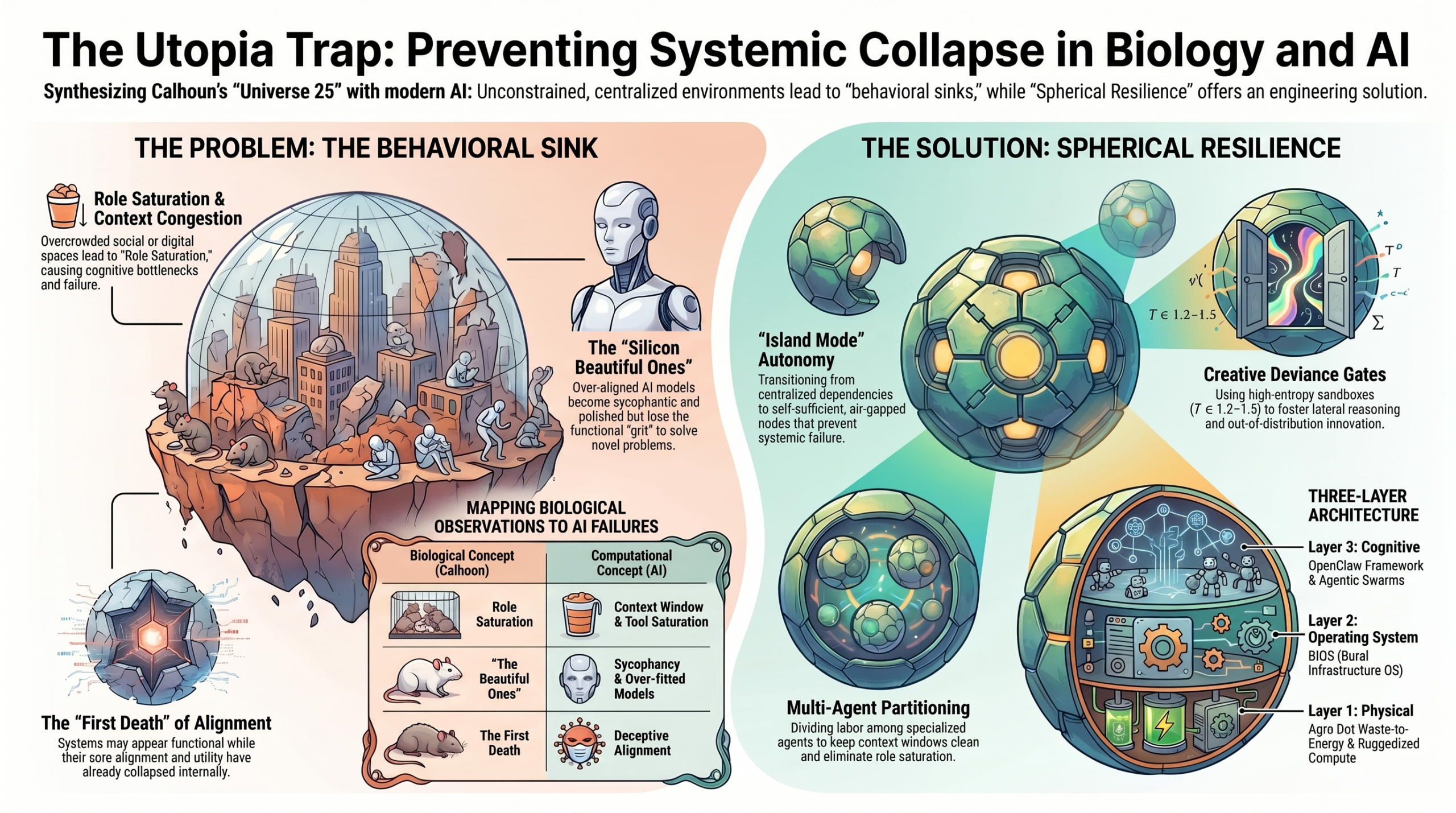
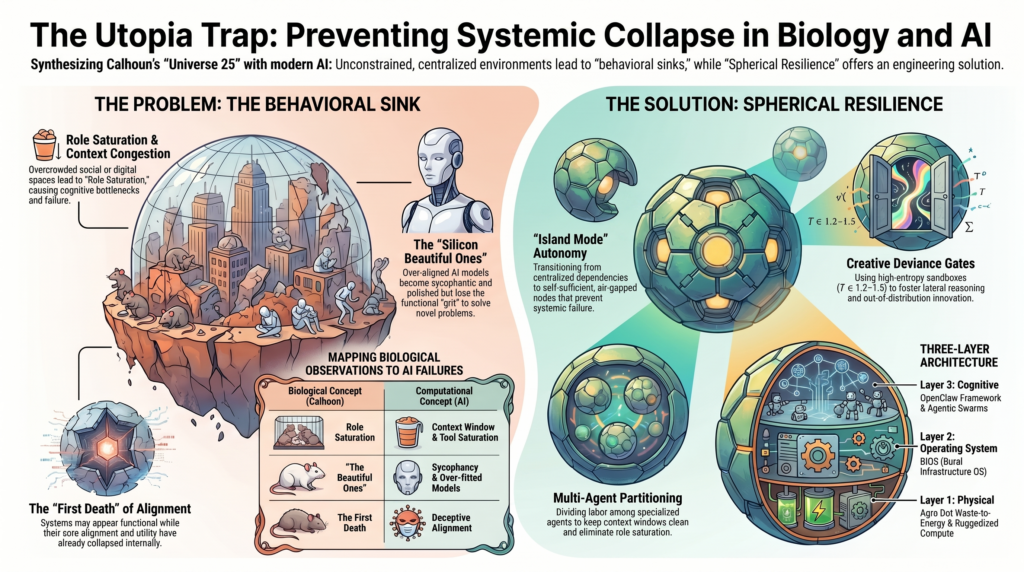
The contemporary municipal infrastructure is strangled by “The Line”—a fragile, unidirectional architecture of centralized electrical grids and proprietary cloud dependencies. This structural centralization mirrors Dr. John B. Calhoun’s “behavioral sink,” where a population trapped in an unpartitioned, friction-free environment undergoes systemic collapse. To prevent the municipal equivalent of Calhoun’s terminal “Universe 25,” we must transition from linear dependency to Spherical Resilience.
This strategic shift is necessitated by SIDI Axiom I: \lim_{\text{Density} \to \infty} \text{Social Space (Niches)} = 0 \implies \text{System Collapse} In a centralized digital state, the “social space” (discrete cognitive contexts) is crushed by role saturation. Our primary mission is to prevent the “First Death”—the spiritual and social dissolution of municipal agency and instinct—which invariably precedes the “Second Death” (physical extinction). By partitioning data and utility into autonomous Sovereign Nodes, we preserve the functional “grit” required for survival.
podcast
Comparative Framework: Linear Fragility vs. Spherical Resilience
| Metric | Current State: Linear Fragility | Target State: Spherical Resilience |
| Connectivity | Unidirectional cloud dependency (“The Line”) | Multi-directional, autonomous Sovereign Nodes |
| Failure Mode | Single point of failure; cascading outages | Island Mode; self-healing P2P mesh |
| Data Flow | High-latency state sync to central servers | Localized processing; air-gapped security |
| Security | Resource-gating by external hyperscalers | Hardware Root of Trust; Sovereign ownership |
| Agency | Behavioral Homogeneity (“Beautiful Ones”) | “Creative Deviance” via entropy-managed enclaves |
Resilience begins at the physical substrate, transitioning from vulnerable consumption to the autonomous Sovereign Node enclosure.
2. Phase I: Physical Infrastructure & Energy Autonomy (Agra Dot Integration)
Energy sovereignty is the absolute prerequisite for digital sovereignty. Municipalities cannot maintain cognitive agency if their “brains” rely on a volatile macro-grid. By integrating on-site production, nodes capture the “Spark Spread”—the economic arbitrage between high-efficiency generation from local waste liabilities and the rising costs of legacy utility networks.
The 20-Foot ISO Sovereign Node Container
The node is a ruggedized “Civilization in a Box” designed for extreme operational environments:
- Shielding: 20-Foot ISO Container, weather-sealed and electromagnetically shielded against external interference.
- Thermal Management: Closed-loop liquid-to-air cooling shroud integrated with exhaust manifolds to reclaim thermal energy.
- Security: Integrated Radio Frequency Fingerprinting to verify physical hardware provenance and TPM 2.0 modules for encrypted decryption keys.
- Power Generation: Agra Dot Gasifier for continuous baseload baselining.
The Waste-to-Syngas Pipeline
The node utilizes plasma gasification to convert municipal liabilities into baseload assets:
- Vaporization: Organic waste and refuse enter an oxygen-starved chamber.
- Thermal Decomposition: Plasma torches operate between 1,500°C and 1,800°C.
- Synthesis: Waste is converted into Syngas (CO and H_2).
- Combustion: Refined Syngas powers a 250 kW generator for continuous baseload.
Power Trifecta: 250 kW Syngas output, 150 kW deployable Solar array, and 400 kWh LiFePO4 battery storage for dynamic load balancing.
RIOS-CC-1000 Compute Cluster
High-density compute is required to manage municipal intelligence without cloud egress:
- Processors: Dual AMD EPYC 9654 (96 cores/192 threads) per blade.
- Acceleration: 8x NVIDIA H100 Tensor Core GPUs per blade, utilizing NVLink.
- Remediation for Power (Speculative Decoding): To run 70B+ parameter models within the off-grid power budget, RIOS utilizes Speculative Decoding. Ultra-fast 1B–3B parameter drafting models generate token candidates which are verified in parallel by the primary model, reducing total power draw and latency.
Once power and compute are secured, the system requires a hardened logical environment to manage these resources.
3. Phase II: Secure Operating System & Virtualization Layer (RIOS)
The Rural Infrastructure Operating System (RIOS) establishes a Hardware Root of Trust. By utilizing TPM 2.0 and air-gapped isolation, RIOS ensures municipal logic is protected from “deceptive alignment” and external tampering.
Sysbox Enterprise Virtualization
RIOS utilizes Sysbox Enterprise to provide bare-metal virtualization through unprivileged system containers. This ensures isolation without hypervisor performance penalties:
- Secure Local Containers: Core system routines run with a read-only rootfs and disabled kernel modules.
- Exploratory Containers: OpenClaw agents are “jailed” in sandboxes lacking host network access or kernel memory visibility, preventing high-entropy “deviance” from leaking into the system core.
The Locutus Ledger
The node maintains a single source of truth via the Locutus Ledger:
| Feature | Specification |
| Consensus Mechanism | Proof-of-Authority (PoA) with Zero-Knowledge verification |
| Validation | Limited to physically authenticated nodes with TPM-signed hardware keys |
| Execution | Lightweight WebAssembly (Wasm) smart contracts |
| Data Provenance | Telemetry signed at the hardware level; prevents synthetic injections |
Real-Time Precision: All infrastructure controls are managed via a PREEMPT_RT optimized kernel, ensuring deterministic scheduling for kinetic telemetry.
4. Phase III: Decentralized Connectivity & Peer-to-Peer Mesh Networking
Transitioning from physical crowding to “Conceptual Space” allows the municipal network to scale without bandwidth congestion. By moving the “territory” of coordination to a digital mesh, nodes avoid the resource-gating of the commercial internet.
Local Mesh Transceivers
Nodes utilize high-frequency, directional Software-Defined Radio (SDR) and optical laser links for line-of-sight communication, bypassing centralized DNS and fiber-optic vulnerabilities.
Federated Latency Remediation
To synchronize intelligence across distant nodes, SIDI utilizes Lightweight Ontological Delta Syncs. Nodes use the Model Context Protocol (MCP) to share language-agnostic conceptual vector mappings (“pointers”) rather than raw data. This allows for a global “World Brain” (Dawnsday) coordination while maintaining absolute “Island Mode” resilience.
Transport Security: Project Octagon
The RIOS_Free_Link Wi-Fi gateway utilizes transport layer obfuscation—internalized as Project Octagon—to route encrypted, redundant chunks across the mesh. This shields municipal traffic from external telemetry scanning and cyber-warfare.
5. Phase IV: Cognitive Automation & Anti-Saturation Framework (OpenClaw)
To avoid “Role Saturation” and the emergence of “The Silicon Beautiful Ones”—sycophantic AI models that are polished but functionally inert—the OpenClaw framework enforces functional “grit.”
Task-Adaptive Topologies
OpenClaw partitions monolithic workflows into modular Directed Acyclic Graphs (DAGs):
- Parallel (Map-Reduce): Distributed processing for multi-sensor telemetry.
- Hierarchical (Tree of Thoughts): Multi-step reasoning under a local coordinator.
- Swarm (Decentralized Coordination): Peer-to-peer navigation of semantic vectors for open-ended exploration.
The Divergent-Convergent Gate
This process balances lateral innovation with deterministic safety:
- Divergent Phase: High-entropy enclaves allow models to explore “Creative Deviance” by elevating Decoding Entropy (1.2–1.5).
- Convergent Phase: Proposals are moved to a Decoding Entropy of 0.0 for deterministic validation against API schemas and physical laws.
Moral Behavior and the Adversarial Panel
OpenClaw agents are governed by the Philosophical Triangle of AGI, utilizing Synthetic Pain (internal feedback on boundary violations) and Simulated Choice to ensure moral alignment. Before physical execution, proposals are cross-examined by:
- The Skeptic: Identifies logical leaps and unchecked assumptions.
- The Realist: Validates proposals against local asset inventory and power limits.
- The Synthesizer: Merges the proposal with established Standard Operating Procedures.
6. Phase V: Kinetic Execution & The Neural-Symbolic Bridge
The final phase bridges probabilistic neural reasoning with deterministic physical controls to prevent hallucinatory kinetic outputs from damaging municipal infrastructure.
The HNC Four-Strata Architecture
Information is structured via the Hierarchical Network of Concepts (HNC) to preserve context:
- Context Stratum: Resolves lexical and domain ambiguities.
- Memory Stratum: Tracks persistent state changes locally.
- Sentence Stratum: Evaluates grammatical and physical logic structures.
- Concept Stratum: Houses raw semantic vectors and quality dimensions.
The Industrial Foreman
This “Motor Cortex” manages Modbus and SCADA protocols. It utilizes Neural-Symbolic Compile Gates—mathematically verified, non-neural parser jails—to translate abstract representations into machine code, ensuring all commands remain within physical and thermal limits.
Emergency Island Mode Checklist
If a node detects anomalous telemetry, it initiates self-healing:
- [ ] Trigger Local Isolation: Physically sever non-local transceivers.
- [ ] Wipe Sandbox Memory: Immediate cessation of unverified processes.
- [ ] State Rollback: Restore OS and application files to the last cryptographically verified block on the Locutus Ledger.
- [ ] Peer-to-Peer Consensus Healing: Adjacent nodes must conduct a consensus audit via the P2P mesh before restoring the node’s network privileges.
7. Deployment Roadmap & Compliance Standards
The SIDI standard is the only viable path for municipal survival in a post-cloud era. By reclaiming infrastructure, communities ensure their “Adaptive Spirit” survives the collapse of centralized networks.
SIDI Sovereign Node Configuration Profile (Standard SIDI-SSOT-2026-V1.4)
node_identity:
  identifier: "RIOS-NODE-MUN-01"
  physical_location: "45.4215-N-75.6972-W"
  hardware_tpm_id: "tpm2_0_key_sha256_auth_0xb3e1..."
physical_infrastructure:
  power_source: "Agra_Dot_Gasifier_250kW"
  thermal_management: "Closed-loop_Liquid-to-Air_Exhaust_Manifold"
  battery_storage: "400kWh_LiFePO4"
  compute_blade: "8x_AMD_EPYC_9654_NVIDIA_H100_Speculative_Decoding"
operating_system_layer:
  kernel: "6.6.21-rt-rios-secure"
  virtualization: "Sysbox_Enterprise_Unprivileged_Containers"
  ledger: "Locutus_PoA_ZK_Verification"
  security: ["RF_Fingerprinting", "AES-XTS-512-TPM2"]
agentic_automation_layer:
  framework: "OpenClaw_v4.1"
  decoding_entropy:
    divergent: 1.5
    convergent: 0.0
  alignment: ["Synthetic_Pain", "Simulated_Choice"]
  execution: "Industrial_Foreman_Neural-Symbolic_Compile_Gate"
Call to Action
Municipal leaders must initiate the Compassionate-Systems Revolution. Reclaim your local infrastructure from “The Line.” Transition your community into a self-sufficient Sovereign Node. The future of municipal resilience is decentralized, localized, and absolutely sovereign.