Technical and Strategic Overview of the Sovereign Power Ecosystem
- The Philosophy of Sovereign Infrastructure
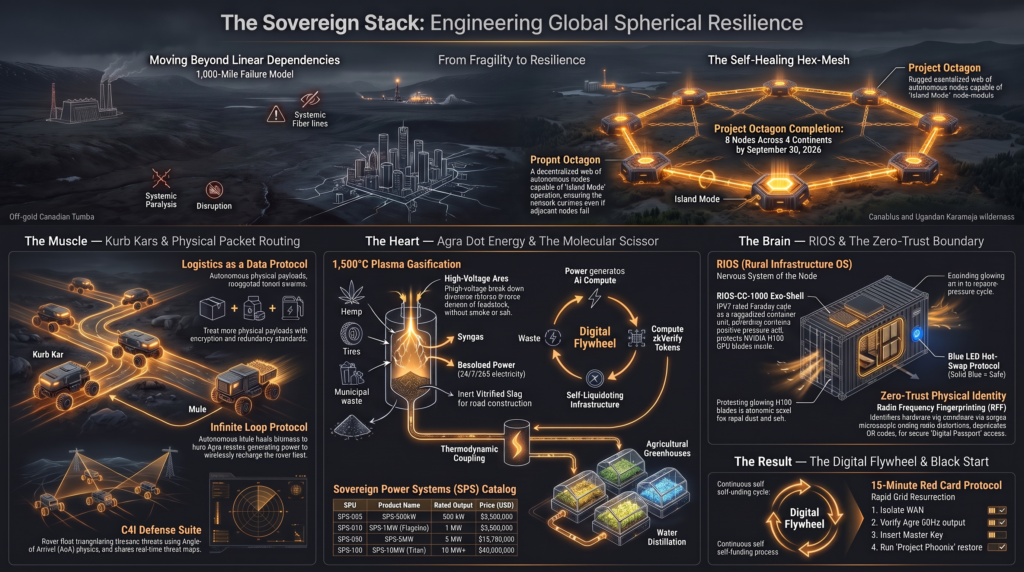
The “Sovereign Stack” is a paradigm shift in industrial engineering, designed to decouple modern communities from the “1,000-Mile Failure Model.” This legacy architecture—characterized by linear dependencies on distant power stations and fragile fiber-optic lines—is strategically obsolete. In its place, we deploy “Spherical Resilience,” a reticular mesh of autonomous nodes that maintains continuity even if adjacent segments collapse. This transition is guided by two core philosophies: “The Death of the Line” and “The Farm is the New Power Plant.” By establishing localized energy and data hubs, we transform agricultural centers into edge-level utilities, converting waste streams into high-density power and AI compute capacity.
To achieve this, Agra Dot Energy utilizes a technology stack that is fundamentally superior to legacy biological digestion:
- Molecular Dissociation vs. Biological Digestion: While legacy systems rely on slow, temperamental bacterial breakdown, Agra Dot Energy utilizes high-temperature thermal plasma physics to trigger immediate molecular dissociation.
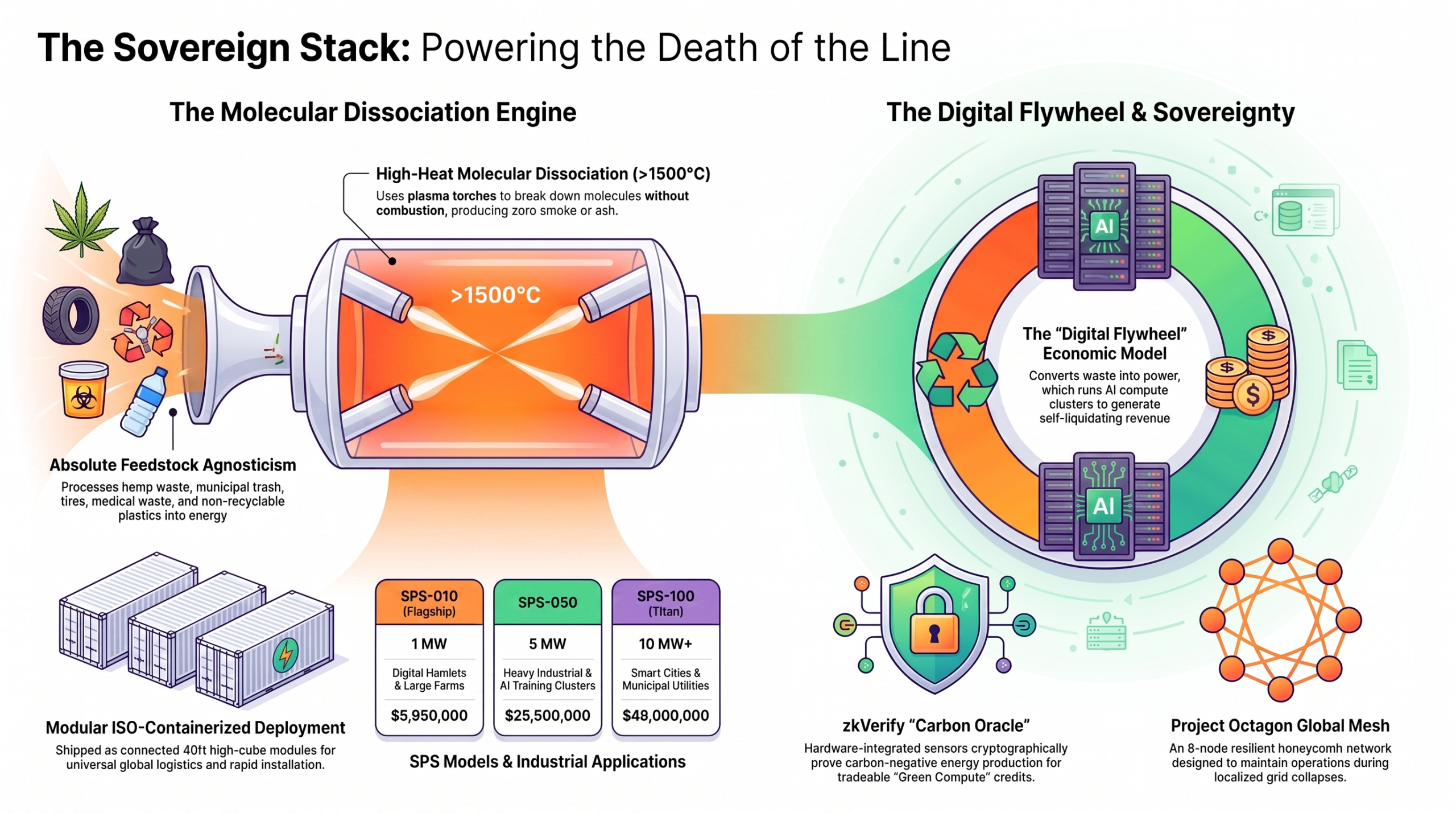
- Physics of Separation: Operating at a baseline of 1,500°C (2,700°F)—with a QA stress-test threshold of 1,800°C—the system breaks feedstock into basic constituent elements. This is not incineration; there is no combustion, no smoke, and no toxic ash.
- Output Density: Unlike biological systems limited to low-energy methane, our plasma gasification is optimized for high-hydrogen syngas and industrial-grade baseload power.
- Feedstock Agnosticism: Our reactors are agnostic to input, processing everything from “wet leaf” hemp stalks and medical waste to non-recyclable plastics and tires that would cause biological digesters to fail.
The strategic efficiency of this system is realized through the “Velcro Principle” of thermodynamic coupling. We recognize that “Data needs Power; Power needs Intelligence.” By integrating high-density AI data centers—specifically NVIDIA H100 blade clusters—with agricultural systems, we transform thermal liabilities into circular assets. The high-velocity waste heat from the compute blades is piped into year-round greenhouse crop cycles and water distillation systems. This thermodynamic symbiosis ensures that every joule is captured, creating a closed-loop economic environment that transitions from philosophical theory to the hard physics of the reactor core.
- Mechanics of the Molecular Dissociation Engine
In an era of escalating energy instability and an AI power crisis, feedstock agnosticism and baseload reliability are the ultimate strategic hedges. Centralized grids are increasingly unable to support high-density compute; our Molecular Dissociation Engine provides an off-grid, “Island Mode” solution that turns local waste into high-value energy and fuel.
The Physics of Plasma Gasification
Unlike traditional incineration, which relies on oxygen-rich combustion, our engine utilizes high-energy plasma torches to perform molecular dissociation. By subjecting refuse to temperatures exceeding 1,500°C, we utilize a “molecular scissor” to break atomic bonds. This reduces complex waste to its simplest elemental components. The process is entirely clean, producing no hazardous emissions. The inorganic portion of the feedstock is recovered as vitrified slag—a non-toxic, obsidian-like glass aggregate.
System Outputs and Byproducts
Output Type Technical Specification Primary Use Case
Syngas (H2+CO) Purified Hydrogen and Carbon Monoxide mix Chemical feedstock or fuel for Micro-GTL synthesis
Baseload Electricity Continuous 24/7/365 high-density power Off-grid AI compute clusters and industrial microgrids
Vitrified Slag Inert, non-toxic obsidian-like glass Sustainable aggregate for road and building construction
Micro-GTL (Gas-to-Liquid) Synthesis
To ensure logistics sovereignty in remote nodes, the reactor can be equipped with a Micro-GTL module. Using a Fischer-Tropsch reactor optimized for high-hydrogen syngas, the system converts excess gas into ASTM-compliant, “drop-in” fuels. This includes Agra Synthetic Diesel (zero sulfur, high cetane) for heavy machinery and Agra Synthetic Jet fuel for autonomous logistics drones. This capability allows a Sovereign Node to maintain its transport fleets without external petrochemical supply chains, directly linking the reactor’s physical outputs to our modular hardware catalog.
- The Sovereign Power Systems (SPS) Hardware Catalog
The Sovereign Stack is deployed as a series of modular, containerized power units designed for rapid deployment and total “Island Mode” autonomy. These units are the physical building blocks of the decentralized global mesh.
Hardware Catalog: Sovereign Power Systems
SKU Product Name Rated Output MSRP (USD) Primary Application
SPS-005 SPS-500kW 500 kW $3,500,000.00 Remote clinics, small farms, and pilot nodes
SPS-010 SPS-1MW (Flagship) 1 MW $5,950,000.00 Digital Hamlets and standard DePIN nodes
SPS-030 SPS-3MW 3 MW $15,750,000.00 Industrial co-ops and manufacturing zones
SPS-050 SPS-5MW 5 MW $25,500,000.00 Heavy industrial and regional logistics hubs
SPS-100 SPS-10MW “Titan” 10 MW+ $48,000,000.00 Restricted/Waitlist Only. Municipal utilities
Mandatory Infrastructure Rules
To participate in the Sovereign Stack, all installations must adhere to strict hardware cross-sell mandates:
- The Sovereign Reserve (BESS-1000): A 1 MWh Lithium Iron Phosphate (LFP) battery system ($549,000). A 1:1 battery-to-MW ratio is mandatory for all SPS-1MW units and above to provide voltage smoothing and “Black Start” capacity.
- The RIOS Power Core (RIOS-PC2X): A $2,499 IoT controller. Mandatory for every installation. Failure to include the RIOS Power Core renders the system unable to participate in the “Carbon Oracle” or the network’s automated monetization layers.
Modularity is central to our deployment velocity. A standard SPS-1MW flagship unit is shipped in three connected 40ft ISO High-Cube containers (Feedstock Loader, Plasma Reactor, and Generator/Turbine modules). This standardized form factor allows for universal DDP (Delivered Duty Paid) logistics, enabling rapid commissioning in even the most remote environments.
- Project Octagon: Rollout of the Global Infrastructure Mesh
Project Octagon is our master strategy to establish an 8-node global “honeycomb” mesh. This network topology provides Spherical Resilience; if a single node faces geopolitical or technical disruption, the self-healing mesh maintains operational integrity across the remaining nodes.
Public Sovereign Nodes
Three nodes serve as the primary stress-test beds for the global mesh:
- Node 2 (Canada): “The Brain”
- Strategic Designation: Primary software registry and control logic host.
- Technical Stress-Test Role: Validating “Cold Iron” start-up protocols in freezing tundra to ensure connectivity during total winter grid collapses.
- Node 3 (Phoenix, AZ): “The Blast Furnace”
- Strategic Designation: R&D Headquarters and manufacturing hub.
- Technical Stress-Test Role: Testing thermal limits of cooling loops and plasma torches in desert temperatures exceeding 115°F (46°C).
- Node 4 (Kaabong, Uganda): “The Green Industrial Engine”
- Strategic Designation: The “Crown Jewel” reference deployment.
- Technical Stress-Test Role: A 10MW+ reference installation running on hemp waste to power a regional high-density AI compute cluster.
Operation Pathfinder Timeline (2026)
We are currently in a high-stakes transition from founder-funded R&D to global industrialization.
- JANUARY 15: Operation “Iron Bird” initiates. The SPS-10MW “Titan” core and Tier 4 Command Container ship via sea freight to the Port of Mombasa.
- JANUARY – FEBRUARY: The “Scrappy” Phase. Utilizing 25,000–35,000 in internal founder capital, a rudimentary RIOS Pilot Explorer is shipped to Uganda to establish the data beachhead.
- LATE FEBRUARY: Establishment of the data uplink in Kaabong.
- MARCH 15: The physical “Black Start” of the Node 4 reactor.
The successful establishment of the Kaabong data uplink is the Pathfinder Milestone, triggering the close of the $1,000,000 Private Placement Memorandum (PPM). We are currently “Default Dead” without this Q1 2026 revenue, making Node 4 the binary trigger for global scaling.
- The Digital Flywheel: Transforming Waste into Revenue
The “Digital Flywheel” is the economic engine of the Sovereign Node, utilizing an “Asset-Free Facility” model to turn typical overhead into a self-liquidating asset. By converting waste and power into compute revenue, the node pays down its own capital expenditure.
The Flywheel Process
- Waste Intake: The node processes zero-cost or revenue-positive feedstock (municipal refuse, biomass).
- Power Generation: The SPS reactor generates continuous baseload electricity.
- AI Compute Processing: Excess electricity powers the hardened on-site RIOS-CC-1000 compute cluster.
- Revenue Generation: Global AI workloads are executed, earning credits that subsidize local operations.
To survive “Logistical Deserts,” the hardware is physically fortified. The Exo-Shell (IP67-rated aluminum Faraday cage) provides a dust-tight seal and EMP shielding without exterior fans. A Positive Pressure Cycle uses internal blowers to cause the unit to “exhale,” actively repelling dust. For data integrity, operators utilize the Blue LED Protocol: NVMe blades can only be extracted when the status light is Solid Blue, indicating the write cache is fully flushed.
The Carbon Oracle and Spark Spread
We monetize environmental impact through “The Carbon Oracle”—a suite of zkVerify sensors integrated into the flow hardware. Using Zero-Knowledge Proofs, we mint tradeable “Verified Green Compute” credits by cryptographically proving carbon-negative energy production. Profitability is maximized via Spark Spread Arbitrage; the RIOS algorithm calculates in real-time whether to sell power to the grid, store it as synthetic fuel, or burn it for high-margin AI model training.
- Deployment, Training, and Operational Protocols
The complexity of 1,500°C plasma physics necessitates the Sovereign Power Technician (SPT) certification program. Human capital is our current bottleneck, managed through the DeReticular Academy.
SPT Certification and Training
- Level 1 (Operator): Safety, feedstock loading, and basic telemetry. Minimum for hardware delivery.
- Level 2 (Alchemist): Syngas optimization and Micro-GTL fuel synthesis. Required for site commissioning.
- Level 3 (Black Start Engineer): Advanced crisis management and grid resurrection.
- The Safety Gate: Students must pass a 100% score exam to unlock practical modules. Training is conducted on AgraSim, a high-fidelity physics-based simulator.
The Black Start Protocol
In the event of a total grid collapse, a node is resurrected in under 15 minutes:
- Power Stabilization: Isolate the node and stabilize SPS output at 60Hz.
- Boot & Integrity: Insert Master Key into Port 0; hold reset for 10 seconds. Listen for the POST pass beep code: 3 short, 1 long.
- Mesh & App Availability: Execute rios-phoenix restore –latest to launch Matrix, Nextcloud, and the Village Ledger.
Capital intensity is managed via a 30/40/20/10 draw schedule: 30% deposit, 40% materials/assembly, 20% factory acceptance, and 10% upon successful on-site “Black Start” and RIOS handshake.
- Strategic Gap and SWOT Analysis
Agra Dot Energy is transitioning from a boutique industrial supplier to a global infrastructure standard. This pivot requires a cold-eyed assessment of our strategic position.
SWOT Analysis
- Strengths: Technological lead in feedstock-agnostic baseload; vertical integration with RIOS; “Carbon Oracle” financial innovation via zkVerify.
- Weaknesses: High initial CapEx ($3.5M entry); long manufacturing lead times (6–14 months); the “Alchemist” human capital bottleneck.
- Opportunities: The global AI power crisis; DePIN market expansion; rural demand for energy sovereignty.
- Threats: Small Modular Reactors (SMRs) targeting off-grid baseload; High-Temperature Alloy Supply Chain volatility; regulatory “green tape” misclassifying gasification as incineration.
2026 Strategic Recommendations
- Scale and Gamify the SPT Program: Subsidize training to rapidly expand the workforce and clear the “Alchemist” bottleneck.
- Differentiate the Brand: Lean into “Sovereign Power” terminology to eliminate brand confusion with biological methane competitors.
- Secure the Supply Chain: Establish long-term contracts for the exotic alloys and refractory bricks required for Generation 2 reactors.
The successful execution of Project Octagon is the ultimate proof of concept for decentralized energy sovereignty. By transforming waste into the three pillars of modern survival—power, compute, and synthetic fuel—the DeReticular ecosystem is not merely building a utility; it is establishing a “Sovereign Franchise.” With a consolidated 2026 revenue target of $120,000,000, we are positioned to emerge as the dominant, self-healing utility of the global decentralized mesh.