Technical Briefing: The Evolution of Cellular IoT—from 2G Sunset to 5G RedCap and 6G Standardisation
Executive Summary
The telecommunications industry is currently undergoing a structural transformation characterized by the “sunsetting” of legacy 2G/3G networks and the rise of a tiered cellular IoT hierarchy. This transition is driven by the need for spectral efficiency, robust security, and the emergence of “Sovereign Stack” architectures that prioritize localized, edge-resilient “Island Mode” operations.
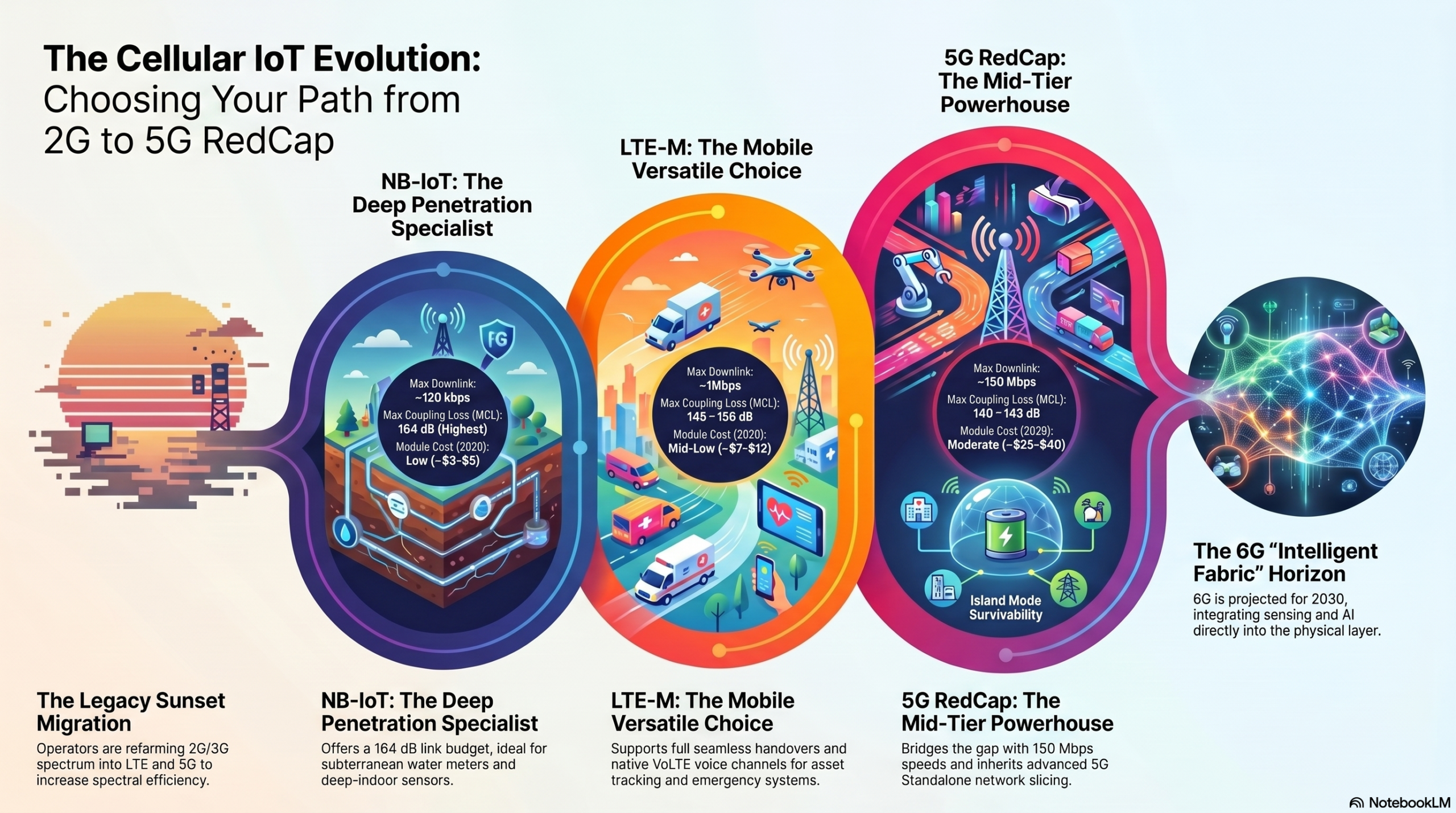
While NB-IoT and LTE-M remain the foundational workhorses for low-power, wide-area networks (LPWAN), 5G RedCap (Reduced Capability) has emerged as the definitive mid-tier solution. RedCap bridges the gap between ultra-low-power sensors and high-end 5G broadband, offering a future-proof migration path for industrial and consumer applications. As the industry moves toward 2030, the focus is shifting to 6G, envisioned as an “intelligent fabric” integrating sensing, communication, and AI-native architectures.
——————————————————————————–
Link to the Technical White Paper https://dereticular.com/technical-white-paper-securing-the-kinetic-edge-a-sovereign-stack-evaluation-of-nb-iot-lte-m-and-5g-redcap/
1. The Legacy Transition: 2G Sunset and LTE Migration
The global decommissioning of 2G infrastructure (GSM/CDMA) is an active operational challenge. Operators are retiring these networks to “refarm” low-frequency spectrum (800 MHz, 900 MHz, 1800 MHz) for LTE and 5G, significantly increasing capacity and data throughput.
Regional Sunset Status (2026)
- Pioneers: Japan, South Korea, Singapore, Taiwan, and Canada have completely decommissioned 2G.
- North America: Major US carriers have largely completed sunsets, maintaining only minor footprints for legacy M2M applications.
- Europe: A phased approach is underway; the UK has a complete phase-out timeline leading to 2030–2033.
- Developing Markets: 2G persists longer in parts of Africa, Latin America, and Asia due to a high base of feature phones and basic utility meters.
Technical Drivers for Migration
The transition is motivated by a shift from circuit-switched voice and basic packet data to all-IP, packet-switched architectures. Key mechanisms facilitating this include:
- Circuit-Switched Fallback (CSFB): A mechanism allowing LTE devices to drop to 2G/3G for voice calls in the absence of VoLTE.
- Dual-Mode Hardware: Hybrid modules utilizing both 2G and LTE (LTE-M/NB-IoT) to ensure connectivity during the transitional period, particularly for cross-border logistics.
——————————————————————————–
Link to the Podcast https://academy.dereticular.com/podcast/evolution-of-cellular-iot-from-5g-redcap-to-6g-foundations/
2. Cellular IoT Hierarchy: NB-IoT, LTE-M, and 5G RedCap
In 2026, the industry has aligned around three distinct 3GPP licensed standards, each optimized for specific performance, cost, and power profiles.
Comparative Technical Matrix
| Feature | NB-IoT (Release 13+) | LTE-M (Release 13+) | 5G RedCap (Rel-17) | 5G eRedCap (Rel-18) |
| Bandwidth | 180 kHz | 1.4 MHz | Up to 20 MHz | 5 MHz |
| Peak Downlink | ~120 kbps | ~1 Mbps | ~150 Mbps | ~10 Mbps |
| Latency | 1.6s to 10s | 50 ms – 100 ms | 10 ms – 50 ms | 20 ms – 100 ms |
| Mobility | Limited (Re-selection) | Full Handovers | Full Handovers | Full Handovers |
| Voice (VoLTE) | No | Yes | Yes (VoNR/VoLTE) | Yes (VoNR) |
| Module Cost | Low (3–5) | Mid-Low (7–12) | Moderate (15–25) | Mid-Low (~$10 target) |
5G RedCap (Reduced Capability) and eRedCap
RedCap (also known as NR-Light) is designed to replace legacy mid-tier technologies like LTE Cat-1 and Cat-4.
- Release 17 RedCap: Reduces hardware complexity by scaling antennas from four to one or two and limiting bandwidth to 20 MHz.
- Release 18 eRedCap: Scales parameters further (5 MHz bandwidth, 10 Mbps peak) to directly compete with LTE Cat-1/Cat-M on price and power.
- Core Benefits: Inherits 5G Standalone (5G SA) features, including Network Slicing (dedicated bandwidth for critical fleets) and Time-Sensitive Networking (TSN) for microsecond-level synchronization in industrial automation.
——————————————————————————–
3. RF Propagation and Coverage Physics
Coverage feasibility is governed by Maximum Coupling Loss (MCL), the maximum signal attenuation a link can tolerate.
Maximum Coupling Loss (MCL) Comparison
- NB-IoT (164 dB): The leader in deep-indoor and subterranean penetration. It achieves this through extreme Power Spectral Density (PSD), concentrating transmit power into an ultra-narrow 180 kHz bandwidth.
- LTE-M (145 dB – 155.7 dB): Uses Coverage Enhancement (CE) modes. CE Mode B repeats transmissions up to 2,048 times to reach deep locations, though this severely drains battery.
- 5G RedCap (140 dB – 143 dB): Suffers a “structural deficit” (3–4 dB penalty) compared to full 5G due to fewer receive antennas. It compensates using Slot Aggregation and Inter-Slot Frequency Hopping.
——————————————————————————–
4. The Sovereign Stack: Resilience and “Island Mode”
A critical strategic thesis is the movement away from cloud-dependent orchestration toward localized “Island Mode” survivability. This is essential for critical infrastructure (microgrids, disaster response, autonomous logistics) that must function if centralized cloud links fail.
- LTE-M as the Practical Edge: LTE-M is currently the most operationally grounded “sovereign” technology. It is highly compatible with private, software-defined networks (e.g., Open5GS, srsRAN) and supports off-grid voice channels.
- NB-IoT “Carrier-Tethered Trap”: NB-IoT is structurally difficult to deploy in private environments due to strict scheduling and frequency requirements, often remaining tethered to centralized telecom operators.
- The Sovereign Decision Matrix: Architects should select technologies based on the environment:
- NB-IoT: Static, buried assets (water meters, soil sensors) requiring 10-15 year battery life.
- LTE-M: Mobile assets or systems requiring local private base stations and voice fallback.
- 5G RedCap: High-performance systems requiring 5G SA network slicing and sub-millisecond precision.
——————————————————————————–
5. Security Evolution: From 2G Vulnerabilities to 5G Integrity
Security is a primary driver for abandoning 2G. Legacy standards are increasingly risky for critical infrastructure.
Security Paradigms
- 2G Weaknesses: Utilizes Unidirectional Authentication (only the device authenticates to the network), allowing for “Stingrays” or IMSI Catchers. Encryption algorithms (A5/1, A5/2) are easily cracked by modern hardware.
- LTE/5G Strengths: Implement Mutual Authentication (user and network validate each other).
- 5G Advanced Features: Introduces IMSI Encryption, converting the Subscription Permanent Identifier (SUPI) into a Subscription Concealed Identifier (SUCI) before transmission, mitigating location tracking.
- Hardware Root of Trust: Modern designs integrate modems with a Trusted Platform Module (TPM) or Hardware Security Module (HSM) to cryptographically sign telemetry at the edge, ensuring data integrity.
——————————————————————————–
6. Strategic Outlook: The Road to 6G (2026–2030)
As of 2026, the global ecosystem is beginning formal 6G standardization under the ITU-R IMT-2030 framework.
6G Roadmap and Technologies
- Timeline: 3GPP Release 20 (Study Phase) is active in 2026. Technical specifications are expected in 2027-2028, with commercial rollout targeted for 2029–2030.
- Core Enablers:
- AI-Native Architecture: Embedding machine learning into the physical layer and core routing.
- Integrated Sensing and Communication (ISAC): Using radio signals for radar-like environmental perception and centimeter-level positioning.
- Spectrum Frontiers: Utilizing Centimeter-Wave (6–8 GHz) for balanced coverage and Sub-THz (above 100 GHz) for ultra-high throughput (up to 1 Tbps).
- Non-Terrestrial Networks (NTN): Native integration of satellite and High-Altitude Platform Stations (HAPS) for ubiquitous global coverage.
Key Strategic Takeaway
The transition from legacy networks to 5G RedCap and eventually 6G is more than a speed upgrade; it is a shift toward unified communication, sensing, and sovereign compute. For long-lifecycle assets (10-15 years), migrating to LTE-M or RedCap is critical to avoid premature obsolescence as 4G networks begin their own eventual sunset in the 2030s.