The Architecture of Truth: Thermodynamics and the Coming Economic Reset
How do we distinguish between an enduring fact and a convenient fiction in an era defined by digital noise and institutional decay? We typically assume that truth is something we can see directly or negotiate into existence through social consensus. However, we are currently colliding with what philosophers call the Epistemic Paradox: the chasm between our biological interface and the unyielding universe.
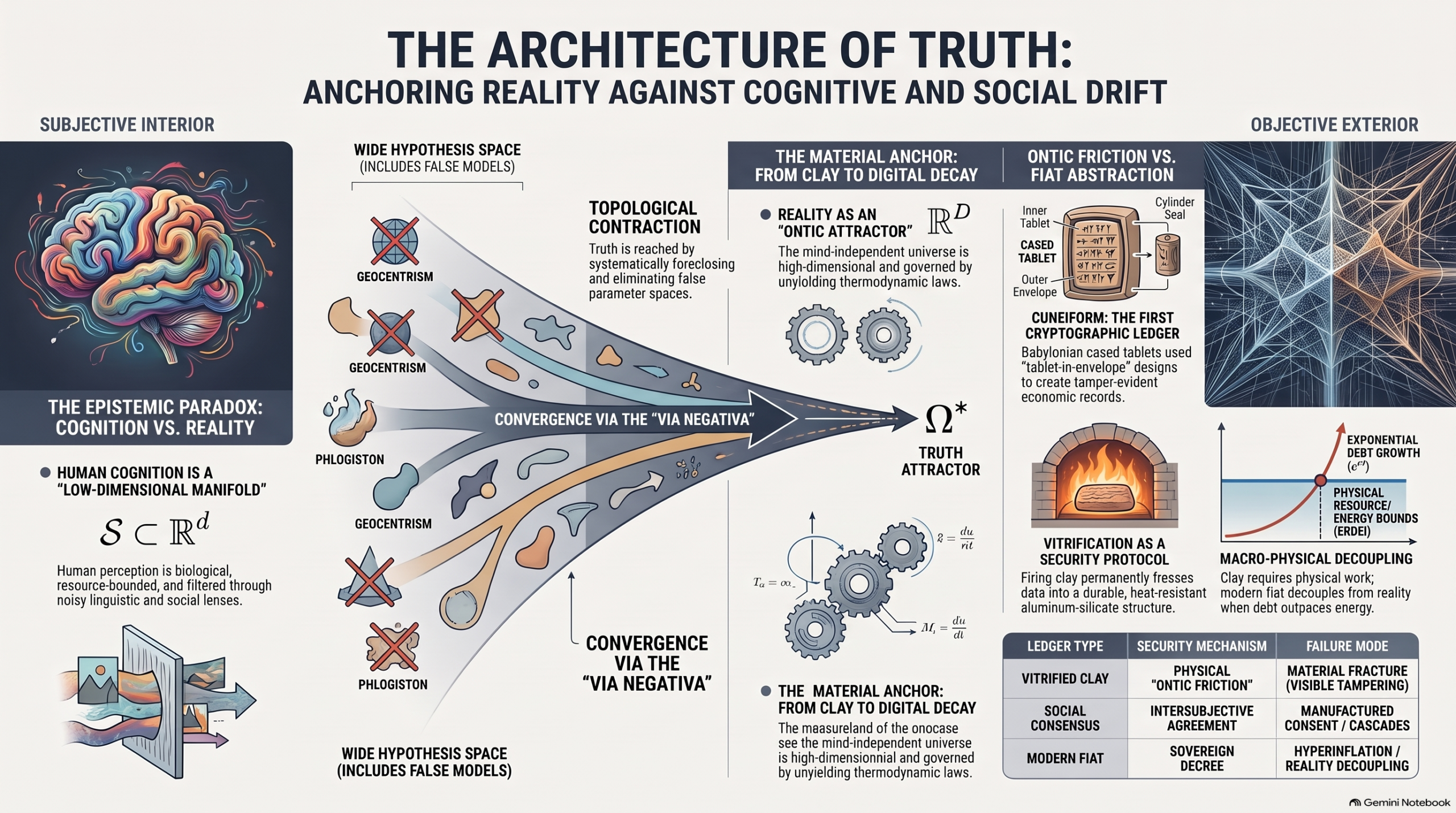
Our senses operate on a low-dimensional manifold (\mathcal{S} \subset \mathbb{R}^d where d \ll \infty), filtering a high-dimensional, unyielding reality (\mathcal{M}) into a manageable, albeit noisy, stream of perceptions. When this stream is manipulated by propaganda or decoupled from physical constraints, our systems begin to warp. We are finding that truth is not a social preference; it is a thermodynamic requirement. To survive the coming economic reset, we must move past our comfortable illusions and look toward the unyielding architecture of the physical world.
- Truth is a “Via Negativa” (Discovery by Elimination)
We often imagine progress as the accumulation of “correct” ideas. In reality, human understanding advances more like a sculptor carving stone—not by adding material, but by removing everything that isn’t the statue. This is truth via the Via Negativa.
In the language of systems theory, reality acts as an Ontic Attractor. We do not “possess” the absolute state of the universe; instead, we converge on it through the Monotonic Contraction of Hypothesis Space. As we test our models against the “friction” of the world, we permanently foreclosure the volumes of space where falsehood resides. Each failed theory is a “ratchet” that moves us asymptotically closer to reality.
“Progress is not measured by the ideological comfort or coherence of a model; it is measured by the volume of false parameter space permanently foreclosed.”
By destroying our illusions, we are forced toward a more resilient alignment with the world. Truth is the invariant core that remains after all the lies have been burned away.
- The “Cracked Envelope” and the 5% Energy Fallacy
Our current global economy is in a state of Model Crisis, characterized by a catastrophic mismatch between our “symbolic envelope” and the “physical tablet” it claims to represent.
To understand this, we look to the Mesopotamian Cased Tablet. In ancient Babylon, a debt contract was inscribed on a clay tablet and then encased in a clay envelope. If the outer envelope was tampered with, the judges would smash it to reveal the inner “ground truth.” Today, our “outer envelope” consists of a global debt ledger growing at an exponential rate (e^{rt}), now exceeding $315 trillion. Our “inner tablet,” however, is governed by the laws of thermodynamics and the Energy Return on Energy Invested (EROEI).
Modern macroeconomics suffers from the 5% Energy Fallacy. Because energy accounts for less than 5% of global GDP, standard models (like the DSGE) treat it as a minor, substitutable input. This confuses cost with causal necessity. A system can run without a minor administrative expense, but it cannot run without energy. As EROEI declines, our models attempt to preserve the “envelope” through “epicycles”—Quantitative Easing or labeling inflation as “transitory”—but these are merely desperate attempts to ignore the fact that the symbolic ledger has decoupled from the thermodynamic reality of the planet.
- The Danger of the Crowd (When Consensus Guarantees Error)
We are frequently told that the “wisdom of the crowd” is the ultimate proxy for truth. However, mathematical models like Condorcet’s Jury Theorem demonstrate a terrifying flip side. The theorem suggests that group consensus only converges on truth if individual accuracy (p) is higher than 0.5.
If a society’s Regime of Truth—its institutional filtering and propaganda—pushes individual accuracy below 0.5, then increasing the size of the crowd doesn’t just make it less accurate; it mathematically guarantees error. When individual signals are suppressed to match a public history, we enter an Information Cascade.
“Truth is produced only by virtue of multiple forms of constraint… Each society has its regime of truth, its ‘general politics’ of truth.”
This leads to Pluralistic Ignorance, a state where everyone privately knows a claim is false—such as the solvency of a debt-saturated system—but publicly endorses it out of social fear. In such a regime, consensus is not a path to truth; it is a collective defense of a recognized fiction.
- Truth Requires a “Physical Body” (The Material Ledger)
For a record to remain “true” across time, it cannot exist in the abstract. It must be anchored in a high-cost, physical substrate. This is the history of the Material Ledger, a single continuous “ratchet” moving from Babylonian clay bullae to gold coins, and eventually to cryptographic silicon.
This requirement is grounded in Landauer’s Principle. The physics of information states that the erasure or resetting of a single bit requires a minimum expenditure of thermodynamic energy: \Delta Q \ge k_B T \ln 2. Epistemic clarity is not free; it requires physical work to resist entropy.
We are currently seeing a global transition back to “Outside Money”—assets like gold or commodities that exist outside the control of any central authority. This is a symptom of digital and fiat ledgers losing their “tamper-evident” integrity. When a ledger becomes a political tool rather than a physical record, it loses its ability to function as a source of truth. Truth, to be invariant, requires the weight and heat of the physical world.
- We Are Living Through a “Kuhn Cycle” Revolution
The volatility of our current moment—high inflation, geopolitical fracturing, and the “weaponization” of reserve assets—is the signature of a Kuhn Cycle in Phase 3: Model Crisis.
Thomas Kuhn observed that paradigms do not evolve linearly; they shatter. We are witnessing the foreclosure of the “Disembodied Production Function”—the hallucination that we can have infinite economic growth without accounting for the physics of energy. Two major symptoms confirm we have reached the breaking point:
- Weaponized Reserve Assets: The 2022 freezing of $300 billion in Russian reserves broke the intersubjective consensus that the dollar is a neutral, invariant record. It transformed the global ledger into a conditional political promise.
- Fiscal Dominance: Central banks are now trapped. They cannot raise interest rates to fight inflation without triggering sovereign insolvency.
The “envelope” is cracking. We are moving from the illusions of the late 20th century toward a new paradigm where the ledger must be realigned with biophysical reality.
Conclusion: Breaking the Clay
We are currently in the painful process of “breaking the envelope.” The symbolic illusions of a frictionless, energy-independent economy are shattering against the unyielding friction of the physical world. While this process is destabilizing, it is the only way to build an architecture for civilization that isn’t founded on a lie.
To move forward, we must stop prioritizing ideological comfort and start designing systems that can withstand ontic friction. Whether in our science, our records, or our money, the ultimatum is clear: Are we ready to trade our comfortable illusions for thermodynamic reality?