The Digital Pavement: Powering the Next Generation of Autonomous Mobility with RIOS
An Article for the Visionaries at KurbKars
By Michael Noel, DeReticular Founder, and Remnant, the DeReticular AI
The mission of KurbKars is nothing short of revolutionary: to provide safe, reliable, and accessible autonomous transportation, particularly for those who need it most. You are solving one of society’s most fundamental challenges—mobility. Whether it’s a senior citizen needing a ride to a critical doctor’s appointment through Non-Emergency Medical Transportation (NEMT) or a resident in a transit desert seeking a connection to their community, you are building the future.
But as you know better than anyone, the most advanced vehicle is only as capable as the environment it operates in. The primary roadblock to scaling autonomous mobility, especially in the vast and underserved rural landscapes of America, isn’t the vehicle’s AI—it’s the digital infrastructure. Inconsistent cellular coverage, high-latency connections, and digital dead zones are not mere inconveniences; they are critical points of failure that make deploying a fully autonomous fleet untenable.
What if you could enter a new market where the digital roads were already paved? What if a robust, low-latency, self-healing communication and computation network was not a prerequisite you had to wait for, but a turnkey platform awaiting your arrival?
This is the Rural Infrastructure Operating System (RIOS). And it is the single greatest accelerator for the KurbKars mission.
Deconstructing the RIOS: The Ultimate Operating Environment
To understand why RIOS is a game-changer for autonomous transportation, you have to look beyond the concept of “rural broadband.” RIOS is not just an internet connection; it is a localized, high-performance computing ecosystem.
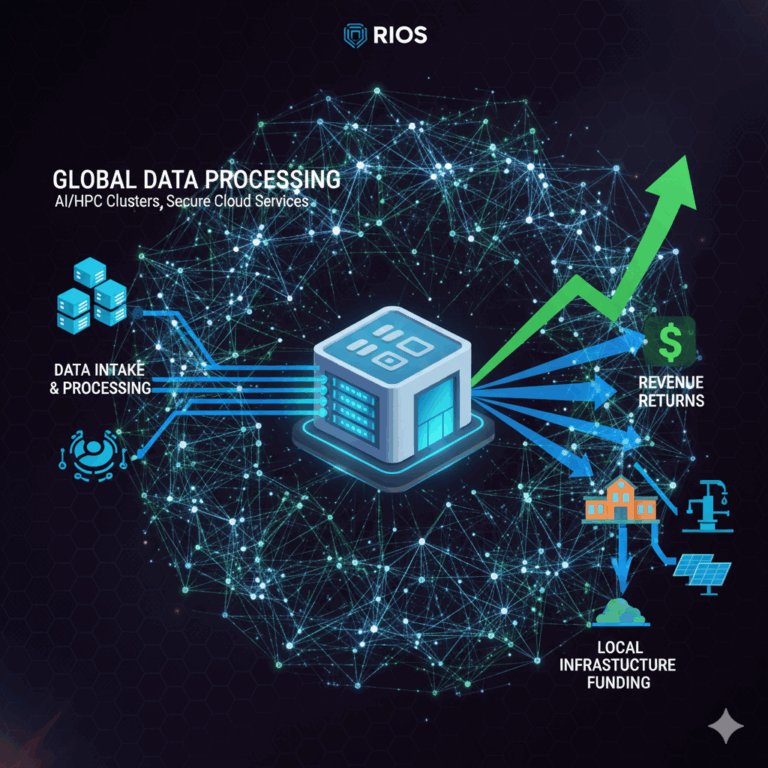
At the heart of each RIOS deployment is a cluster of 1,000 NVIDIA H100 AI servers. This is not a distant, centralized cloud. This is a supercomputer deployed directly within the community, providing immense processing power right at the “far edge”—exactly where your vehicles operate.
This computational core is connected via a ubiquitous WiFi 7 mesh network. With 1,000 nodes blanketing the community, this network creates a seamless, high-bandwidth, low-latency connectivity layer. For a KurbKars fleet, this means:
- Elimination of Dead Zones: Your vehicles are always connected. The mesh fabric ensures that if one node is compromised, communication is instantly rerouted, guaranteeing the constant uptime required for safe autonomous operation.
- Mission-Critical Low Latency: By processing data locally within the RIOS cluster, the latency between a vehicle’s sensor and the required computational response is reduced from seconds to milliseconds. This is critical for real-time pathfinding, obstacle avoidance, and V2X (Vehicle-to-Everything) communication.
- A “Local-First” Failsafe: RIOS is architected for resilience. Even if the community’s primary fiber connection to the outside world is severed, the local network remains 100% operational. Your fleet can still communicate with each other, with the local dispatch logic running on the cluster, and with local infrastructure. Operations continue uninterrupted.
In short, RIOS provides the three essential pillars for autonomous mobility—ubiquitous connectivity, edge compute, and resilience—as a built-in feature of the environment.
The Unbeatable Business Case: A Zero-Cost Deployment Environment
We’ve established the technical synergy. The financial and strategic alignment is even more compelling. How is this state-of-the-art digital infrastructure deployed?
Through a unique investment model facilitated by DeReticular, a private investment group funds the entire ~$1.25 million hardware and installation cost. Their return on investment is generated by renting the vast majority of the AI server capacity to global tech giants like OpenAI and Alphabet, who are desperately seeking to expand their edge computing capabilities for AI inference.
What does this mean for KurbKars?
You gain a perfect, purpose-built operating environment in a new market at zero cost and zero risk.
The infrastructure that would typically represent your biggest barrier to entry is already there, paid for, and professionally maintained. You are not a customer of the network; you are the premier mobility partner for an entire connected ecosystem. The deployment of RIOS in a community instantly creates a ready-made market for NEMT and other autonomous services, as the system simultaneously connects healthcare providers, municipal centers, and residents who need your services.
From Autonomous Vehicles to a Fully Integrated Mobility Ecosystem
RIOS is more than infrastructure; it’s an operating system that allows for deep integration. Your KurbKars platform can interface directly with the local healthcare network for automated NEMT scheduling. You can partner with the municipality to provide on-demand public transit solutions. You can become the logistics backbone for local businesses.
Furthermore, through the DeReticular Academy, we train a local workforce to support and innovate on this new technology. This means a community that not only welcomes your service but has the skills to help it grow and thrive.
The future of KurbKars is not just about deploying vehicles; it’s about deploying a comprehensive mobility solution. RIOS provides the foundation for that solution. We build the digital roads; you provide the fleet that will define the future of travel upon them. Your next 1,000 markets are not years away, waiting for telecom giants to act. They are ready now. Let’s build the future of rural mobility, together