The Future of the Ballot: How ‘Sovereign’ Tech is Fixing Democracy’s Trust Crisis
Modern elections are weathering a catastrophic crisis of trust. For many voters, the process of casting a ballot has devolved into an exercise in blind faith rather than transparent civic duty. We interact with “black-box” machines—proprietary systems from centralized vendors with opaque codebases—and wait, often with growing anxiety, for results that feel disconnected from the physical act of voting. This systemic vulnerability, ranging from supply-chain risks to delayed reporting, has turned the bedrock of democracy into a flashpoint for public skepticism.
However, a shift is occurring in the way we conceptualize election infrastructure. Moving away from the era of centralized, vendor-locked systems, a new philosophy is emerging: Sovereign Automation. This approach, embodied in the “Sovereign Elector” suite, suggests that the solution to election integrity isn’t just a faster machine, but a complete reimagining of the voting terminal as a transparent, cryptographic, and physical entity.
By treating the voter not just as a participant but as a “Sovereign Elector,” this technology seeks to replace institutional trust with mathematical proof. It is a sophisticated, optimistic vision for the future—one where the voting process is as un-hackable as it is verifiable.
The Paper Trail as the “Ultimate Truth”
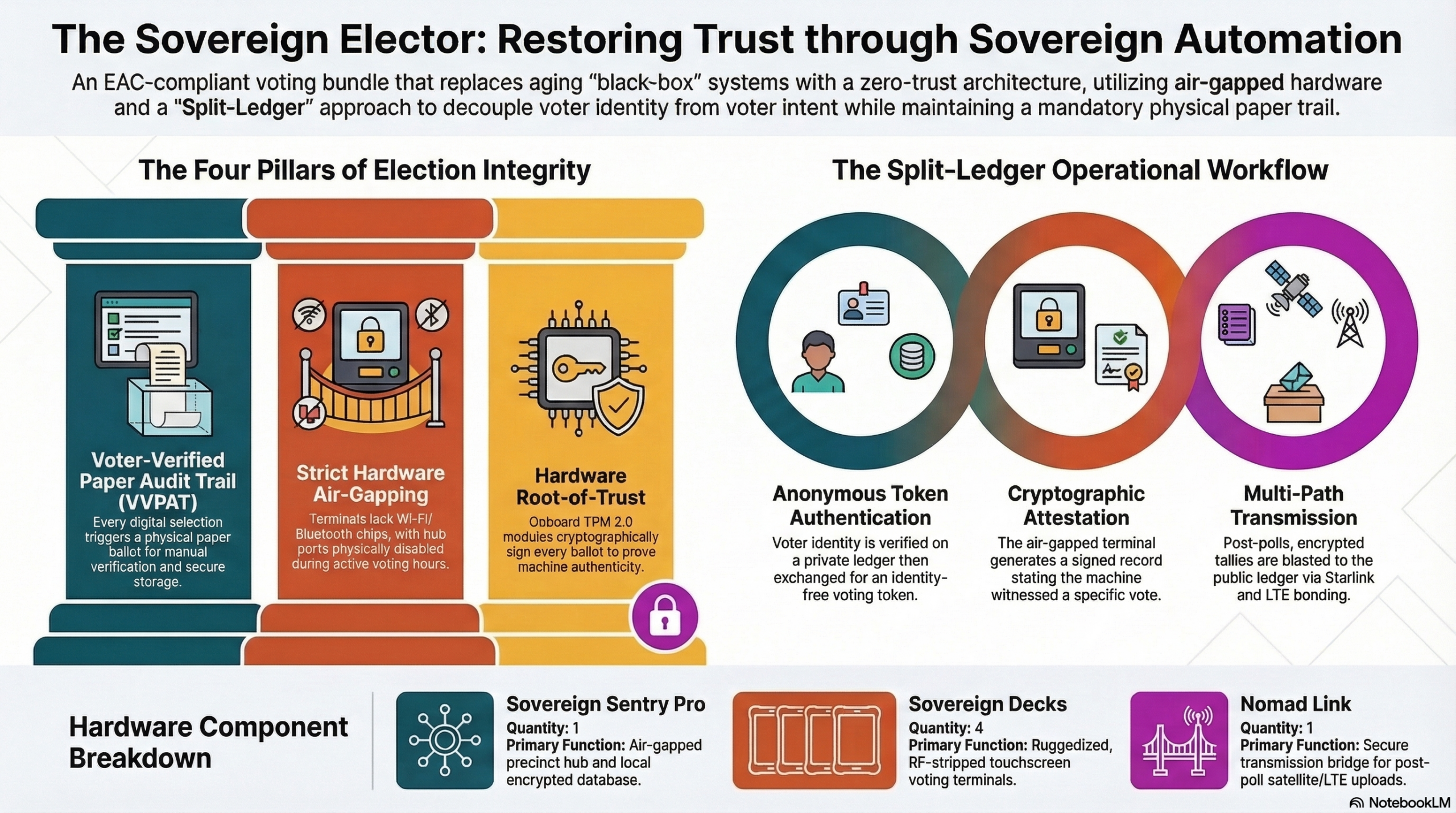
In an era of high-speed digital transactions, it is a strategic masterstroke that the gold standard for 21st-century election security remains a physical piece of paper. The Sovereign Elector prioritizes a Voter-Verified Paper Audit Trail (VVPAT), ensuring that the digital record never supersedes the physical one. This acknowledges a fundamental reality: while cryptography secures the digital twin of the vote, 14th-century technology provides the ultimate safeguard against digital manipulation.
The system utilizes industrial thermal printers enclosed in tamper-evident DeReticular chassis. When a voter makes their selection on a Sovereign Deck, the machine generates a physical ballot. The voter then verifies this paper record before depositing it into a secure lockbox. By making the paper trail the final word, the system aligns with federal VVSG 2.0 guidelines, which strictly mandate a physical audit trail.
REGULATORY POLICY: RISK MITIGATION R-VOTE-03 The VVPAT Ultimate Truth: DeReticular policy defers to the physical paper. The printed, voter-verified paper ballot dropped in the physical box serves as the ultimate legal authority for recounts, aligning with US legal standards.
True Security Means Removing the Silicon
While software-based security and firewalls are standard, the Sovereign Elector adopts a “Strict Air-Gapping” strategy that modifies the hardware itself to reduce the attack surface to zero. To eliminate the risk of remote network tampering, the Sovereign Decks (voting terminals) are physically stripped of all Wi-Fi and Bluetooth chips during manufacturing.
This hardware-level security is reinforced via physical connectivity; the Decks are hardwired via Cat6 cabling to the Sovereign Sentry Pro hub. This hub uses hardware-level relays to physically disable its WAN ports and antennas during active voting hours. From a strategic perspective, this shifts the security paradigm from “defendable” to “impenetrable.” Software can be patched, but a missing chip cannot be hacked.
Furthermore, the system establishes a hardware root-of-trust using onboard TPM 2.0 modules. These modules cryptographically sign every cast ballot, proving that the data was generated by a certified, untampered machine. In this model, civic duty is anchored in the silicon itself.
Decoupling Identity from Intent: The Split-Ledger
One of the greatest challenges in civic design is the “anonymity paradox”: verifying eligibility without linking identity to specific candidate choices. The Sovereign Elector solves this through a Split-Ledger Architecture, a concept originally pioneered for DeReticular’s combat-tested HempGrade AI.
The architecture functions through a sophisticated multi-phase process:
- Phase 1 (The Private Ledger): The voter’s identity is verified against the State’s Electronic Poll Book (Layer A). Once confirmed, they are marked as “Voted” and issued a single-use QR token. Crucially, this token contains no identity data—it is a mathematical permission slip.
- Phase 3 (The Hardware Oracle): The voter uses the token at an air-gapped terminal. The Sovereign Deck generates a Cast Vote Record (CVR) and uses its Ed25519 Private Key to sign the packet.
- Phase 4 (The Merkle Tally): The signed CVR is stored on the Sentry Pro’s NVMe RAID array. When polls close, the system compiles these hashes into a Merkle Tree, creating a mathematically undeniable audit trail of the precinct’s results.
This architecture proves that a vote was cast by a legitimate machine at a specific time and location (e.g., “Machine #802 witnessed a vote at 14:02 PM”) without ever exposing who cast it.
Resilience Against “Spicy Pillows” and Grid Attacks
Election integrity is as much about operational continuity as it is about cryptography. Whether facing a localized power failure or a targeted grid attack, a precinct must remain functional to maintain public calm. DeReticular addresses these “Spicy Pillows” (Risk ID: R-VOTE-02) via a rugged, off-grid Precinct Bundle.
The Sovereign Sentry and Decks are low-power devices, supported by a 2kWh LiFePO4 battery backup that allows a four-terminal precinct to operate for 48 hours without external power. However, the true strategic innovation lies in Nomad Signal Fusion (Risk ID: R-VOTE-04). To prevent a “Transmission Blockout,” the Nomad Link bridge utilizes Starlink satellite failover and bonded LTE. This ensures that the encrypted tally reaches the State’s central Locutus Ledger (Layer B) immediately, bypassing potentially compromised or failing terrestrial infrastructure.
The human element remains critical to this resilience. At the close of polls, the Precinct Judge must insert a physical Sovereign Key (YubiKey) into the Sentry Pro to transition the system from “Voting” to “Tally” mode, ensuring a strictly controlled, human-in-the-loop sequence.
AI-Powered Accessibility Without the Cloud
Civic infrastructure must be accessible to all, but accessibility cannot come at the cost of security. The Sovereign Elector integrates the OpenClaw “Poll Worker” agent to meet ADA compliance through local, offline artificial intelligence.
By utilizing whisper-local and text-to-speech AI, the system provides audio navigation and supports sip-and-pull interfaces for voters with disabilities. Because the AI is containerized and runs locally on the Sovereign Deck, it requires zero internet connectivity. This “edge AI” approach provides a seamless experience for the voter without “phoning home” to a central server, maintaining the absolute integrity of the air-gapped environment.
A Strategic Shift Toward Radical Transparency
The transition represented by the Sovereign Elector is a move from “trusting a vendor” to “verifying the math.” For decades, the US election market has been dominated by aging conglomerates like ES&S and Dominion, whose proprietary secrets have become the subject of intense scrutiny. DeReticular is disrupting this landscape not with better marketing, but with radical transparency.
By retooling industrial-grade hardware for civic duty, we provide a system where the hardware proves its own integrity, the ledger is public, and the paper trail is paramount. In a time of deep political polarization, the most effective way to heal the divide is to implement infrastructure where results are mathematically undeniable.
It raises a vital question for the future of our democracy: Would you trust a public, cryptographically-signed ledger more than a proprietary black box?