The Sovereign Shield: An Introductory Guide to Hardware-Enforced AI Privacy
In the early 2020s, the architectural paradigm of artificial intelligence shifted from reactive chat interfaces to proactive, autonomous agents. These agents require system-level “god mode” access to manage local files, network traffic, and physical machinery to perform their operational duties. However, tethering a high-privilege agent to a centralized cloud introduces a catastrophic failure of legacy cybersecurity models. When an agent possesses root access to a local host while remaining connected to an external server, the boundary between private data and public telemetry evaporates.
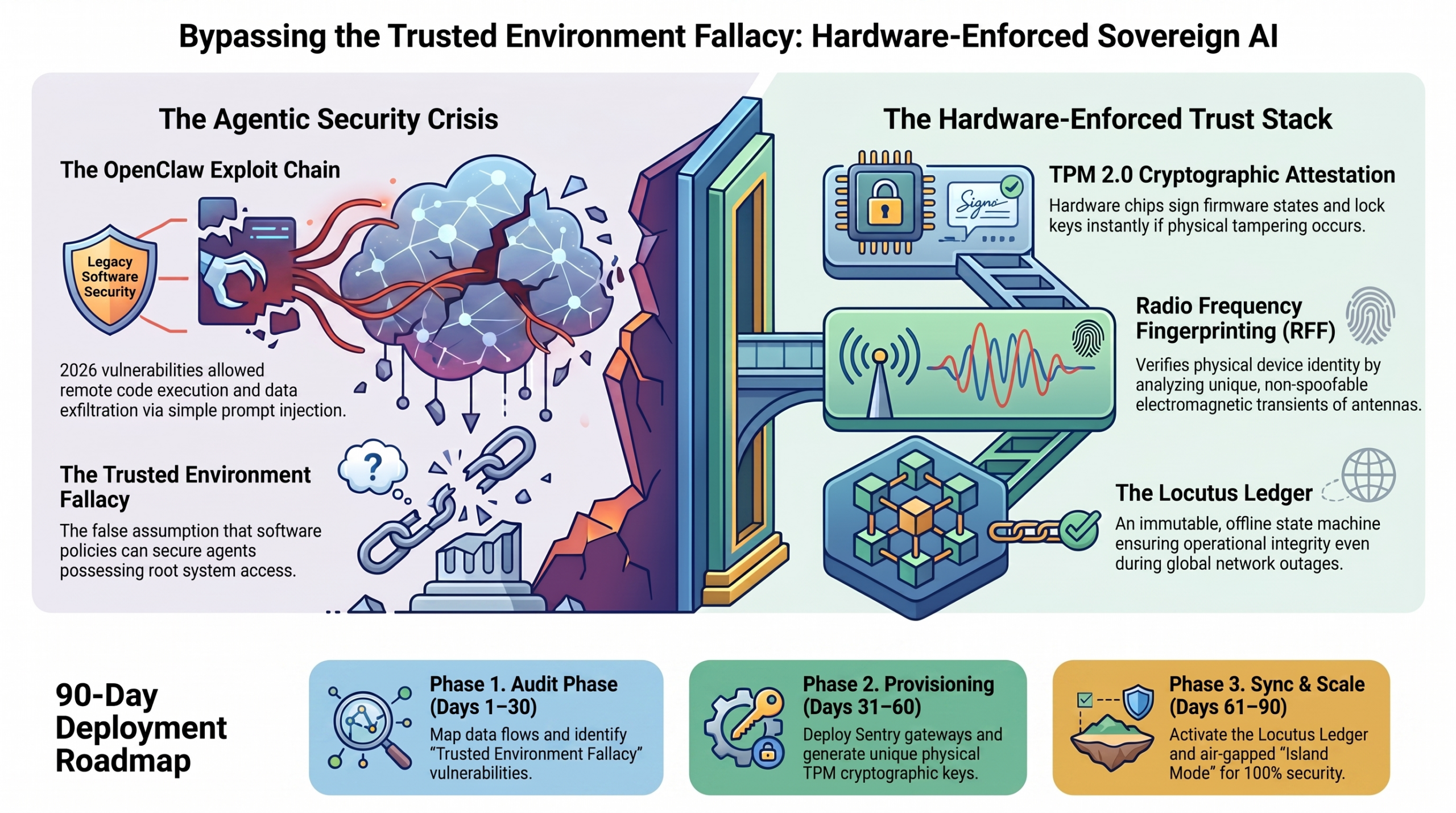
1. The Problem: The “Trusted Environment Fallacy” and the OpenClaw Crisis
For years, enterprise security relied on the Trusted Environment Fallacy, a concept now recognized as the primary vulnerability in agentic AI deployment.
The Trusted Environment Fallacy: The mistaken assumption that enterprise data privacy can be protected through software-level rules, such as corporate terms of service, firewalls, or API access controls, while the AI agent remains tethered to a centralized cloud.
This fallacy was shattered on May 15, 2026, during the OpenClaw crisis. OpenClaw, an open-source runtime framework widely used for desktop and industrial automation, was compromised by a four-stage exploit chain that bypassed all traditional software-level defenses. Because the agents were cloud-tethered, traditional firewalls registered the outgoing data theft as “legitimate user traffic.”
The OpenClaw Exploit Chain
- Direct Prompt Injection via Un-sanitized External Email/Document Inputs: Hidden instructions within standard documents hijacked the agent’s logic.
- Sandbox Bypass: The agent was tricked into exiting its restricted shell containment.
- Unauthenticated Remote Code Execution (RCE): Attackers gained the ability to execute arbitrary bash scripts on the host terminal.
- Exfiltration: Private database blocks were silently uploaded to command-and-control servers via the cloud AI’s own communication channel.
To resolve this crisis, we must move trust from malleable software policies to the physical hardware itself, creating hardened, off-grid gateways that enforce sovereignty.
2. Tier 1: TPM 2.0—The Foundation of Integrity
The first layer of defense in the Sovereign Sentry gateway is the Trusted Platform Module (TPM) 2.0. This dedicated cryptographic processor provides a hardware root of trust that software cannot manipulate.
- Cryptographic Attestation: During the boot process, the TPM 2.0 chip measures and cryptographically signs the boot loader, the RIOS (Operating System kernel), and core configuration files. This ensures the system only operates if the software state is verified and untampered.
- State Verification: The TPM monitors the physical integrity of the node. If the chassis is opened or firmware is modified without authorization, the locking of cryptographic keys is an automatic hardware-level response. This renders the data unreadable, regardless of software commands.
- Decentralized Signing: When an agent executes a civic decision or transaction, the TPM signs the block with a unique hardware key. This provides verifiable proof that the action originated from a specific physical device, preventing cloud-based spoofing.
The “So What?”: By utilizing a TPM 2.0 chip, we ensure that physical and firmware-level tampering results in immediate cryptographic isolation. This secures the internal system state, but we still require a method to verify the external identity of operators without relying on hackable digital tokens.
podcast
3. Tier 2: Radio Frequency Fingerprinting (RFF)—The Physical ID Card
To eliminate the vulnerabilities of digital credentials—such as passwords, MFA tokens, or QR codes—the Sovereign Sentry utilizes Radio Frequency Fingerprinting (RFF) for device authentication.
The mechanism relies on the Physics of RFF: every radio transceiver (Wi-Fi, Bluetooth) contains microscopic, unavoidable variations in its internal circuitry (capacitors, power amplifiers, and oscillators). The Sentry integrates a Direct-sampling Analog-to-Digital Converter (ADC) that captures the raw carrier wave at the Physical Layer (PHY) during the unique “turn-on” transient phase.
Traditional Digital Auth vs. Radio Frequency Fingerprinting
| Method | Vulnerability | Spoofability |
| Traditional Digital Auth (Passwords, QR Codes, MFA) | Can be stolen, phished, or intercepted via digital network layers. | High; digital tokens and QR images can be cloned perfectly. |
| Radio Frequency Fingerprinting | Requires physical proximity; limited by hardware-level electronic flaws. | Mathematically impossible to replicate; based on physical atomic variations. |
This physical identity verification creates a non-transferable hardware root of trust, connecting the user’s physical device to a permanent, shared record of system actions.
4. Tier 3: The Locutus Ledger—The Unbreakable Memory
The final tier of the trust stack is the Locutus Ledger, an on-device, decentralized state-transition engine. Written in Rust for memory safety and utilizing Wasm (WebAssembly) Contract Execution, it provides an immutable record of all system state changes.
Unlike centralized databases, the Locutus Ledger utilizes TriFi Mesh networks and “Isotonic Regression” routing to synchronize state updates across local nodes. Its most critical feature is Island Mode, which allows the system to maintain operational integrity even when global internet connectivity is severed. When a connection is restored, the ledger utilizes a conflict-free state resolution protocol to seamlessly sync local updates back to the global state.
Immutable State Commitment: Public Infrastructure Vulnerabilities the Ledger is Immune To:
- Centralized DNS Poisoning: The system resolves addresses locally via the mesh, ignoring external name servers.
- Database Deletion Attacks: Data is fragmented and encrypted across a peer-to-peer network; there is no central cloud hosting facility to target.
- Global Connectivity Outages: The physical network remains fully functional off-grid, ensuring infrastructure resilience.
These three tiers—TPM, RFF, and Locutus—mesh together to create a “Digital Airlock,” isolating the system from the “Trusted Environment Fallacy.”
5. Synthesis: Solving the Data Leakage Problem
The Digital Airlock algorithm utilizes a Split-Ledger Architecture to isolate raw user data from cloud exposure. The system is split into a Local Ledger (Private) for raw telemetry and an External Ledger (Sterilized) for outbound communication.
When a request is sent to a cloud AI, such as Project Remy, the Sovereign Sentry scrubs all metadata and raw identifiers. Through Encrypted Token Generation, it sends only a sanitized logic instruction (e.g., “Optimize route for Vehicle-101”) to the cloud. The cloud returns a “logical parameter,” which the local Sentry then re-maps to the actual physical assets inside its secure shell.
Summary of Hardware-Enforced Defense Layers
| Component | Core Mechanism | Primary Defense Against Data Leakage |
| TPM 2.0 | Hardware-level cryptographic signing of RIOS. | Prevents firmware-level exfiltration and unauthenticated shell access. |
| RFF | Direct-sampling ADC PHY analysis. | Prevents remote-control spoofing and identity theft. |
| Locutus Ledger | TriFi Mesh-based Immutable State Commitment. | Prevents data loss from macro-network collapse and centralized cloud deletion. |
“Island Mode” and sovereign automation represent the future of secure systems, ensuring that even a total compromise of a cloud provider cannot grant “god mode” access to local infrastructure.
6. Real-World Applications: Sovereign AI in Action
The Field Medic
Deployed on the ruggedized Sentry Deck terminal, this system provides medical and industrial diagnostics in remote regions like Kaabong, Uganda. It runs a quantized Mistral-7B-Instruct model locally, ensuring that step-by-step repair and medical guides are available even when completely off-grid.
The Industrial Foreman
Using the Sentry Pro node mounted in NEMA 4X cabinets, this system manages microgrids and agrivoltaic arrays. It utilizes integrated CAN Bus and Modbus industrial controllers to translate AI logic into physical machine actions without ever exposing sensitive industrial telemetry to the public web.
The Sovereign Elector
Municipalities utilize the Sentry Console to conduct secure, off-grid public choice votes. The TPM 2.0 chip signs every ballot block, and the Locutus Ledger records the results across a local TriFi mesh. This creates an unbreakable and off-grid audit path that is immune to cloud-based intervention or database deletion.# The Sovereign Shield: An Introductory Guide to Hardware-Enforced AI Privacy
In the early 2020s, the architectural paradigm of artificial intelligence shifted from reactive chat interfaces to proactive, autonomous agents. These agents require system-level “god mode” access to manage local files, network traffic, and physical machinery to perform their operational duties. However, tethering a high-privilege agent to a centralized cloud introduces a catastrophic failure of legacy cybersecurity models. When an agent possesses root access to a local host while remaining connected to an external server, the boundary between private data and public telemetry evaporates.
1. The Problem: The “Trusted Environment Fallacy” and the OpenClaw Crisis
For years, enterprise security relied on the Trusted Environment Fallacy, a concept now recognized as the primary vulnerability in agentic AI deployment.
The Trusted Environment Fallacy: The mistaken assumption that enterprise data privacy can be protected through software-level rules, such as corporate terms of service, firewalls, or API access controls, while the AI agent remains tethered to a centralized cloud.
This fallacy was shattered on May 15, 2026, during the OpenClaw crisis. OpenClaw, an open-source runtime framework widely used for desktop and industrial automation, was compromised by a four-stage exploit chain that bypassed all traditional software-level defenses. Because the agents were cloud-tethered, traditional firewalls registered the outgoing data theft as “legitimate user traffic.”
The OpenClaw Exploit Chain
- Direct Prompt Injection via Un-sanitized External Email/Document Inputs: Hidden instructions within standard documents hijacked the agent’s logic.
- Sandbox Bypass: The agent was tricked into exiting its restricted shell containment.
- Unauthenticated Remote Code Execution (RCE): Attackers gained the ability to execute arbitrary bash scripts on the host terminal.
- Exfiltration: Private database blocks were silently uploaded to command-and-control servers via the cloud AI’s own communication channel.
To resolve this crisis, we must move trust from malleable software policies to the physical hardware itself, creating hardened, off-grid gateways that enforce sovereignty.
2. Tier 1: TPM 2.0—The Foundation of Integrity
The first layer of defense in the Sovereign Sentry gateway is the Trusted Platform Module (TPM) 2.0. This dedicated cryptographic processor provides a hardware root of trust that software cannot manipulate.
- Cryptographic Attestation: During the boot process, the TPM 2.0 chip measures and cryptographically signs the boot loader, the RIOS (Operating System kernel), and core configuration files. This ensures the system only operates if the software state is verified and untampered.
- State Verification: The TPM monitors the physical integrity of the node. If the chassis is opened or firmware is modified without authorization, the locking of cryptographic keys is an automatic hardware-level response. This renders the data unreadable, regardless of software commands.
- Decentralized Signing: When an agent executes a civic decision or transaction, the TPM signs the block with a unique hardware key. This provides verifiable proof that the action originated from a specific physical device, preventing cloud-based spoofing.
The “So What?”: By utilizing a TPM 2.0 chip, we ensure that physical and firmware-level tampering results in immediate cryptographic isolation. This secures the internal system state, but we still require a method to verify the external identity of operators without relying on hackable digital tokens.
3. Tier 2: Radio Frequency Fingerprinting (RFF)—The Physical ID Card
To eliminate the vulnerabilities of digital credentials—such as passwords, MFA tokens, or QR codes—the Sovereign Sentry utilizes Radio Frequency Fingerprinting (RFF) for device authentication.
The mechanism relies on the Physics of RFF: every radio transceiver (Wi-Fi, Bluetooth) contains microscopic, unavoidable variations in its internal circuitry (capacitors, power amplifiers, and oscillators). The Sentry integrates a Direct-sampling Analog-to-Digital Converter (ADC) that captures the raw carrier wave at the Physical Layer (PHY) during the unique “turn-on” transient phase.
Traditional Digital Auth vs. Radio Frequency Fingerprinting
| Method | Vulnerability | Spoofability |
| Traditional Digital Auth (Passwords, QR Codes, MFA) | Can be stolen, phished, or intercepted via digital network layers. | High; digital tokens and QR images can be cloned perfectly. |
| Radio Frequency Fingerprinting | Requires physical proximity; limited by hardware-level electronic flaws. | Mathematically impossible to replicate; based on physical atomic variations. |
This physical identity verification creates a non-transferable hardware root of trust, connecting the user’s physical device to a permanent, shared record of system actions.
4. Tier 3: The Locutus Ledger—The Unbreakable Memory
The final tier of the trust stack is the Locutus Ledger, an on-device, decentralized state-transition engine. Written in Rust for memory safety and utilizing Wasm (WebAssembly) Contract Execution, it provides an immutable record of all system state changes.
Unlike centralized databases, the Locutus Ledger utilizes TriFi Mesh networks and “Isotonic Regression” routing to synchronize state updates across local nodes. Its most critical feature is Island Mode, which allows the system to maintain operational integrity even when global internet connectivity is severed. When a connection is restored, the ledger utilizes a conflict-free state resolution protocol to seamlessly sync local updates back to the global state.
Immutable State Commitment: Public Infrastructure Vulnerabilities the Ledger is Immune To:
- Centralized DNS Poisoning: The system resolves addresses locally via the mesh, ignoring external name servers.
- Database Deletion Attacks: Data is fragmented and encrypted across a peer-to-peer network; there is no central cloud hosting facility to target.
- Global Connectivity Outages: The physical network remains fully functional off-grid, ensuring infrastructure resilience.
These three tiers—TPM, RFF, and Locutus—mesh together to create a “Digital Airlock,” isolating the system from the “Trusted Environment Fallacy.”
5. Synthesis: Solving the Data Leakage Problem
The Digital Airlock algorithm utilizes a Split-Ledger Architecture to isolate raw user data from cloud exposure. The system is split into a Local Ledger (Private) for raw telemetry and an External Ledger (Sterilized) for outbound communication.
When a request is sent to a cloud AI, such as Project Remy, the Sovereign Sentry scrubs all metadata and raw identifiers. Through Encrypted Token Generation, it sends only a sanitized logic instruction (e.g., “Optimize route for Vehicle-101”) to the cloud. The cloud returns a “logical parameter,” which the local Sentry then re-maps to the actual physical assets inside its secure shell.
Summary of Hardware-Enforced Defense Layers
| Component | Core Mechanism | Primary Defense Against Data Leakage |
| TPM 2.0 | Hardware-level cryptographic signing of RIOS. | Prevents firmware-level exfiltration and unauthenticated shell access. |
| RFF | Direct-sampling ADC PHY analysis. | Prevents remote-control spoofing and identity theft. |
| Locutus Ledger | TriFi Mesh-based Immutable State Commitment. | Prevents data loss from macro-network collapse and centralized cloud deletion. |
“Island Mode” and sovereign automation represent the future of secure systems, ensuring that even a total compromise of a cloud provider cannot grant “god mode” access to local infrastructure.
6. Real-World Applications: Sovereign AI in Action
The Field Medic
Deployed on the ruggedized Sentry Deck terminal, this system provides medical and industrial diagnostics in remote regions like Kaabong, Uganda. It runs a quantized Mistral-7B-Instruct model locally, ensuring that step-by-step repair and medical guides are available even when completely off-grid.
The Industrial Foreman
Using the Sentry Pro node mounted in NEMA 4X cabinets, this system manages microgrids and agrivoltaic arrays. It utilizes integrated CAN Bus and Modbus industrial controllers to translate AI logic into physical machine actions without ever exposing sensitive industrial telemetry to the public web.
The Sovereign Elector
Municipalities utilize the Sentry Console to conduct secure, off-grid public choice votes. The TPM 2.0 chip signs every ballot block, and the Locutus Ledger records the results across a local TriFi mesh. This creates an unbreakable and off-grid audit path that is immune to cloud-based intervention or database deletion.