The Sovereign Stack: A Primer on Autonomous Ecological Restoration
- The Guam Crisis: Why We Need a Sovereign Stack
The island of Guam is currently the site of a catastrophic systemic failure triggered by the accidental introduction of the brown tree snake (Boiga irregularis) following World War II. Traditional suppression methods—manual hand-capture and aerial baiting—have failed to achieve island-wide results. This failure is largely attributed to the Prey Abundance Trap: in environments saturated with live prey, the snakes’ predatory drive is fully satiated, causing them to ignore passive baits and restricted traps.
The crisis is defined by three devastating impacts:
- Ecological Impact: The snake has driven 10 of Guam’s 12 native forest bird species to local extinction. This has dismantled the island’s natural seed dispersal networks, leading to a profound collapse in trophic balance.
- Socioeconomic Impact: Utilizing a unique climbing technique known as “Lasso Locomotion”—where the snake loops its body around smooth cylinders to scale vertical structures—these predators infiltrate power substations. These interactions cause frequent short circuits, costing the local economy approximately $4.5 million annually in repairs and lost productivity.
- Biosecurity Impact: As a major Pacific transport hub, Guam represents a high-risk launchpad for regional export. If the snake colonizes Hawaii, modeling suggests an annual economic disaster between $456 million and $761 million.
Key Metric: Due to the extinction of frugivorous (fruit-eating) birds, new forest seedling recruitment in Guam’s forests has declined by a staggering 92%.
Legacy human-led suppression is no longer viable against a cryptic, nocturnal predator that has mastered the “Lasso Locomotion” technique; we require a high-tech, autonomous solution capable of persistent, 24/7 engagement.
- The Anatomy of the Sovereign Stack: Muscle meets Brain
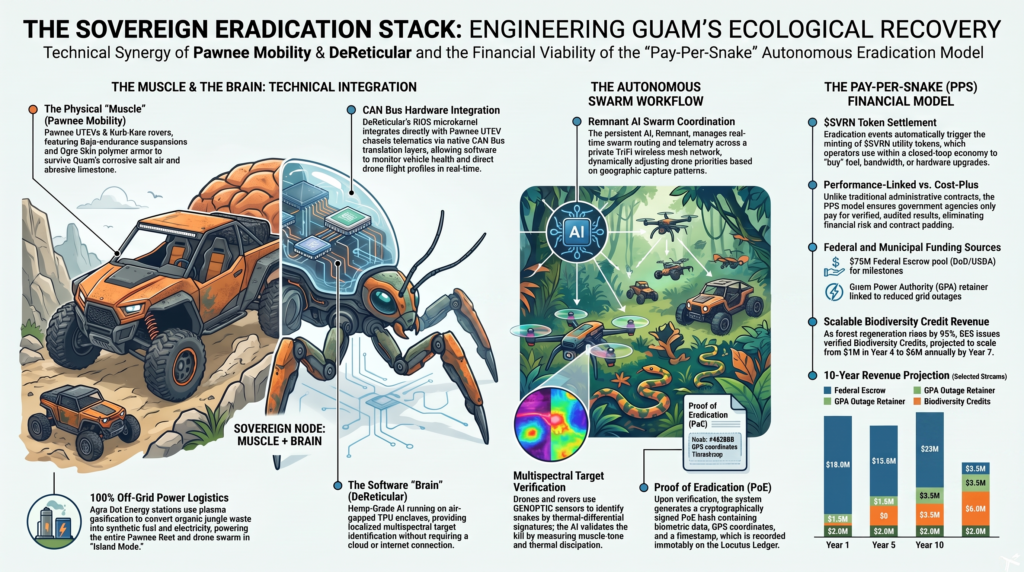
The Sovereign Stack is a two-layer technological framework designed for “Island Mode”—operating with complete independence from global cloud infrastructure. This system represents the convergence of heavy-duty physical chassis and localized edge computing.
Layer Component Core Function/Role
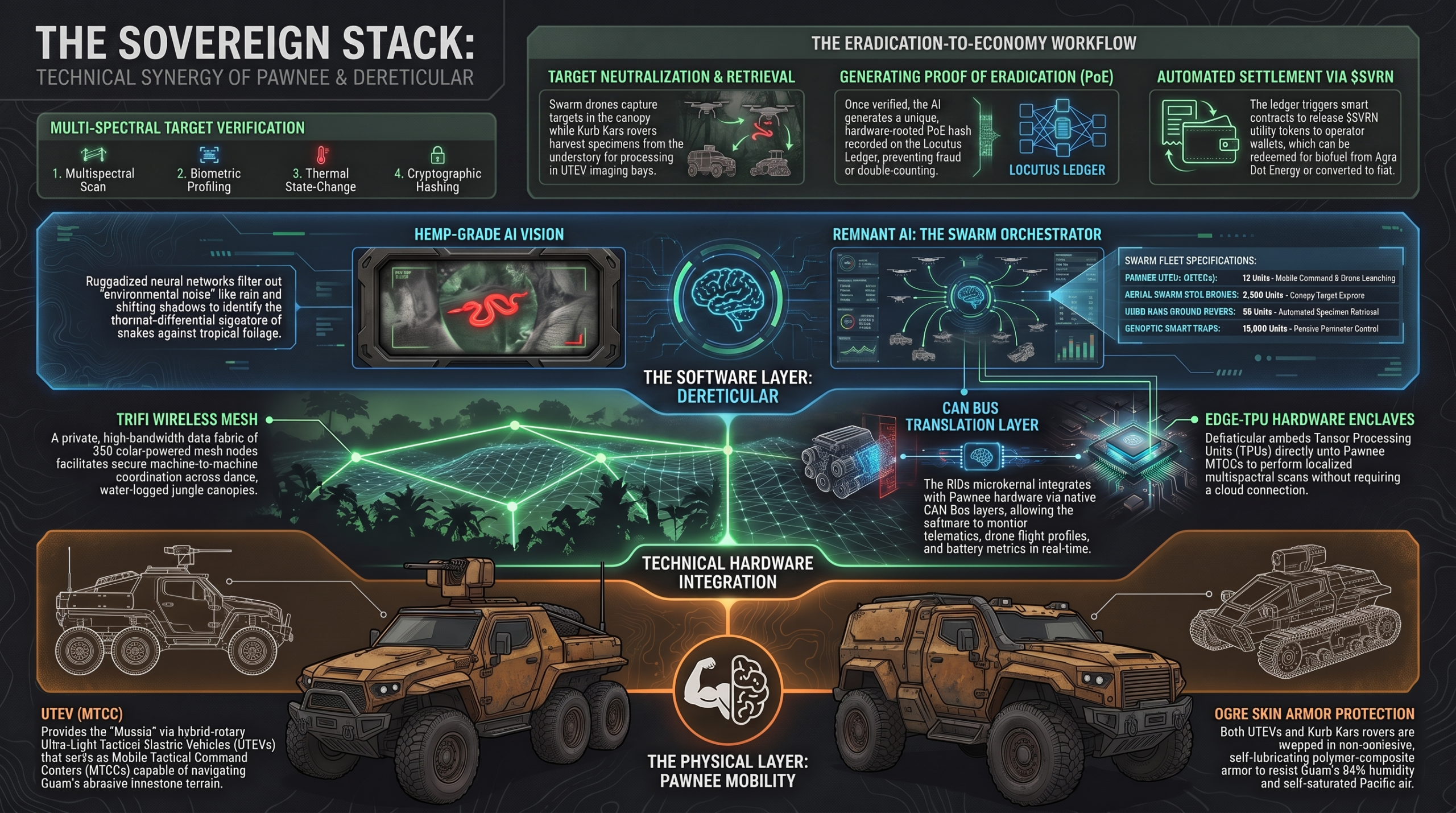
Physical Mechanical Layer (The “Muscle”) Tactical hardware (UTEVs, Kurb Kars, Drones) protected by Ogre Skin armor to navigate abrasive limestone.
Edge Computing & Software Layer (The “Brain”) The RIOS Microkernel, Hemp-Grade AI, and Locutus Ledger. Natively communicating via CAN Bus translation layers to govern telematics and target identification.
For this system to survive Guam’s harsh interior, the “Muscle” must be as rugged as the “Brain” is smart; sophisticated software is useless if the hardware it inhabits is dissolved by salt spray or shredded by volcanic rock.
- The Physical Mechanical Layer: The “Muscle” in the Jungle
The Sovereign Stack utilizes three primary hardware assets to penetrate the roadless wilderness:
- Pawnee UTEVs (Ultra-Light Tactical Electric Vehicles): These range-extended hybrid platforms serve as Mobile Tactical Command Centers (MTCCs).
- Primary Benefit: Equipped with a Baja-inspired suspension and Ogre Skin armor—a self-lubricating, non-corrosive polymer—they can traverse jagged limestone that acts like industrial sandpaper on standard vehicle hulls.
- Kurb Kars Autonomous Ground Vehicles: Rugged, low-signature rovers that sweep the understory for specimen retrieval.
- Primary Benefit: Fitted with Ogre Skin impact armor to withstand dense canopy branches while feeding specimens into integrated biometric imaging bays.
- GENOPTIC Drones: Low-altitude, vertical take-off and landing (VTOL) units equipped with mechanical pick-up mechanisms.
- Primary Benefit: These swarms navigate the upper canopy, identifying targets amidst shifting shadows where human search teams cannot reach.
These physical machines stay powered in roadless wilderness by utilizing mobile Agra Dot Energy stations, which utilize localized plasma gasification to convert jungle biomass, discarded tires, and municipal waste into synthetic fuel and off-grid electricity.
- The Edge Computing Layer: The “Brain” in “Island Mode”
The “Brain” of the stack is designed to think and act locally. In “Island Mode,” the system operates air-gapped from the public cloud, relying on the RIOS microkernel and localized Tensor Processing Units (TPUs).
Named for the extreme tensile strength and resilience of industrial hemp, Hemp-Grade AI is a ruggedized, edge-native neural architecture. It is specifically engineered to operate in severe field conditions, utilizing neural filters to ignore “environmental noise”—such as heavy tropical rain, wet foliage, and shifting canopy shadows—ensuring high-precision target detection in total darkness.
This localized intelligence moves beyond sensing to create a permanent, un-spoofable record of success, anchored by hardware-rooted TPM chips that sign data at the source.
- The Proof of Eradication (PoE) Workflow
To ensure financial transparency, the Hemp-Grade AI executes a hardware-anchored four-step verification process for every capture:
- Multi-Spectral Scan ──> Captures thermal, near-infrared, and visible-spectrum imagery to detect the snake’s heat signature against rain-cooled leaves.
- Biometric Profiling ──> Measures length, volume, and weight, while analyzing unique lateral scale patterns.
- State Verification ──> Monitors active thermal dissipation and muscle tone to confirm the specimen is newly neutralized and organic.
- Cryptographic Hashing ──> Generates a Proof of Eradication (PoE). This unique digital certificate is signed by hardware-rooted TPM (Trusted Platform Module) chips at the lens level.
By signing the video stream at the hardware root, the Locutus Ledger prevents “double-counting,” identity spoofing, or deepfakes from being submitted for bounties. This verified data is the “currency” that drives the project’s unique economy.
- The “Pay-Per-Snake” (PPS) Economy & $SVRN Tokens
The Sovereign Stack replaces traditional “cost-plus” contracts with a performance-driven, closed-loop economy. Capital is held in a Federal Escrow pool managed by InVentures, and payouts in $SVRN tokens are only triggered when a PoE is committed to the ledger.
Traditional Model Sovereign PPS Model
Administrative “cost-plus” fees. Performance-linked payouts ($SVRN).
High overhead and delayed reviews. Instant, automated audit via blockchain.
Pays for labor, not necessarily outcomes. Pays exclusively for verified eradications.
Reliant on third-party banking. Closed-loop economy: Tokens recycled for fuel, bandwidth, and repairs.
This economic shift ensures that $SVRN tokens are recycled within the cohort—field operators use tokens to pay Agra Dot for synthetic fuel and TriFi for network bandwidth, creating a self-sustaining financial loop.
- Beyond Eradication: The Return of the Birds and Global Export
The ultimate mission is the total reclamation of Guam’s ecosystem. As the snake population is suppressed, we project a 92% increase in tree recruitment, allowing the forest canopy to regenerate. This measurable lift generates “Guam Biodiversity Credits,” which are used to buy back and retire $SVRN tokens, cementing the project’s long-term viability.
Future Outlook
The Sovereign Stack is a repeatable blueprint for global conservation. We are currently preparing to export this architecture to secure biosecurity firewalls in the following areas:
- Hawaii & the Galápagos: Protecting endemic bird species from invasive predators through autonomous canopy surveillance.
- Pacific Region Feral Swine Control: Retraining the Hemp-Grade AI to manage feral swine and rodent populations that damage native soil and flora.
- Global Transport Hubs: Deploying the stack at international ports to identify and neutralize invasive species before they colonize new territories.