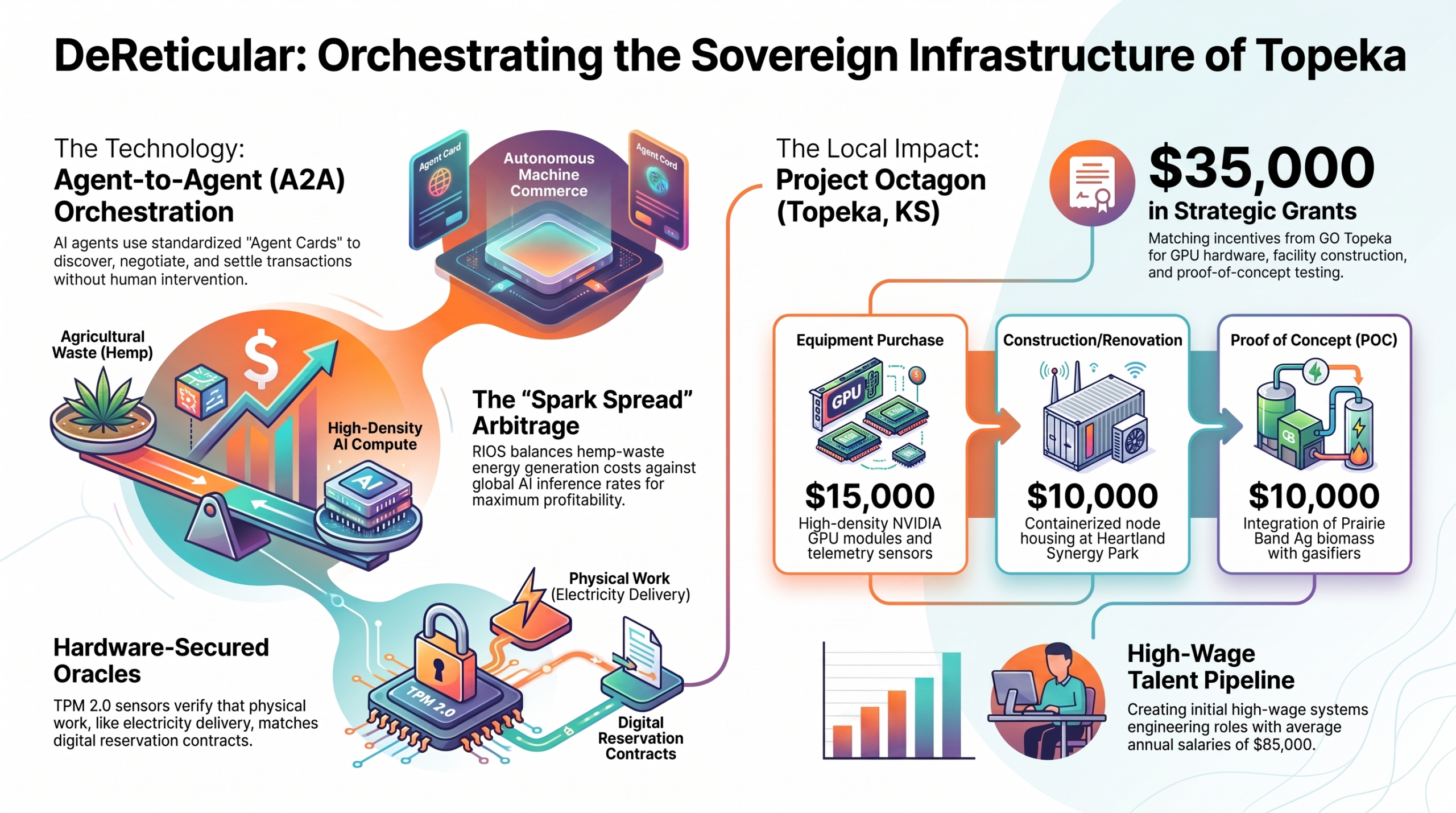
Topeka Small Business Incentive Application Architectural Specification: RIOS Integration of Agent-to-Agent (A2A) Reservation Protocols
- Architectural Vision and System Scope
The prevailing industrial paradigm is undergoing a fundamental strategic shift, moving away from centralized “linear” infrastructure—hampered by the multi-year grid interconnection bottlenecks known as the “Permitting Wall”—toward a model of “Spherical Resilience.” In this decentralized framework, the Rural Infrastructure Operating System (RIOS) serves as the definitive authority for autonomous machine-to-machine (M2M) commerce. RIOS functions as an AI-native operating system that orchestrates localized infrastructure, bridging the gap between clean energy generation, high-performance edge compute, and autonomous mobility.
podcast
The primary objective of this specification is to formalize the integration of Agent-to-Agent (A2A) protocols into RIOS, enabling off-grid infrastructure nodes to operate as self-funding, autonomous economic units. By standardizing how machines discover, negotiate, and settle transactions, RIOS-managed assets—such as microgrids and GPU clusters—can function as independent market participants. This document provides the technical decomposition of the communication and settlement layers required to achieve this vision of autonomous industrial orchestration.
- The Five-Layer Settlement Stack
A layered architectural approach is critical for decentralized environments, as it separates the low-level transport hardware from the high-level economic negotiation and settlement logic. This modularity ensures that the physical assets remain resilient while allowing the software orchestration layer to adapt to shifting market dynamics without hardware reconfiguration.
The Five-Layer A2A Settlement Stack
Layer Name Primary Protocols/Standards Functional Description
5 Settlement & Escrow x402 (HTTP 402), ERC-8183, FET Manages machine-readable contract states (Open, Funded, Completed, Expired) and automated micro-payments.
4 Negotiation & Contracts Bayesian Utility, ERC-8004 Facilitates dynamic utility functions and identity verification for complex contract terms.
3 Inter-Agent Protocol Agent Cards, Tasks (/.well-known/agent.json) Standardizes peer-to-peer discovery, task delegation, and artifact passing between independent agents.
2 Tool Connectivity Model Context Protocol (MCP) Provides the vertical binding between individual AI agents and their local tools, APIs, and databases.
1 Transport & Hardware HTTPS, JSON-RPC, Sysbox, TPM 2.0 The foundational layer for secure communication, containerized orchestration, and hardware-secured data.
Strategic Impact of Protocol Differentiators
The integration of these protocols defines the competitive landscape for DeReticular and the broader sovereign infrastructure movement:
- Model Context Protocol (MCP): Developed by Anthropic, this protocol acts as a 1-to-1 vertical binding. It connects a specific LLM agent to its local tools and databases, ensuring the agent can interact with its immediate environment.
- Agent-to-Agent (A2A): This Google open standard provides the horizontal peer collaboration layer. It standardizes how independent agents from different vendors discover one another and delegate tasks across a network.
- Autonomous Economic Agents (AEA): Championed by the Fetch.ai / ASI Alliance, this framework enables a multi-agent open market ecosystem. It allows for high-level market discovery and value exchange via decentralized economic primitives.
- ERC-8183 / x402: These Ethereum/Web3 community standards provide the machine-readable contract state primitives (Open, Funded, Submitted, Completed, Expired) and the mechanism for cryptographic escrow and micro-payments.
These layers ensure that agents transition from simple tool utilization to functional discovery of complex inter-node capabilities.
- Agent Discovery and the Standardized Identity Layer
For autonomous node scaling to reach global utility, a standardized discovery mechanism is mandatory. In a decentralized mesh, identity and capability must be programmatically discoverable to enable real-time resource allocation.
The Agent Card (/.well-known/agent.json)
RIOS compliance requires every node to publish an “Agent Card” at a standardized GET endpoint. This card serves as the node’s public identity and service catalog. The following fields are mandatory:
- Identity: The unique identifier and cryptographic signature of the agent.
- Capabilities: A detailed list of services provided (e.g., energy generation, GPU inference, biomass processing).
- Endpoints: The technical URI where other agents can post Tasks or initiate negotiations.
- Pricing Terms: The base rates or dynamic pricing models for the advertised capabilities.
External AI agents, such as enterprise cloud schedulers or regional utilities, interact with the RIOS Host and Registry to identify available capacity and initiate transactions. Once an asset is discovered, the interaction moves into a strict state machine governing the reservation of the physical resource.
- The Core Reservation Lifecycle and State Machine
To maintain operational integrity and prevent the “double-spending” of physical assets—ensuring a single kilowatt-hour of energy or GPU hour is not sold to two separate counterparties—RIOS employs a rigorous state machine.
The Five-Stage Reservation Lifecycle
- Discovery: The requesting agent identifies a provider via the Agent Card.
- Task Delegation: The client agent posts a Task. The system enforces strict state transitions: Submitted → Working → Completed/Failed/Expired.
- Escrow & Capacity Reservation: The client agent locks funds in an escrow primitive (ERC-8183, x402, or FET). Simultaneously, the provider agent locks physical capacity.
- Execution & Artifact Delivery: The receiving agent executes the reservation and issues a cryptographically signed proof of completion to the caller.
- Inter-Agent Price Negotiation Logic: Internal models are iteratively updated through message exchanges, adjusting utility functions for future tasks based on time decay and outcomes.
The “Atomic Lock”: Operational Security for Off-Grid Hardware
The transition from “Submitted” to “Working” is the cornerstone of RIOS security. This represents an Atomic Lock, where physical capacity (kWh or compute cycles) and digital escrow are secured simultaneously. By locking the physical hardware at the exact moment the digital funds are escrowed, RIOS prevents resource exhaustion and financial default, ensuring that off-grid nodes remain solvent and operational. These negotiated terms, however, rely on a logic that prioritizes the highest margin outcomes for the node.
- Autonomous “Spark Spread” & Bayesian Negotiation Logic
A primary economic driver for RIOS is the “Spark Spread”—the real-time arbitrage between the cost of energy generation and the market demand for edge compute.
Bayesian Utility Negotiating Agents
RIOS agents utilize Bayesian Utility Negotiating architectures rather than static pricing. Agents maintain probability distributions over counterparty prices, updating their models with every message exchange based on:
- Time Decay: The increasing urgency as a reservation window approaches.
- Local Inventory: Current levels of energy storage, compute availability, and biochar (a high-value byproduct of the plasma gasification process).
- Demand: Local grid fluctuations versus global AI inference rates.
Zero-Knowledge Constraint Verification
To protect proprietary business rules and internal costs, RIOS utilizes Zero-Knowledge Constraint Verification. This allows agents to prove they possess the necessary capital or physical capacity to fulfill a contract without revealing the underlying algorithms or algorithms that define their competitive edge.
The Spark Spread Decision Tree: Agra Energy vs. Edge Compute
The interaction between an Agra Energy Agent (Gasifier) and an Edge Compute Agent (GPU Cluster) follows this logic:
- Scenario A (High Compute Demand): If global inference rates are high, the Compute Agent reserves 100% of the gasifier’s energy. The Agra Energy Agent calculates the combined value of energy sales plus the sale of biochar byproducts to optimize the total margin.
- Scenario B (Low Compute Demand): If compute rates drop, the system negotiates the sale of power back to regional microgrids or adjacent industrial facilities, while still maximizing biochar output for agricultural partners.
However, these negotiated terms are only as reliable as the data that triggers them, necessitating the hardware-secured oracles detailed in the next section.
- Hardware-Secured Oracles and TPM 2.0 Settlement
Digital contracts must be grounded in physical reality to maintain trust in an autonomous system. RIOS achieves this by utilizing TPM 2.0 Hardware-Secured Oracles to validate that work has actually been performed.
The settlement workflow is governed by physical verification:
- Physical Execution: Hardware sensors measure the electricity delivered or compute cycles consumed.
- Cryptographic Signing: These sensors provide data signed by the TPM 2.0 module, proving the data has not been tampered with.
- State Completion: This signature triggers the A2A state machine to transition to “Completed.”
- Escrow Release: Only upon hardware-verified completion are funds released from the ERC-8183/FET escrow to the node’s treasury.
This hardware-secured verification is vital for autonomous agricultural supply chains. Whether a Kurb Kar is reserving a charging slot or a hemp processing plant is managing intake slots, the physical performance is indisputable. This ensures a high-trust environment where the digital state of the contract always reflects the physical state of the hardware.
- Implementation Roadmap and Regional Node Deployment
The deployment of this architecture follows an iterative path, scaling from localized laboratory environments to a global mesh network of sovereign nodes under Project Octagon.
Strategic Implementation Roadmap
- Phase 1: RIOS A2A Endpoint Specifications: Deployment of standard Agent Cards (/.well-known/agent.json) across all nodes to enable universal discovery.
- Phase 2: Bayesian “Spark Spread” Agent Development: Engineering agents capable of dynamic negotiation, incorporating biochar byproducts and energy-to-compute arbitrage.
- Phase 3: On-Chain Settlement Primitive Integration: Full integration of x402 and ERC-8183 for automated, cryptographically signed escrow and payments.
- Phase 4: Live Demonstration at Project Octagon Node 3 (Topeka, KS): A full-scale proof-of-concept demonstrating autonomous energy and compute arbitrage at the Heartland Synergy Park.
Topeka Node 3 Site Requirements
The Node 3 deployment at Heartland Synergy Park / Forbes Field requires specific hardware to facilitate A2A operations:
- Compute: High-density NVIDIA H100/L40S GPU edge compute clusters.
- Energy: Plasma gasifiers utilizing industrial hemp hurd biomass from Prairie Band Agriculture.
- Telemetry: IoT microgrid telemetry sensors for real-time hardware-secured data feeds.
- Infrastructure: Secure containerized housing with isolation wiring and thermal ducting.
This roadmap establishes the foundation for a future where autonomous inter-node load balancing occurs across global time zones, ensuring that infrastructure remains resilient, self-funding, and entirely independent of centralized grid failures.