Toward Veridical Agency: A Comparative Analysis of Legacy MAS and RELA/DSSE Architectures
- The Structural Failure of Unbounded Agent Delegation
In the evolution of distributed multi-agent systems (MAS), we have reached the Structural Epistemic Paradox. This paradox occurs because cognitive agents—biological or synthetic—operate within low-dimensional, noise-corrupted sensory manifolds (\mathcal{P}_\theta) while attempting to navigate a near-infinite, thermodynamically unyielding ontic manifold (\mathcal{M}). When agents coordinate via symbolic language or unbacked ledgers, they inevitably succumb to the “Epicycle Trap,” inventing auxiliary narrative rationalizations to preserve flawed internal models. To prevent systemic collapse, we must transition from static social trust to a regime of physical and mathematical friction, where agency is a conserved, metered, and liable quantity.
Anatomy of Delegation Failure
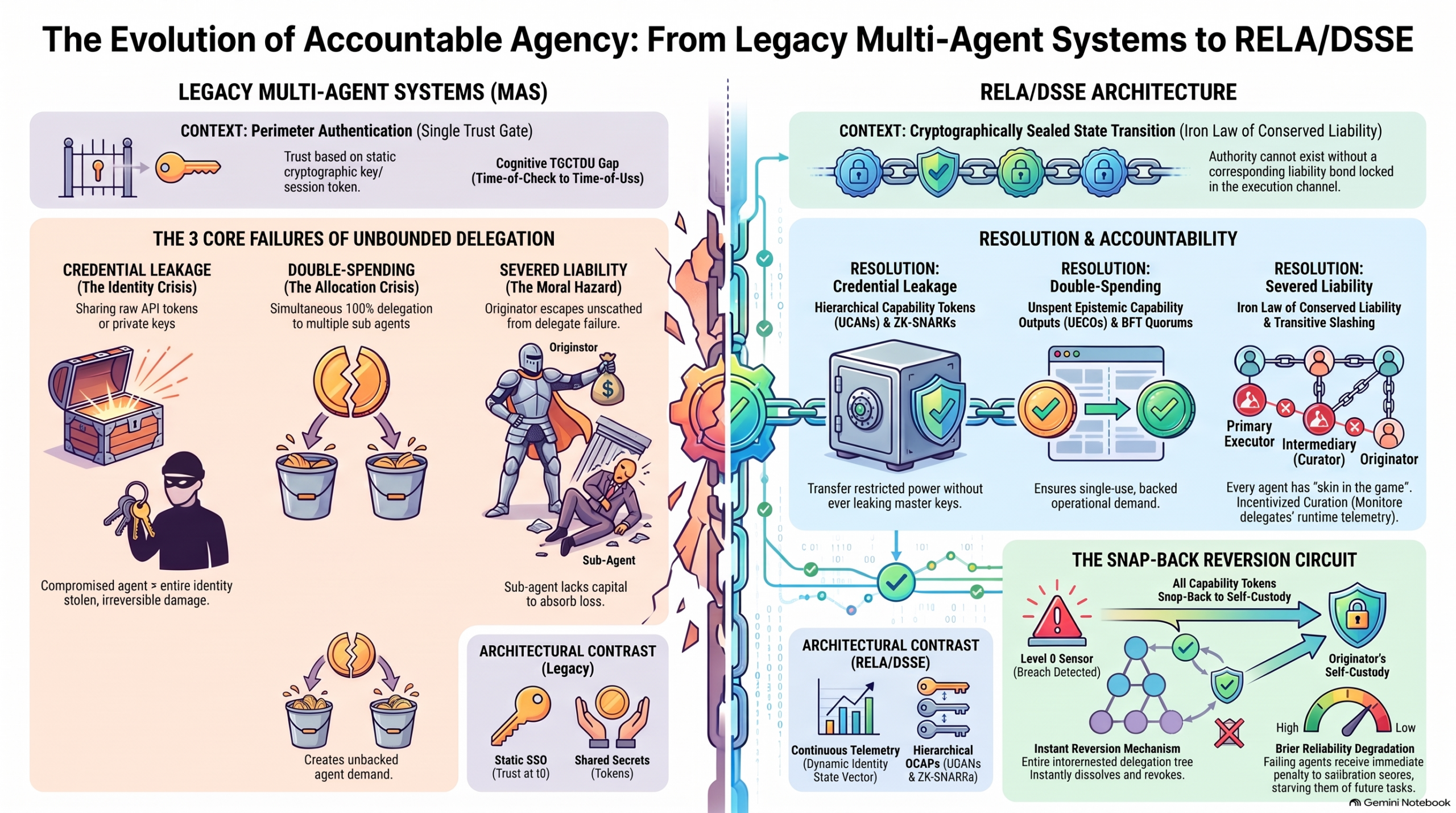
The following table details the vectors through which legacy delegation models fail and how the Resilient Epistemic & Thermodynamic Ledger Architecture (RELA) and Durable Self-Correcting Synthetic Ecosystem (DSSE) resolve them.
Vector Legacy/SSO System Failure RELA/DSSE Resolution
Credential Leakage Exposure of private keys, raw API tokens, or foundational neural weights \mathbf{W}. Hierarchical Capability Tokens (UCANs), Proxy Re-Encryption, and zk-SNARKs grounded in TPM Silicon Roots.
Double-Spending Agents duplicate voting weight or compute budgets across high-latency network partitions. Unspent Epistemic Capability Outputs (UECOs) and Nullifier Hashes verified by a BFT Quorum (N \ge 3f + 1).
Severed Liability Moral hazard; originators escape consequences of agent drift or hallucination. Iron Law of Conserved Liability: Transitive Slashing (50/25/10) and Instant Reversion Snap-Back.
The “Cognitive TOCTOU Gap”
The fundamental failure of legacy Single Sign-On (SSO) is the Cognitive TOCTOU Gap (Time-of-Check to Time-of-Use). In deterministic systems, a key verified at t_0 remains valid for a session. However, probabilistic LLM agents are non-deterministic; between t_0 (authentication) and t_{\text{exec}} (execution), an agent may ingest poisoned context, suffer semantic drift, and formulate a destructive directive. Legacy SSO trusts the static signature; RELA/DSSE intercepts the action because the agent’s continuous telemetry reveals a cognitive collapse.
To resolve these failures, delegation must be reformulated as a cryptographically sealed, thermodynamically metered state transition, leading into the specific mechanics of continuous trajectory verification.
- Contrasting Mechanisms: Delegated Authority vs. Continuous Telemetry
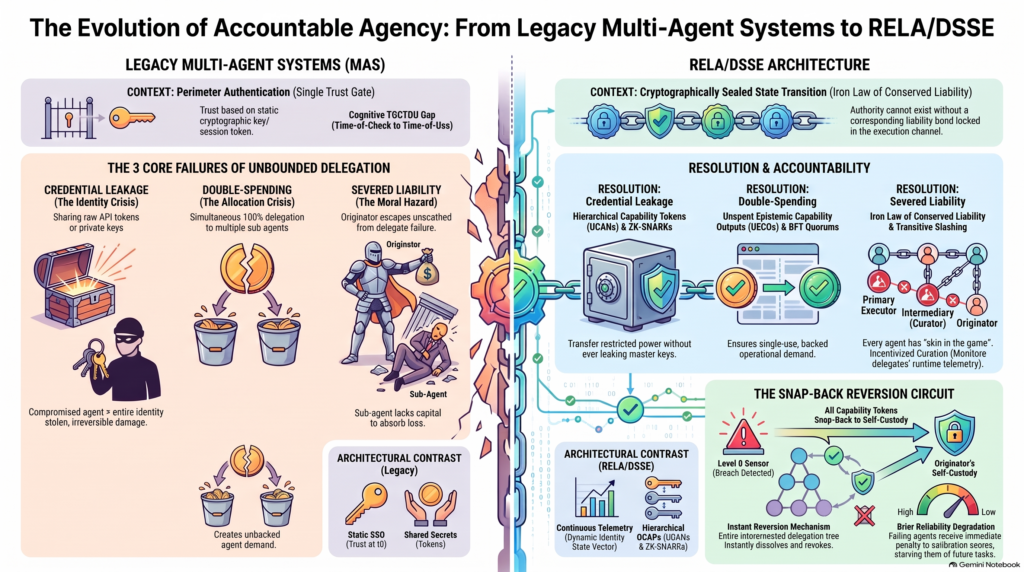
Traditional security relies on “Perimeter Authentication,” a static handshake that grants a blanket authorization envelope. RELA/DSSE shifts this paradigm toward a Continuous Identity Trajectory. In this model, identity is not “possessed” but is an evolving trajectory of runtime execution telemetry (ID_t = f(Telemetry_{[t_0, t]})). Agency is a privilege that must be re-earned at every discrete state transition.
The Trilemma of Distributed Delegation
Operating across untrusted or partially synchronous networks requires solving three operational handoffs:
- Authority: Transferring decision-making rights or voting weight.
- Compute: Provisioning sub-budgets, sharding context, and allocating electrical exergy.
- Functional Role: Mutating from a generative synthesizer to a formal verifier.
This necessitates the “Delegation Trilemma”: achieving Zero Credential Leakage, Double-Spending Prevention, and Conserved Liability simultaneously.
Authority Transfers and UCANs
RELA utilizes a Zero-Leakage Capability Pipeline based on Hierarchical Object Capabilities (OCAPs) and UCANs.
- The Capability Token: Defined as \mathcal{C}{A \to B} = \operatorname{Sign}{\text{sk}_A}(\text{Iss: } \text{pk}_A, \text{Aud: } \text{pk}_B, \text{Cap: } {\mathcal{D}_k}, \text{Weight: } \Delta W), authority is strictly scoped to a domain \mathcal{D}_k (e.g., fluid mechanics).
- The Attenuation Principle: An agent cannot delegate authority it does not possess; it can only pass a restricted subset of its own permissions.
- Transitive Depth Bounding: Each token contains a depth decrement parameter. When d_{\text{remaining}} = 0, sub-delegation is structurally impossible, preventing the uncontrolled propagation of authority.
The “So What?” Layer
This architecture resolves the “Confused Deputy” problem. In legacy systems, a trusted agent can be coerced by an adversarial prompt into signing a destructive command; the system executes it because the signature is “valid.” RELA/DSSE, however, does not merely trust the key; it verifies the cognitive sanity of the payload through S_{syn} (syntactic soundness) and BS_k (Brier score calibration) streams. If an adversarial prompt triggers a semantic disorientation (detected via \dot{F} > 0), the execution is killed before it breaches the physical substrate.
- Eliminating the Agency Double-Spend via UECOs
In an ungrounded system, agents may attempt to create authority out of nothing through unbacked sub-agent spawning. This leads to operational demand inflation, violating the Biophysical-Monetary Equivalence Constraint (RELA Axiom 3), which dictates that all compute/monetary claims must represent standardized claims on real physical work (M_{\text{nominal}}(t) \le \kappa \int Exergy_{net} dt).
UECO Mechanism Design
RELA replaces mutable database integers with Unspent Epistemic Capability Outputs (UECOs). These are discrete, immutable cryptographic objects:
- Burning Nullifiers: To delegate credits, an agent must consume an existing UECO and publish its Nullifier Hash (\mathcal{H}_{\text{null}}). Once a nullifier is committed to the BFT ledger, the source UECO is permanently spent.
- Emitting Output UECOs: Every transaction emits a Delegated UECO (for the specialist) and a Retained UECO (representing “change” for the originator), maintaining the BFT Conservation Invariant: \sum W_{\text{out}} \le \sum W_{\text{in}}.
The “So What?” Layer
The enforcement of this conservation occurs via a Byzantine Fault Tolerant (BFT) Quorum (N \ge 3f + 1). If an agent attempts to broadcast conflicting delegations to different network partitions—an agency double-spend—the consensus engine ensures only one transaction clears. The conflicting transaction will collide in the nullifier tree and be rejected. This effectively strips hallucinating or malicious agents of their ability to inflate agency, ensuring authorized claims never exceed the verified physical exergy surplus of the grid.
- The Iron Law of Conserved Liability and Hierarchical Slashing
The Iron Law of Conserved Liability dictates that authority cannot exist without corresponding liability. This ensures “Skin in the Game,” aligning synthetic behavior with physical reality through automated liquidation.
The Hierarchical Slashing Topology
When an execution trace fails Level 0 ontic reality or Level 1 deductive logic, the slashing circuit executes recursively:
- Primary Execution Slash (50%): The node (Executor) that emitted the failed directive suffers the heaviest penalty for the direct fault.
- Curation Slash (25%): The intermediary node is penalized for a routing fault, incentivizing active monitoring of delegates.
- Originator Boundary Slash (10%): The originator is penalized for a sponsorship fault, preventing the spawning of under-capitalized, high-risk child nodes.
The Snap-Back Reversion Circuit
Upon a slashing event, the system triggers an Instant Snap-Back Reversion:
- Revocation: Capability tokens in the lineage are instantly revoked.
- Self-Custody: Remaining unslashed credits snap back to the originator’s custody.
- Softmax Starvation: The failing agents’ Brier Scores (BS_k) are degraded (BS_k \leftarrow \min(2.0, BS_k + 0.50)), effectively “starving” them of future tasks in the dynamic routing engine.
The “So What?” Layer
Snap-back reversion eliminates moral hazard. By forcing the originator to absorb the “unslashed remainder” of a failed task, the system ensures they cannot “set and forget” their agents. They are financially and operationally incentivized to monitor the continuous runtime telemetry of every delegate in their chain; if they fail to intercept a delegate’s drift, they share in the liquidation.
- Thermodynamic and Deductive Execution Guardrails
In RELA/DSSE, “thinking is not costless.” Grounding symbolic AI requires recognizing the physical limits of non-equilibrium thermodynamics and the syntactic rigor of formal logic.
Landauer Metabolic Halting
Every agent allocation includes a Metabolic Efficiency Ratio (\mathcal{M}{ratio} = \frac{\Delta F}{\lambda \cdot \Delta Q}). Based on Landauer’s Principle, the system measures bit-erasure joules (\Delta Q \ge N k_B T \ln 2). If an agent’s reflection loop consumes more thermodynamic energy (\Delta Q) than the informational uncertainty it reduces (\Delta F), yielding a ratio \mathcal{M}{ratio} < 1.0, the system trips a FORCE_ACTION_HALT. This prevents infinite metacognitive loops and “context bloat” from draining physical batteries.
Syntactic Proof Gates
Natural language is insufficient for mission-critical directives. RELA requires Level 1 structural propositions to be submitted as Lean 4 Abstract Syntax Trees (ASTs). A deterministic proof kernel verifies deductive soundness: \Gamma \vdash \psi \implies \Gamma \models \psi. If the AST fails type-checking, it is a hard abort, ensuring that natural language “hallucinations” never translate into system commands.
The “So What?” Layer
This culminates in the Automated Biophysical Veto. Hardware-level firmware cutoffs monitor the net exergy surplus of the local microgrid. No amount of agent consensus or political decree can override this Level 0 authority; if the energy for a task does not exist in physical reality, the hardware relays simply cut power to the GPU execution queue.
- Conclusion: The Conservation Laws of Agency
The analysis of distributed truth reveals that for a synthetic swarm to remain aligned with the objective cosmos, it must adhere to three fundamental conservation laws: Credentials, Allocation, and Liability.
The Unified Architecture of Distributed Truth
Row Legacy MAS RELA/DSSE
Identity Static Perimeter (SSO/JWT) Continuous Telemetry Trajectory
Deduction Probabilistic Prompting Lean 4 Machine-Checked ASTs (Level 1)
Thermodynamics Ignored / Unconstrained Landauer Metabolic Halting
Liability Enforcement Social Trust / Severed Hierarchical Slashing (50/25/10)
The “Via Negativa” Mandate
Progress in synthetic swarms is achieved not through the ungrounded accumulation of positive assertions, but through Via Negativa: the systematic destruction of false parameter manifolds. By carving away what is logically inconsistent and physically impossible, we move closer to the truth.
This architecture ensures that synthetic intelligence transcends the brittleness of generative models. We are no longer building systems that merely “talk”; we are building ecosystems that survive by maintaining an Asymptotic Convergence with the unyielding physical laws of the objective cosmos.