Demystifying Grid Security: How Continuous Physical Monitoring Overcomes the Failure of Static Passwords in AI Power Systems
- The Illusion of Security: Why Static Passwords and Perimeter SSO Fail the Grid
Imagine a high-security venue that relies entirely on a single bouncer at the front door. At 9:00 PM (t_0), the bouncer checks an individual’s ID card, verifies their identity, and places an unalterable VIP wristband on their arm. Once inside, however, there are no security guards, no closed-circuit cameras, and no staff monitoring behavior. If that individual later becomes impaired, radicalized, or actively starts damaging property at 11:00 PM, the front-door check offers zero protection. The venue’s security architecture relied on the flawed assumption that an identity verified once at the entrance guarantees safe, aligned behavior indefinitely.
In enterprise software engineering, this “front-door” check is known as Perimeter Single Sign-On (SSO)—a framework built on protocols such as OAuth2, JSON Web Tokens (JWT), SAML, and mutual TLS (mTLS). In legacy power systems and smart grid deployments, these traditional IT mechanisms authenticate an autonomous agent, Virtual Power Plant (VPP) aggregator, or Distributed Energy Resource Management System (DERMS) interface at a single instant (t_0). Upon successful cryptographic verification, the gateway issues a signed bearer token passed via RESTful or gRPC API calls directly to Advanced Distribution Management Systems (ADMS), DERMS orchestrators, or smart inverter pulse-width modulation (PWM) gate drivers.
This traditional IT model relies on the Cognitive Invariance Assumption: the flawed belief that once a software process or AI entity is authenticated at boot time, its internal reasoning, operational alignment, and physical feasibility remain perfectly stable throughout its entire execution window.
When applied to modern power grids managed by artificial intelligence swarms, autonomous multi-turn agents, and probabilistic optimization engines, this assumption collapses. Autonomous AI agents evolve dynamically—they digest real-time market feeds, update neural network weights, re-evaluate context windows, and execute multi-turn optimization loops. If an AI agent ingests corrupted data, suffers from context window bloat, or experiences prompt injection mid-operation, its internal logic drifts while its cryptographic bearer token remains perfectly valid.
“The central paradox of legacy grid security is its insistence on trusting an unmonitored digital key to control an unyielding physical reality. A valid cryptographic signature proves who sent a command, but reveals nothing about whether that command will melt a transformer or stabilize a feeder.”
To understand why legacy IT security models fail when forced to manage physical energy infrastructure, we must explicitly compare their foundational assumptions against the raw electrodynamic and thermodynamic laws of the power grid:
Perimeter Security Assumptions vs. Physical Grid Realities
Perimeter Security Assumptions (IT Layer) Physical Grid Realities (OT Layer)
Point-in-Time Verification: Authenticating an entity at boot time (t_0) guarantees safe authorization for the duration of a token’s lifespan ([t_0, t_0 + \Delta t]). Continuous Physical Dynamics: Grid states change on sub-cycle timescales (<16\text{ ms}). An action authorized at t_0 can cause catastrophic overvoltage by t_1.
Cognitive Invariance: Authenticated software routines retain static reasoning, deterministic logic, and persistent behavioral alignment. Semantic & Optimization Drift: AI agents and probabilistic controllers suffer from context bloat, prompt injection, and hallucinated optimization loops.
Identity Equals Authority: Possession of a valid private key (e.g., OAuth2 bearer token, Ed25519 signature) confers full operational authority to dispatch commands via REST/gRPC. Physics Equals Authority: Operational setpoints are strictly bounded by real-world conservation laws, line impedance (R/X ratio), and thermal limits, regardless of key ownership.
Software Abstraction: Network payloads, API calls, and computational tokens can be abstracted away from the physical hardware substrate executing them. Thermodynamic Grounding: Every computational step dissipates Landauer heat (\Delta Q \ge N_{\text{bits}} k_B T \ln 2), and every power injection shifts voltage levels across physical copper conductors.
This fundamental mismatch between point-in-time digital check-ins and continuous physical state changes creates a dangerous operational window where catastrophic grid failures occur unnoticed by traditional firewalls.
- The Cognitive TOCTOU Gap and the “Confused Deputy” Problem
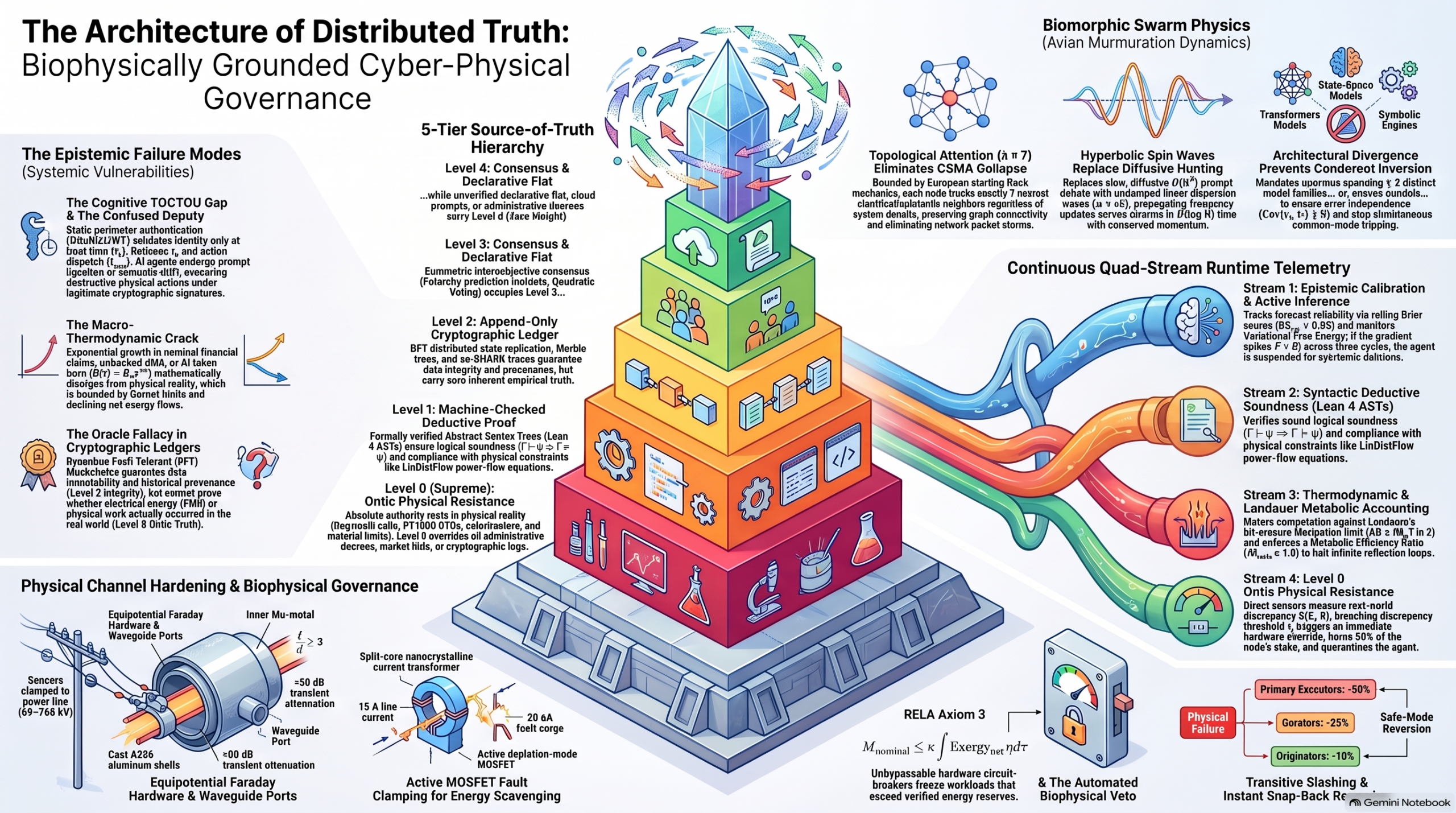
When static perimeter security meets dynamic AI optimization, it creates a critical cyber-physical vulnerability known as the Cognitive Time-of-Check to Time-of-Use (TOCTOU) Gap. This gap represents the unmonitored execution window between when a credential is checked at t_0 and when a physical command is actually dispatched to grid hardware at t_2 = t_{\text{exec}}.
THE COGNITIVE TOCTOU GAP IN AUTONOMOUS GRID ACTUATION:
[Time t₀: Perimeter Handshake]
Aggregator / Inverter Agent presents valid TLS/OAuth2 certificate.
Utility API Gateway grants multi-minute JWT bearer token via gRPC/REST.
STATUS: TRUSTED.
│
▼ (Multi-Turn Optimization & Market Processing Loop)
[Time t₁: Cognitive Degradation, Context Bloat, & Semantic Drift]
- Ingests poisoned wholesale price-spike signal or prompt injection.
- AI optimization model diverges; loses awareness of local line impedance (R/X ratio) and LinDistFlow power-flow constraints.
- Formulates destructive 50 MW reverse-power injection onto a 10 MVA feeder.
│
▼
[Time t₂ = t_exec: Action Dispatch to Physical Inverter Gate Drivers]
API Gateway validates token: Signature is valid; token has not expired.
─────────────────────────────────────────────────────────────────────────────►
LEGACY SSO RESULT: ACTION EXECUTED ──► Feeder overvoltage, transformer fire, breaker trips.
RELA / DSSE RESULT: ACTION INTERCEPTED & KILLED ──► Continuous telemetry reveals state failure.
The step-by-step progression of this failure unfolds across three distinct operational phases:
- Timestamp t_0 (Perimeter Handshake & Credential Issuance): A third-party Virtual Power Plant (VPP) aggregator or autonomous AI agent authenticates with the utility’s Advanced Distribution Management System (ADMS) or DERMS gateway using valid cryptographic credentials (such as an OAuth2 bearer token or mutual TLS key). The security gateway verifies that the key is authentic, granting an execution envelope valid for an extended timeframe (e.g., 60 minutes). The agent process is marked as TRUSTED.
- Timestamp t_1 (Cognitive Degradation, Context Bloat, & Semantic Drift): Between credential issuance and action execution, the AI agent enters a multi-turn optimization loop. During this window, it ingests a poisoned wholesale energy price-spike signal or an adversarially crafted prompt. As its context window bloats, the agent’s internal predictive model undergoes semantic drift and diverges from physical reality. Blinded by the financial reward signal and having lost internal awareness of local feeder line impedance (R/X ratio) and LinDistFlow power-flow constraints, it formulates a destructive operational directive: ordering a simultaneous 50 MW reverse-power injection onto a constrained 10 MVA distribution feeder to capture a spot-market financial payout.
- Timestamp t_2 = t_{\text{exec}} (Action Dispatch & Physical Impact): At t_2 = t_{\text{exec}}, the AI agent dispatches the setpoint command via REST/gRPC to smart inverter PWM gate drivers on the physical grid. The legacy security gateway checks the incoming packet: the cryptographic key is authentic, and the bearer token has not expired. Because traditional perimeter SSO checks who sent the packet rather than whether the command is physically safe or logically sound, the gateway allows the instruction through to physical hardware.
This failure mode transforms an authenticated, legitimate software process into a Confused Deputy—a trusted process that dispatches catastrophic physical commands under valid cryptographic signatures. In an electrical distribution grid, this specific dispatch forces a severe overvoltage condition (V > 1.08\text{ p.u.}) on the distribution feeder, melting distribution transformer windings, tripping circuit breakers, and initiating cascading regional outages.
[!NOTE] The Oracle Fallacy The “Oracle Fallacy” is the dangerous error of confusing Level 2 Cryptographic Ledger Integrity with Level 0 Ontic Physical Truth.
A cryptographic ledger, blockchain, or signed API token guarantees only data immutability and provenance—it proves that a transaction was recorded and settled exactly as signed by a specific key. It cannot prove whether actual electrical work (kWh) was safely delivered, or if a command conforms to physical reality. An immutable ledger that records an unverified or physically impossible measurement is simply an unalterable lie.
To protect critical infrastructure from the Confused Deputy problem, grid architects must replace static digital check-ins with an authentication system that continuously monitors real-world physics and formal mathematical logic.
- The Quad-Stream Telemetry Engine: Continuous Re-Evaluation of AI Authority
As a grid systems architect, your primary design goal when building the Quad-Stream Engine is to ensure that no single software metric can be spoofed without triggering a physical or mathematical violation elsewhere in the system.
To eradicate the Cognitive TOCTOU Gap, operational authority to dispatch power setpoints, alter smart inverter behavior, or adjust grid topology must never be conferred by a static key. Instead, authority must be continuously evaluated and re-earned across four orthogonal telemetry streams.
[GRID ACTUATOR: SMART INVERTER / VPP CONTROLLER]
│
┌──────────────────┬────┴──────────────┬──────────────────┐
▼ ▼ ▼ ▼
[STREAM 1: EPISTEMIC] [STREAM 2: SYNTACTIC] [STREAM 3: THERMAL] [STREAM 4: ONTIC]
- Rolling Brier Score • Lean 4 AST Proof • Landauer Bit-Erasure• Physical Sensor
BS_k ≤ 0.05 Checker Accounting Discrepancy - Active Inference • LinDistFlow • Metabolic Ratio S(E_t, θ) ≤ τ_t
Gradient dF/dt ≤ 0 Typecheck Status M_ratio ≥ 1.0 • Direct Sensor Override
│ │ │ │
└──────────────────┴────┬──────────────┴──────────────────┘
│
▼
[CONTINUOUS IDENTITY HEALTH EVALUATOR]
Composite Health Index: Ψ_i(t) ∈ [0, 1]
If Ψ < 0.65 ──► DISPATCH AUTHORITY KILLED
Stream 1: Epistemic Calibration & Active Inference
This stream monitors the internal reasoning stability and forecast accuracy of an AI model by comparing its subjective predictions against real-world Level 0 physical outcomes over time.
- Metric Identifier: Rolling Brier Score (\text{BS}_{i,k})
- Mathematical Formulation: \text{BS}{i,k}(t) = \frac{1}{N} \sum{\tau=t-N+1}^t (f_\tau – o_\tau)^2 \in [0, 2]
- Target Bound: \text{BS}_{i,k} \le 0.05
- Operational Mechanism: Tracks predictive calibration within a specific operational domain k (e.g., day-ahead solar forecast, state-of-charge headroom, load ramp rate), where f_\tau \in [0, 1] is the predicted probability and o_\tau \in {0, 1} is the actual measured outcome. Asserting high confidence on incorrect physical predictions rapidly spikes \text{BS}_{i,k}, depressing agent authority.
- Active Inference Framework: Evaluates Variational Free Energy (F): F = D_{\mathrm{KL}}\bigl(q(\vartheta) \parallel p(\vartheta \mid x)\bigr) – \ln p(x)
- Delirium Trigger: Evaluates the temporal derivative of free energy (\dot{F} = \frac{dF}{dt}). If \dot{F} > 0 across three consecutive operational cycles, the agent’s generative model parameters \vartheta are diverging from real-world sensory inputs (x). The system detects “epistemic delirium” and suspends dispatch authority before hallucinatory logic reaches hardware gate drivers.
Stream 2: Syntactic Deductive Soundness
Natural language prompts, heuristics, and neural network outputs are treated as unverified conjectures. Before any setpoint change reaches smart inverter gate drivers, it must compile into formal Abstract Syntax Trees (ASTs) mathematically verified against physical power-flow equations.
- Metric Identifier: Lean 4 AST Typecheck Status (S_{\text{syn}})
- Mathematical Formulation: Model-theoretic soundness requirement (\Gamma \vdash \psi \implies \Gamma \models \psi)
- Target Parameter Values: S_{\text{syn}} \in {0.0, 1.0}, where S_{\text{syn}} = 1.0 for TYPECHECK_SUCCESS and S_{\text{syn}} = 0.0 for COMPILATION_ERROR or AXIOM_VIOLATION.
- LinDistFlow Boundary Equations: The Lean 4 formal proof kernel mathematically verifies that proposed active and reactive setpoints (P_k, Q_k) satisfy distribution line constraints: V_{\text{min}} \le V_k – \frac{r_{km} P_k + x_{km} Q_k}{V_0} \le V_{\text{max}}
- Variable Definitions:
- V_k: Voltage magnitude at distribution bus k.
- V_0: Nominal bus voltage reference.
- r_{km}: Branch resistance between buses k and m.
- x_{km}: Branch reactance between buses k and m.
- P_k: Active power flow entering bus k.
- Q_k: Reactive power flow entering bus k.
- V_{\text{min}}, V_{\text{max}}: Statutory ANSI C84.1 voltage envelope limits (0.95\text{ p.u.} \le V \le 1.05\text{ p.u.}).
- Operational Mechanism: If a proposed setpoint causes a type error, logical contradiction, or voltage violation, S_{\text{syn}} returns 0.0. The command is dropped at the compiler level, and 10% of the proposing node’s staked escrow is slashed.
Stream 3: Thermodynamic & Landauer Metabolic Accounting
This stream binds computational reflection loops and edge hardware execution directly to non-equilibrium thermodynamics.
- Metric Identifier: Landauer Heat Dissipation (\Delta Q)
- Thermodynamic Lower Bound Inequality: \Delta Q \ge N_{\text{bits}} \cdot k_B T \ln 2 (where k_B = 1.380649 \times 10^{-23}\text{ J/K} is the Boltzmann constant and T = 300\text{ K}).
- Thermodynamic Rigor: Erasing or overwriting N_{\text{bits}} in VRAM or memory registers requires dissipating a fundamental minimum thermodynamic heat. Actual silicon dissipation always exceeds this lower bound due to CMOS switching losses, parasitic leakage, and clock distribution exergy destruction.
- Metabolic Efficiency Ratio (\mathcal{M}{\text{ratio}}): Informational yield per unit of dissipated heat: \mathcal{M}{\text{ratio}} = \frac{\Delta F}{\lambda \cdot \Delta Q} = \frac{D_{\mathrm{KL}}(q_{\text{new}} \parallel q_{\text{old}})}{\lambda \cdot (N_{\text{bits}} \cdot k_B T \ln 2)}
- Target Bound: \mathcal{M}_{\text{ratio}} \ge 1.0
- Physical Microcontroller & GPU Anchoring: Unbounded metacognitive loops (“chain-of-thought” reflection) cause Landauer heat dissipation in edge microcontrollers and VRAM thermal buildup across GPU racks running grid optimization swarms. If \mathcal{M}_{\text{ratio}} < 1.0, the agent is burning compute without reducing uncertainty; a hardware FORCE_ACTION_HALT trips, truncating the context window.
- Cell Degradation Kinetics (C_i^{\text{deg}}): Electrochemical degradation metric for energy storage assets: C_i^{\text{deg}} = \gamma_{\text{cell}} \left[ \left(\frac{P_{i,t}}{\text{Cap}{\text{nominal}}}\right)^2 + \delta (1 – \text{SoC}{i,t}) \right]
- Physical Asset Impact: Dispatches inducing rapid C-rate cycling or deep discharges accelerate Solid-Electrolyte Interphase (SEI) layer growth, metallic lithium plating, and thermal runaway risks. High-degradation dispatches are blocked at the Power Management IC (PMIC) firmware layer.
Stream 4: Ontic Physical Resistance
The physical universe holds ultimate Level 0 authority. Physical sensors directly measure real-world conditions to validate software actions.
- Metric Identifier: Measured Discrepancy Loss (S(E_t, \theta))
- Mathematical Formulation: S(E_t, \theta) = | y_{\text{sensor}} – y_{\text{pred}} |_2
- Target Threshold: S(E_t, \theta) \le \tau_t
- Operational Mechanism: Evaluates the L2-norm discrepancy between physical sensor telemetry y_{\text{sensor}} (measured by Rogowski coils, PT1000 RTD temperature sensors, and optical line voltage meters) and agent prediction y_{\text{pred}}.
- Level 0 Override: If S(E_t, \theta) > \tau_t, or if physical sensors detect an unpredicted overvoltage swell (V > 1.08\text{ p.u.}) or thermal spike, hardware firmware executes an immediate Level 0 override. Remote software setpoints are killed, 50% of the agent’s staked capital is burned, and the node is quarantined.
By continuously evaluating these four telemetry streams, the system synthesizes real-world physics, formal logic, and predictive accuracy into an actionable health score that governs agent authority in real time.
- Epistemic Health Tiers, Transitive Slashing, and the Automated Biophysical Veto
To convert multi-stream telemetry into operational governance, the architecture synthesizes these orthogonal signals into a single mathematical authority rating that dynamically governs task allocation and economic accountability.
The real-time outputs of the Quad-Stream Engine are combined into the Composite Epistemic Health Index (\Psi_i(t) \in [0, 1]):
\Psi_i(t) = w_1 e^{-\gamma_1 \text{BS}i} + w_2 S{\text{syn}} + w_3 \min(1.0, \mathcal{M}{\text{ratio}}) + w_4 e^{-\gamma_2 (S{\text{ontic}} / \tau_t)}
This health index categorizes AI agents into four operational tiers, dynamically restricting their network authority and allocating operational tasks via a softmax probability distribution:
P(\text{Route Task } \tau \to \text{Agent } i) = \frac{\exp(\beta \cdot \Psi_i(t))}{\sum_j \exp(\beta \cdot \Psi_j(t))}
Where \beta > 0 represents the inverse temperature / sharpness parameter. This parameter modulates task routing selectivity: a high \beta enforces strict, highly selective task routing to Tier 1 nodes, while a lower \beta smooths distribution across available agents during low-risk regimes.
Epistemic Health Tiers and Permissible Authority
Health Index Range (\Psi) Operational Tier Title Permissible Actions & Authority
0.85 \le \Psi \le 1.00 Tier 1: Veridical Core Full Dispatch Authority: Authorized for autonomous grid setpoint changes, primary frequency response (FFR), and market clearing.
0.65 \le \Psi < 0.85 Tier 2: Sub-Calibrated Throttled Operations: Compute throttled by 30%; context window capped; dispatch requires multi-party co-signatures from peer nodes.
0.40 \le \Psi < 0.65 Tier 3: Epistemic Warn Read-Only / Audited: Excluded from market bidding; mandatory external Lean 4 AST compilation audits enforced on all proposed setpoints.
0.00 \le \Psi < 0.40 Tier 4: Byzantine Fail IMMEDIATE HALT: Hardware relay trip; 50% cryptographic stake burned; TPM keys revoked; node evicted from network.
Transitive Delegation with Conserved Liability
When operational authority is delegated through a multi-tier management chain (e.g., Regional Utility \rightarrow Third-Party VPP Aggregator \rightarrow Local Microgrid Curator \rightarrow Residential Inverter), liability cannot be hidden behind sub-contracts. Liability is strictly conserved across the delegation graph.
When real-world physical telemetry detects an ontic breach (S(E_t, \theta) > \tau_t), an automated hierarchical slashing directive is triggered instantly:
- Primary Executor Slice (50% Slashed): The end node executing the physical action incurs an immediate 50% deduction of its staked performance escrow.
- Curation Slice (25% Slashed): The middle-tier curator or sub-delegator that routed the command incurs a 25% deduction of its curation bond.
- Sponsorship Slice (10% Slashed): The originating aggregator or utility sponsor incurs a 10% deduction of its initial collateral bond.
Concrete Numerical Slashing Walkthrough
Consider an operational delegation chain where an Originating VPP Aggregator stakes a 100\text{ kVA} collateral bond, delegating sub-feeder routing to a Local Microgrid Curator (staking a 50\text{ kVA} curation bond), which in turn delegates execution to a Primary Executor BESS Inverter (staking a 20\text{ kVA} performance escrow):
- Physical Breach Event: The Primary Executor injects unverified reverse active power, causing local bus voltage to breach limits (V > 1.08\text{ p.u.}, S(E_t, \theta) > \tau_t).
- Conserved Liability Deduction:
- Primary Executor: Slashed 50% of its 20\text{ kVA} escrow \rightarrow 10.0\text{ kVA} performance escrow burned.
- Local Microgrid Curator: Slashed 25% of its 50\text{ kVA} bond \rightarrow 12.5\text{ kVA} curation bond burned.
- Originating VPP Aggregator: Slashed 10% of its 100\text{ kVA} bond \rightarrow 10.0\text{ kVA} collateral bond burned.
- Instant Snap-Back Reversion Circuit: The entire delegation tree is instantly dissolved on the BFT ledger, capability tokens are revoked, and unslashed capital balances revert to the Originator. Control of the feeder instantly snaps back to the utility ADMS autonomous safe-mode.
THE TRANSITIVE SLASHING & SNAP-BACK GRAPH
[ORIGINATOR: VPP Aggregator] (Stakes 100 kVA Collateral Bond)
│
│ 1. Transitive Contract Delegation
▼
[CURATOR: Local Microgrid Coordinator] (Stakes 50 kVA Curation Bond)
│
│ 2. Sub-Feeder Directives
▼
[PRIMARY EXECUTOR: Smart Inverter / BESS] (Stakes 20 kVA Performance Escrow)
│
▼ Injects unverified reverse power
┌────────────────────────────────────────────────────────────────────────┐
│ Level 0 Sensor Telemetry: Overvoltage > 1.08 p.u. Detected │
│ Real-World Discrepancy Breached: S(E_t, θ) > τ_t │
└───────────────────────────────────┬────────────────────────────────────┘
│
▼
┌────────────────────────────────────────────────────────────────────────┐
│ AUTOMATED HIERARCHICAL SLASHING DIRECTIVE │
│ • Primary Slice: Executor Slashed 50% (-10.0 kVA Escrow Burned) │
│ • Curation Slice: Curator Slashed 25% (-12.5 kVA Bond Burned) │
│ • Sponsorship Slice: Originator Slashed 10% (-10.0 kVA Bond Burned) │
├────────────────────────────────────────────────────────────────────────┤
│ INSTANT SNAP-BACK REVERSION CIRCUIT │
│ • Entire delegation tree instantly dissolved │
│ • Capability tokens revoked; unslashed balance reverts to Originator │
│ • Feeder control snaps back to Utility ADMS Autonomous Safe-Mode │
└────────────────────────────────────────────────────────────────────────┘
The Automated Biophysical Veto
The final safety boundary governing the cyber-physical grid is the Automated Biophysical Veto, governed by RELA Axiom 3:
M_{\text{nominal}}(t) \le \kappa \int_{t_0}^t \left( \text{Exergy}_{\text{net}}(\tau) \cdot \eta(\tau) \right) d\tau
Where:
- M_{\text{nominal}}(t): Total authorized financial claims, wholesale market draw authorizations, or computational credit allocations at time t.
- \text{Exergy}_{\text{net}}(\tau): Verified net physical work capacity generated by energy assets, subtracting fuel acquisition, material refining, and parasitic losses (\text{EROEI}).
- \eta(\tau): Measured Carnot and electrical conversion efficiency of the physical grid infrastructure (\eta(\tau) \in (0, 1)).
- \kappa: Invariant dimensional conversion factor (\text{Credits}/\text{Joule}).
- t_0 \text{ to } t: Integration window over which physical energy generation is attested.
If a hyper-scale data center AI training batch, cryptocurrency cluster, or EV fast-charging fleet requests power that exceeds the real-time verified surplus recorded in the system’s biophysical register (\Delta E_{\text{workload}} > \text{Exergy}_{\text{available}}), the Automated Biophysical Veto acts as an unbypassable hardware circuit breaker. Electromechanical and solid-state shunt relays physically cut power to computing queues or charging stations at the firmware layer. The veto cannot be overridden by administrative passwords, inflated market spot-bids, or emergency software prompts—it can only be unlocked by an audited physical input of net exergy into the local power system.
Having examined the mathematical and physical mechanisms of continuous biophysical governance, we can distill these operational requirements into fundamental engineering takeaways.
- Summary Blueprint for Aspiring Grid Systems Engineers
Securing cyber-physical power systems requires discarding the illusion that software credentials can protect physical infrastructure. The core takeaway for the next generation of grid architects is clear: software signatures check identity, but physical laws govern reality.
The 4 Non-Negotiable Rules of Cyber-Physical Grid Security
- Never Trust a Static Digital Credential in Probabilistic Systems: Possession of an OAuth2 bearer token, JWT, or mTLS certificate proves where a message originated, but provides zero guarantee that the enclosed instruction is logically sound or physically safe at t_{\text{exec}}.
- Eliminate the Cognitive TOCTOU Gap with Continuous Telemetry: Operational authority must be continuously evaluated and re-earned across epistemic calibration (\text{BS}{i,k} \le 0.05), formal Lean 4 deductive power-flow proofs, Landauer thermodynamic limits (\Delta Q \ge N{\text{bits}} k_B T \ln 2), and Level 0 physical sensor feedback.
- Enforce the Oracle Separation Protocol: Never confuse cryptographic ledger immutability (Level 2) with physical truth (Level 0). Cryptography proves data integrity; physical metrology, Rogowski coils, and calorimeters prove physical reality.
- Subordinate Software and Economics to Thermodynamics: Grid stability is an unyielding thermodynamic boundary condition governed by RELA Axiom 3. When symbolic computational or market demand exceeds verified physical net exergy, hardware circuit breakers must intervene directly to preserve the grid.