From Heavy Iron to Intelligent Swarms: Why the Future of Farming is Small
1. The Industrial Shift: Defining the “Giants” vs. “Swarms”
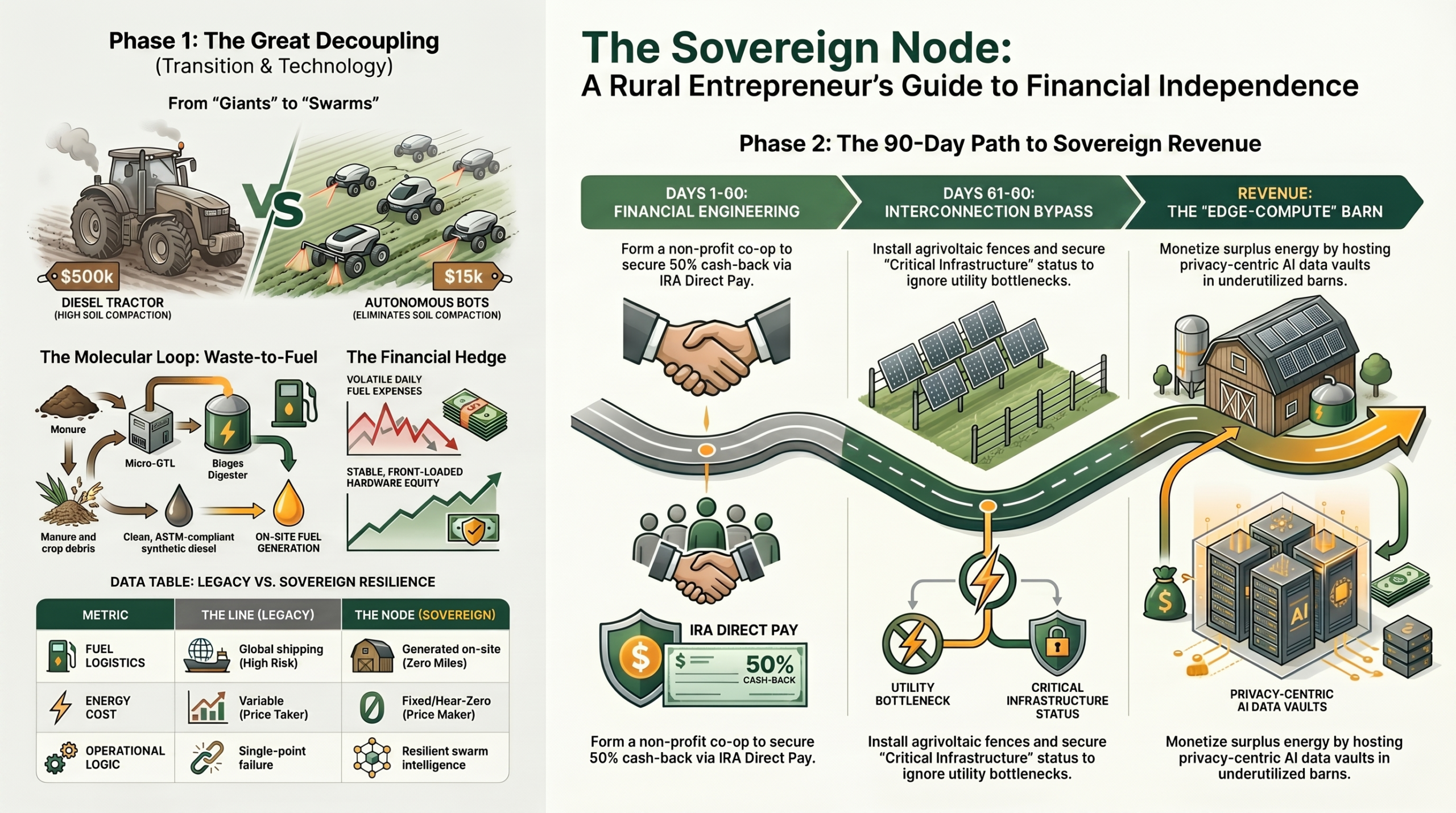
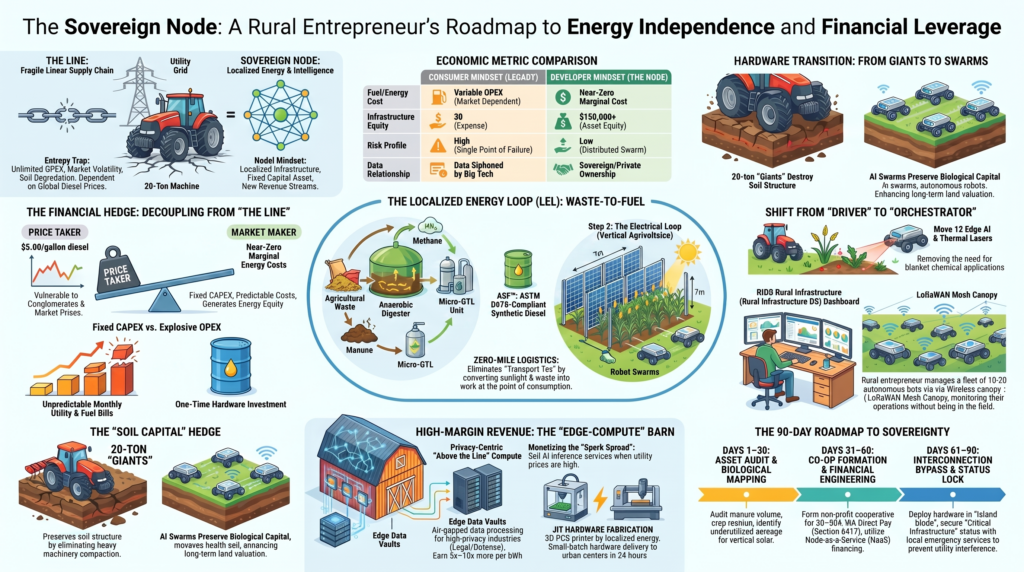
For the last century, agricultural productivity was governed by the “Driver-to-Horsepower Ratio.” To maximize expensive human labor, machines became monolithic “Giants”—20-ton tractors designed for a centralized, industrial era. However, this model has hit a Capital Gap that signals its obsolescence. With a single high-end autonomous tractor now costing between $500,000 and $800,000, small-to-medium landowners are being forced into a debt-heavy “Entropy Trap.”
The sovereign response is Swarm Logic: replacing the fragile, multi-million dollar single-point-of-failure with a fleet of modular, electric robots costing $10,000 to $25,000 each. This transition shifts the rural entrepreneur from a consumer of heavy iron to a developer of distributed intelligence.
AaaS is the definitive “Above the Line” business model for rural infrastructure. Entrepreneurs own and operate fleets of small, AI-driven robots to provide precision outcomes (like weeding or seeding) to local farms. Instead of the farmer carrying massive CAPEX debt, they pay a “per-acre” or “per-result” fee (OPEX), effectively turning high-tech precision into a cash-flow-positive service.
The financial barrier of the “Giants” is matched only by their destructive physical impact on the land they are meant to serve.
——————————————————————————–
video
2. Physical Impact: The Hidden Cost of Soil Compaction
“The Giants” carry a hidden agronomic tax that degrades the very asset they operate on. A 20-ton tractor creates deep-soil compaction penetrating up to 3 feet deep, crushing soil structure and reducing water infiltration. This “Physical Entropy” limits root growth and slashes potential yields by 10–20%.
By contrast, small bots utilize “Swarm Logic” to achieve a Land Equivalent Ratio (LER) of 1.2x to 1.6x. By operating at ultra-low weights, swarms preserve the “biological capital” of the soil and extend the operating window into seasons that would swallow heavy iron.
Mechanical Divergence
| Metric | Legacy Equipment (“Giants”) | AaaS Swarm Bots (“Swarms”) |
| Weight (lbs) | 40,000 – 50,000 lbs | 150 – 800 lbs |
| Ground Pressure | High; exceeds soil limits | Ultra-low; less than a human footprint |
| Operating Window | Limited by soil saturation | High; operates on saturated/wet soil |
| Intelligence Type | GPS-Macro (Where is the field?) | Vision-based Move 12 (Where is the plant?) |
The “So What?”: Benefits of Ultra-Low Weight for Land Valuation
- Asset Preservation: Eliminates the need for aggressive tillage or expensive chemical “soil repairs” by avoiding structural crushing.
- Operational Agility: Small bots can operate during wet conditions, allowing for 24/7 background agent workflows that “Giants” cannot match.
- Yield Arbitrage: Achieving a 1.2x–1.6x LER increases the total output of the land without requiring additional acreage.
As we transition from the physical weight of the machine to the digital weight of its intelligence, we find that productivity is no longer about mass, but about precision.
——————————————————————————–
podcast
3. Intelligence at the Edge: Introducing “Compute-per-Plant”
In the legacy model, intelligence is macro-scale. In the swarm model, productivity is defined by Compute-per-Plant. Utilizing on-device Move 12 logic, robots use Computer Vision and Neural Processing Units (NPUs) to execute decisions at the individual plant level.
The Precision Workflow:
- Identification (Milliseconds): High-frequency cameras scan the soil to locate every sprout.
- Differentiation (Crop vs. Weed): CNNs distinguish a 2-inch corn sprout from a 2-inch ragweed sprout with 99% accuracy.
- Targeted Action (Laser/Mechanical): High-wattage thermal lasers or mechanical tabs eliminate the weed, resulting in a 90% reduction in herbicide costs.
The Strategic Shift “Productivity is no longer about speed of travel (mph); it is about certainty of action. The swarm does not move 20 tons of iron to apply a blanket chemical spray; it moves an 800-lb node to execute a micro-targeted laser firing.”
The individual precision of each bot creates a collective strength that is structurally superior to the industrial model.
——————————————————————————–
4. Systemic Resilience: The Anti-Fragile Advantage
Legacy machinery represents a fragile “single point of catastrophic failure.” If one vital sensor fails on a $600,000 tractor, 100% of the operation halts. Swarms utilize distributed logic to ensure that the system grows stronger under stress.
Fragile (Legacy): High Unit Risk. One machine = 100% capacity. Breakdowns require specialized, external technicians and long downtime. Anti-fragile (Swarm): Distributed Risk. In a 20-unit swarm, if one bot fails, 95% of capacity remains. The “Fleet Commander” can swap a modular part in minutes.
While the swarm provides operational reliability, the energy that powers it provides total sovereignty.
——————————————————————————–
5. Energy Sovereignty: “The Line” vs. “The Node”
The fundamental differentiator for the Sovereign Developer is the Localized Energy Loop (LEL). Legacy farming is a victim of “The Line“—a fragile, global supply chain for diesel. The Nodal entrepreneur harvests energy exactly where it is spent, using the Three Pillars of LEL:
- Biological Pillar: Agra-Dot units use Fischer-Tropsch technology and Plasma Refinement to convert bio-waste (manure/crop debris) into high-density ASF™ (Agra Synthetic Fuel).
- Photovoltaic Pillar: Vertical Agrivoltaic Fences (7-meter spacing) provide direct DC power while allowing bots to operate between rows.
- Storage/Logic Pillar: LFP Battery Vaults combined with RIOS (Rural Infrastructure OS) manage the “Spark Spread.”
Energy Loop Comparison
| Factor | The Line (Giants) | The Node (Swarms) |
| Fuel Origin | Global oil markets (Centralized) | Local sun and bio-waste (Decentralized) |
| Logistics | Fragile thousands-of-miles chain | Zero-miles (Produced on-site) |
| Cost Control | Price Taker: Victim of market spikes | Market Maker: Sovereign Producer |
The “Spark Spread” & The Grid Buffer Because the marginal cost of LEL energy is near zero, the entrepreneur can execute Energy Arbitrage. When agrivoltaic output is high, RIOS routes excess power to Edge Data Vaults—climate-controlled server racks—to earn 5x-10x more per kWh by selling AI compute than they would by exporting power to the grid.
——————————————————————————–
6. The New Operator: From Field Hand to “Fleet Commander”
The human role in this ecosystem is not manual labor, but high-level orchestration. The Rural Telemetry Commander manages the fleet via the RIOS dashboard, using “Voice-in, Structure-out” (Move 9) logic.
The Commander’s Daily Workflow:
- Instruction: Verbal commands (“Clear the North 40 by Tuesday”) are parsed by RIOS into specific swarm coordinates.
- Deployment: RIOS uses Move 12 logic to sync tasks with energy levels, shifting bots to “low-energy” monitoring mode during cloud cover.
- Oversight: The Commander intervenes only when bots alert them via the LoRaWAN mesh canopy.
The 30% Human Rule & The Green Data Premium In the Nodal model, AI handles 70% of repetitive operational labor. The Commander focuses the remaining 30% on market navigation. Simultaneously, they collect high-fidelity soil-carbon data to sell as a “Green Data” Premium on the Locutus Ledger, turning environmental health into a secondary revenue stream.
To protect this independence, the entrepreneur secures Critical Infrastructure (CI) Status. By linking the hub to emergency services (e.g., “Sovereign Medic” clinic power), the developer creates a “Bypass Formula” against utility interference.
——————————————————————————–
7. Conclusion: Decoupling from the Entropy Trap
The rural entrepreneur wins by moving “Above the Line.” While conglomerates face rising variable costs and structural decay, the Nodal entrepreneur uses fixed-cost hardware and localized energy to own outcomes. Using the Section 6417 IRA Direct Pay “Bypass Formula,” first-time developers can receive 30–50% cash reimbursement for hardware, effectively subsidizing their leap into sovereignty.
- Financial Resilience: Shifts from $500k debt to modular $15k assets with 50% hardware cash-back via IRA Direct Pay.
- Energy Sovereignty: Replaces $5.00/gallon global diesel with ASF™ and vertical solar, turning a 13% fuel expense into a profit center via Edge Data Vaults.
- Agronomic Superiority: Achieves a 1.2x–1.6x LER by ending soil compaction and replacing blanket chemicals with precision Move 12 thermal lasers.
The Sovereign Developer does not just own tools; they own the localized infrastructure of the future. By choosing the Swarm over the Giant, they decouple from the Global Entropy Trap and build a business that is truly un-killable.