Strategic Briefing: The DeReticular Sovereign Stack and the Future of Decentralized Infrastructure (Late 2026 Assessment)
Executive Summary
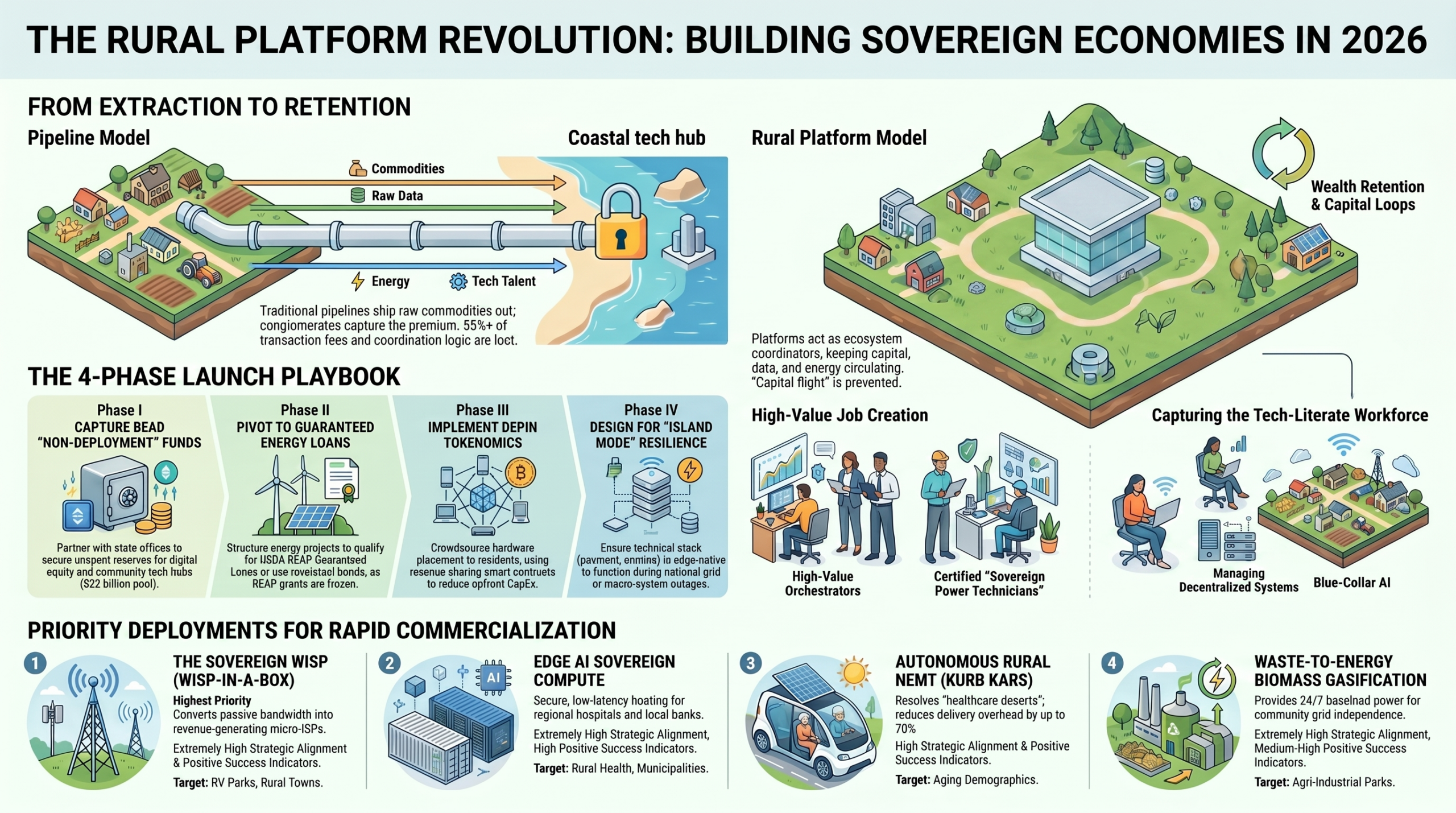
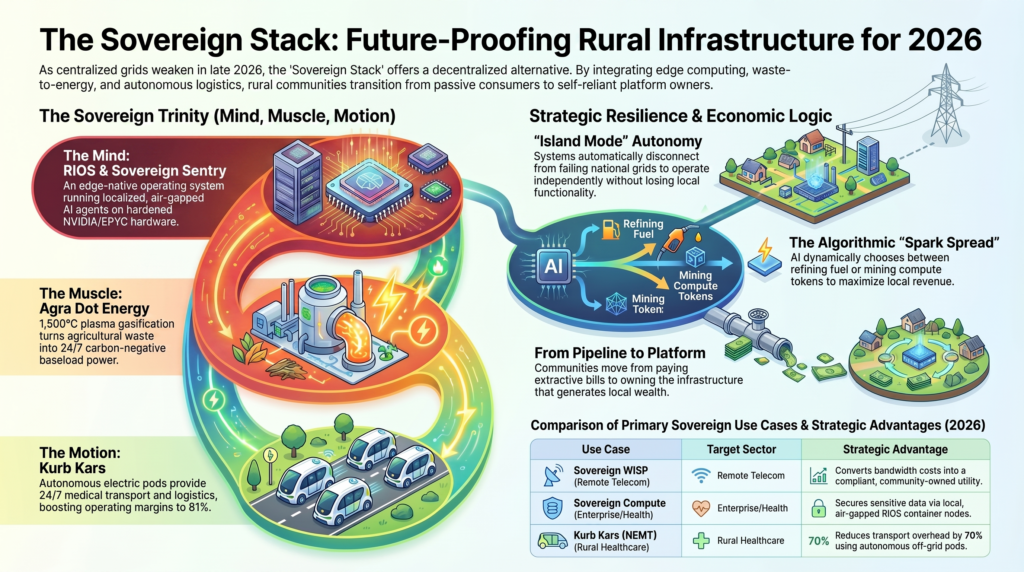
As of late 2026, the global digital and physical landscape is undergoing a profound structural shift. The reliance on centralized, linear cloud providers and infrastructure—termed “pipelines”—has exposed acute vulnerabilities in privacy, security, and systemic resilience. In response, the Sovereign Stack, governed by the Rural Infrastructure Operating System (RIOS) and the OpenClaw AI framework, has emerged as a comprehensive architecture for decentralized physical infrastructure networks (DePIN).
This briefing analyzes the transition from a “Consumer Mindset” to a “Developer Mindset,” where communities and enterprises move away from extractive utility models toward sovereign, self-funding, and air-gapped platform ecosystems. Key takeaways include the prioritization of localized “Island Mode” operations, the strategic use of the “Spark Spread” to arbitrage energy and compute value, and the navigation of a complex 2026 regulatory environment defined by federal funding bottlenecks and a massive expansion in Edge AI hardware.
1. The Philosophical Foundation: Pipelines vs. Platforms
The Sovereign Stack is built upon the strategic frameworks of Sangeet Paul Choudary and the industrial vision of Michael Noel (Biz Builder Mike). It represents an inversion of the traditional firm, moving from internal production to the orchestration of external ecosystems.
Core Strategic Axioms
- Linear Fragility vs. Spherical Resilience: Traditional infrastructure (long-distance power lines, centralized data centers) suffers from linear vulnerability, where a single point of failure collapses the chain. The Sovereign Stack utilizes multi-directional, k-connected mesh networks to achieve “spherical resilience.”
- Island Mode Independence: Every node in the stack is engineered to disconnect from national grids and public clouds during outages or cyber-warfare, maintaining essential local functionality.
- The Value Chain of Knowledge: In an era where AI commoditizes execution, business value shifts to a triad of Curiosity (framing the inquiry), Curation (filtering signal from noise), and Judgment (high-stakes decision-making with conviction).
The Sovereign Stack Pillars
| Pillar | Component | Primary Function |
| The Mind | RIOS / OpenClaw AI | AI-native operating system managing local grids and data arbitrage. |
| The Muscle | Agra Dot Energy | Waste-to-energy plasma gasification generating 24/7 baseload power. |
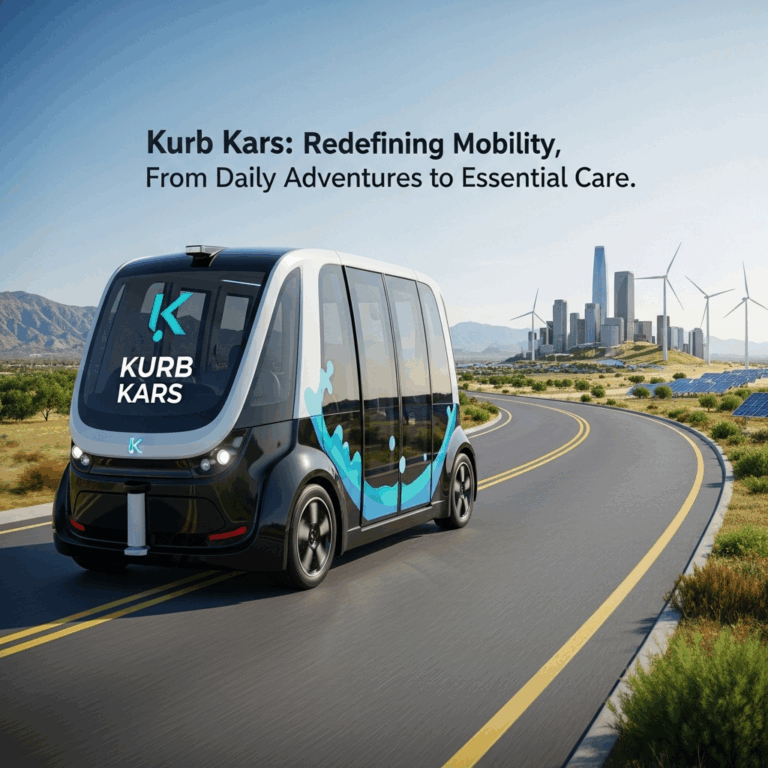
| The Motion | Kurb Kars | Autonomous electric pods for rural logistics and transportation. |
video
2. Strategic Evaluation and Ranking of Use Cases
A rigorous assessment of the DeReticular ecosystem identifies seven primary use cases, ranked by strategic alignment and market viability in late 2026.
Priority Ranking Matrix
| Rank | Use Case | Primary Hardware | Strategic Advantage |
| 1 | Sovereign WISP | Sovereign Sentry Pro / WISP Kit | Converts bandwidth costs into compliant, monetized local utilities. |
| 2 | Edge AI Compute | RIOS Containers (CC-1000) | Provides localized, off-grid data center capacity for enterprises. |
| 3 | Rural NEMT | Kurb Kars (Autonomous Pods) | Boosts NEMT margins from 10% to 81% by automating drivers/fuel. |
| 4 | Biomass Gasification | Agra Dot Energy Reactors | Generates 24/7 carbon-negative baseload power. |
| 5 | Edge Automation | Sentry Deck / Industrial Modules | Localizes industrial AI diagnostics without cloud data leakage. |
| 6 | Sovereign Gateway | Silicon Sentry (Router) | Enforces home privacy via a physical “Digital Airlock.” |
| 7 | Deep Archive/Comm | Localized RIOS Nodes | Delivers censorship-proof, peer-to-peer messaging. |
3. Late 2026 Macroeconomic and Policy Landscape
Node deployments must navigate specific frictions and opportunities present in the late 2026 theater.
- The $22 Billion BEAD Reserve: Administrative delays in the $42.5 billion federal Broadband Equity, Access, and Deployment (BEAD) program have resulted in a pivot toward “tech-neutral” localized mesh networks. $22 billion in “non-deployment” reserves are currently being distributed for digital equity and training.
- The REAP Funding Pause: As of March 31, 2026, the USDA halted direct cash grants for the Rural Energy for America Program (REAP) to rewrite guidelines. However, REAP Guaranteed Loans remain active, favoring continuous baseload projects like biomass over intermittent solar.
- The Enterprise Cloud AI Ban: Following the May 2026 OpenClaw CVE security crisis, major industrial and municipal players have banned cloud-connected AI agents from accessing operational technology (OT), driving an exponential rise in the Edge AI Hardware market (24.8B–28.9B valuation).
- Rural Demographic Reversal: A reversal of population decline is bringing tech-literate professionals back to rural areas, creating a hybrid talent pool of “blue-collar” operators and digital strategists.
podcast
4. Technical Architecture: Edge Intelligence and Connectivity
The OpenClaw AI Agent Suite
The stack utilizes specialized, air-gapped agents running on local hardware to manage physical and digital directives:
- The DevOps Sovereign: Monitors local network health and performs air-gapped code reviews.
- The Field Medic: Provides real-time diagnostic and repair guidance for off-grid infrastructure via mesh headsets.
- The Industrial Foreman: Orchestrates machinery via CAN Bus and Modbus, automating agrivoltaic tilts and microgrid flows.
- The Sovereign Elector: A secure voting module interfacing with the Locutus Ledger to record civic decisions immutably via TPM 2.0 hardware.
Secure Connectivity Protocols
- The Digital Airlock: A “Split-Ledger” architecture that strips sensitive personal context from queries, sending only sterilized logical tokens to external cloud models (e.g., Google’s Project Remy).
- Dual-Stack Communications: Integrates Hyphanet (for deep, anonymous archiving) and the New Freenet (for real-time, low-latency DApps like the River chat client).
- Signal Fusion: Dynamically bonds Starlink Business satellite internet with cellular data to maintain connectivity in remote “dead zones.”
5. Financial Engineering and Non-Extractive Models
To bypass predatory external debt and capital flight, the Sovereign Stack employs a closed-loop financial architecture.
The “Spark Spread” Arbitrage
The RIOS operating system continuously calculates the Spark Spread: Spark Spread = Real-time Value of Compute Tokens - On-site Energy Production Cost The system automatically determines whether to refine energy into liquid Advanced Synthetic Fuel (ASF™) or power GPU clusters to process high-margin Edge AI inference.
Funding and Ownership Structures
- Node-as-a-Service (NaaS): Hardware is deployed with zero down payment, amortizing its own lease through a percentage of the Spark Spread revenue.
- Sovereign-Public-Private Partnerships (S-P3): Bottom-up, community-owned cooperatives hold ownership of physical assets, shielding them from external creditors.
- Section 6417 (Elective Pay): Under the Inflation Reduction Act, tax-exempt entities (municipalities, 501(c)(3)s, tribes) can receive direct cash refunds from the U.S. Treasury for 30% to 50% of clean-energy CapEx.
- Intercompany Sovereign Debt: DeReticular issues low-interest debt to local nodes, denominated in local energy units to hedge against currency devaluation and global forex shocks.
6. Identified Gaps and Strategic Remediation
A comprehensive gap analysis reveals critical vulnerabilities in the theoretical model that require engineering corrections:
- Hardware Sourcing Paradox: The original specification of modified Apple M4 silicon for third-party routers is unviable due to Apple’s closed ecosystem. Remediation: Standardize on open-market silicon like NVIDIA Jetson or Rockchip RK3588.
- Networking Bandwidth Mismatch: LoRaWAN bandwidth is physically insufficient for real-time state machine synchronization. Remediation: Implement split-network topologies using Wi-Fi 7/5G for applications and LoRaWAN strictly for emergency heartbeats.
- Industrial Safety Boundaries: Quantized 4-bit AI models used in the Industrial Foreman may hallucinate, posing explosion risks in gasifiers. Remediation: Enforce a hardware-level safety boundary where the AI writes to a write-protected register audited by a deterministic Programmable Logic Controller (PLC).
- Regulatory Phasing for Kurb Kars: Feasibility grants do not equal operational approval for autonomous vehicles. Remediation: Phase rollout starting with human safety drivers and cargo transport on private roads before seeking public passenger certification.
Conclusion: Constructing Planetary Geometry
The deployment of these sovereign nodes is not merely the installation of software; it is the construction of an interconnected, highly resilient planetary geometry. By integrating autonomous mobility, decentralized power, and edge computation, the Sovereign Stack enables communities to transition from passive consumers to self-reliant technology producers, ensuring that innovation remains owned by those who live and work on the land.