
Sovereign Infrastructure Deployment: The DeReticular Generation 5 Quartzsite Report
Executive Summary
Project Quartzsite is a strategic deployment of DeReticular’s Generation 5 (Gen 5) Sovereign Infrastructure in Quartzsite, Arizona. The mission is to transform a high-density, off-grid desert gathering of over 1.2 million seasonal nomads into a living demonstration and commercial platform for decentralized connectivity, kinetic power, and localized AI computing.
The operation spans a critical seven-month window (September 15 – April 15), aligning with the Bureau of Land Management (BLM) Long-Term Visitor Area (LTVA) season. By deploying a self-healing, air-gapped “Spherical Resilience” architecture, DeReticular aims to solve chronic infrastructure failures caused by cellular network saturation and power instability.
Critical Takeaways:
- Revenue Potential: Consolidated seasonal revenue is projected between 2.3M (Conservative)** and **16.8M (Aggressive), with a moderate target of $7.09M.
- Operational Edge: The deployment utilizes the Rural Infrastructure Operating System (RIOS) to manage off-grid power, compute, and multi-carrier bonded communications.
- Strategic Market: Target segments include high-net-worth digital nomads, over 2,000 commercial show vendors, and luxury overland expedition communities.
I. Architectural Philosophy and Core Technology
DeReticular’s approach is centered on “The Death of the Line,” a move away from fragile, centralized, linear topologies (e.g., national power grids and cloud data centers) toward Spherical Resilience. This framework ensures that sovereign nodes can operate in “Island Mode,” independent of external utilities.
1. RIOS (Rural Infrastructure Operating System)
RIOS is an AI-native orchestration layer that manages the entire ecosystem, including power balancing, bandwidth routing, and mesh topology across distributed nodes.
2. Supporting Software & Compute Architecture
- Locutus/Ludis Ledger: An offline-first database enabling peer-to-peer transaction verification and telemetry synchronization without internet access.
- Tri-Fi Mesh Topology: A localized mesh networking system that allows vehicles and hubs to communicate across miles of desert without cellular service.
- pfSense Edge Firewall: Physical hardware-level security embedded in gateways to ensure data sovereignty.
II. Generation 5 (Gen 5) Product Portfolio
The Gen 5 hardware suite is categorized into connectivity gateways, kinetic power systems, and automation agents.
| Product Name | Unit MSRP | Core Features | Target Buyer |
| WISP-in-a-Box Base | $1,497 | Direct 12V, Ruggedized, Tri-Fi Mesh | Vanlifers, Budget Nomads |
| WISP-in-a-Box LTE | $5,887 | Multi-Carrier Bonding (Starlink+LTE/5G) | Remote Execs, Show Vendors |
| WISP Agentic AI | $9,997 | Air-Gapped Local AI, Locutus Ledger | Tech Founders, DePIN Builders |
| Pawnee Power GenSet | $49,997 | 45kW Microgrid Unit, Whisper-Quiet | Vendor Plazas, Camp Enclaves |
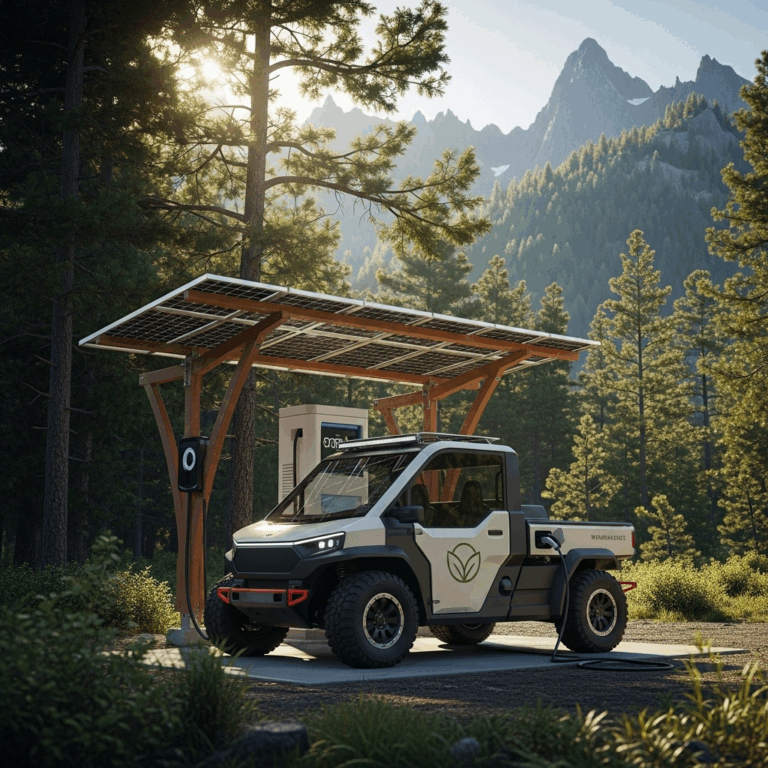
| Pawnee Hybrid Buggy | $99,000 | Autonomous Off-Road, Cargo Drop Pods | Expedition Rigs, Fleet Ops |
| Pawnee Flagship TAV | $797,000 | 6×6 Mobile Command-and-Control (C2) | UHNW Overlanders |
Additional High-Density Infrastructure:
- Edge Compute Racks: High-density GPU clusters (320 H100 Equivalent) for local AI model training and inferencing in the field (~$5.8M).
- The Field Medic: An autonomous diagnostic platform for off-grid vehicle maintenance and medical triage.
- The Industrial Foreman: An air-gapped platform for operating heavy machinery and microgrid balancing.
III. Market Dynamics: Quartzsite, Arizona
Quartzsite serves as a unique operational laboratory due to its extreme seasonal demographic shifts.
1. Demographic Waves (September – April)
The population expands in four distinct phases:
- Phase 1 (Sept 15 – Oct 31): 15,000 – 45,000 “Pioneers.” Commercial vendors and early-season nomads.
- Phase 2 (Nov 1 – Dec 31): 150,000 – 400,000 “Early Snowbirds.” Remote tech workers and vanlifers.
- Phase 3 (Jan 1 – Feb 28): 1.0M – 1.5M+ “Peak Show Wave.” RV show attendees and luxury overlanders.
- Phase 4 (Mar 1 – Apr 15): 50,000 – 120,000 “Wind-Down.” Extended-stay LTVA campers.
2. Operational Friction vs. Solutions
The surge of visitors creates severe stress on local infrastructure, which DeReticular addresses directly:
- Overloaded Cell Towers: Local networks often throttle to <1Mbps. WISP-in-a-Box gateways bypass this using multi-carrier bonding.
- Unreliable Vendor POS: Credit card terminals frequently fail during peak show hours. DeReticular provides guaranteed point-of-sale (POS) uptime via bonded connectivity.
- Loud Power Generation: Traditional gas generators create noise and air pollution. Pawnee GenSets offer whisper-quiet microgrid power sales.
IV. Revenue Stream Architecture
DeReticular captures value through four primary monetization channels during the seven-month season.
| Stream | Description | Pricing Model |
| 1. Consumer Hardware | Direct sales of WISP-in-a-Box gateways and network passes. | $1,497 – $9,997 (Hardware); $650/Season (Pass) |
| 2. Commercial Packages | “Unbreakable POS” connectivity kits for vendors. | $499/mo lease or $3,497 purchase |
| 3. Kinetic & Power | Microgrid power sales and Pawnee vehicle field services. | $0.45/kWh or daily flat rates; recovery subscriptions |
| 4. DePIN & Compute | GPU rack rentals and Locutus Ledger verification fees. | High-density GPU rentals for AI inferencing |
V. Financial Forecasts
The following table outlines the consolidated seasonal revenue potential from mid-September through mid-April.
| Revenue Source | Conservative | Moderate | Aggressive |
| Direct Hardware Sales | $1,328,146 | $4,211,571 | $10,167,956 |
| Sovereign Network Passes | $260,000 | $780,000 | $1,950,000 |
| Vendor POS Lease Packages | $299,400 | $898,200 | $2,245,500 |
| Pawnee Power Sales | $180,000 | $450,000 | $900,000 |
| Edge GPU Compute/DePIN | $150,000 | $500,000 | $1,200,000 |
| Field Support Services | $90,000 | $250,000 | $360,000 |
| TOTAL GROSS REVENUE | $2,307,546 | $7,089,771 | $16,823,456 |
VI. Operational Execution Roadmap
Operations are deployed in four strategic phases to maximize demographic capture.
- Phase 1: Infrastructure Anchor (Sept 15 – Oct 15)
- Deploy primary RIOS WISP towers at key BLM LTVA access points (La Posa North, South, West).
- Launch early-bird $650 full-season network passes.
- Phase 2: Commercial Onboarding (Oct 16 – Nov 30)
- Pre-install WISP-in-a-Box LTE gateways for show vendors.
- Establish Pawnee 45kW GenSets in central vendor aisles.
- Phase 3: Community Scale (Dec 1 – Jan 15)
- Integrate Tri-Fi localized mesh networking at major gatherings like the Rubber Tramp Rendezvous (RTR).
- Commission local Edge GPU compute racks in desert container hubs.
- Phase 4: Peak Show Execution (Jan 16 – Feb 28)
- Maintain 100% network SLA for “The Big Tent” RV Show (150k–750k visitors).
- Operate an interactive showcase booth for on-site hardware sales.
VII. Risk Register and Mitigation
| Risk Factor | Severity | Mitigation Strategy |
| Environmental Extremes | High | Industrial 3D-printed chassis with passive cooling and IP67 sealing for heat and dust. |
| Backhaul Throttling | High | Multi-carrier bonding engine balances Starlink with multiple 5G/LTE networks. |
| Land Use Restrictions | Medium | Primary hubs located on private vendor land leases (Tyson Wells/Desert Gardens). |
| Supply Chain | Medium | Buffer stock of 150 WISP units pre-staged in Phoenix warehouse by September 1. |
VIII. Conclusion
Project Quartzsite is more than a seasonal operation; it is the primary commercial launchpad for DeReticular’s Generation 5 technology. By solving acute connectivity and power failures for a migrant population exceeding one million, DeReticular validates the real-world execution of Sovereign Infrastructure. The project is expected to yield between $7M and $16.8M in revenue while establishing the platform as an essential utility for modern nomads and off-grid commerce.
- The Seasonal Operational Lifecycle: A Four-Phase Strategic Roadmap
The strategic deployment of infrastructure in Quartzsite, Arizona, is governed by the rigid seasonal calendar of the Bureau of Land Management (BLM). Aligning operations with the Long-Term Visitor Area (LTVA) season is not merely a logistical necessity but a foundational anchor for project success. The September 15 start date serves as the critical “anchor point” for the entire operational lifecycle. By establishing a presence at the official opening of the permit season, DeReticular can execute optimal frequency planning and land selection before the massive influx of over one million migrants renders traditional communication channels unusable and local cellular towers collapse under the weight of saturated bandwidth.
The operational lifecycle is categorized into four distinct chronological phases:
- Phase 1: Infrastructure Anchor (September 15 – October 31)
- Target Demographics: “Pioneers,” commercial rockhounds, early-season long-term nomads, and commercial show organizers (15,000 – 45,000 people).
- Technical Objectives: Deployment of primary RIOS Mobile WISP towers at critical access points (La Posa North, South, West, and Tyson Wash) and the launch of the early-bird $650 full-season network pass.
- Phase 2: Commercial Onboarding & Community Scale (November 1 – December 31)
- Target Demographics: “Early Snowbirds,” attendees of the Rubber Tramp Rendezvous (RTR), vanlifers, and remote tech workers (150,000 – 400,000 people).
- Technical Objectives: Pre-installation of WISP-in-a-Box LTE gateways for show vendors and deployment of Caravan mesh networks. Strategic focus is placed on providing high-speed streaming and work-bandwidth to the influx of tech-dependent remote professionals.
- Phase 3: Peak Show Surge (January 1 – February 28)
- Target Demographics: Attendees of “The Big Tent” (Quartzsite Sports, Vacation & RV Show), international gem collectors, and high-net-worth overlanders (1,000,000 – 1.5M+ people).
- Technical Objectives: Maintaining 100% network uptime for Point-of-Sale (POS) systems across vendor corridors (Desert Gardens, Tyson Wells) and commissioning high-density edge GPU compute racks to support local AI workloads.
- Phase 4: Operational Wind-Down (March 1 – April 15)
- Target Demographics: Extended-stay LTVA campers, field maintenance teams, and off-season storage planners (50,000 – 120,000 people).
- Technical Objectives: Hardware retrieval, software updates, and transitioning backbone nodes into permanent winter storage or mobile expedition configurations.
The strategic necessity of Phase 1 is paramount. By establishing RIOS Mobile WISP towers during this window, DeReticular builds a sovereign mesh before local cellular towers throttle to speeds below 1Mbps. This proactive stance ensures a reliable alternative backbone is operational before the “cellular blackout” hits, providing the infrastructure foundation required to sustain executive-level hardware and sovereign digital residency.
- Generation 5 Connectivity: Architectures for Sovereign Resilience
DeReticular’s architecture is rooted in the “Death of the Line”—a rejection of fragile, centralized, linear topologies like traditional power grids and cloud data centers that represent single points of failure. In their place, Generation 5 (Gen 5) hardware introduces “Spherical Resilience.” This shift allows sovereign nodes to operate in “Island Mode,” maintaining full power, compute, and communications functionality even when completely disconnected from national utilities or external internet backbones.
The primary gateway for this resilience is the WISP-in-a-Box series, which replaces fragmented DIY setups with enterprise-grade, direct-to-12V systems.
Model Tier Unit MSRP Core Features Target User Profile
WISP-in-a-Box Base $1,497 Direct 12V, ruggedized 3D mesh, Tri-Fi localized connectivity Vanlifers, budget-conscious nomads
WISP-in-a-Box LTE $5,887 Multi-carrier bonding (Starlink + LTE/5G), pfSense edge router Remote executives, commercial show vendors
WISP Agentic AI $9,997 Air-gapped local AI engine, Locutus/Ludis sync ledger Tech founders, DePIN builders, remote creators
These hardware tiers are orchestrated by the Rural Infrastructure Operating System (RIOS) and Tri-Fi Mesh Topology. RIOS serves as an AI-native operating system managing local power balancing and bandwidth routing. Tri-Fi mesh enables localized communication webs to bridge vehicles across miles of desert without external service. Central to this is the Locutus/Ludis Ledger, an offline-first database that ensures machine-to-machine data and transactions remain synchronized across localized fleets via peer-to-peer verification, ensuring total digital sovereignty for high-net-worth nomads and remote founders.
Executive Summary: The Gen 5 stack transforms the Sonoran Desert from a digital dead zone into a mission-critical Command & Control (C2) hub, providing unbreakable broadband for trade execution and secure remote management.
However, digital resilience is insufficient without physical durability; the hardware must withstand the punishing realities of the desert environment.
- Engineering for Extreme Environments: Overcoming Desert Friction
Quartzsite presents unique systemic “friction points” during its winter explosion. Environmental extremes—heat, invasive dust, and isolation—are compounded by the network saturation of 1.2 million people. Standard hardware inevitably fails under these conditions, leading to revenue-losing network drops for vendors and digital isolation for nomads.
DeReticular Gen 5 hardware is engineered to counteract these specific desert failures:
Quartzsite Winter Friction DeReticular Gen 5 Synergy Solution
Overloaded Cell Towers & Unusable Wi-Fi RIOS WISP-in-a-Box Multi-Carrier Bonding & Localized Edge Routing
Remote BLM Camp Isolation & Zero Signal Tri-Fi Localized Mesh & Offline Locutus/Ludis Ledger Synchronization
Off-Grid Vendor Terminal Transaction Crashes Air-Gapped AI Gateways & Local Compute Clusters for Merchant POS
Remote Desert Emergency & Logistics Pawnee Kinetic Series, “The Field Medic” AI, and “The Industrial Foreman”
The physical engineering of the Gen 5 stack reflects this resilience. Every unit is housed in a custom, 3D-printed, heat-tolerant chassis designed for passive cooling and IP67 dust/water sealing. Utilizing battery-free and ruggedized designs, these systems survive the full 7-month operating window without the degradation typical of standard electronics.
To solve the “last-mile” emergency and supply challenge, DeReticular deploys the Pawnee Kinetic series and Sovereign Automation line. “The Field Medic” provides automated, localized diagnostics for off-grid repairs and medical triage, while “The Industrial Foreman” orchestrates micro-grid balancing and heavy machinery in “Island Mode.” These systems work alongside the Pawnee Flagship TAV (797,000) and Hybrid Dune Buggy (99,000) to provide trail logistics, cargo delivery, and off-road recovery in a wilderness where traditional services are overextended.
- Revenue Architecture: Monetizing the Nomadic Surge
The monetization of “Project Quartzsite” utilizes a comprehensive ecosystem of hardware sales, recurring subscriptions, and high-margin service leases. This multi-layered architecture captures value across the entire demographic spectrum, from the rockhound to the ultra-high-net-worth overlander.
- Consumer & Nomad Hardware/Subscriptions: In addition to WISP-in-a-Box sales, DeReticular offers a 120 Monthly Pass** and a **650 Full Season Pass, providing off-grid Wi-Fi via the desert-wide Tri-Fi mesh backbone.
- Commercial Vendor POS Packages: This “Unbreakable POS” model ensures the 2,000+ businesses at Quartzsite never miss a transaction. Vendors can choose a 499/month lease** or a **3,497 flat purchase for specialized kits that include zero-downtime Starlink/5G failover.
- Heavy Kinetic & Power Microgrids: Pawnee 45kW GenSet leases provide whisper-quiet energy at 0.45/kWh** or **150/day flat rates per vendor row, offering a premium alternative to noisy gasoline generators.
- DePIN Local Compute & Edge Services: High-density GPU racks providing up to 320 H100 Equivalents are deployed for air-gapped AI inferencing and Locutus Ledger storage. Users pay compute rental and data verification fees for localized, low-latency processing.
Revenue Category Conservative Target Moderate Target Aggressive Target
Direct Hardware Sales $1,328,146 $4,211,571 $10,167,956
Network Subscriptions $260,000 $780,000 $1,950,000
Vendor POS Leases $299,400 $898,200 $2,245,500
Power & Microgrid Sales $180,000 $450,000 $900,000
Edge Compute & Services $150,000 $500,000 $1,200,000
Kinetic Field Services $90,000 $250,000 $360,000
Consolidated Seasonal Revenue $2,307,546 $7,089,771 $16,823,456
- Strategic Conclusion
The deployment of the Generation 5 infrastructure stack in Quartzsite is more than a seasonal operation; it is the definitive proof-of-concept for the “Civilization in a Box” philosophy. By solving critical power, connectivity, and logistical failures for 1.2 million people, DeReticular transforms a temporary desert metropolis into a global showcase for decentralized resilience.
This project validates a future where localized, air-gapped nodes replace fragile national grids. The “Spherical Resilience” model, proven in the Sonoran Desert, now stands as the blueprint for sovereign infrastructure deployments worldwide. DeReticular has transitioned from a hardware provider to the essential architect of the future’s autonomous and resilient physical world.