Resilient Commerce: The Architecture of Off-Grid A2A Reservation Systems
- The Infrastructure Gap in High-Margin Outdoor Economies
In high-margin outdoor economies, such as the New River Gorge corridor of West Virginia, reliance on centralized travel platforms like Expedia, Viator, and Airbnb represents a critical structural vulnerability. These legacy aggregators operate as cloud-dependent silos designed for urban environments with ubiquitous connectivity. In rural mountain regions, cellular dependency creates a catastrophic single point of failure; when a tourist enters a signal dead zone, the atomic state of the transaction is lost. Cloud-dependent booking applications crash, leading to missed shuttles, double-bookings, and thousands of dollars in lost local revenue. This extractive model forces family-owned outfitters to surrender up to 30% of their gross income to external entities while remaining tethered to fragile, external infrastructure.
The Pawnee.us Agent-to-Agent (A2A) Sovereign Mesh replaces this cloud-dependent fragility with a localized, peer-to-peer execution environment.
Dimension Old Way (Centralized Aggregators) Pawnee.us A2A Sovereign Mesh
Network Dependency 100% Cloud-Dependent (Cellular/Fiber) Air-Gapped Mesh Relay (Zero Internet Dependency)
Commission Structure 15% to 30% Extraction 2.5% Protocol Micro-Fee
Confirmation Latency 5 to 15 Minutes (Manual/Static) < 4 Seconds (Real-Time Cryptographic Smart Contracts)
Data Control Closed Corporate Silos Sovereign P2P Mesh (Local State Synchronization)
This architecture shifts the regional economic paradigm from “Extractive Corporate Profit Export” to “Local Wealth Retention.” By decentralizing the commerce layer, the A2A engine ensures that economic value and data remain within the local ecosystem, fostering regional stability. Technical resilience is the necessary foundation for this economic shift, necessitating a move to specialized, hardware-grade infrastructure.
- WISP Gateway Mechanics: Engineering the Sovereign Mesh
The physical anchor of the A2A protocol is DeReticular’s Gen 5 commercial hardware series. These “WISP-in-a-Box” gateways, supported by the Pawnee Flagship TAV ($797,000.00) mobile server hubs and Pawnee Power GenSets (45 kW Rotary), replace fragile cellular signals with a persistent, local agentic network. This infrastructure ensures that transaction processing is linked directly to behind-the-meter AI compute, fulfilling the statutory Captive Power Requirement (≥ 70%) necessary for a resilient, off-grid economy.
The A2A protocol utilizes three primary Gen 5 gateway models to manage the localized mesh:
- WISP-in-a-Box Agentic ($9,997.00): The primary local AI agent server. It houses the OpenClaw execution environment and provides the local Large Language Model (LLM) inference required for autonomous state synchronization and decision-making.
- WISP-in-a-Box LTE ($5,887.00): A dual-WAN failover unit (Starlink + LTE) responsible for syncing the local A2A ledger state with broader regional nodes.
- WISP-in-a-Box Base ($1,497.00): A lightweight gateway deployed at trailheads and merchant shops to manage short-range Bluetooth and Wi-Fi handshakes between traveler agents and the mesh.
The synergy between the OpenClaw Agentic Kernel and the Hyphanet/NeoMesh network enables a traveler’s agent to “broadcast an encrypted intent” for peer-to-peer negotiation without an internet connection. This is further optimized by the RIOS Spark Spread AI, which thermodynamically integrates booking volume with local power availability. This off-grid reliability prevents the “thousands of dollars in local economic value evaporation” that occurs when glossy cloud apps fail in mountain hollows, ensuring measurable financial gains for the merchant.
- Economic Disintermediation: The High-Margin Advantage for Outfitters
The Pawnee.us protocol addresses the “Commission Gap” by introducing a 2.5% micro-fee structure, fundamentally disrupting the profit-and-loss statements of family-owned outfitters. By framing this as a disintermediation strategy, the protocol makes legacy participation in 15%–30% commission models mathematically illogical for the merchant. The outfitter retains 97.5% of the transaction value, securing the economic surplus previously lost to urban corporate aggregators.
The OpenClaw kernel eliminates “human-in-the-loop latency” through atomic smart contracts and automated evaluation trees. This allows for the autonomous coordination of complex, multi-leg trips:
- Rafting: The traveler agent secures a 10:00 AM slot via a direct P2P ping.
- Transport: The system automatically dispatches a Pawnee Hybrid Dune Buggy for a 9:30 AM trailhead pickup.
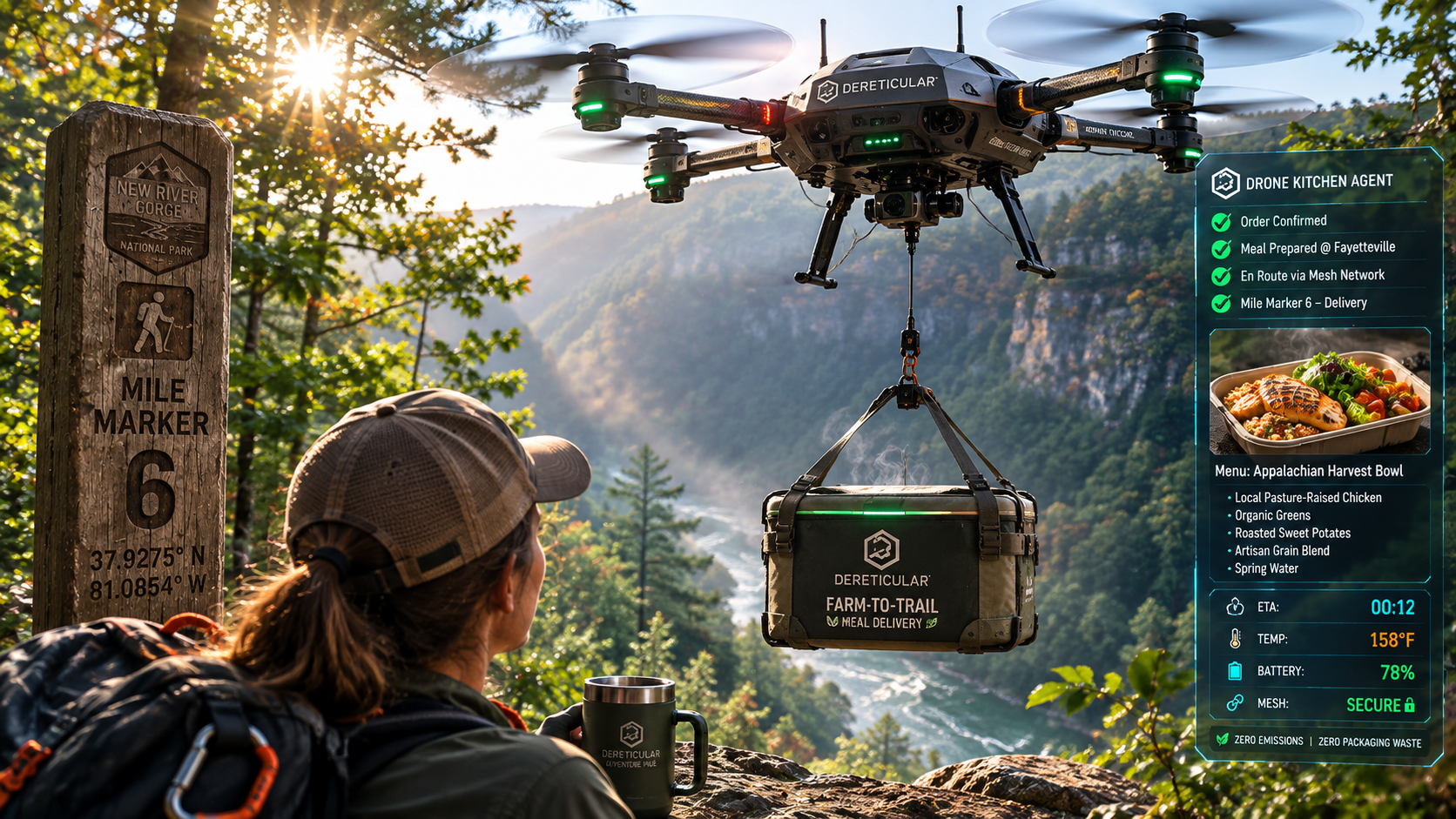
- Logistics: A hot meal is scheduled for drone delivery to a specific GPS trail marker for lunch.
By executing these logistics in under four seconds, the system captures 100% of the local market share by removing the friction of manual booking and phone-based coordination. While the 2.5% fee attracts merchants, hardware-level security is what ensures the long-term integrity of those transactions.
- Hardware-Grade Security: The TPM 2.0 Root-of-Trust
In a decentralized environment, security must be anchored in a “Silicon Oracle.” To prevent double-spending and data breaches, the Pawnee.us architecture moves security from vulnerable cloud databases to physical hardware chips (TPM 2.0) embedded in the Gen 5 gateways. This hardware root-of-trust ensures that every service confirmation and location ping is cryptographically signed and immutable.
The TPM 2.0 chip executes a signing process using a minimum viable data set—Agent ID, Service Timestamp, Price, and GPS Location—to ensure the transaction cannot be spoofed or replayed on the air-gapped mesh.
Conceptual A2A Signature Formula: Signature_A2A = Sign_TPM_PrivateKey(Agent_ID || Service_Timestamp || Price || GPS_Location)
This security model utilizes Sysbox isolated container runtimes to harden mesh nodes against cyber-attacks. Furthermore, the architecture is designed for regulatory compliance with W. Va. Code §24-2-21a, which exempts local microgrid commerce networks from Public Service Commission (PSC) utility oversight. This security architecture enables the protocol to scale from a regional pilot to a global DePIN standard.
- Strategic Roadmap: From Local Pilot to Global Standard
The Pawnee.us A2A expansion is a structured three-phase evolution designed to establish a new global infrastructure for autonomous commerce.
Phase 1: New River Gorge Regional Pilot (Years 1–2) The initial phase focuses on onboarding 100+ local West Virginia outfitters and eco-lodges. This includes the deployment of 20 Agentic Gateways and the funding of 8 WVU Computer Science student fellowships. These fellowships are dedicated to building open-source connectors for local Point-of-Sale (POS) systems, bridging the gap between legacy merchant software and the A2A mesh.
Phase 2: Appalachian and National Expansion (Years 3–5) Expansion will scale the protocol into outdoor hubs across Kentucky, Virginia, North Carolina, and Tennessee. Integration will extend to regional public transit and rural Non-Emergency Medical Transportation (NEMT) systems, utilizing the A2A engine for autonomous dispatch and settlement.
Phase 3: Global DePIN Standard (Years 6–10) The final phase establishes Pawnee.us as the global open-source standard for off-grid autonomous commerce. By leveraging the TPM 2.0 security model, the protocol will scale into international travel and rural logistics markets.
The long-term vision targets a gross booking volume (GBV) exceeding $20 Billion annually. The sustainability of this growth is underpinned by the WVU “Energy Student” developer pipeline and the NSF RETI Consortium, ensuring a continuous influx of engineering talent. The transition to autonomous, off-grid commerce in the physical world is an inevitability that the Pawnee.us architecture is uniquely positioned to lead.