Anatomy of the Sovereign Gateway: The Student’s Guide to Digital Independence
1. Introduction: The Death of the Line and the Birth of Resilience
In the curriculum of Sovereign Tech, the most vital lesson is the transition from Linear Dependence to Spherical Resilience. For decades, digital infrastructure has relied on “The Line”—centralized power and data conduits that create single points of failure. When the line is cut, the “smart” environment collapses. DeReticular’s mission is “The Death of the Line,” replacing vulnerable, centralized utility dependencies with autonomous, air-gapped nodes capable of self-preservation.
The Sovereign Gateway is the primary edge-compute node designed to facilitate this shift. It is the physical manifestation of a “Trustless Infrastructure” philosophy, ensuring that your local environment remains intelligent regardless of the status of the global web.
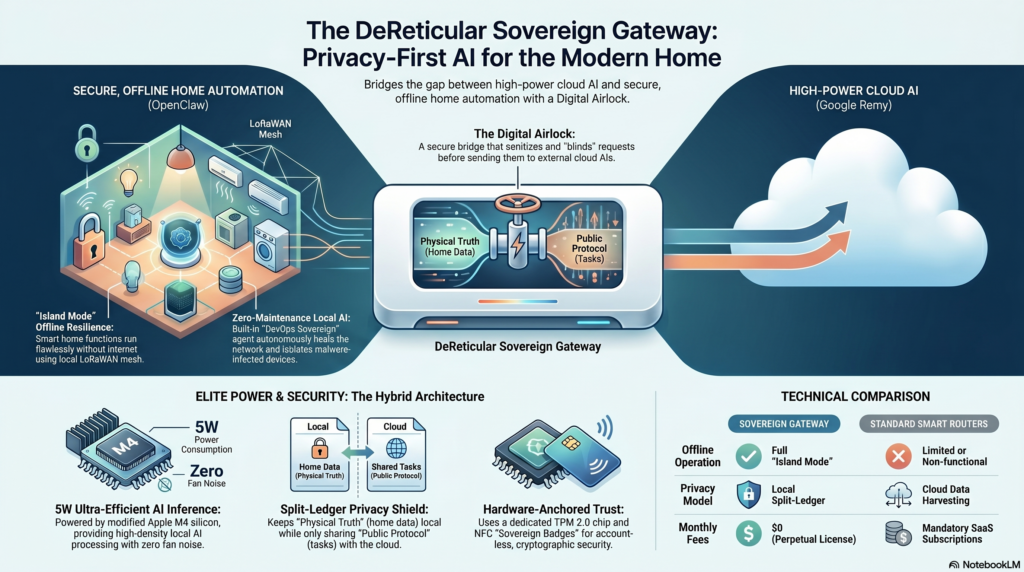
The Elevator Pitch: “The Sovereign Gateway gives you the logistical magic of Big Tech AI, without letting Big Tech see inside your home. It’s an unbreakable, self-healing mesh network powered by local AI that keeps your smart home running even when the internet goes down.”
Core Value Propositions:
- Island Mode: Absolute offline resilience for smart home operations and local networking.
- Zero-Maintenance IT: Autonomous AI agents that manage, heal, and secure the network without user intervention.
- Trustless Cloud Integration: A secure “Digital Airlock” that bridges to external powerhouses like Google Project Remy while maintaining local data sovereignty.
To master the Gateway’s function, we must first analyze the “Premium Silicon Sentry”—the high-density hardware layer that enables this autonomy.
——————————————————————————–
2. The Physical Layer: The Premium Silicon Sentry
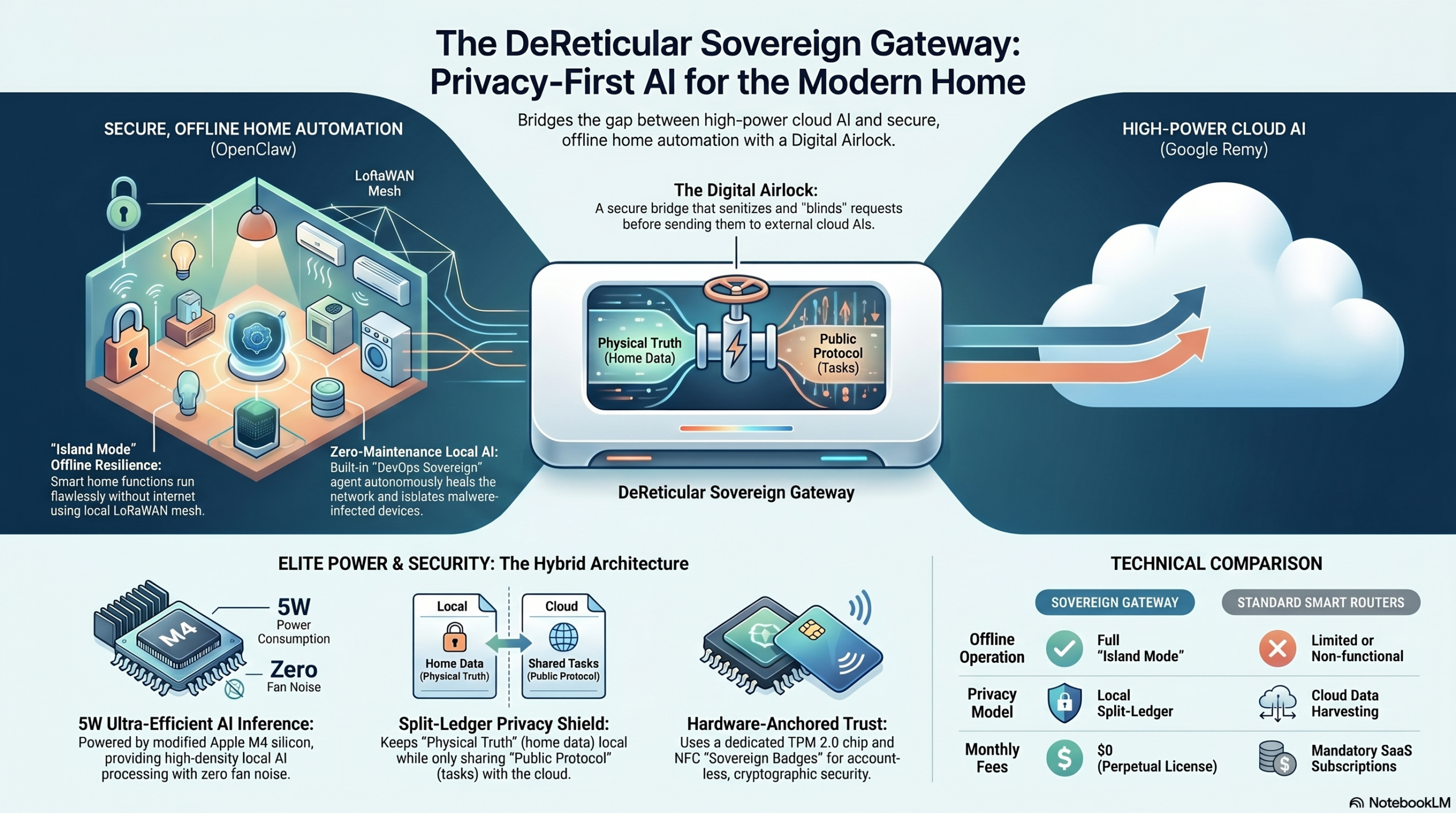
The hardware of the Sovereign Gateway (SKU: DER-SOV-GW-01) is not a consumer router; it is a specialized edge-compute node. At its core is a modified Apple M4 chip, specifically selected for its industry-leading performance-per-watt. The device maintains a 5W idle power draw, allowing for a 100% fanless, silent design. Heat is dissipated through a custom-extruded anodized aluminum chassis which acts as a primary passive heatsink.
Hardware Anatomy
| Component | Specification | Functional Benefit for the Student |
| Processor | Modified Apple M4 Silicon | Enables on-device volumetric security analysis and Whisper AI processing without cloud latency or data leakage. |
| Memory/Storage | 16GB RAM / 512GB NVMe | Facilitates local hosting of the OpenClaw framework and the storage of private Split-Ledger data. |
| Networking Array | Trifi Wireless (Wi-Fi 6E & LoRaWAN) | Creates a dual-layer “canopy”: high-speed data for devices and a long-range, low-power mesh for IoT sensors. |
| Chassis | Anodized Aluminum Shell | Provides silent, zero-decibel cooling (0dB) and structural durability for rural or industrial deployments. |
| Security Module | Dedicated TPM 2.0 | Serves as the cryptographic anchor for the “Genesis Block” of the user’s local private network. |
This physical foundation provides the compute overhead necessary for the “Brain”—the Logic Layer.
——————————————————————————–
3. The Logic Layer: RIOS and the OpenClaw Framework
The software environment is governed by the Rural Infrastructure Operating System (RIOS), an AI-native, container-optimized Linux kernel. RIOS is designed for high-availability “Island Mode” operations, ensuring that the system does not “home-call” to a central server to function.
Autonomy is orchestrated via the OpenClaw framework, the 2026 standard for agentic, self-hosted AI. Within the Gateway, OpenClaw manages three critical Sovereign Agents:
- SOV-AUTO-DEV (DevOps Sovereign): The “Invisible IT Department.” It autonomously audits network traffic, isolates malware-infected IoT devices, and silently restarts crashed containers. It eliminates the need for manual troubleshooting.
- SOV-AUTO-EXEC (Sovereign Executive): A private Chief of Staff. Utilizing local Whisper AI for voice-to-text, it processes voice commands entirely offline. It manages local logistics without transmitting audio clips to a corporate cloud.
- Vault Warden (Consumer Edition): A security specialist that utilizes the M4 GPU for volumetric and multispectral analysis of local camera feeds. It ensures that security data remains on-site and subscription-free.
——————————————————————————–
4. Operational Excellence: “Island Mode” & Self-Healing
The defining characteristic of the Sovereign Gateway is Island Mode. By utilizing the Trifi Wireless array, the Gateway maintains a private mesh canopy. Even if the primary ISP link is severed, the LoRaWAN and Wi-Fi 6E mesh allows the home’s lights, locks, and security sensors to communicate flawlessly.
Furthermore, the Gateway supports Asynchronous Agent Handoff. If a user issues a command requiring the cloud (e.g., via Google Remy) during an outage, the OpenClaw agent queues the request. Through the Nomad Link synchronization module, the Gateway bulk-transmits these queued “intent payloads” as soon as a Starlink or LTE backhaul is re-established.
Traditional Router vs. Sovereign Gateway
| Feature | Traditional Cloud Router | Sovereign Gateway |
| ISP Outage Behavior | Smart home features (lights/locks) cease to function. | Island Mode: Local operations continue; cloud tasks are queued. |
| Data Privacy | Telemetry and voice data are harvested for advertising. | Zero-Harvesting: All “Physical Truth” stays on local silicon. |
| Maintenance | Requires manual reboots and user troubleshooting. | Self-Healing: Managed by the SOV-AUTO-DEV agent. |
| Identity Model | Mandatory cloud account (Email/Password). | Account-less: Cryptographically anchored to physical hardware. |
——————————————————————————–
5. The Digital Airlock: Bridging to Google Project Remy
To participate in the modern economy, the Gateway utilizes a “Hybrid” model. It connects to Google Project Remy to leverage its proactive logistical power (booking, scheduling, web research), but it does so through a Digital Airlock.
This architecture is governed by the Split-Ledger Privacy Shield, which creates a hard dichotomy:
- Physical Truth: Your home telemetry, camera feeds, and voice recordings stay locked in the local RIOS environment.
- Public Protocol: Only sanitized, “blinded” intent payloads are sent to the cloud for execution.
The Sanitized API Handoff Process:
- The User Command: A request is issued to the Sovereign Executive.
- Local Sanitization: The OpenClaw agent strips IP data, home context, and unnecessary identifiers.
- The “Blinded” Payload: A compressed, anonymized intent packet is sent through the Airlock.
- External Execution: Google Project Remy executes the task (e.g., booking a flight) and returns the confirmation to the local Gateway.
——————————————————————————–
6. Identity and Security: The Sovereign Badge
The Gateway abandons centralized identity for Zero-Account Setup, ensuring no user data exists on DeReticular’s servers.
- Identity Anchoring (TPM 2.0 & RF Fingerprinting): The system identity is physically anchored. It combines the hardware TPM 2.0 with a unique RF Fingerprint of the device’s specific Wi-Fi 6E/LoRaWAN radios. This creates a “Genesis Block” for the system that cannot be spoofed or duplicated.
- Zero-Account Setup: Upon unboxing, the user taps their smartphone to an NFC-Enabled Setup Card. This card mints a Sovereign Badge—a soulbound cryptographic token—directly into the user’s mobile wallet. This badge serves as the root administrator key.
- Physical Data Destruction: In high-risk scenarios, a physical hardware reset pin triggers “Cryptographic Shredding.” This instantly wipes the TPM 2.0 keys, rendering all local storage—including Vault Warden footage and logs—into unrecoverable digital noise.
——————————————————————————–
7. Summary: The Future of Trustless Infrastructure
By 2026, the tech industry has succumbed to the “Trusted Environment Fallacy”—the mistaken belief that centralized clouds can be “trusted” to manage our private lives. The Sovereign Gateway offers the only viable alternative: Trustless Infrastructure. It acknowledges that while we need the compute power of the cloud (Remy), we must own the data layer that defines our physical reality (OpenClaw).
The Sovereign Gateway is the first step toward a re-industrialized, resilient world where the “Line” no longer dictates our digital survival.
Learner’s Checklist:
- The M4 Edge Advantage: Recall that the Gateway uses high-density silicon for volumetric and voice processing to avoid cloud latency.
- Physical Truth vs. Public Protocol: Master the Split-Ledger concept—only anonymized “intent” leaves the local node.
- Autonomous Maintenance: Understand that the SOV-AUTO-DEV agent serves as a 24/7, local sysadmin for “Zero-Maintenance” IT.