The Death of the Line: A New Era of Lunar Connectivity
1. Introduction: The Umbilical Cord to Earth
For the first seventy years of the space age, every mission beyond our atmosphere was governed by a “Point-to-Point” communication model. This architecture relies on a metaphorical umbilical cord—a direct, linear link between every off-world asset and Earth’s Deep Space Network (DSN). In this legacy paradigm, we treat the Moon as a “dumb terminal,” where raw data is gathered in the regolith and squeezed through a narrow 250,000-mile radio frequency (RF) pipe to be processed by terrestrial supercomputers.
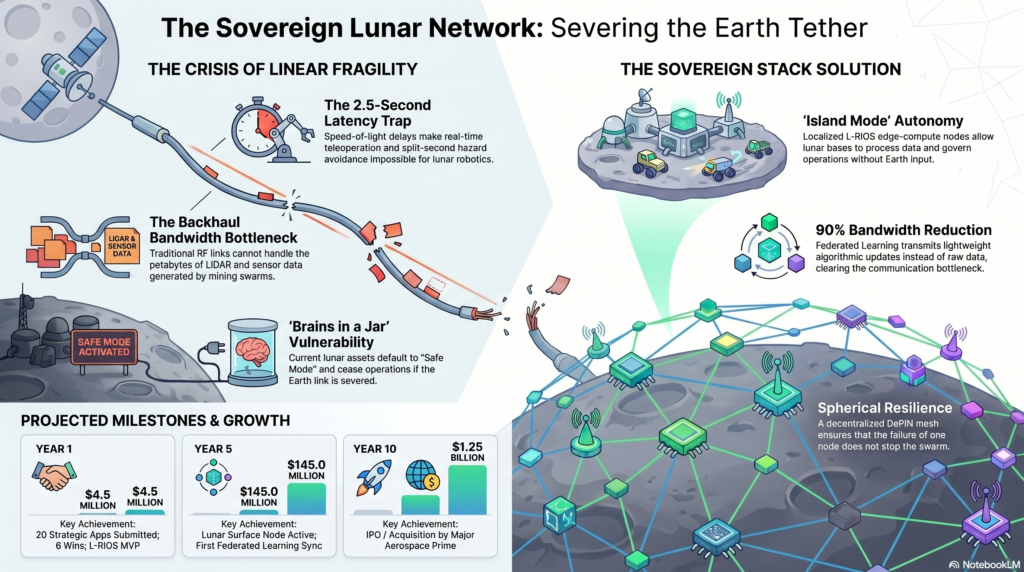
However, as we move from scientific sorties to industrial lunar extraction, this umbilical cord has become a fatal liability. The DSN is no longer a robust link; it is an oversubscribed bottleneck forced to split its finite bandwidth between Mars rovers, the aging Voyager probes, and the burgeoning lunar economy. This model is hitting its physical and economic limits. To achieve industrial scale, we must recognize that the “line” is dying to make way for a more resilient, decentralized structure.
2. The Conflict: Linear Fragility vs. Spherical Resilience
The evolution of lunar infrastructure requires a shift from centralized dependency to localized autonomy. We define this transition as the move from Linear Fragility to Spherical Resilience.
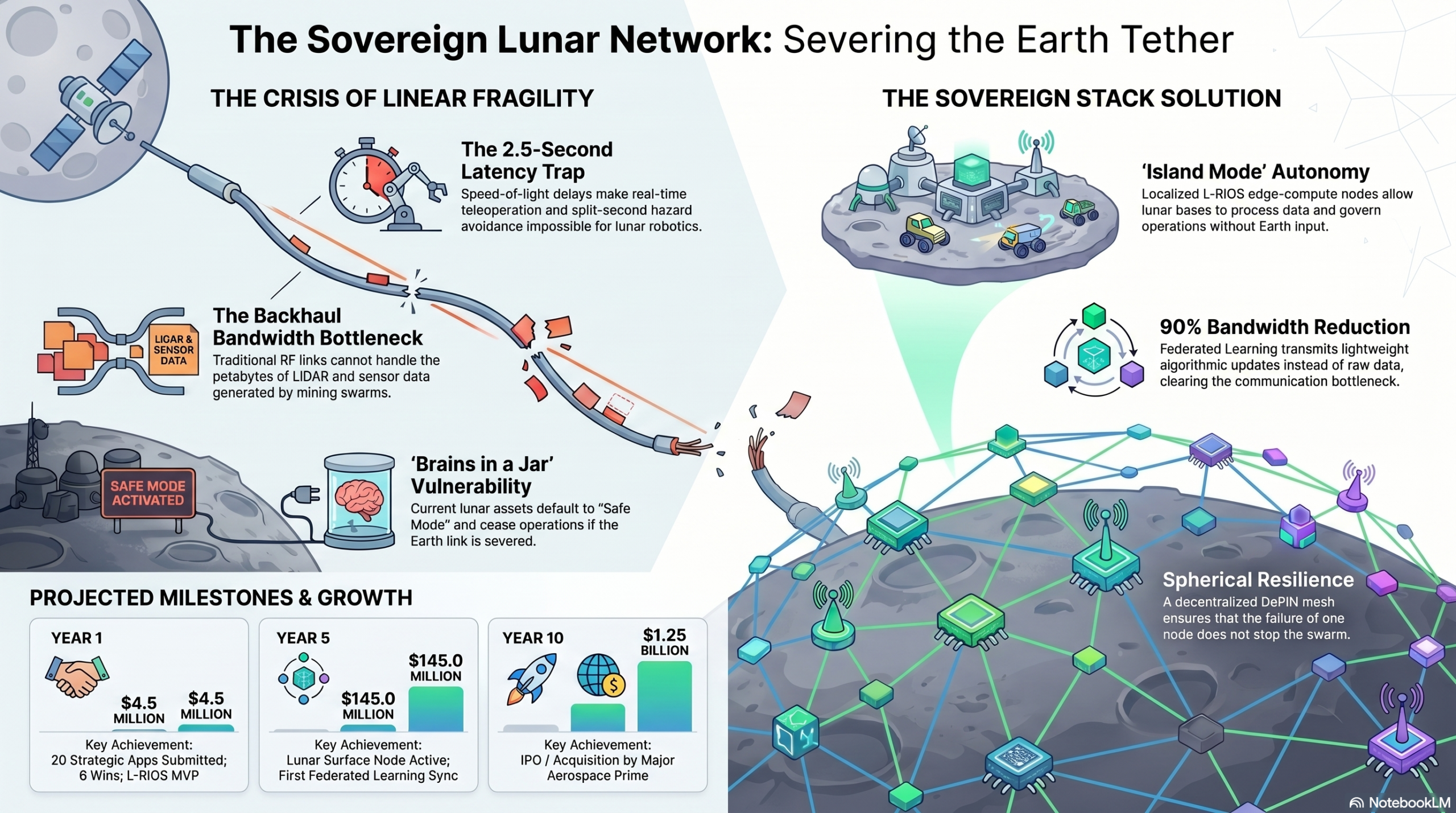
Linear Fragility describes a state where a single break in the data supply chain—whether due to DSN scheduling conflicts, round-trip latency, or signal interference—forces robotic hardware to cease operations and enter a dormant “Safe Mode.” This fragility is compounded by the harsh lunar environment, where signals are often lost to crater-wall multipath fading in metallic shadows or abrasive dust attenuation during active mining.
In contrast, Spherical Resilience treats the lunar surface as a self-healing mesh. This model, adapted from Operation Octagon—a terrestrial proof-of-concept where DeReticular deployed decentralized nodes in extreme environments like the Arizona desert (Node 3) and off-grid Uganda (Node 4)—replaces the single line with a redundant, peer-to-peer hive.
Comparison of Communication Paradigms
| Feature | Linear Fragility (The Old Way) | Spherical Resilience (The New Way) |
| Network Structure | Centralized Point-to-Point (Earth-centric) | Decentralized Mesh / DePIN (Lunar-centric) |
| Primary Vulnerability | DSN Scheduling Conflicts & Round-trip Latency | None; redundant peer-to-peer nodes |
| Operational State during Blackouts | Safe Mode: All industrial operations cease | Island Mode: Continuous autonomous operation |
This paradigm is enabled by a specific suite of decentralized technologies known as the Sovereign Stack.
3. The Sovereign Stack: Architecture of the Mesh
To eliminate the Earth-tether, Sovereign Space Systems (S3) and DeReticular provide the hardware and software architecture necessary for “Sovereign” operations. This isn’t just a branding term; it is a technical state secured by a Hardware Root of Trust, utilizing TPM chips and RF Fingerprinting to ensure every node in the mesh is cryptographically verified.
- The Brain (L-RIOS): The Lunar Infrastructure Operating System. This provides the base with “Black Start” capabilities, allowing it to manage the entire ecosystem without an Earth handshake. To ensure radiation hardening and survival, L-RIOS is housed in localized Lunar Data Centers situated within stable lava tubes.
- The Muscle (Agra Dot Astro): Localized power and comms modules. By utilizing micro-nuclear fission and high-efficiency solar, these modules provide an energy and signal “canopy.” This height is critical to overcome the Moon’s extreme curvature and jagged topography, which create severe line-of-sight obstructions.
- The Motion (Kurb Crawlers): Ruggedized, swarm-capable mining automata. Unlike delicate rovers, these machines use localized proximity signals to coordinate peer-to-peer, adapting to the terrain in real-time.
This decentralized hardware allows the network to enter a state of total independence from the terrestrial cloud.
4. Mastering “Island Mode” and Signal Latency
Architectural resilience on the Moon is measured by a system’s ability to navigate the ~2.5-Second Latency Trap. Because data cannot exceed the speed of light, any Earth-in-the-loop command suffers a delay that makes real-time teleoperation for high-precision tasks—like drilling through varying regolith densities—mathematically impossible.
The Power of “Island Mode”
To bypass this trap, the Sovereign Stack utilizes Island Mode.
So What? Island Mode allows a lunar base to act as a sovereign “Edge Data Center.” It processes its own telemetry and continues industrial extraction even when Earth is entirely dark due to solar flares or orbital occlusions. The base becomes the master of its own logic, relegating Earth to the role of an asynchronous observer.
While Island Mode maintains operational continuity, the Federated Learning protocol ensures the swarm continues to evolve its intelligence.
5. Federated Learning: Solving the Bandwidth Bottleneck
Traditional lunar missions suffer from “Asymmetrical Data Flow.” A mining swarm using LiDAR and 4K video generates petabytes of data, but the radio “pipe” back to Earth is far too narrow to carry it. Federated Learning serves as “Zero-Knowledge Data Arbitrage,” protecting the privacy of industrial data while solving the bandwidth crisis.
The Federated AI Workflow
Instead of moving massive raw data to a terrestrial model, we move the model to the data:
- Local Encounter: A Kurb Crawler hits a patch of unexpectedly dense basalt-mixed water ice.
- Edge Processing: The rover analyzes the physical resistance on its onboard GPU, training a solution locally (e.g., an optimized pulsed drill rhythm).
- Federated Transmission: The rover sends a tiny, lightweight algorithmic update—only 45 KB—to the local Lunar Data Center, rather than petabytes of raw video.
- Swarm Sync: The data center instantly shares this “instinct” with the rest of the fleet via the mesh.
This process reduces bandwidth requirements by over 90%, allowing the swarm to get smarter in real-time without ever clogging the DSN link.
6. The Shackleton Crater Scenario: Intelligence vs. Instinct
Consider a swarm of Kurb Crawlers operating in the permanent shadows of the Shackleton Crater. In a Legacy System, if a rover’s drill overheats while hitting iron-rich regolith, the machine would freeze, enter “Safe Mode,” and wait hours for Earth-side engineers to diagnose the fault. The entire mining operation stalls.
In a Sovereign Mesh, the rover’s onboard L-RIOS identifies the thermal spike, calculates a new torque pattern, and resumes the mission in milliseconds. It then broadcasts the optimized 45 KB drill profile to the rest of the swarm.
“The intelligence of one machine becomes the instinct of the entire swarm without ever waiting for an Earth signal.”
This shift from communication to autonomous computation is the final step in establishing a viable multi-planetary economy.
7. Conclusion: Achieving Lunar Sovereignty
The “Death of the Line” is the necessary evolution for lunar industrialization. By cutting the umbilical cord, we transition from fragile, tethered experiments to a resilient, sovereign industrial engine.
Strategic Imperatives for Future Lunar Planners:
- Establish Computational Sovereignty by treating the lunar surface as a network of localized Edge Data Centers rather than a “dumb terminal” for Earth.
- Eradicate bandwidth bottlenecks by adopting Federated Learning to synchronize swarm “instincts” via lightweight algorithmic updates.
- Establish “Island Mode” as the baseline for all industrial hardware, ensuring that the failure of a terrestrial link never results in the death of a lunar mission.