
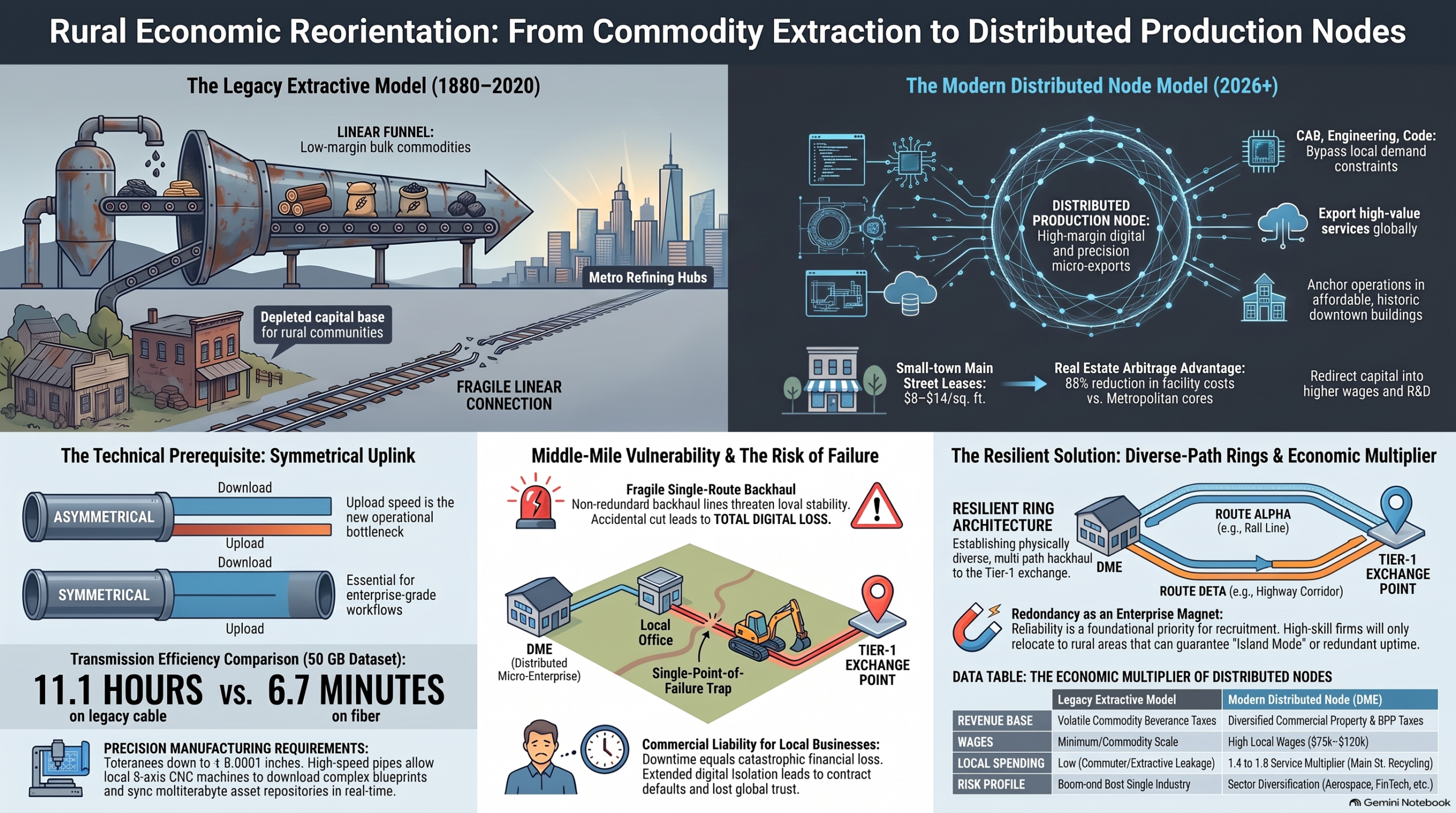
From Extractive Funnels to Sovereign Nodes: A Comparative Analysis of Rural Economic Architectures
- The Structural Evolution of Rural Production
The 20th-century rural economy was architected as an “extractive funnel,” a system designed to harvest raw, low-margin commodities—timber, grain, and minerals—for transport to metropolitan processing hubs. This model was sustained through industrial recruitment, a strategy where municipalities offered steep tax abatements to attract large-scale branch plants or call centers. This created systemic fragility: when corporate headquarters consolidated or relocated, rural communities suffered immediate capital flight. Today, failure to decouple from linear infrastructure is a choice for managed decline. Transitioning to a “sovereign node” model is not a suggestion; it is the fundamental prerequisite for long-term fiscal stability in a distributed production era.
Paradigm Shift: Extraction vs. Distributed Nodes
Dimension Historic Commodity-Extractive Model Modern Distributed Node Model
Capital Flow Extractive: Values flow out to metro/corporate hubs Circular: High-margin exports retain local value
Primary Infrastructure Linear: Rails, highways, and one-way grids Spherical: Symmetrical gigabit fiber & microgrids
Margin Profile Low: Bulk commodities subject to market swings High: Specialized services and precision parts
Economic Sensitivity High: Vulnerable to single-industry shocks Low: Diversified through global digital access
The Risk of “The Line” and Spatial Reclassification
Rural communities have historically been defined by “The Line”—a state of linear fragility where the town sits at the terminal end of centralized power grids and corporate supply chains. This dependency is exacerbated by federal spatial taxonomies. Under the 25% Commuting Rule (Employment Interchange Measure), if a quarter of a rural county’s workforce commutes to an urban core, the OMB reclassifies the entire county as “Metropolitan.” This statistical “swallowing” bars the community from essential federal rural aid, forcing it into a metropolitan shadow where it cannot compete for capital. Symmetrical gigabit fiber acts as the catalyst for decoupling commercial scalability from this physical geography, allowing the rise of the Distributed Micro-Enterprise (DME).
- The Operational Economics of the Distributed Micro-Enterprise (DME)
The Distributed Micro-Enterprise (DME) is the strategic alternative to the low-wage branch-plant model. DMEs are highly skilled firms of 3 to 25 employees that leverage “Real Estate and Operating Cost Arbitrage” to maintain superior margins. However, the path to DME development is blocked by the Construction Cost Inversion: in many rural interiors, building a new facility costs 220–320 per square foot, while local comps yield an appraisal of only 90–140 per square foot. This “appraisal gap” creates a financing deficit that prevents private banks from underwriting new production space, making the adaptive reuse of historic “Main Street” buildings a strategic necessity rather than an aesthetic choice.
The Technical Prerequisite: Symmetrical Gigabit Architecture
Modern enterprise workflows are paralyzed by the “Upload Bottleneck.” Rural firms must have symmetrical pipes to participate in real-time CAD/CAM co-authoring and remote machine telemetry.
Connection Type Upload Capacity 50 GB Dataset Transfer Time (e.g., LiDAR Point Cloud)
Legacy Asymmetric 10 Mbps 11.1 Hours (Failure-Prone)
Symmetrical Fiber 1,000 Mbps 6.7 Minutes (Secure, Real-Time Collaboration)
Real Estate Arbitrage and Savings
Operating from a non-core downtown provides massive leverage compared to metropolitan or suburban overhead.
Expense Category Tier-1 Metro Core Suburban Office Park Small-Town Main Street Rural Arbitrage Savings (%)
Commercial Rent $227,500 $98,000 $38,500 -83.1% vs. Metro
Facility/CAM Fees $36,000 $14,000 $1,200 -91.4% vs. Suburban
Cost per Workstation $23,500 $10,200 $3,600 -84.7% vs. Metro
The Four Pillars of Rural DME Diversification
This arbitrage allows rural firms to execute “Digital-to-Physical” workflows, exporting high-value products globally:
- Specialized Finance: Forensic blockchain auditing, cross-border tax, and R&D credit defense.
- Engineering: Geospatial LiDAR modeling, NEPA permitting, and hydrological simulations.
- Software & Media: Cloud-native API integration and real-time 3D game engine (Unreal/Unity) pipelines.
- Precision Manufacturing: 5-axis CNC machining of titanium surgical tools and aerospace sensor housings.
High-value production, however, is worthless if the data pipe is severed.
- The Middle-Mile Imperative: Redundancy and Operational Resilience
Last-mile fiber is a superficial solution if the “middle-mile” backhaul is fragile. Redundancy is the mandatory price of entry for sustaining modern rural production nodes. Communities must transition from linear fragility to Spherical Resilience—an “Island Mode” capability where the town can operate independently during external grid or network collapses.
Risks of Single-Route Dependency
A Fragile Single-Route Backhaul creates unacceptable commercial liability for DMEs hosting live applications or performing time-sensitive audits. Technical risks include:
- Physical Severance: A single backhoe cut 80 miles away results in total local economic blackout.
- Administrative Vulnerability: Dependence on a single provider often leads to “Paper Availability,” where ISPs report high speeds to the FCC while delivering unstable, unusable links.
The Sovereign Enclave Philosophy
A true sovereign enclave must deploy the “Sovereign Stack.” This includes 700V DC Microgrids and Thermochemical Gasification of agricultural waste to provide local baseload power that survives grid failure. Rural Electric Cooperatives (RECs) are the ideal anchors for this transition. Unlike investor-owned utilities (IOUs) that demand rapid returns, RECs operate on 20- to 40-year repayment cycles, allowing them to build out the low-density infrastructure required for resilient nodes.
- Analyzing Single-Point Failures: Threats to Local Business Continuity
Infrastructural instability transforms technical glitches into catastrophic economic shocks. Without redundancy, rural businesses face “Complete Digital Loss” across vital sectors:
- Precision Agriculture: Autonomous fleets fail as RTK telemetry drops, halting critical harvest windows.
- Institutional Telehealth: Loss of eICU feeds forces patient transfers to metro centers, draining local revenue and creating transport liabilities (3,500–12,000 per run).
- Precision Manufacturing: Interrupted cloud-linked CAM processing can ruin high-value titanium billet alloys during toolpathing.
- Knowledge Services: Suspension of real-time CAD co-authoring damages client trust and violates secure data protocols.
The Capacity Chasm and Actuarial Retreat
The “Capacity Chasm” is an administrative single-point failure. A “Two-Desk” town hall lacks the staff to challenge flawed FCC maps or navigate the Letter of Credit (LOC) hurdle and BABA (Build America, Buy America) compliance required for federal grants. This leads to Actuarial Retreat, a state of business uninsurability:
- Portfolio Truncation: National carriers use algorithms to quietly withdraw from rural ZIP codes due to unmanaged convective storm risks.
- ISO PPC Class 9/10 Ratings: Depleted volunteer fire rosters and low water pressure result in “unprotected” status.
- Premium Surges: Forced-place surplus line premiums consume 15% to 25% of local net income, leading to mortgage defaults and structural abandonment.
- Synthesis: The Municipal Roadmap to Spherical Resilience
Rural economic independence is secured through the export of high-value services and precision products, not the outmigration of human capital. Civic leaders must replace outdated industrial recruitment with the “Sovereign Node Playbook.”
Rural Municipal Policy Conversion Checklist
Outdated Approach Modern Sovereign Node Strategy
Zoning: Rigid, single-use Euclidean codes Form-Based Codes: Allowing clean, 5-axis CNC live-work production
Infrastructure: Chasing single-employer factories Sovereign Stack: 700V DC Microgrids & 3-Phase 480V Power Conversion
Econ Dev: Tax abatements and raw exports Local Multipliers: DMEs exporting high-margin precision services
The Connectivity Fiscal Multiplier
Investment in symmetrical fiber yields a Connectivity Fiscal Multiplier of 1.4 to 1.8. Stability is achieved through localized payroll recycling and Business Personal Property (BPP) taxes on high-value equipment like server racks and CNC mills, which provide a more stable revenue stream than fluctuating residential assessments.
The Four-Phase Transition Protocol
- Audit & Isolate: Perform an “Island Mode” audit to identify nodes that must survive a regional blackout.
- Secure Baseload: Partner with RECs to deploy Layer 1 microgrids using IRA Section 6417 Direct Pay.
- Erect the Mesh: Deploy autonomous mesh communications and on-premises edge computing to secure data sovereignty.
- Deregulate & Activate: Modernize zoning to invite DMEs into historic Main Street spaces and clear the path for global exports.
Resilience is a policy choice. Small towns that fail to build sovereign infrastructure choose to remain extractive colonies at the terminal end of a failing line. The future belongs to the nodes.