
How a 1963 Trucker Radio Network Shattered Ma Bell—and Why the Battle for the Web Echoes It Today
In 1963, a simple logistical headache unfolded along U.S. Highway 66. Commercial semi-trailers hauling freight between Chicago and St. Louis needed reliable, low-cost dispatch communication with their home terminals. However, mobile two-way radio signals faded out after just 30 to 50 miles, and leasing telephone lines from the American Telephone and Telegraph Company (AT&T) was prohibitively expensive for small fleet operators. To make matters worse, AT&T strictly prohibited third-party radio systems from connecting to its Bell lines.
This localized frustration sparked a chain reaction that ultimately dismantled the largest corporate monopoly in human history. At the time, the Bell System controlled over 80% of U.S. telephone lines and nearly 100% of the long-distance network, operating as a legally sanctioned natural monopoly under the Communications Act of 1934. AT&T insisted that unified, end-to-end control was mandatory to preserve the network’s technical and systemic integrity. Yet, a tiny radio initiative along Route 66 proved that physical gatekeepers consistently overestimate their own indispensability—and that technological defiance can shatter even the most entrenched chokepoints.
The historical trajectory from 1960s trucking radios to today’s digital infrastructure reveals critical insights about monopolies, regulation, and network architecture. Here are six surprising takeaways from the battle against Ma Bell and its modern legacy.
Takeaway 1: The Long-Distance Revolution Was Started by Truckers on Route 66
The overhaul of a multi-billion-dollar telecommunications market began not as a grand legal plot hatched in Wall Street boardrooms, but as a practical workaround for Midwestern truck drivers. In December 1963, John D. “Jack” Goeken, a two-way radio salesman based in Joliet, Illinois, founded Microwave Communications, Inc. (MCI). Goeken’s initial concept was disarmingly simple: construct a chain of low-power microwave relay towers along 250 miles of Route 66 between Chicago and St. Louis. Trucking companies could place base stations near a tower, transmit voice signals via microwave, and communicate with long-haul fleets at a fraction of AT&T’s leasing rates.
When Goeken applied to the Federal Communications Commission (FCC) for microwave radio construction permits, AT&T—alongside subsidiaries Illinois Bell and Southwestern Bell—mounted fierce opposition. AT&T’s legal army argued that MCI was engaging in predatory “cream-skimming” by targeting profitable, high-density traffic corridors. This, AT&T claimed, would destroy the delicate system of internal cross-subsidies that kept rural and residential local phone service affordable.
The narrative climax of this early battle arrived after six years of bureaucratic delays and hearings: in 1969, the FCC issued the landmark MCI Decision (Docket 16509) by a razor-thin 4-to-3 vote, granting MCI permission to build its experimental link. Goeken’s humble trucker radio problem had unexpectedly punched the first hole in Ma Bell’s armor, proving that an alternative microwave path could bypass the monopoly’s physical wires entirely.
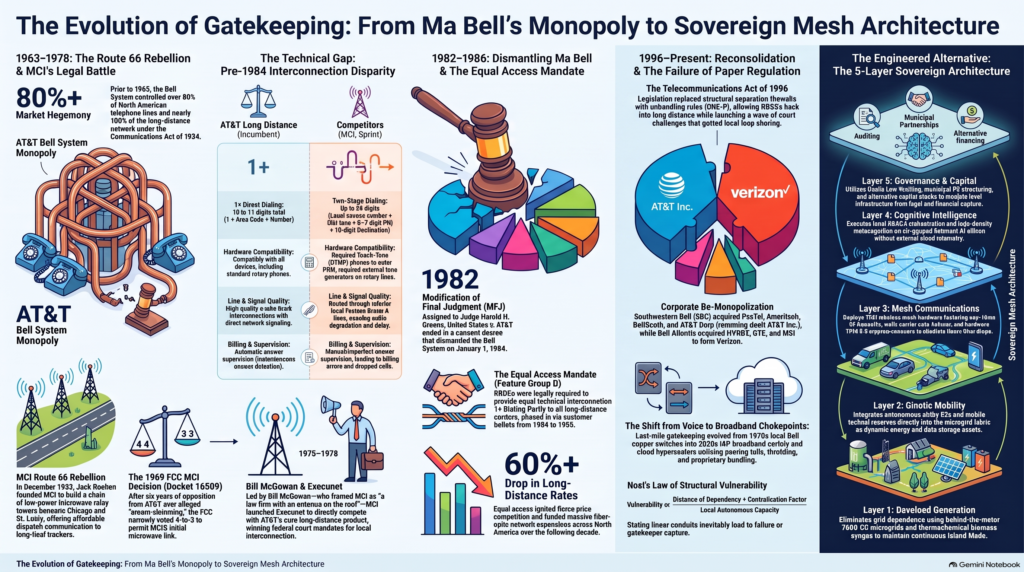
However, Goeken lacked the massive capital and national strategy required to fight AT&T long-term. In 1968, he partnered with William G. “Bill” McGowan, a venture capitalist and consultant with an engineering degree and a Harvard MBA. McGowan recognized that Goeken’s trucker radio network was a operational blueprint to dismantle the entire Bell System. McGowan restructured the company into MCI Communications Corporation in 1972, raised venture capital, and famously elevated legal and regulatory warfare into MCI’s primary operational weapon.
“MCI is a law firm with an antenna on the roof.”
— Bill McGowan
In 1975, MCI launched Execunet, a shared-switch service allowing subscribers to dial into MCI’s network and reach any telephone number across the country, entering direct competition with AT&T’s core long-distance product. When the FCC attempted to halt Execunet at AT&T’s request, MCI counterattacked in federal court. Between 1977 and 1978, the U.S. Court of Appeals for the D.C. Circuit repeatedly ruled in MCI’s favor, forcing AT&T to grant MCI local exchange interconnections nationwide.
Takeaway 2: The “24-Digit Nightmare”—How Monopoly Sabotage Made Calling Competitors Miserable
Even after courts mandated that AT&T interconnect with competitors, the incumbent weaponized malicious compliance and deliberate user-experience friction to protect its physical chokepoint. Throughout the 1970s, AT&T maintained pristine technical standards for its own long-distance division while dumping competitors like MCI onto inferior local connections known as Feature Group A.
AT&T legally defended this severe technical disparity by offering MCI discounted interconnection fees, using lower wholesale pricing as a cover to justify an intentionally degraded user experience.
Feature Comparison: AT&T 1+ Direct Dialing vs. Competitor Two-Stage Dialing
Dialing Method AT&T: Direct 1+ Dialing required entering 1 + Area Code + Number (7 to 11 digits total).
Competitors (MCI): Two-Stage Dialing required dialing a 7-digit local access number, waiting for a second dial tone, entering a 5-to-7-digit security PIN, and then dialing the 10-digit destination number (up to 24 digits total).
Phone Compatibility AT&T: Functioned seamlessly across all standard rotary dial and Touch-Tone phones.
Competitors (MCI): Required Touch-Tone (DTMF) signaling to transmit authorization PINs; completely useless on rotary phones without purchasing an external acoustic tone generator.
Routing & Audio Quality AT&T: Connected directly via high-quality 4-wire trunk interconnections with direct network signaling.
Competitors (MCI): Routed through inferior Feature Group A local lines, suffering from severe line noise, lower audio levels, and delayed call setups.
Call Completion & Billing AT&T: Built-in automatic answer supervision instantly detected when the receiving party picked up.
Competitors (MCI): Manual or imperfect answer supervision caused frequent dropped connections and improper billing charges.
By forcing consumers to punch in up to 24 digits on scratchy, noise-plagued lines while AT&T customers enjoyed seamless 1+ dialing, Ma Bell demonstrated how an incumbent can protect a physical bottleneck through engineered user frustration and subtle technical degradation.
Takeaway 3: Judge Greene’s Structural Solution Created the “Golden Era” of Telecommunications
In November 1974, the U.S. Department of Justice filed a monumental antitrust lawsuit against AT&T (United States v. AT&T), alleging violations of Section 2 of the Sherman Act through cross-subsidization and exclusionary interconnection practices. In 1978, the case was assigned to U.S. District Judge Harold H. Greene, a disciplined jurist who rejected AT&T’s stall tactics, set aggressive discovery deadlines, and pushed the case to trial in 1981.
“The government’s evidence proved AT&T had deliberately used its monopoly power in local distribution to block competition in long distance and equipment.”
— Judge Harold H. Greene (denying AT&T’s 1981 Motion to Dismiss)
Recognizing an inevitable court-ordered defeat, AT&T negotiated a settlement with the Department of Justice. On August 24, 1982, Judge Greene issued the Modification of Final Judgment (MFJ), taking effect on January 1, 1984. The consent decree instituted radical structural firewalls:
- The Divestiture: AT&T was forcibly shattered, spinning off its 22 local Bell Operating Companies into seven independent Regional Bell Operating Companies (RBOCs), known as the “Baby Bells” (Ameritech, Bell Atlantic, BellSouth, NYNEX, Pacific Telesis, Southwestern Bell, and US West).
- Line-of-Business Firewalls: The Baby Bells retained local exchange monopolies but were strictly prohibited from offering long-distance services or manufacturing equipment. AT&T retained its long-distance division, Western Electric, and Bell Labs.
- The Equal Access Mandate: Local operating companies were legally mandated to provide all long-distance carriers (AT&T, MCI, Sprint) with interconnection “equal in type, quality, and price to that provided to AT&T.”
Codified as Feature Group D (FGD), Equal Access introduced true “1+ Dialing Parity,” replacing the severely degraded Feature Group A (FGA) lines. Consumers received ballots in the mail to select their Primary Interexchange Carrier. Dialing 1 + Area Code + Number automatically routed the call through the chosen provider with identical audio quality and zero extra digits.
Separating local line ownership from long-distance competition ignited a golden era of innovation between 1984 and 1996. Long-distance rates plummeted by over 60%. To capture market share, MCI constructed the world’s first transcontinental single-mode fiber-optic network, while Sprint rolled out its pristine “pin-drop” clear fiber architecture, forcing AT&T to rapidly modernize its own legacy infrastructure.
Takeaway 4: Paper Laws Couldn’t Stop “Ma Bell” from Reassembling Itself
Despite the triumphs of the 1984 breakup, legal decrees and regulatory watchdogs proved incapable of preventing long-term corporate reconsolidation. The Telecommunications Act of 1996 dismantled the MFJ’s structural firewalls under the banner of deregulation. In exchange for opening local loops to competitors via Unbundled Network Elements, the Baby Bells were permitted back into long distance. Subsequent court rulings, most notably U.S. Telecom Ass’n v. FCC, gutted local loop unbundling mandates, starving competitive local exchange carriers of capital and driving them into bankruptcy.
What followed was a swift wave of corporate mergers that systematically reassembled the ancient monopoly into a modern duopoly:
- AT&T Inc.: Southwestern Bell (SBC Communications) acquired Pacific Telesis, Ameritech, SNET, and BellSouth. In 2005, SBC purchased its former parent company, AT&T Corp., adopting the historic name AT&T Inc.
- Verizon: Bell Atlantic absorbed NYNEX and GTE to form Verizon. Following WorldCom’s collapse in an $11 billion accounting scandal, Verizon acquired the restructured remnants of MCI in 2006.
By the mid-2000s, the hyper-competitive long-distance landscape created by Judge Greene had collapsed. The decentralized market was once again controlled by two reconstituted Bell giants.
Takeaway 5: Net Neutrality Is Just the Ghost of 1970s Telephony in a New Digital Tollbooth
As circuit-switched copper lines gave way to Voice over IP (VoIP), mobile networks, and high-speed broadband, long-distance voice ceased to exist as a separate billable service. However, the core technical and economic debate merely migrated from voice circuits to broadband last miles, mobile carriers, and cloud hyperscalers.
Modern broadband Internet Service Providers—primarily the reconstituted Bell descendants alongside cable monopolies—occupy the exact same gatekeeper bottleneck today as Ma Bell did in the 1970s. Rather than degrading analog voice calls via Feature Group A line noise, modern last-mile gatekeepers face financial incentives to throttle peering links, impose data caps, extract transit tolls from independent edge providers, and introduce artificial latency.
This structural dynamic is governed by the 1,000-Mile Failure Model—the inherent vulnerability created whenever critical human or economic activity relies on long, centralized, single-point conduits like remote cloud availability zones, high-voltage transmission lines, or monopoly fiber trunks. This principle is formally expressed by Noel’s Law of Structural Vulnerability:
Vulnerability ∝ (Distance of Dependency × Centralization Factor) / Local Autonomous Capacity
“When you petition an administrative agency for ‘Equal Access’ or ‘Net Neutrality,’ you are conceding ownership of the physical layer to your adversary. You are negotiating the terms of your own tenancy.”
— DeReticular Consortium Monograph
The cyclical regulatory battles at the FCC—classifying broadband under Title II common carriage in 2015, repealing it under Title I in 2017, and moving to reinstate Title II rules in 2024—mirror the endless bureaucratic proceedings waged by Goeken and McGowan half a century ago. Relying on administrative rules while leaving physical wires in the hands of centralized incumbents perpetually recreates the same last-mile tollbooth.
Takeaway 6: True Parity Cannot Be Litigated—It Must Be Engineered
The ultimate lesson of six decades of telecommunications history is that legal decrees and regulatory mandates offer only temporary relief against centralized chokepoints. When an incumbent controls the physical wire, an asymmetric power dynamic is created by the physics of the conduit itself. Real operational independence requires engineering architectures that bypass the gatekeeper entirely at the physical layer.
Just as Jack Goeken used private microwave towers in 1963 to circumvent AT&T’s local exchange monopoly, modern decentralized engineering focuses on “Island Mode” architectures designed to eliminate physical dependency. As an editorial case study in modern sovereign edge engineering, frameworks like DeReticular’s 5-Layer Sovereign Architecture illustrate how complete “de-reticulation” systematically neutralizes physical chokepoints across every operational layer:
- Layer 1 (Baseload Generation): Bypasses vulnerable electric power utilities using behind-the-meter 700V DC microgrids and thermochemical biomass syngas to maintain continuous, self-sufficient energy on-site without utility interconnection queues.
- Layer 2 (Kinetic Mobility): Integrates autonomous utility EVs and nomadic tactical battery assets directly into the local microgrid fabric, turning transport fleets into dynamic energy reserves.
- Layer 3 (Mesh Communications): Bypasses centralized fiber trunks through TriFi wireless mesh architectures featuring sub-16ms dynamic channel handoffs, multi-carrier auto-failover, and hardware TPM 2.0 cryptoprocessors on every node.
- Layer 4 (Cognitive Intelligence): Eliminates remote cloud API dependencies by executing real-time SCADA orchestration, predictive analytics, and metacognitive logic on air-gapped local silicon engines (such as Remnant) directly at the edge.
- Layer 5 (Governance): Utilizes Noel’s Law auditing and municipal public-private structures to shield physical assets from administrative and financial capture.
When a node generates its own power, routes its own data packets over a local wireless mesh, and executes its own cognitive logic on air-gapped silicon, the central gatekeeper is not merely regulated—it becomes mathematically obsolete.
Conclusion: The Line Is Dead—What Will You Build at the Edge?
From the 1963 trucker radio towers along Route 66 to the breakup of AT&T and today’s endless battles over broadband throttling and cloud lock-in, network history demonstrates a single immutable truth: centralized conduits will always attempt to extract rents from the traffic flowing through them. While Judge Greene’s intervention proved that monopolies could be temporarily unbundled, the subsequent reconsolidation of Ma Bell showed that paper laws cannot permanently defend an open network if physical control remains centralized.
True operational freedom is never granted by a regulatory commission or a benevolent utility provider; it must be engineered at the autonomous edge through sovereign baseload power, local mesh communications, and decentralized computing.
As modern infrastructure grows increasingly centralized under broadband and cloud cartels, how much of your critical operation relies on a centralized line you do not control?