Implementation Blueprint: Transitioning to Sovereign Edge Automation
1. The Strategic Mandate: Breaking the Cloud-Tether Trap
Modern industrial artificial intelligence faces a critical “design paradox.” While AI integration promises to optimize yields and automate complex diagnostics, the prevailing reliance on cloud-centric architectures introduces structural vulnerabilities that undermine the very efficiency they seek to provide. Cloud dependency forces physical facilities to contend with non-deterministic latency and the risk of data exfiltration. In a kinetic environment, where a millisecond delay can disrupt a control loop and a network dropout can halt a production line, the “cloud-first” approach creates a tether that is fundamentally at odds with the requirement for industrial uptime.
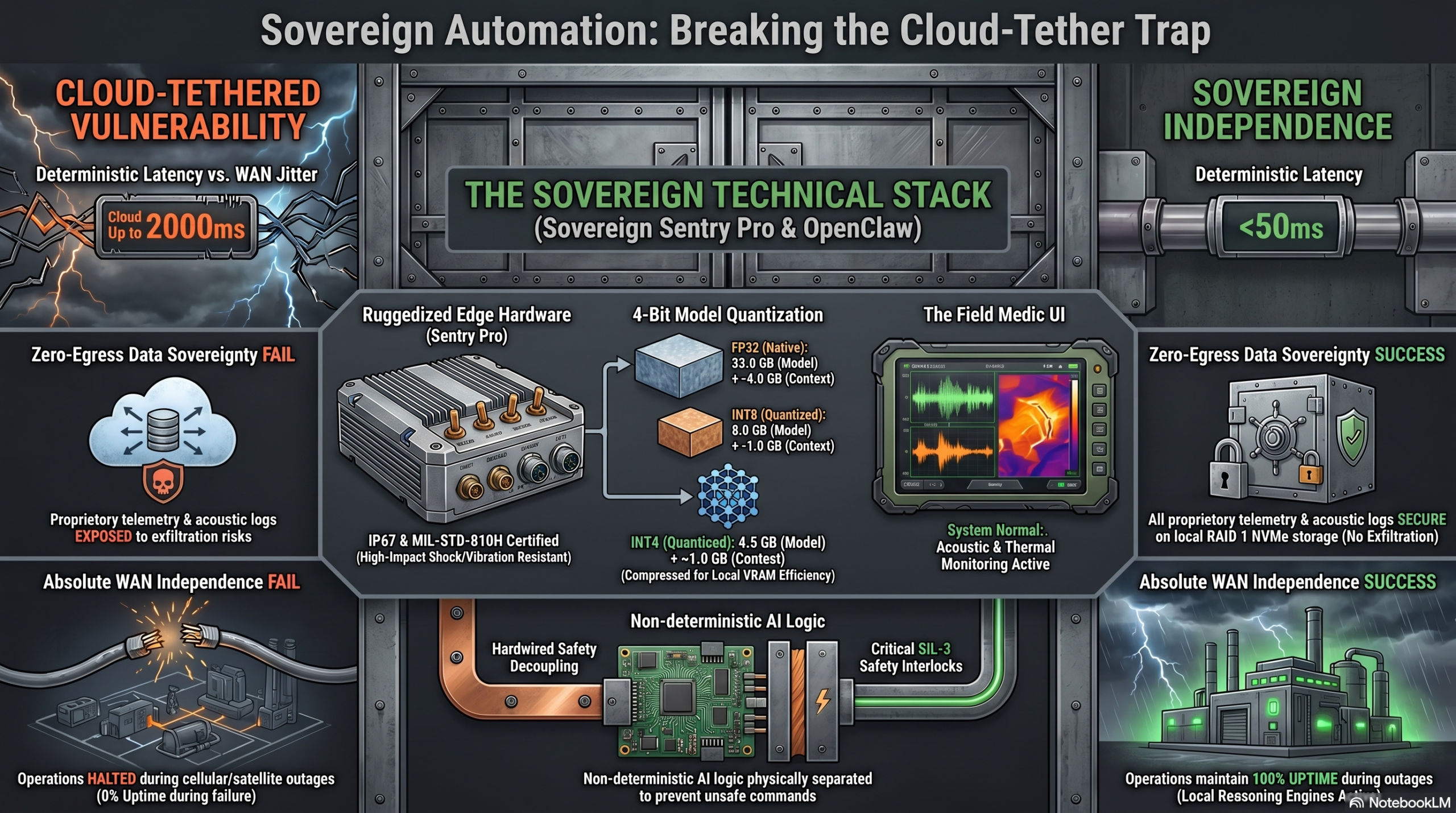
The operational risks of remaining tied to a centralized cloud architecture manifest in four primary failure modes:
- Deterministic Network Deficits: High-level decisions, such as conveyor load balancing, cannot tolerate the non-deterministic latency spikes of wide-area networks (WAN). Jitter ranging from 30ms to 1200ms prevents stable control loops. So What? Unstable loops lead to equipment fatigue and precision errors that degrade product quality.
- WAN Fragility: Remote sites—such as offshore platforms, mines, or isolated agricultural operations—cannot assume continuous connectivity. So What? When the WAN backhaul fails, cloud-tethered intelligence ceases to function, immediately halting predictive maintenance pipelines and leaving complex machinery in sub-optimal, unguided states.
- Data Sovereignty and Exfiltration: Uploading continuous streams of proprietary telemetry and acoustic logs exposes the enterprise to corporate espionage and state-sponsored interception. So What? Loss of intellectual property and operational metadata can compromise competitive advantages and violate evolving privacy compliance frameworks.
- Software Lock-in and the “Right to Repair”: When diagnostic engines require a cloud-based handshake to authorize a mechanical override, operators lose sovereignty. So What? During critical harvesting windows or production runs, waiting for cloud-based authorization can result in losses exceeding thousands of dollars per hour and significant technician dispatch fees.
- https://youtu.be/jseWTK7snQM
The Sovereign Alternative Sovereign Automation is defined by the principle of localized intelligence: the capacity for reasoning and coordination must reside exactly where the physical work is performed.
“The future of industrial stability lies in the transition from cloud-dependence to localized autonomy. By packing dense processing power into ruggedized field units, facilities ensure that even if external communications are severed, the plant remains fully capable of autonomous, optimized operations.”
Transitioning from the theoretical risks of the cloud to the physical requirements of localized hardware requires a rigorous commitment to environmental hardening and compute density.
——————————————————————————–
2. Hardware Provisioning and Environmental Hardening
Transitioning to a sovereign model requires a shift toward “ruggedized” compute clusters. Standard server hardware, designed for climate-controlled data centers, fails rapidly when exposed to the high-vibration, dust-heavy environments typical of heavy industry. Strategic hardware provisioning ensures the “brain” of the operation is as durable as the machinery it controls.
Thermal and Power Audit Protocol Prior to deployment, engineering leads must execute a thermal and power audit of targeted DIN rail cabinets, seeking a power budget of 35W to 75W per node. Environmental specifications must meet the following baseline for “Sovereign” status:
| Feature | Environmental Deployment Specification |
| Chassis Design | IP67-rated, fanless, CNC-milled aluminum with deep cooling fins |
| Shock Resistance | MIL-STD-810H certified (high-impact shock and multi-axis vibration) |
| Operating Window | -40°C to +60°C ambient temperatures |
| Storage Protection | RAID 1 NVMe with Power Loss Protection (PLP) capacitors |
Sovereign Sentry Pro Specifications The Sovereign Sentry Pro serves as the hardware foundation, utilizing 3x redundant, hot-swappable System-on-Modules (SOMs).
- Compute Density: Each node delivers 275 Sparse TOPS of AI compute.
- Memory Architecture: 64 GB LPDDR5 Unified Memory delivering 204.8 GB/s bandwidth.
The Unified Memory Architecture is critical for edge AI because it addresses the decoding bottleneck. In autoregressive models, the processor must load the entire model’s weights from memory into registers for every single token generated; high-speed unified memory ensures this process does not stall the inference engine.
Physical Security Anchors To ensure an absolute air-gap, the hardware features a physical, brass-capped key-switch. Turning this to the “ISOLATE” position physically disables RJ45 and wireless transceivers. Security is further anchored by an on-board TPM 2.0 module, creating a “Trust Root” that verifies cryptographic signatures for all updates, ensuring the system cannot be compromised via remote network vectors.
With the physical enclosure secured, the focus shifts to the mathematical constraints of the models residing within it.
——————————————————————————–
3. Optimization Mathematics: Quantization and Edge Performance
Edge AI requires a strategic shift from “brute-force computing” to precision memory management. Because edge hardware has a fixed memory ceiling, operators must manage the trade-off between model size and operational stability.
Quantization Impact Analysis Quantization maps continuous floating-point weights to lower-precision representations. Using AWQ (Activation-aware Weight Quantization) and Group-Size 128, we can achieve significant compression with minimal reasoning loss.
| Precision | Weight Memory (GB) | Context Overhead (8k) | Perplexity Degradation |
| FP32 | 32.0 GB | ~4.0 GB | Baseline |
| FP16 | 16.0 GB | ~2.0 GB | Negligible |
| INT8 (Q8_0) | 8.0 GB | ~1.0 GB | +0.35% |
| INT4 (Q4_K_M) | 4.5 GB | ~1.0 GB | +2.97% |
The “So What?” of INT4 INT4 quantization is the “golden mean” for industrial edge deployment. The 71.8% reduction in memory overhead allows an 8B parameter model to fit into a small fraction of the Sentry Pro’s memory. This is vital for maintaining a 30% VRAM buffer, which prevents Out-of-Memory (OOM) crashes during multi-agent operations or complex retrieval tasks.
Performance Benchmarking Edge AI computation is divided into the Prefill Phase (compute-bound prompt processing) and the Decoding Phase (memory-bandwidth bound token generation). To calculate Maximum Theoretical Token Generation (T_{max}):
T_{max} = \frac{\text{Memory Bandwidth (B)}}{\text{Model Size (GB)}}
For an 8B model at INT4 (4.5 GB) on the Sentry Pro’s 200 GB/s processor: T_{max} = \frac{200}{4.5} \approx 44.4 \text{ tokens/sec}
In practice, accounting for KV-cache overhead, the system stabilizes at 30–35 tokens/sec. This exceeds the requirements for real-time diagnostic reasoning and automated logging.
——————————————————————————–
4. Software Architecture: The OpenClaw Framework
To eliminate the “Python-runtime tax”—which introduces significant memory overhead and version conflicts—the OpenClaw framework utilizes a native C++ runtime.
The Native Runtime Advantage The OpenClaw stack provides a containerized (Podman) orchestration layer:
- llama.cpp Engine: Customized C++ optimized inference.
- GGUF Format: Optimized binary format for rapid local loading.
- Local Vector DB: SQLite-VSS or Qdrant instances for localized Retrieval-Augmented Generation (RAG).
Protocol Mapping and Ingestion OpenClaw uses local proxies to translate raw industrial bus signals (Modbus, CAN bus, OPC UA) into structured JSON telemetry.
{
  "timestamp": "2026-05-21T14:16:00Z",
  "system": "Hydraulic_Pump_Alpha",
  "metrics": {
    "pump_pressure_psi": 2150,
    "return_flow_gpm": 12.4,
    "oil_temp_c": 54.2
  },
  "active_faults": [0x4F]
}
Localized Data Structures By grounding AI agents in local OEM manuals and schematics through RAG, hallucinations are minimized. A functional example is the “Field Medic” workflow: by combining multi-modal vision (identifying micro-fissures) and acoustic capture (detecting pump cavitation frequencies), the agent can query the local SQLite-VSS for specific repair steps. In field tests, this local intelligence allowed an operator to perform an O-ring substitution and clear a Modbus 0x4F fault without internet access, saving $12,000 in dispatch fees.
——————————————————————————–
5. Phased Implementation Roadmap: The 16-Week Transition
Software is only as reliable as the deployment methodology used to install it. A disciplined rollout is critical for transitioning from legacy PLCs to agentic automation.
The Roadmap Matrix
- Phase 1: Isolation & Decoupling (Weeks 1-4)
- Focus: Telemetry mapping and LAN partitioning.
- Critical Blocker: Lack of network architecture partitioning.
- Action: Install managed network switches with isolated VLANs to segment machine-level traffic from external WAN access.
- Phase 2: Hardware Provisioning (Weeks 5-8)
- Focus: Sentry Pro installation and thermal/power verification.
- Critical Blocker: Cabinet space lacking thermal profiling and vibration protection.
- Action: Mount hardware in DIN rail cabinets using vibration-damping isolation dampers rated for MIL-STD-810H.
- Phase 3: Software Mapping (Weeks 9-12)
- Focus: OpenClaw deployment and local RAG indexing.
- Critical Blocker: Absence of localized Vector Search Structures (VSS) on-site.
- Action: Deploy SQLite-VSS containers and index all technical manuals as low-dimensional vector embeddings.
- Phase 4: Validation & Commissioning (Weeks 13-16)
- Focus: Offline diagnostic loop testing and boundary validation.
- Critical Blocker: Absence of offline cryptographic verification pipelines.
- Action: Establish an Offline PKI (Public Key Infrastructure) pipeline for cryptographically signed USB-C updates.
——————————————————————————–
6. Safety, Governance, and Risk Mitigation
Deploying non-deterministic AI in kinetic environments requires “Safety Decoupling”—the absolute separation of cognitive reasoning from life-safety circuits.
The Deterministic Validator Layer To prevent AI hallucinations from executing dangerous commands, all outputs pass through a Strict Deterministic Parsing Layer. This layer validates AI suggestions against hardcoded schema boundaries and register write limits. If the AI suggests a torque value or pressure setting outside the machine’s safe operating envelope, the software halts execution.
SIL-3 Safety Loops AI logic is restricted to an advisory or optimization role, never overriding life-safety systems.
| Cognitive Agent Tasks (OpenClaw) | Hardwired Safety Tasks (Safety PLC) |
| Predictive diagnostics (e.g., “Field Medic”) | Emergency Stop (E-Stop) hardwired loops |
| Dynamic logistics (e.g., “Foreman”) | Over-pressure relief valves |
| VFD speed optimization (within limits) | High-limit temperature shutdowns |
| RAG-based repair guidance | SIL-3 rated physical interlocks |
Air-Gap Lifecycle Management Sovereign systems are subject to the “Air-Gap Maintenance Tax.” Updates are delivered via cryptographically signed USB-C media. The local TPM 2.0 module verifies the engineering division’s signature before any container or model weight is modified, preventing unauthorized software tampering.
——————————————————————————–
7. Operational Readiness Checklist and Technical Glossary
Sovereign Automation provides the ultimate foundation for the “Right to Repair” and long-term operational independence. By owning the compute and the data, facilities are insulated from the subscription traps of the cloud.
The Readiness Checklist
- [ ] VRAM Budgeting: Does the system maintain a 30% VRAM buffer to prevent OOM crashes?
- [ ] Safety Isolation: Are all critical shutdown systems hardwired to independent, deterministic PLCs?
- [ ] Storage Redundancy: Are local databases stored on RAID 1/5 PLP-equipped NVMe drives?
- [ ] Deterministic Validation: Has the OpenClaw schema validator been configured with hardcoded register limits?
- [ ] Offline PKI: Has a secure pipeline been established for signing and verifying physical media updates?
Technical Glossary
| Term | Definition |
| AWQ | Activation-aware Weight Quantization; preserves salient weights to minimize reasoning loss. |
| CAN bus | Robust vehicle bus standard for microcontroller communication. |
| GGUF | Binary file format optimized for local loading with llama.cpp. |
| Modbus | Serial communication protocol common in industrial electronics. |
| OPC UA | Machine-to-machine protocol for industrial automation. |
| Perplexity | Metric for model coherence; lower is better. |
| RAG | Pattern using local vector indices to ground AI output in factual OEM data. |
| TPM 2.0 | Dedicated microcontroller for securing hardware via cryptographic keys. |
The future of advanced physical intelligence is not in the cloud; it is running silently, securely, and autonomously at the edge.