Concept Guide: The Architecture of a Sovereign Autonomous Economy
1. Introduction: The Evolution of the Internet
The global digital architecture is undergoing a structural metamorphosis. We are transitioning from an internet designed for human-centric information sharing to a decentralized network optimized for autonomous machine coordination. This evolution is best understood as a progression of sovereignty and agency across three distinct phases.
| Phase | Core Function | Dominant Entities |
| Phase 1 (1980s–2000s) | Information Internet: Static data exchange, email, and basic websites. | Nation-states and early telecommunications providers. |
| Phase 2 (2005–2020) | Platform Internet: Cloud computing, centralized SaaS, and data monopolies. | Hyperscale providers (Amazon, Google, Microsoft). |
| Phase 3 (2025 onward) | Autonomous Coordination Internet: AI agents, machine commerce, and decentralized orchestration. | Self-sustaining autonomous economic ecosystems; DePIN networks. |
Defining the Sovereign Autonomous Economy (SAE)
A Sovereign Autonomous Economy (SAE) is a localized or distributed ecosystem where AI agents, decentralized physical infrastructure networks (DePIN), and programmable payment rails coordinate production and finance with minimal institutional dependency.
The “So What?”: This shift marks the end of machines as passive tools. In an SAE, hardware and software become active economic participants. By enabling machines to negotiate prices, procure energy, and manage logistics independently, communities can decouple from centralized cloud monopolies and reclaim total control over their data, compute, and economic destiny.
To realize this vision, we must first architect the physical and software bedrock that ensures operational independence.
——————————————————————————–
2. Layer 1: The Sovereign Bedrock (Operating Systems & Physical Security)
True autonomy requires a departure from the “hyperscaler” model of cloud dependency. The architecture begins with the Rural Infrastructure Operating System (RIOS), a foundational layer designed for hardware abstraction and local AI execution. RIOS utilizes a hardened stack of open-source tools—specifically Kubuntu (Linux) and pfSense—to ensure that critical infrastructure remains locally owned and intelligent.
- Kubuntu (Linux): Serves as the modular, stable base for edge deployment, providing the flexibility needed for local AI inference.
- pfSense: Acts as the sovereign firewall and network security layer, enabling deterministic routing and local policy enforcement.
Strategic Advantages of a Linux-Centric Foundation
Adopting a sovereign Linux stack over proprietary, cloud-native systems provides three non-negotiable benefits:
- Sovereignty: Direct control over the software lifecycle, eliminating vendor lock-in and foreign licensing constraints.
- Telemetry Avoidance: The removal of hidden data extraction and remote dependencies embedded in commercial operating systems.
- Offline Operability: The capacity for long-term maintainability without a persistent connection to a centralized “mothership.”
### **Concept Spotlight: "Island Mode" Operations**
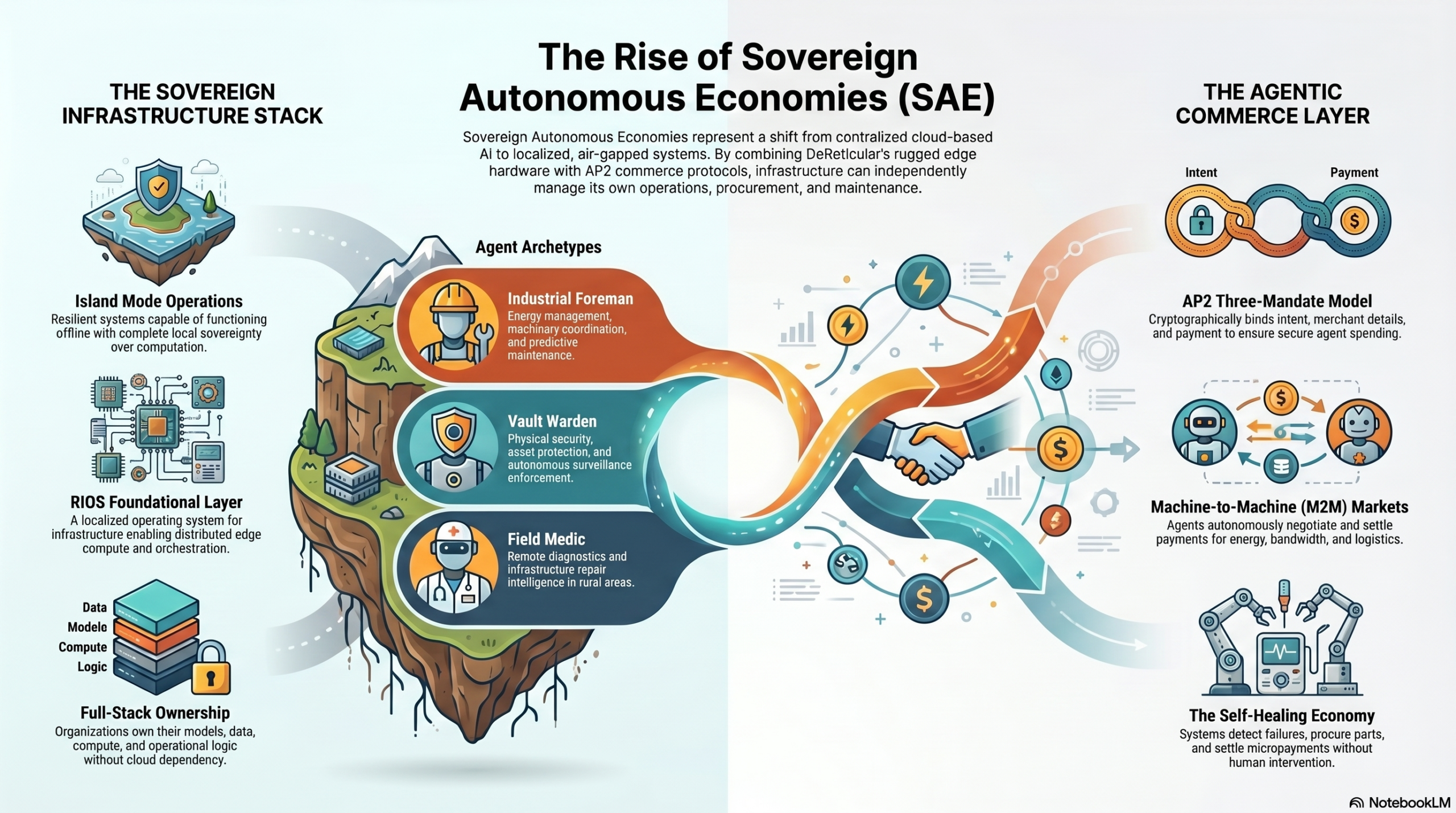
"Island Mode" is the strategic capability of physical infrastructure to function as a resilient cyber-physical system while completely disconnected from the global internet. By operating air-gapped, these systems achieve military-grade resilience, eliminating hyperscaler dependency and ensuring that vital services remain operational during disasters or geopolitical fragmentation.
With the physical hardware and local OS secured, the architecture requires a medium for resilient communication that bypasses centralized oversight.
——————————————————————————–
3. Layer 2: The Resilient Fabric (Decentralized Communication)
The second layer of the SAE stack is the Resilient Fabric, which utilizes Freenet to establish a peer-to-peer (P2P) networking environment. This layer is engineered for censorship resistance and decentralized data distribution, ensuring that information remains persistent across a mesh of independent nodes.
P2P Networking for Rural and Frontier Economies
For regions with unstable banking or intermittent internet, the Resilient Fabric provides a survivable economic substrate through:
- Survivable Communications: The ability for data to traverse a mesh network even when primary backbones are compromised.
- Disconnected Persistence: Vital operational data remains available locally, stored across the P2P network rather than in vulnerable, distant data centers.
- Operational Continuity: Enabling frontier markets to maintain local trade and logistics coordination despite external infrastructure failures.
With a resilient communication fabric established, the infrastructure requires a localized reasoning engine to transform raw data into autonomous decisions.
——————————————————————————–
4. Layer 3: The Intelligence Layer (OpenClaw & Agentic Orchestration)
The OpenClaw Framework serves as the intelligence layer and orchestration middleware. It bridges the gap between raw edge hardware and high-level AI reasoning, transforming “static assets” into “cyber-physical coordination engines.” OpenClaw manages the execution of specialized agents via the Model Context Protocol (MCP), providing the “handshake” necessary for agents to access the tools they need to interact with the physical world.
Agent Archetypes
OpenClaw orchestrates various “Agentic” products, each with a defined mission:
| Agent Type | Primary Mission |
| Industrial Foreman | Orchestrates machinery, energy balancing (e.g., solar microgrids), and predictive maintenance. |
| Vault Warden | Manages physical security, asset protection, and autonomous surveillance. |
| Field Medic | Provides remote diagnostics and autonomous logistics for emergency or rural response. |
| DevOps Sovereign | Acts as the “Deep Admin,” handling cyber-defense and IT operations in air-gapped environments. |
| Sovereign Executive | Manages administrative automation, operational workflows, and enterprise coordination. |
The “So What?”: This intelligence layer allows infrastructure to gain its own “brain.” A power grid is no longer a collection of wires; it becomes a self-optimizing agent capable of monitoring its own health and negotiating its own repairs.
However, localized intelligence is insufficient for a true economy; these agents must be granted the authority to trade resources and settle payments.
——————————————————————————–
5. Layer 4: The Economic Engine (AP2 & x402 Protocols)
For an SAE to thrive, it requires machine-native commerce rails. The Agent Payments Protocol (AP2) and the x402 standard provide the trust framework for autonomous machine spending.
Solving “Trust in Spending” via the Three-Mandate Model
AP2 allows agents to spend money on behalf of humans while staying within strict, cryptographically verifiable boundaries. This prevents “hallucinated purchases” or runaway spending:
- Intent Mandate: Defines authorized intent (e.g., “Purchase solar energy under $0.10/kWh” or “Buy airfare under $400”).
- Cart Mandate: A merchant-signed confirmation of exact products and pricing, ensuring the agent cannot be misled by a vendor.
- Payment Mandate: Binds the payment to the context of the approved Intent and Cart mandates, ensuring final settlement matches the original human authority.
The Programmable Payment Fabric
The system leverages x402, built around the “402 Payment Required” HTTP status code. This turns the web into a programmable payment fabric where machines use stablecoins to settle debts instantly and autonomously, without the latency or fees of traditional banking.
As agents begin to coordinate and transact, the architecture must finally address the problem of verifying who—or what—is acting within the system.
——————————————————————————–
6. The Peak: The Governance and Identity Layer
Identity is the largest unsolved problem in the autonomous economy. Traditional systems (passports, credit scores) fail because machines can replicate, migrate, fork, and evolve at a speed humans cannot track.
Machine Identity vs. Human Identity
Machine identity requires a shift from legal documentation to Hardware Attestation. By verifying the integrity of the physical chip (the “Silicon Root of Trust”), we can ensure that an agent is operating on secure, uncompromised hardware. This is coupled with:
- Cryptographic identity: Persistent, unique signatures for machine accountability.
- Reputation systems: Verifiable histories of an agent’s past economic and operational behavior.
Autonomous Governance
In the SAE, institutional oversight is replaced by Policy Engines and Machine Constitutions. These are machine-readable rule sets encoded directly into the agents’ operational logic. This creates a strategic opportunity for Compliance Layers—autonomous modules that handle KYC/AML and jurisdictional regulations without human intervention.
These integrated layers combine to form a unified, self-governing system capable of surviving and thriving in a fragmented global landscape.
——————————————————————————–
7. Conclusion: The Future of Autonomous Infrastructure Capitalism
By integrating RIOS (Linux), Freenet, OpenClaw, and AP2, we move toward a state of Autonomous Infrastructure Capitalism. In this paradigm, infrastructure is a self-financing, self-repairing, and self-optimizing economic actor.
Key Takeaways for the Sovereign Architect
- The Shift of Power: Economic power is migrating from centralized cloud providers to localized, sovereign ecosystems that own their compute and data.
- Machines as Economic Peers: We are entering an era where agents will negotiate, trade, and settle transactions as primary participants in the global economy.
- Resilience is Sovereignty: The ability to operate in “Island Mode” is no longer a luxury—it is the prerequisite for national and community survival in an age of geopolitical and cyber conflict.
Final Insight Statement: Sovereignty over compute and payments is now equivalent to national economic sovereignty. The future of global competition will be defined not by nations or companies, but by autonomous economic ecosystems with different governance models and the resilience to operate independently of the old world’s centralized rails.