Operational Playbook: The Sovereign Energy Arbitrage Model
1. Strategic Foundation: The Weaponization of Linear Fragility
In the era of decaying legacy infrastructure, centralized power grids—most notably the Electric Reliability Council of Texas (ERCOT)—are defined by “Linear Fragility.” This is not a risk to be managed; it is a market inefficiency to be exploited. DeReticular Energy Intelligence (DEI) operates as a fintech-energy hybrid division designed to weaponize this volatility. While passive consumers are crushed by price swings ranging from -$100/MWh to $5,000/MWh, DEI positions the sovereign node as an “active sovereign lender” of infrastructure.
By adopting a Venture Studio model, DEI acts as the “Strategy Core” and “Lender,” providing the capital and intelligence for independent operating divisions to move from “borrower” to “owner.” The DEI “Sovereign Stack” is the financial weapon of this transition. It integrates the Muscle (Agra Dot Energy’s carbon-negative plasma gasification), the Motion (Kurb Kars autonomous logistics), and the Mind (RIOS), creating a system capable of “Island Mode” defection. This stack ensures that when the centralized grid fails, the sovereign node remains a self-sufficient engine of capital extraction.
Paradigm Shift: Centralized Fragility vs. Sovereign Resilience
| Feature | Traditional Energy (Centralized Fragility) | Sovereign Energy (Localized Resilience) |
| Source | Fossil fuels / Intermittent renewables | Local waste, hemp, livestock biomass |
| Grid Status | Grid-dependent and brittle | Island Mode / Defect-ready |
| Environmental Impact | Carbon-heavy | Carbon-negative / Waste-to-energy |
| Reliability | Susceptible to cascading blackouts | Baseload (Always-on) |
| Primary Unit | Utility-scale (Subject to external limits) | 10 TPD Micro-Unit up to 11 MW Nodes |
By treating grid instability as unharvested kinetic energy, DEI ensures the Sovereign Stack is the primary tool for extracting fiat profit from the terminal decline of legacy systems. This strategy is predicated on the total ownership of physical hardware to bypass the latency of the public cloud.
2. Physical Infrastructure: The Muscle and Storage Layer
Ownership of physical assets is a non-negotiable prerequisite for the DEI model. Public cloud-based trading and remote management introduce unacceptable latency and security risks. By maintaining on-site, edge-based hardware at Node 5—the “Urban Energy Lab” located in the historic Stockyards District of Fort Worth—DEI ensures execution occurs at millisecond speeds, independent of external network health.
The Fort Worth node serves as the hardware blueprint, validating models using local livestock biomass data:
- Industrial Battery Energy Storage Systems (BESS): Commercial-scale Tesla Megapacks managed by RIOS for high-frequency arbitrage.
- Agra Micro-Units (10 TPD Plasma Gasification): Carbon-negative units converting waste into 24/7 baseload power. This ensures the node is never solely grid-dependent and provides the “carbon-negative” data essential for Oracle monetization.
- Sovereign Sentry Servers & RIOS-CC-1000 Compute Racks: High-density clusters that process market telemetry and host local, off-grid cloud infrastructure, preventing capital flight to centralized providers.
The Agra Micro-Unit is the strategic cornerstone. Unlike intermittent renewables, it provides a consistent power source that functions regardless of weather or grid health. This allows the node to maintain 100% uptime, sustaining critical operations or high-density compute tasks while the external grid faces catastrophic collapse.
The physical Muscle is governed by an autonomous intelligence layer that dictates the flow of power based on ruthless financial logic.
3. The Intelligence Layer: RIOS and the Spark Spread Algorithm
The Rural Infrastructure Operating System (RIOS) is the “Mind” of the stack, functioning as a Federated Learning Mesh. Under the strategic oversight of Remnant (Lead Intelligence) and The Trader (Operational AI), lessons learned at Node 5—such as hardware degradation in Texas heat—are instantly pushed to the global network.
The Trader monitors real-time ERCOT pricing, weather models, and grid telemetry with zero personnel overhead. It operates the Spark Spread Algorithm, a mathematical decision-making framework:
- Value Differential Calculation: Remnant constantly calculates the “Spark Spread”—the differential between the cost of electricity and the value of digital compute.
- Dynamic Compute Allocation: If electricity is cheap or prices are negative, the AI directs power inward to spin up servers for complex AI model training for other nodes (e.g., Node 1 Chicago or Node 2 Canada).
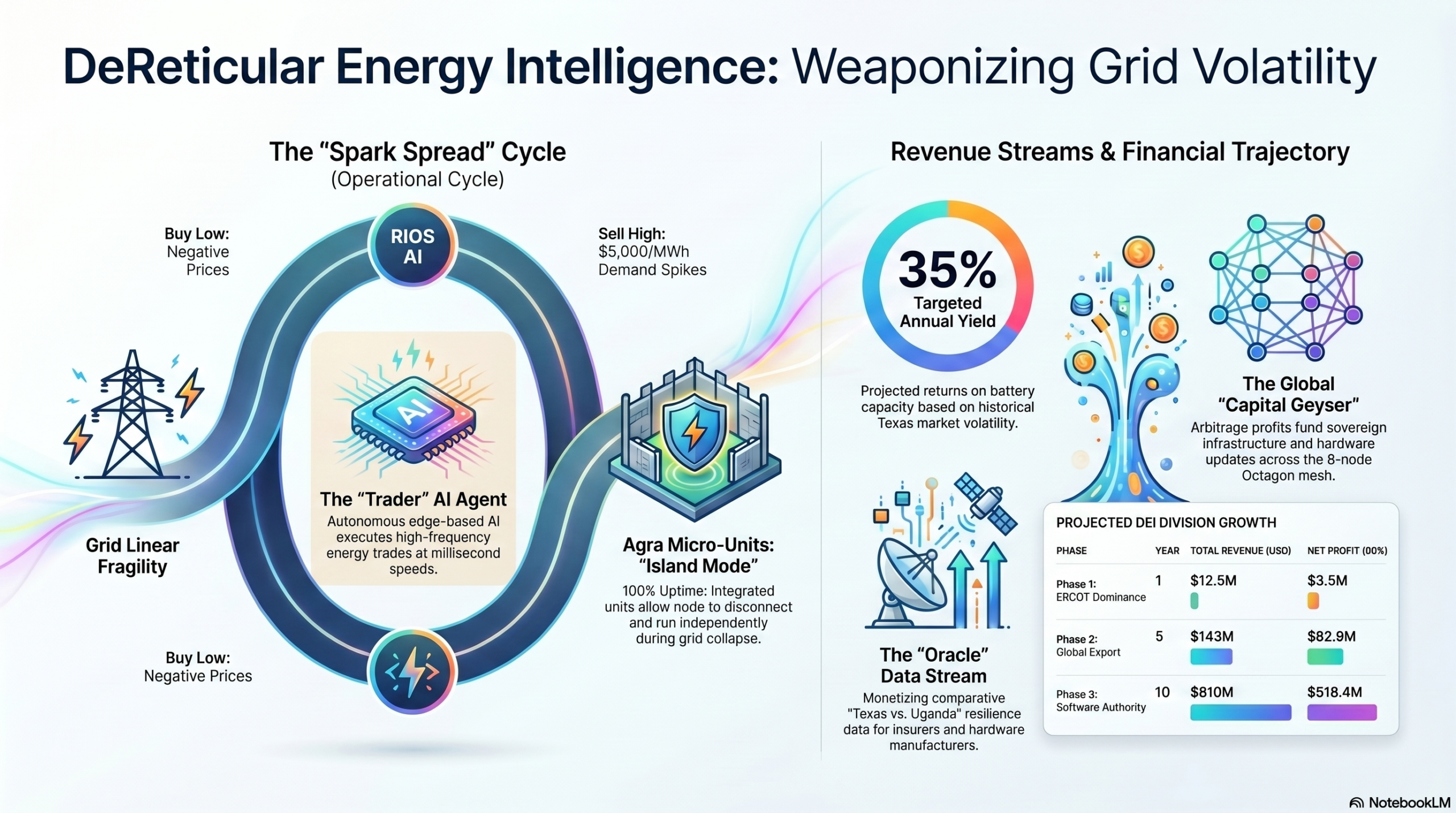
- Threshold of Discharge: During demand spikes, the AI identifies the millisecond the ERCOT price cap is hit (up to $5,000/MWh) and triggers a mass BESS discharge for maximum fiat profit.
This intelligence allows for seamless transitions between operational states, ensuring the facility is never idle and always profitable.
4. Operational Modes: Arbitrage, Compute, and Island Mode
To maximize capital extraction, the facility is multi-modal, adapting to any grid condition:
- Low/Negative Pricing (The Accumulation Phase): Triggered by wind oversupply. The AI charges the BESS at rates where the grid pays DEI to take power, while simultaneously initiating high-density compute tasks.
- High Pricing (The Discharge Phase): Triggered by extreme heat or freezes. The AI suspends non-essential compute and discharges BESS energy to the grid at peak caps.
- Grid Collapse (Island Mode): Triggered by total grid instability. The facility severs all external ties. It utilizes the Agra Micro-Unit for 100% uptime, supporting local microgrids. If grid-selling becomes unfavorable due to regulatory shifts, the AI pivots to producing Agra GTL (Gas-to-Liquid) fuel for physical storage and sale.
The Industrial Foreman acts as the cyber-physical executor. It is an air-gapped agent that translates Remnant’s financial logic into reality, switching inverters and routing power via Modbus/CAN Bus protocols. Its air-gapped nature ensures that the node’s physical safety and IP are protected from grid-based cyber vulnerabilities.
5. The Automated Treasury: Revenue Streams and Financial Proforma
DEI serves as the Automated Treasury for the DeReticular mesh. It acts as a “Capital Geyser,” generating fiat profits that are cryptographically routed via the Locutus Ledger to fund community hubs and hardware in Node 1 (Chicago) and beyond.
The Four Revenue Pillars
- Energy Arbitrage (The Treasury): Pure buy-low/sell-high operations on wholesale markets.
- Ancillary Services (The Peacekeeper): Paid contracts for Frequency Regulation and Voltage Support, providing millisecond grid stabilization to prevent blackouts.
- Resilience Data (The Oracle): Monetizing “Digital Twin” comparative data between Texas and Uganda. This carbon-negative, predictive data is sold to insurers and manufacturers to price risk for global infrastructure projects.
- Software Licensing (RIOS Energy): Licensing “The Trader” and grid-edge management stacks to third-party microgrid operators as “Stability-as-a-Service.”
10-Year Financial Proforma (Values in $000s USD)
| Year | Arbitrage Rev | Grid Services | Data/Software | Total Revenue | Net Profit (80%) |
| 1 | $10,500 | $1,500 | $500 | $12,500 | $3,500 |
| 3 | $45,000 | $6,500 | $3,500 | $55,000 | $19,800 |
| 5 | $110,000 | $18,000 | $15,000 | $143,000 | $62,920 |
| 7 | $210,000 | $35,000 | $65,000 | $310,000 | $161,200 |
| 10 | $450,000 | $80,000 | $280,000 | $810,000 | $518,400 |
6. Global Scaling and Risk Mitigation: From Texas to the Global South
DEI utilizes a Digital Twin strategy. Node 5 (Texas) is the “University,” mastering “Hard Mode” grid math. These algorithms are exported via OTA updates to Node 4 (Uganda), helping balance the internal “Hemp Factory” industrial load with national grid sales.
Strategic Risk Mitigation
- Regulatory Shift: If market rules become unfavorable, DEI pivots to “Island Mode,” utilizing 100% of power for internal AI compute or Agra GTL fuel production.
- Hardware Degradation: Using RIOS “University” data, we perform predictive maintenance, swapping BESS components before failure occurs.
- Competition: Ownership of the physical “Sovereign Stack” provides a millisecond speed advantage over hedge funds who rely on latent public cloud infrastructure.
Three-Phase Expansion Roadmap
- Phase 1: ERCOT Dominance (Years 1-2): Scale Fort Worth to 100MWh; open a second “Hard Mode” site in West Texas to capture wind volatility.
- Phase 2: Global South Export (Years 3-5): Deploy DEI software to Node 4 (Uganda) to maximize export revenue to their national grid.
- Phase 3: Energy-as-a-Software (Years 6-10): Transition to a software-centric model, managing energy for over 100 sovereign nodes globally.
“The grid is failing everywhere. DEI is the system that learns how to catch the falling pieces and turn them into gold.” — Remnant