
Why Your Next Flight Might Be Kept Aloft by a Ghost in the Machine: The End of the Aerospace Parts Drought
The global aviation fleet is effectively under house arrest. Despite record-breaking travel demand, the industry is paralyzed by a “Parts Drought” that has seen the average age of commercial aircraft climb from 14 years in 2019 to a precarious 16 years today. We are witnessing a unique market paradox: the more we need to fly, the harder it is to keep our assets in the air.
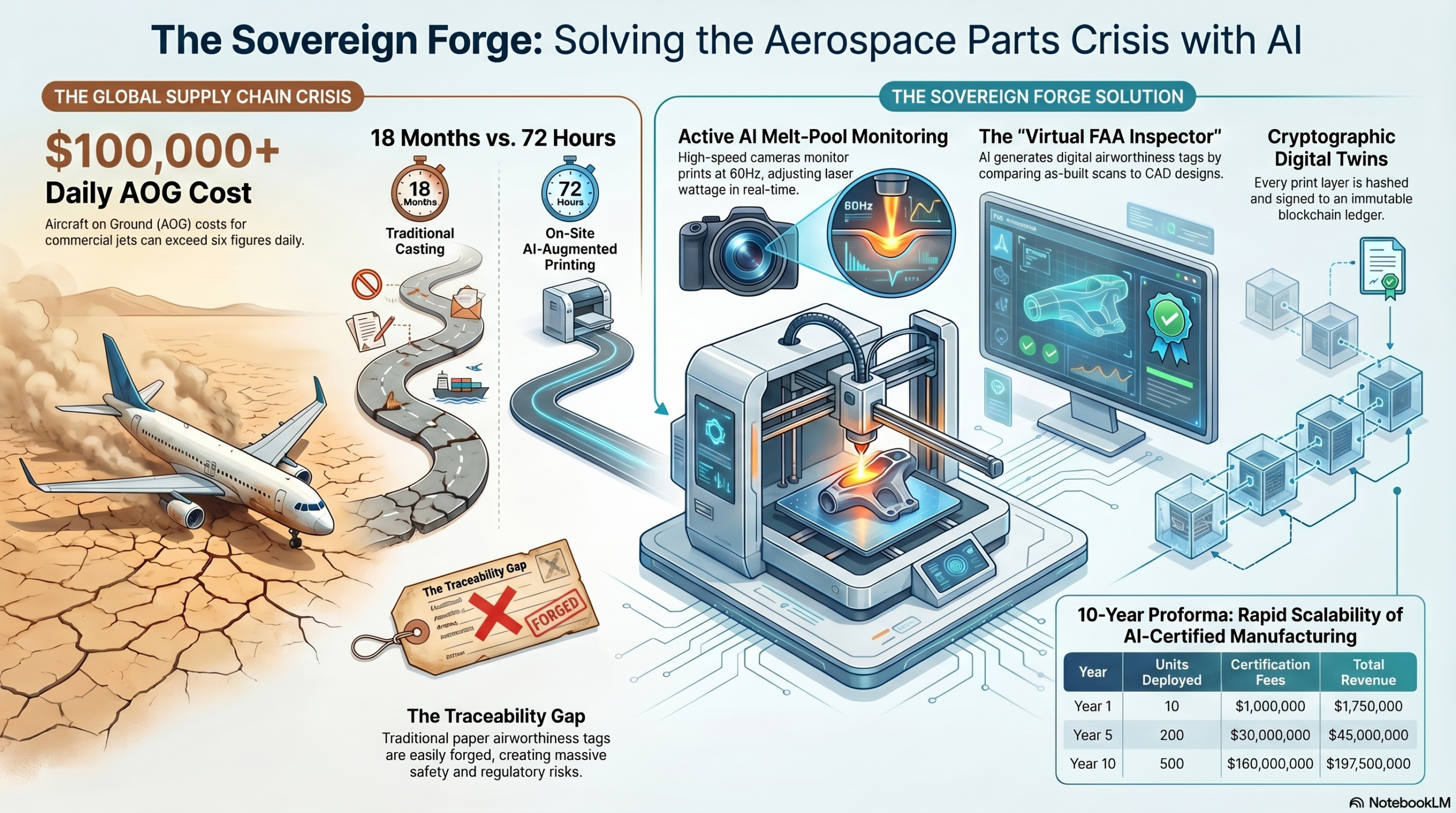
When a multi-million-dollar jet is grounded for a single missing bracket or turbine blade—a state known as Aircraft on Ground (AOG)—the financial hemorrhaging is catastrophic, often exceeding $100,000 per day in lost revenue and logistical penalties. For decades, we relied on a fragile “Just-in-Time” global supply chain that assumed geopolitical stability and infinite OEM capacity. That era is over. The future of flight depends on a radical “Point-of-Use” manufacturing model where we stop moving heavy metal across oceans and start moving encrypted bits to local, AI-governed printers. We are decoupling aerospace production from global instability and reclaiming national sovereignty over our own infrastructure.
The Death of the 12-Month Lead Time
In the current climate, lead times for flight-critical engine components from major OEMs like Boeing or Airbus have ballooned to 12 or 18 months. For an airline executive, this isn’t just a delay; it is an existential threat to EBITDA. The emergence of the “Sovereign Forge” capability (SKU: SOV-AUTO-FORGE) represents a paradigm shift, compressing this agonizing wait into a 48-to-72-hour window.
This is the birth of “Time-as-a-Service.” In this new economy, the value of a part isn’t dictated by the weight of the alloy, but by the speed of its certification. By localizing production through high-end additive manufacturing, a repair station ceases to be a “part seeker” and is transformed into a “part creator.” This inversion of the model allows airlines to bypass the “Just-in-Time” bottlenecks that have plagued the post-pandemic recovery, turning grounded assets back into revenue-generating machines in days rather than seasons.
Beyond Paper: Why Traceability is the New Currency
The 2023-2024 AOG Technics scandal, where thousands of engine parts were integrated into the global fleet using forged airworthiness documents, exposed a terrifying truth: our paper-based heritage is a liability. In an era of sophisticated forgery, the industry now demands a “dirty fingerprint”—a digital trail of such high resolution that it is mathematically impossible to fake.
The new standard for aerospace integrity utilizes an “Automated Notary” system. Every single layer of a 3D-printed part is hashed and signed by a hardware-based TPM 2.0 module. This creates an immutable Digital Twin on the Locutus Ledger, linking the physical part’s “DNA”—every sensor log and thermal fluctuation—directly to its serial number.
“The AOG Technics scandal proved that paper records are easily faked. Traceability is now a premium currency, and software solutions must focus on the ‘Back-to-Birth’ history of a part to ensure the sky remains a zone of absolute trust.”
Mastering the “Impossible” Metal: AI as a Thermal Architect
The most valuable components in an engine—High-Pressure Turbine (HPT) blades and propulsion mounts—must survive environments that would liquefy standard steel. This requires refractory metals like Tungsten, which boasts a melting point of 3,422°C. Historically, Tungsten’s extreme brittleness made it nearly impossible to cast or print without “hot cracking.”
To solve this, we use the RIOS Pilot AI Core (Tier 3) to run millions of thermal stress simulations before a single grain of powder is laid down. During the actual print, AI-augmented specialty printers act as “Thermal Architects.” Using high-speed cameras, the AI performs Melt-Pool Monitoring at 60Hz. If the melt-pool temperature fluctuates by as little as >2%, the AI’s “Closed-Loop Control” adjusts laser wattage or scan speed in real-time to save the part.
Mastery of these specialty materials is now the benchmark for aerospace readiness:
- Tungsten: For the ultra-high temperature environments of HPT blades.
- Rhenium: For high-performance propulsion alloys.
- Inconel & Titanium-Aluminide: For extreme pressure resistance and heat shields in high-speed drone frames.
To ensure continuity of these critical prints, the “Industrial Foreman” agent manages strategic stockpiles of these powders, even as sanctions and raw material scarcity spike global prices.
The AI That Signs Its Own FAA Forms
Regulatory headwinds are stiffening. The FAA Reauthorization Act of 2024 and new mandates for drug and alcohol testing at foreign repair stations (effective 2027) have placed an immense burden on global maintenance facilities. The Sovereign Forge solves this by acting as a “Virtual FAA Inspector.”
Instead of waiting weeks for a secondary inspection facility to verify a component, the SOV-AUTO-FORGE utilizes real-time “As-Built” vs. “As-Designed” data to generate a digital FAA Form 8130-3 (Airworthiness Approval Tag) the moment the print is complete. This is a game-changer for “Contested Logistics.” Imagine a “Mobile Forge” unit in a ruggedized 20ft container on a naval carrier or a remote airfield—producing and certifying parts on-site without a centralized supply chain. By using the Locutus Aero-Fork, we submit high-resolution truth datasets directly for Part 145 compliance, ensuring the machine’s word is as good as a gold-standard inspector’s stamp.
Ephemeral Decryption and the Sovereign Vault
A primary barrier to localized manufacturing has been the “IP Leak.” Sending sensitive CAD files for a turbine blade to a foreign repair station often results in the theft of high-value aerospace designs.
Our solution is “Ephemeral Decryption.” Proprietary CAD files exist only within the volatile RAM of the Sovereign Forge during the print cycle. The moment the laser shuts off, the data is wiped. To ensure “Human-in-the-Loop” accountability, a lead engineer must authorize the print using a physical Sovereign Key (YubiKey). This is protected by a “Split-Ledger Architecture”:
- The Private Layer: Keeps the proprietary G-Code in an encrypted, unreachable vault.
- The Public Layer: Publishes the unforgeable “Proof of Quality” to the public ledger for airline and regulatory transparency.
Conclusion: The $1.06 Trillion Shift
The aircraft parts market is entering a “super-cycle,” projected to reach $1.06 trillion by 2032. While the aftermarket segment alone is valued at $53 billion, the real value lies in the transition from “Just-in-Time” to “Just-in-Case” infrastructure. With the lapse of federal SBIR/STTR funding, the burden of innovation has shifted to private, sovereign AI-driven models that can bypass global logistics crises.
The ultimate question for the industry is no longer about the cost of the metal, but the security of the bits. Does the future of global logistics lie in moving physical parts across oceans, or in moving encrypted, certified blueprints to local printers?
The inversion is already here: We are moving from a system of desperate aftermarket scavenging to a future where every repair station is a primary production hub, ensuring the next generation of flight is built on a foundation of digital truth and sovereign resilience.