Prospectus: Sovereign Energy-Compute Infrastructure & The Appalachian Silicon Hollow
- The Strategic Pivot: From Linear Fragility to Spherical Resilience
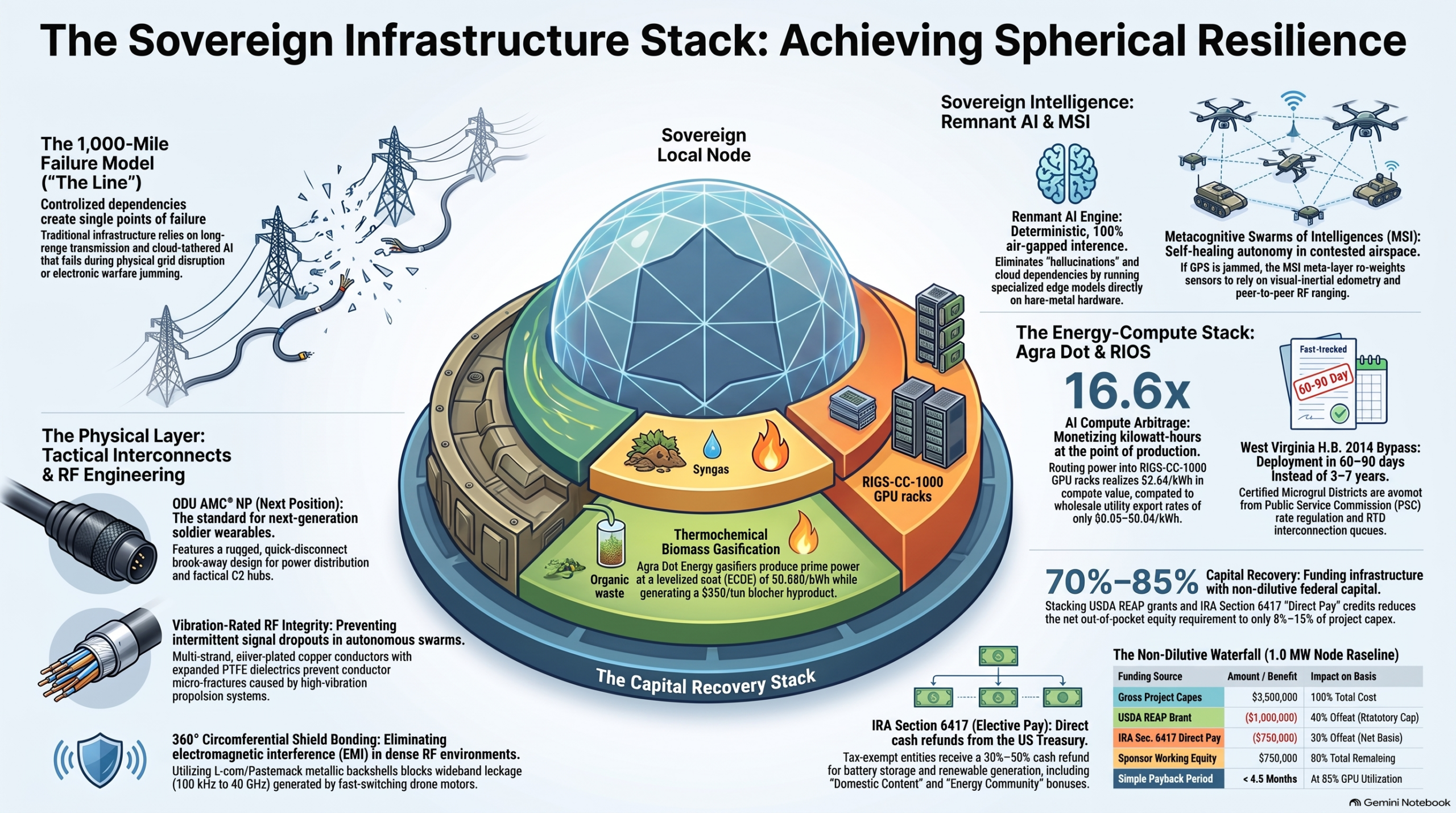
The global landscape of artificial intelligence infrastructure is undergoing a fundamental transition from centralized grid dependency to “Spherical Resilience.” Traditional data center models rely on “The Line”—a fragile, linear dependency on a centralized power grid. This paradigm is characterized by the 1,000-Mile Failure Model, where high-value assets are vulnerable to single-point cascade failures, transmission volatility, and physical disruption. As sovereign AI assets require absolute uptime and data integrity, the mandatory successor is Spherical Resilience: self-contained, air-gapped enclaves that operate behind-the-meter. These sovereign nodes integrate on-site energy production and high-density compute into an omnidirectional operating environment, ensuring continuity regardless of external infrastructure collapse.
Comparative Infrastructure Philosophies
Metric The Line (Legacy) Spherical Resilience (Sovereign)
Connectivity Dependency Continuous fiber/grid tether Air-gapped, local mesh (WISP)
Failure Points Linear (1,000-Mile Failure Model) Distributed, self-contained nodes
Scalability Dependent on utility upgrades Modular, point-of-need deployment
Regulatory Friction 3–7 year RTO/PSC approval queues 60–90 day statutory bypass
This shift is accelerated by the “Permitting Wall.” Regional Transmission Operator (RTO) interconnection queues, particularly within PJM, have become a systemic barrier to hyperscale sovereign AI deployment, often resulting in 3-to-7-year bottlenecks. This prospectus offers a functional bypass to this gridlock by moving infrastructure behind-the-meter, allowing stakeholders to transition from multi-year delays to operational status in months.
By decoupling from external utilities, these enclaves leverage specific legislative frameworks designed to fast-track sovereign infrastructure.
- Regulatory Arbitrage: Statutory Bypass via West Virginia H.B. 2014
The strategic deployment of sovereign infrastructure at pace requires state-level legislative shields to neutralize federal and regional oversight. West Virginia H.B. 2014 (The Power Generation and Consumption Act) serves as the primary mechanism for this bypass, enabling the creation of “Certified Microgrid Districts” that operate outside the jurisdiction of traditional utility monopolies.
Under W. Va. Code §5B-2-21 and §24-2-21a, these districts are granted specific legal immunities:
- Exemption from Certificates of Public Convenience and Necessity: Eliminates the primary legal hurdle for independent power generation.
- PSC Rate Regulation Immunity: Complete exemption from Public Service Commission oversight on energy pricing.
- Franchise Exclusivity Bypass: Protection from utility franchise disputes, allowing for private, behind-the-meter energy loops.
A critical requirement for this legal immunity is the 84.8% captive load ratio. By consuming the vast majority of generated energy on-site for high-density compute, the enclave is legally classified as a designated high-impact industrial load. This status is the specific prerequisite for the statutory exemption, insulating the cluster from export tariffs and utility franchise interference.
Further speed is attained through the “Coal-Transition Advantage”:
- Fast-Track Siting: Utilizing former surface mining permits and retired coal infrastructure accelerates environmental permitting.
- Zoning Speed: Brownfield re-utilization minimizes local resistance and streamlines entitlement.
- Economic Alignment: Coal-transition regions offer specialized incentives for industrial revitalization.
- Incentive Stacking: Strategic location in fossil-fuel transition zones secures mandatory federal adders for capital recovery.
These regulatory shields provide the protected environment necessary to deploy the technical core of the sovereign energy-compute stack.
- The Technical Core: Integrated Energy-Compute Architecture
The “Behind-the-Meter” model eliminates transmission losses and grid instability by co-locating energy production with compute consumption. This integrated architecture creates a sovereign loop featuring sub-16ms islanding capability and black-start survival, ensuring the 100% uptime required for deterministic AI.
The Agra Dot Energy Stack
The physical generation layer utilizes a multi-level thermochemical conversion process:
- Thermochemical Conversion: A high-temperature plasma gasifier converts organic feedstock (forestry slash and timber waste) into high-BTU synthesis gas (\text{CO} + \text{H}_2).
- Solar Augmentation: DOE-spec 80x parabolic solar thermal troughs focus sunlight to produce 350^\circ\text{C} process steam. This steam preheats the gasifier, eliminating daytime parasitic fuel consumption.
- Direct DC Generation: Pawnee Rotary GenSets (Wankel units) run continuously on syngas, rectifying power directly into a 700V DC native busbar at 97.7% efficiency. This native DC topology eliminates AC-DC conversion losses and supports high-density power delivery.
RIOS-CC-1000 Compute Cluster
The compute layer is represented by the RIOS-CC-1000 cluster, engineered for extreme security and thermal density:
- Kove:SDM Software-Defined Memory: Provides microsecond-latency dynamic RAM pooling across edge nodes for hyperscale performance.
- Direct-to-Chip Liquid Cooling: Advanced thermal management supports NVIDIA H100/Blackwell arrays in modular enclosures.
- Remnant AI Engine: A 100% air-gapped, deterministic inference engine running on bare-metal hardware to eliminate probabilistic hallucinations and data exfiltration.
Tactical Integrity Layer
To maintain stability within high-vibration power generation environments, the architecture utilizes military-grade interconnects. ODU AMC® NP connectors provide rugged quick-disconnect capabilities, while L-com 360° shielded RF cabling is mandatory for suppressing motor-induced EMI. This precision engineering prevents contact fretting and VSWR (Voltage Standing Wave Ratio) degradation, ensuring data integrity despite the mechanical stress of the energy production environment.
The technical superiority of the stack is matched only by the financial engineering that funds its deployment.
- Financial Engineering: The Non-Dilutive Capital Waterfall
The “Non-Dilutive Capital Stack” is designed to preserve enterprise equity while leveraging federal subsidies to offset high upfront Capex. By stacking grants and tax credits, the net cost of deployment is drastically reduced.
Federal Capital Recovery Matrix
Funding Source Mechanism Benefit Strategic Requirement
USDA REAP 50% Capital Grant Direct cash (up to $1M) Rural location (<50k pop)
IRA Sec. 6417 Elective (Direct) Pay Cash refund from Treasury Tax-exempt or municipal entity
IRA Sec. 6418 Credit Transferability Cash sale of tax credits For-profit entity/Developer
IRA Sec. 48E Investment Tax Credit 30%–50% Capital recovery Qualifying clean energy asset
The 70%–80% Capital Offset Waterfall
For a 1.0 MW RIOS Node with a gross Capex of $2.5M, the recovery waterfall proceeds as follows:
- USDA REAP Grant: Direct recovery of $1,000,000 (statutory cap for renewable installations).
- IRA Section 48E Base ITC: 30% credit on the remaining equipment basis.
- Energy Community Bonus: 10% adder for coal-transition regions.
- Domestic Content Bonus: 10% adder for US-manufactured structural and electronic components.
This stacking results in a Net Effective Cost of approximately $750,000, representing a 70% total offset.
Bridge Facility Solution
To manage the 6-to-14 month federal reimbursement gap, the project utilizes a “Bridge Facility.” This short-term debt is secured specifically by verified grant award letters and equipment titles, leaving parent corporate equity unpledged. This structural isolation ensures liquidity for procurement without diluting stakeholder ownership.
- Economic Performance: The 16.6x AI Compute Arbitrage
The financial core of the model is the transition from “Energy Producer” to “Compute Provider.” Selling kilowatt-hours into a GPU rack creates an economic multiplier far superior to wholesale grid exports.
The Arbitrage Formula
The economic advantage is quantified by the Gross Fuel Conversion Multiplier, comparing the market value of GPU-hours to the cost of local power:
\text{Gross Realized Value per kWh} = \frac{\text{Market Rate per GPU-Hour}}{\text{Hourly GPU Power Consumption (kW)}} = \frac{$1.85}{0.70\text{ kW}} \approx $2.64/\text{kWh}
Comparing this $2.64/kWh value to the production cost yields a 16.6x Arbitrage Multiple.
Levelized Cost of Energy (LCOE) Justification
The project achieves an LCOE of 0.038/kWh**. This is driven by low-cost feedstock and the monetization of the gasification byproduct. High-grade biochar, valued at **350/Ton, acts as a secondary revenue stream and carbon-sink credit, effectively subsidizing the primary cost of power.
Project Pro-Forma (1.0 MW RIOS Node)
- Total Project Capex: $2,500,000
- Net Effective Cost: $750,000 (After grants/tax credits)
- Annual Revenue: $4,200,000 (Based on 85% GPU utilization)
- Simple Payback Period: < 4.5 months
- Strategic Implementation: The 60-to-90 Day Roadmap
Speed-to-market is the primary competitive advantage in the AI race. Sovereign nodes utilize a modular deployment cycle to bypass the multi-year timelines of grid-tethered data centers.
Three-Phase Execution Schedule
- Phase 1: Entitlement & Filings (Days 1–30): Submission of the WV H.B. 2014 Certified Microgrid notice and filing of the USDA REAP grant application.
- Phase 2: Physical Build (Days 31–65): Installation of the 700V DC busbar and modular containment pads; commissioning of the Agra Dot Energy gasifier and Pawnee Rotary GenSets.
- Phase 3: Compute Active (Days 66–90): Seating of RIOS GPU racks, activation of the air-gapped Remnant AI Engine, and activation of the multi-gigabit microwave/optical mesh backhaul (WISP-in-a-Box).
Case Study: Guam Sovereign Eradication
The resilience of these nodes is demonstrated in the Guam Sovereign Eradication initiative. In this deployment, sovereign nodes operate in “Island Mode” to power autonomous robotic swarms. These units utilize deterministic Remnant AI to track and neutralize the invasive Brown Tree Snake (Boiga irregularis), which threatens the utility resilience of Andersen AFB. By operating independently of the local grid, these nodes defend critical defense infrastructure from biological and electrical disruption.
Executive Mandate
The convergence of West Virginia’s regulatory shields, federal grant stacking, and the 16.6x compute arbitrage creates a unique, non-dilutive entry point for institutional stakeholders. By abandoning the fragility of “The Line” and embracing the security of “Spherical Resilience,” investors can deploy high-density AI infrastructure that is faster to commission, cheaper to operate, and fundamentally sovereign.