Operational Readiness Assessment: Transitioning to Defense-Grade Sovereign Infrastructure
- Executive Mandate: The Strategic Shift from Prototype to Production
The transition from Technology Readiness Levels (TRL) 4–6 to accredited, defense-grade production (TRL 7–8) represents the critical evolutionary threshold for sovereign infrastructure. For deep-tech ventures, this shift is not merely a technical milestone but a strategic necessity to mitigate the “structural mismatch” between the high capital expenditure (CapEx) of physical hardware and the rapid-exit timelines of traditional venture financing. By institutionalizing TRL 7–8 readiness, the ecosystem graduates from theoretical designs and lab artifacts into validated, defensible assets ready for federal procurement schedules. It must be noted that while the primary objective is TRL 7–8 across the platform, this audit recognizes a current maturity variance, with certain developmental subsystems residing at TRL 2–3.
Intellectually, this transformation is rooted in the move from “Centralized Dependency” to “Sovereign Autonomy.” The term reticular originates from the Latin reticulum (a small net), describing interconnected grid arrangements. The “DeReticular” model signifies a deliberate reduction of dependence on these externally managed, single-point-of-failure networks in favor of autonomous nodes.
Feature Centralized Dependency (Reticular) Sovereign Autonomy (DeReticular)
Network Structure Macro-Utility Grid / Centralized Cloud Local-First Sovereign Nodes
Resilience Vulnerable to Upstream Failures Autonomous Functionality during Outages
Power Source External Utility / Centralized Feedstock Behind-the-Meter / Local Feedstock
Connectivity Public Telecom Dependence MANET / Tactical RF / LEO Bridging
Achieving federal procurement readiness requires the orchestration of four core execution pillars: Hardware Certification to ensure technical defensibility; the Reg D 506(c) Capital Engine to provide non-dilutive leverage; SF 1408 & CMMC Compliance to satisfy fiscal and cyber gatekeepers; and SBA Affiliation Insulation to preserve Small Business Concern (SBC) eligibility. Together, these pillars provide the framework for transitioning to a production-grade defense posture, beginning with rigorous hardware validation.
- Hardware Certification and Technical Validation Protocols
Third-party laboratory verification serves as the “So What?” layer of the infrastructure transition. It converts engineering design models into defensible, production-grade assets capable of meeting the stringent reliability and safety standards of the Defense Industrial Base (DIB). Without documented, independent lab data, hardware remains in the “Prototype” phase, ineligible for high-value sole-source Phase III production contracts.
The Hardware Certification & Testing Pipeline for the ecosystem targets the following engineering benchmarks:
- Gen 5 Pods
- EMP Hardening: Certification under MIL-STD-188-125-1 for High-Altitude Electromagnetic Pulse (HEMP) protection of ground-based C4I facilities.
- Shielding Effectiveness (SE): Verified attenuation targets of \ge 80 dB to 100 dB across the 10 kHz to 1 GHz spectrum.
- Environmental Ingress: Validation via MIL-STD-810H (Method 506.6 Rain, Method 510.7 Sand/Dust, and Method 501.7 High Temperature up to +55^\circ\text{C}).
- Agra Dot Energy
- 500-Hour Continuous Duty Cycle: Integrated testing of the plasma gasifier and Pawnee rotary GenSet under load, logging mass balance, slag recovery, and thermodynamic efficiency.
- Syngas Engineering: Stringent targets for syngas tar content (<50 \text{ mg/Nm}^3) to ensure engine longevity and fuel quality.
- Grid Interoperability: Compliance with UL 1741 SB / IEEE 1547-2018 for anti-islanding and black-start functionality.
- Kurb Kars
- TRL 7 Field Trials: Demonstration in relevant operational environments using the Pawnee Sand Buggy platform.
- Mesh Networking & Latency: Verification of RIOS mesh networking throughput and multi-agent coordination with latency targets of <50 ms.
- GNSS-Denied Performance: Validated swarm autonomy and pathfinding under active GPS/EW jamming at DAOS R Us facilities.
Hardware Certification Summary
Asset Standards Target Required Deliverable
Gen 5 Pods MIL-STD-188-125-1 / MIL-STD-810H Lab Verification Certificate & Shielding Log
Agra Dot Energy UL 1741 SB / IEEE 1547 / UL 2200 Factory Mutual (FM) / Intertek ETL Mark AND Published Engineering Data Sheet
Kurb Kars DoD TRL 7 / RIOS Mesh Protocol Field Telemetry Log & Published White Paper
These certifications satisfy the technical evidentiary demands of federal procurement, yet they must be supported by a fiscal architecture that meets the rigorous cost-accounting standards of the Department of Defense.
- Federal Procurement Compliance and Cost-Accounting Architecture
Strategic readiness for multi-million-dollar cost-reimbursable defense contracts necessitates an accounting system that exceeds the simple requirements of early SBIR grants. Implementing Standard Form 1408 (SF 1408) criteria is the regulatory gateway for this transition. This architecture is the mandatory precursor to securing a Negotiated Indirect Cost Rate Agreement (NICRA), the “gold standard” for overhead recovery in federal contracting.
The Federal Compliance Ledger Architecture requires the strict segregation of Direct Costs (project-traceable) from Indirect Cost Pools. The following mathematical formulas are used to establish defensible indirect rates:
- Fringe Rate: \frac{\text{Total Fringe Costs (Health, Taxes, 401k)}}{\text{Total Labor Base (Direct + Indirect Labor)}}
- Overhead Rate: \frac{\text{R&D Facility Rent, Lab Consumables, Shop Utilities}}{\text{Direct Labor + Direct Fringe Base}}
- G&A Rate: \frac{\text{Exec Salary, Legal, Accounting, IT}}{\text{Total Cost Input (Direct Labor + Direct Materials + Subcontracts + Overhead)}}
Crucial to this structure is the implementation of FAR Part 31 Firewalls. These safeguards isolate “unallowable costs” from government reimbursement to prevent False Claims Act exposure. Specifically, the following must be firewalled:
- SAFE Securities Legal, Platform, and Drafting Fees
- Marketing, Advertising, and Public Relations
- Interest Expense on Convertible Notes or Debt
- Executive Entertainment and Unallowable Travel Costs
Fiscal transparency through an SF 1408-ready system ensures the integrity of the capital stack, but this must be reinforced by a hardened digital environment to protect technical IP.
- Cybersecurity Hardening and NIST/CMMC Enclave Implementation
For sovereign infrastructure entities handling Controlled Unclassified Information (CUI)—particularly regarding Gen 5 Comms or Kurb Kars tactical telemetry—CMMC 2.0 Level 2 compliance is non-negotiable. This standard protects 20-year statutory SBIR Data Rights and sensitive technical packages from foreign influence or unauthorized disclosure.
Implementation of the 110 controls of NIST SP 800-171 is categorized into three execution areas:
- Enclave Architecture: Deployment of a FedRAMP High-authorized cloud environment (e.g., Microsoft 365 GCC High or AWS GovCloud) to isolate technical drawings and CUI communications.
- Access Control: Strict adherence to FIPS 140-3 validated multi-factor authentication (MFA) and hardware-level encryption for all endpoint devices.
- Risk Reporting: Maintaining a System Security Plan (SSP) and submitting accurate scores to the DoD Supplier Performance Risk System (SPRS) database.
[!IMPORTANT] The “So What?”: Failure to maintain a validated System Security Plan (SSP) and a current SPRS score legally bars portfolio entities from receiving defense contracts involving critical technologies such as Gen 5 modular pods or autonomous swarm platforms.
Cybersecurity hardening reinforces corporate sovereignty by securing the digital perimeter as the organization scales its governance.
- Corporate Governance and SBA Affiliation Insulation
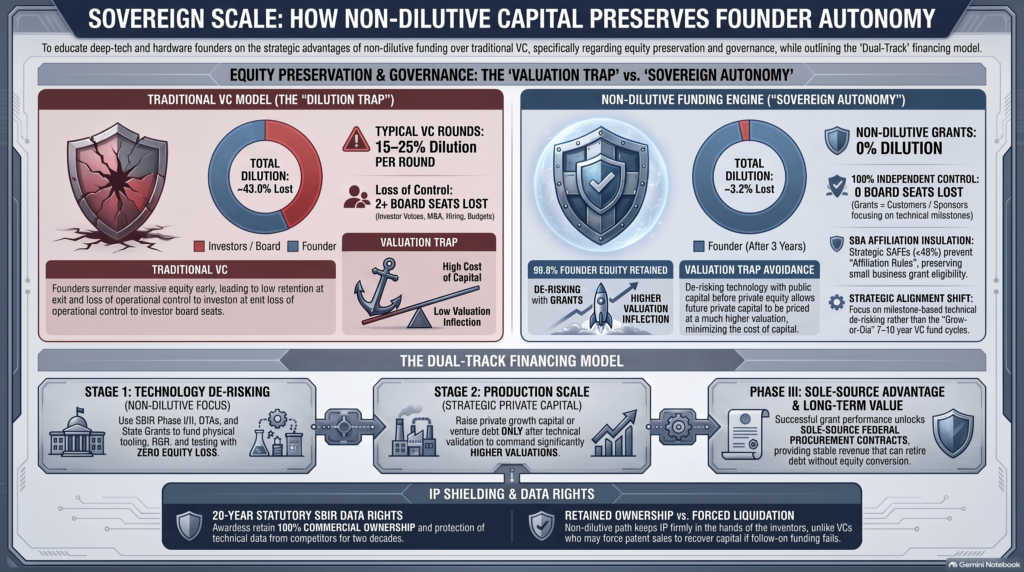
A primary risk in deep-tech scaling is the “Affiliation Trap” (13 CFR § 121.103). If the Small Business Administration (SBA) determines that a Venture Studio “controls” its spinouts, it aggregates their headcounts. If the total exceeds 500 employees, the entities lose their Small Business Concern (SBC) status, disqualifying them from non-dilutive SBIR/STTR funding.
To defend against findings of “Identity of Interest” (13 CFR § 121.103(f)) or “Economic Dependence,” the following governance insulation must be institutionalized:
- Eliminate Negative Control Vetoes: Spinout bylaws must exclude investor or Studio vetoes over operating budgets, executive hiring/firing, or the incurrence of standard operational debt.
- Preserve Minority Equity: The Venture Studio must maintain a minority stake (<49%), ensuring operational founders retain majority voting control (>51%).
- Independent Board Majority: Boards must be composed of independent or founder-appointed seats to prevent centralized control by a single entity.
- Arms-Length Service Level Agreements (SLAs): All shared services must be billed at verifiable fair-market rates, and spinouts must retain the contractual right to terminate these services or hire third-party vendors.
The SBA Affiliation Defense Structure: By maintaining Minority Equity (<49%) and an Independent Board Majority, each entity remains a distinct sovereign business, facilitating the clean injection of private capital.
- Integrated Capital Engine: Reg D 506(c) and SAFE Matching
The DeReticular capital strategy utilizes Simple Agreements for Future Equity (SAFEs) as high-leverage tools to meet federal matching requirements (e.g., AFWERX or DOE cost-share). This hybrid model eliminates technical risk with public capital first, allowing subsequent conversion at higher valuations. This process results in a 60%–80% compression of founder dilution compared to early-stage priced equity rounds.
To scale this, the ecosystem utilizes Regulation D, Rule 506(c), enabling general solicitation to capture private capital.
Feature Regulation D 506(b) Regulation D 506(c)
General Solicitation Strictly Prohibited Permitted (Public Promotion)
Investor Verification Self-Certification Mandatory Third-Party Accreditation
Compliance Requirement Pre-existing Relationship Verification API / Tax Review
The Automated 506(c) Workflow includes third-party accreditation (CPA letters, W-2 analysis) and screens investors through CFIUS/FOCI filters to block foreign capital from dual-use technologies.
Crucially, the Venture Studio must operate within the Broker-Dealer Safe Harbor (Rule 3a4-1) by decoupling compensation from capital-raise success. Failure to adhere to this firewall exposes the organization to statutory rescission rights, where investors may demand 100% of their capital back due to regulatory non-compliance. This hybrid model provides the ultimate capital efficiency for sovereign infrastructure development.
- Strategic Execution Roadmap: The 24-Month Horizon
Closing the gap between prototypes and certified defense production requires an orchestrated, phased implementation.
24-Month Integrated Implementation Roadmap
Milestone / Quarter Technical & Hardware Track Finance, Legal & Compliance Track
Phase 1: Foundation (Q1, Mos 1-3) Build 500-hr test plan for Agra GenSet; CAD models for Gen 5 EMP enclosure. Amend spinout bylaws to drop SBA vetoes; deploy SF 1408-compliant ledger.
Phase 2: Systems Launch (Q2, Mos 4-6) Begin continuous GenSet runs; conduct GPS-denied field trials at DAOS R Us. Launch 506(c) portal; file Form ADV as ERA; establish GCC High cloud enclave.
Phase 3: Certification (Q3-Q4, Mos 7-12) Complete MIL-STD-188-125 EMP chamber tests; attain UL 1741 SB / IEEE 1547. Syndicate $2.0M+ in grant-matching SAFEs; undergo mock DCAA/SF 1408 audit.
Phase 4: Scale & Production (Year 2) Scale Gen 5 Pod production; commission multi-MW Agra gasification site. Execute Phase III Sole-Source defense contracts; attain NICRA for overhead recovery.
Adhering to this roadmap allows the ecosystem to bypass competitive bidding through Phase III transition and achieve dominance in the sovereign infrastructure market via validated technology and institutionalized compliance.