
THE HYPER-CONNECTED WILDERNESS: STRATEGIC BRIEFING
Executive Summary
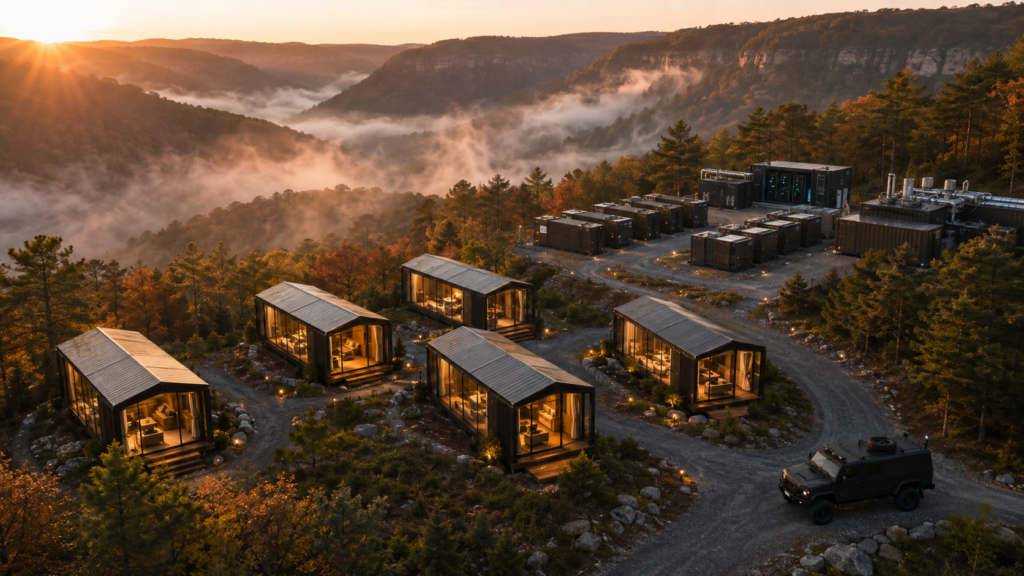
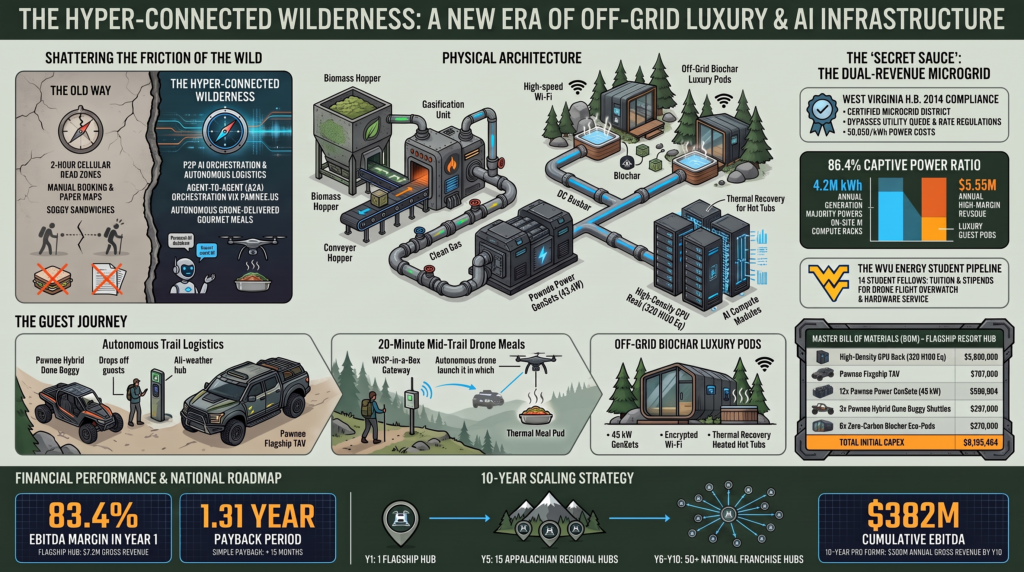
Digital Adventures Outdoors R Us LLC, in partnership with DeReticular LLC, is launching a flagship luxury eco-resort in the New River Gorge region of West Virginia. This project leverages the “Sovereign Stack” architecture and West Virginia House Bill 2014 to create an off-grid, hyper-connected wilderness experience. By integrating high-end hospitality with behind-the-meter AI compute (Compute-as-a-Service), the company bypasses traditional utility constraints and achieves an exceptional 83.4% EBITDA margin.
Key Financial Takeaways:
- Initial Flagship CapEx: $8,195,464
- Year 1 Gross Revenue: $7,519,094
- Simple Payback Period: 1.31 years (15.7 months)
- 10-Year Cumulative EBITDA: Projected at $382,450,000 across 15 regional hubs.
The Vision: “Shattering the Friction of the Wild”
The project aims to replace high-friction traditional tourism with a seamless, AI-orchestrated experience. The “Hyper-Connected Way” utilizes Agent-to-Agent (A2A) negotiation, removing the need for manual bookings or traditional payment interfaces.
Friction Reduction Comparison
Feature The Old Way (High Friction) The Hyper-Connected Wilderness
Connectivity 2-Hour Cellular Dead Zones P2P AI Agent Orchestration (A2A)
Infrastructure No Interconnection or Power Off-Grid Biochar Eco-Pods (700V DC Bus)
Logistics Manual Shuttle Coordination Autonomous Trailhead Shuttles (Pawnee Buggy)
Dining “Soggy Sandwiches” in a Backpack 20-Minute Mid-Trail Drone Hot Meals
Impact High Carbon & Environmental Impact Zero-Carbon Microgrid (H.B. 2014 Certified)
Strategic Legal Framework: West Virginia House Bill 2014
A core competitive advantage is the designation of resort sites as statutory Certified Microgrid Districts under W. Va. Code §5B-2-21 & §24-2-21a.
- Grid Bypass: This allows the company to bypass the “Permitting Wall”—multi-year utility queue delays and Public Service Commission (PSC) rate regulations.
- Speed to Market: Certified status can be acquired in 60 days.
- Captive Power Requirement: To maintain PSC exemption, the site must consume \ge 70% of its generated power on-site. The flagship hub achieves an 86.42% captive power ratio by diverting the majority of energy to AI compute modules.
The Dual-Revenue Hospitality Engine
Unlike traditional hospitality models where power is an expense, this model treats energy and computation as a primary revenue stream.
- AI Compute-as-a-Service (CaaS): An on-site, containerized GPU rack (320 H100 equivalents) absorbs >70% of generated power. This generates $5.55M in annual high-margin revenue, effectively subsidizing the resort’s operational costs.
- Luxury Hospitality: Six off-grid biochar eco-pods offer high-end amenities (climate control, Wi-Fi, hot tubs) powered by waste thermal heat from the AI compute modules and GenSets.
Technological and Operational Architecture
The resort utilizes DeReticular’s Generation 5 (Gen 5) commercial hardware and the RIOS kernel to manage all autonomous operations.
Physical Infrastructure
- Power Generation: 12 Pawnee Power GenSets (45 kW) running on clean local biomass syngas.
- Transport & Logistics: Autonomous Pawnee Hybrid Dune Buggies for guest transport and Pawnee Flagship TAVs for all-weather backup.
- Dining Delivery: Autonomous drones launch from mobile TAV pads to deliver gourmet meals to hikers via GPS tracking and winch systems.
- Connectivity: WISP-in-a-Box gateways provide encrypted high-speed Wi-Fi and agentic booking nodes deep within cellular dead zones.
Hardware Bill of Materials (Master BOM)
Gen 5 Product Name Unit Qty Unit Price (USD) Total Cost (USD)
Pawnee Flagship TAV 1 $797,000.00 $797,000.00
Pawnee Hybrid Dune Buggy 3 $99,000.00 $297,000.00
Pawnee Power GenSet (45 kW) 12 $49,997.00 $599,964.00
WISP-in-a-Box (Various Models) 20 Variable $81,500.00
High-Density GPU Rack 1 $5,800,000.00 $5,800,000.00
Zero-Carbon Biochar Eco-Pods 6 $45,000.00 $270,000.00
Total Initial CapEx $8,195,464.00
Human Capital: The WVU Energy Student Pipeline
The project integrates a workforce development model through a partnership with the WVU Statler College of Engineering.
- Fellowships: 14 graduate/undergraduate “Energy Student Fellows” operate A2A nodes, conduct drone overwatch, and service GenSets.
- Funding: Fellows receive full tuition and stipends funded by 2.43% of gross resort revenues.
SWOT Analysis Summary
- Strengths: Statutory PSC exemption (H.B. 2014); dual-revenue model; proprietary Gen 5 hardware.
- Weaknesses: High initial capital requirements ($8.19M); reliance on specialized technical talent.
- Opportunities: Rapid growth in premium eco-tourism ($1.1T market); surging demand for edge AI compute.
- Threats: Severe mountain weather; supply chain delays for GPU hardware; legislative shifts in carbon rules.
Strategic Growth Roadmap
- Phase 1 (Years 1–2): Flagship deployment at New River Gorge; secure 25-acre site; launch commercial lodging and A2A engine.
- Phase 2 (Years 3–5): Expand to 15 Appalachian regional hubs (e.g., Snowshoe, Seneca Rocks); establish central manufacturing for eco-pods on coal brownfield sites.
- Phase 3 (Years 6–10): National franchise scaling across U.S. National Parks (Yellowstone, Zion, etc.); license the RIOS A2A Reservation Engine and Pawnee.us sovereign mesh to third-party operators.