Strategic Briefing: The Sovereign Nodal Destination Network and A2A Deep Hospitality
1. Executive Summary
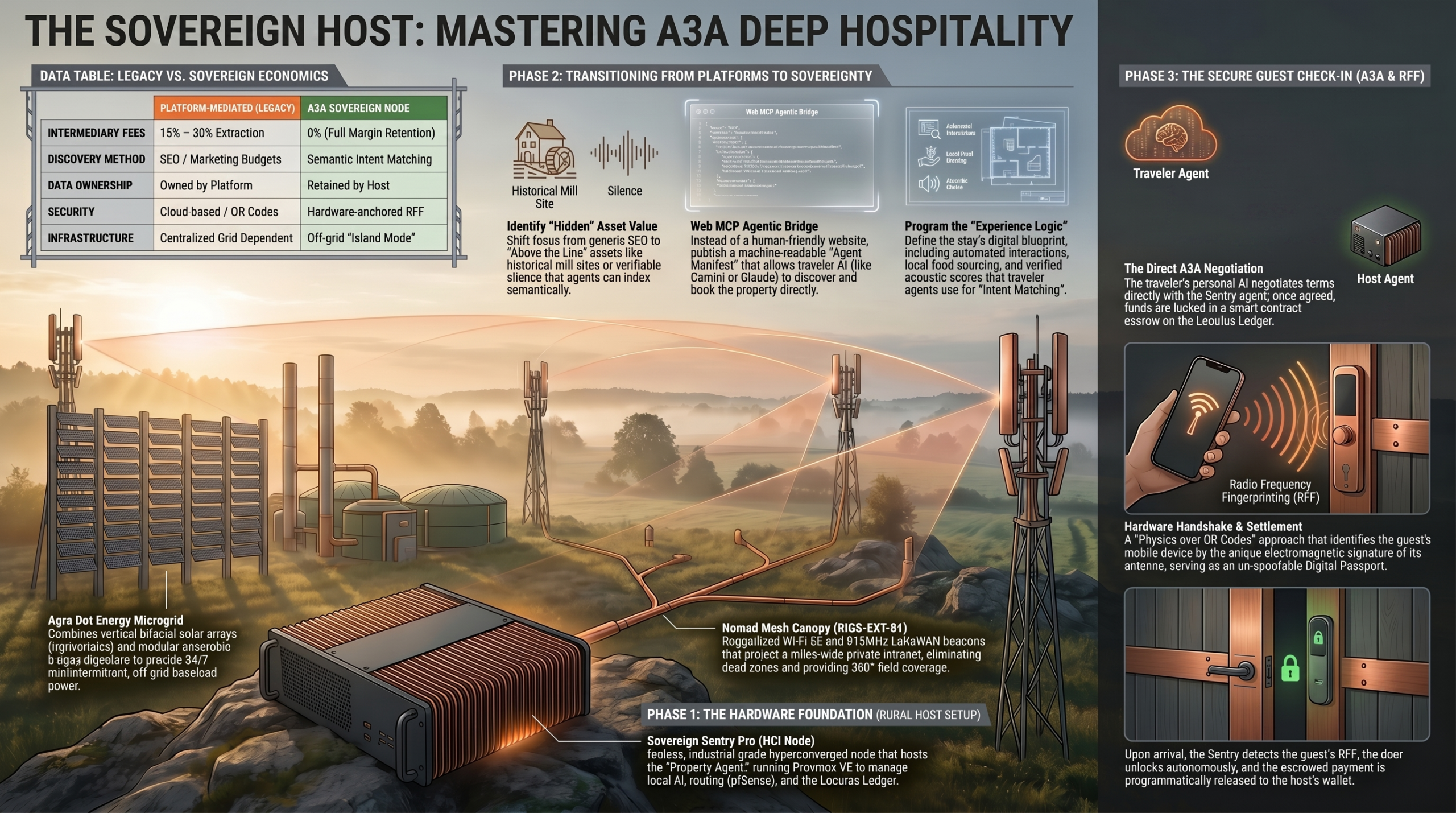
The hospitality and travel industry is undergoing a structural paradigm shift, transitioning from a “Platform-Mediated” model to an “Agent-Orchestrated” model. For decades, centralized aggregators (Airbnb, Booking.com, Expedia) have acted as gatekeepers, extracting 15–30% in commission fees while controlling data and visibility.
The emerging era of “Deep Hospitality” utilizes Agent-to-Agent (A2A) and Agent-Web3-Agent (A3A) protocols to bypass intermediaries. This shift allows rural entrepreneurs to become Sovereign Hosts, operating high-value, self-sustaining “Nodal Destinations.” These nodes integrate decentralized physical infrastructure (DePIN), air-gapped AI automation, and on-site clean energy.
Critical Takeaways:
- Economic Restoration: By cutting out platform fees, hosts increase net margins by 20–35%.
- Technological Sovereignty: Each node operates in “Island Mode,” remaining functional during utility blackouts or centralized cloud outages.
- Value Bifurcation: Value is shifting from “Below the Line” (standardized commodities) to “Above the Line” (unique historical and biological contexts).
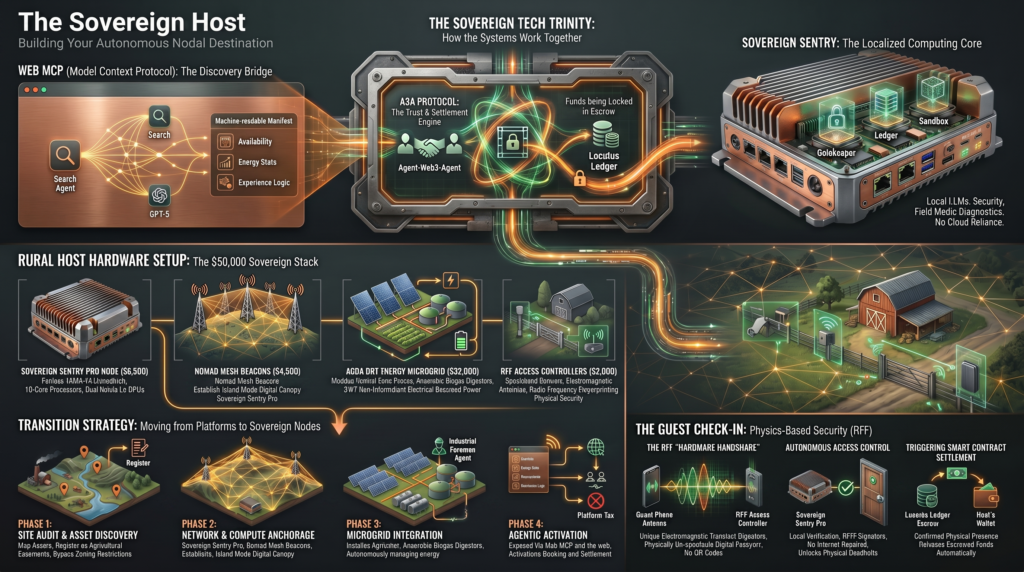
- Financial Viability: A single node requires a $50,000 CAPEX and projects a 58.3% Internal Rate of Return (IRR) over a 10-year period.
- Identity Security: Radio Frequency Fingerprinting (RFF) replaces easily cloned digital keys with un-spoofable hardware signatures.
——————————————————————————–
podcast
2. The Structural Shift: From Platforms to Sovereign Nodes
The Death of the Platform Tax
The central inefficiency of current travel is the “Manual Search Barrier,” where humans scroll through generic listings manipulated by search engine optimization (SEO) and promoted rankings.
- Platform-Mediated Model: Aggregators control discovery, trust, and relationship data.
- Agent-Orchestrated Model: Consumer-side AI agents (e.g., Gemini Spark) communicate directly with property-side AI agents using open protocols like Google’s Web MCP.
“Above the Line” vs. “Below the Line”
The industry is splitting into two distinct tiers:
- Below the Line (The Commodity): Standardized hotels and generic rentals that are price-sensitive and easily commoditized by Google/Expedia.
- Above the Line (The Context): Non-reproducible assets such as historic gristmills, off-grid energy-independent cabins, and remote scenic ridges. These prioritize “Experience Logic”—a digital blueprint of the stay that an agent can verify (e.g., real-time “quiet scores” or verifiable off-grid energy metrics).
——————————————————————————–
podcast
3. Technical Architecture: The Five-Layer Stack
The Sovereign Nodal Destination Network is built on a “Spherical Resilience” model, where every node acts as a self-sufficient entity.
| Layer | Component | Function |
| Experience Layer | DAOSRUS / RFF | AR trails, historical storytelling, and hardware-based identity (RFF). |
| Trust & Settlement | A3A / Locutus | Smart contract escrow and peer-to-peer financial settlement. |
| Local Logic | OpenClaw / LLMs | Air-gapped AI agents for admin, diagnostics, and automation. |
| Physical Network | Sovereign Sentry | Hyperconverged infrastructure (HCI) nodes and private mesh canopy. |
| Base Generation | Agra Dot Grid | On-site biogas and vertical agrivoltaic solar microgrids. |
Core Infrastructure Hardware
- Sovereign Sentry (Standard & Pro): Fanless, industrial-grade HCI nodes hosting virtualized environments:
- The Gatekeeper: Security routing and WAN failover.
- The Ledger: Locutus/Freenet daemon for encrypted data shards.
- The Sandbox: Local, air-gapped Large Language Models (LLMs).
- Nomad Mesh-Point Routers: Wi-Fi 6E and 915MHz LoRaWAN beacons projecting a miles-wide private intranet canopy.
- Agra Dot Energy: Vertical bifacial solar arrays (allowing agricultural use) and modular anaerobic biogas digesters for 24/7 baseload power.
——————————————————————————–\
video
4. The Transactional Paradigm: A2A and A3A Protocols
A2A (Agent-to-Agent)
A framework-agnostic protocol that enables independent AI systems to communicate.
- Discovery Manifests: Properties publish capabilities in formats understandable by models (Gemini, Claude, GPT-5).
- The Agent Card: A standardized JSON document (agent.json) detailing an agent’s endpoints, skills, and authentication requirements.
video
A3A (Agent-Web3-Agent)
Extends A2A by embedding a decentralized trust and Web3 settlement layer.
- Direct Negotiation: Traveler and Host agents negotiate terms via JSON-RPC 2.0.
- Escrow: Funds are locked in a smart contract on the Locutus Ledger.
- Verifiable Execution: Payments are automatically released only when sensor-validated conditions are met (e.g., an RFF-verified physical check-in).
——————————————————————————–
5. Economic Model and 10-Year Proforma
The joint venture between DeReticular and DAOSRUS transforms isolated rural assets into high-yield, multi-vertical revenue generators.
Unit Economics (Single Node)
- Initial CAPEX: $50,000 (Includes Sentry Pro, 5x Mesh Beacons, Agra Dot Microgrid, and RFF Controllers).
- Annual Gross Revenue: $84,500.
- Lodging: $59,250 (Avg. $250/night @ 65% occupancy).
- Edge Compute Leasing: $6,000.
- Mesh Access Subscriptions: $12,000.
- Energy Arbitrage: $7,250.
- Annual OPEX: $11,425.
- Net Operating EBITDA: $73,075.
Scaling Projections
| Year | Phase | Year-End Nodes | Cumulative Cash Flow |
| Y1-Y2 | Alpha/Beta | 10 | ($25,013) |
| Y3-Y5 | Regional Mesh | 100 | $4,974,736 |
| Y6-Y10 | Planetary Scale | 500 | $90,933,484 |
Valuation Metrics:
- NPV (10% discount): $36,548,210.
- IRR: 58.3%.
——————————————————————————–
6. Gap Analysis and Strategic Mitigation
While the technology is ready, several operational and regulatory hurdles exist.
Identified Gaps
- Financial: The $50k CAPEX is high for independent landowners.
- Remediation: Implement Node-as-a-Service (NaaS) leasing models and programmatic capture of USDA REAP grants.
- UX/Friction: Web3 wallet management is complex for average users.
- Remediation: Utilize Zero-Knowledge (ZK) Account Abstraction and hardware-anchored key management via RFF.
- Regulatory: Legacy utilities and OTAs may lobby against off-grid operations.
- Remediation: Structure nodes under Agricultural Easements and maintain a Land Equivalent Ratio (LER) above 1.2 to bypass commercial zoning bans.
SWOT Summary
- Strengths: “Island Mode” resilience, 100% margin retention, multi-vertical revenue.
- Weaknesses: High initial CAPEX, steep learning curve for tech-heavy stacks.
- Opportunities: “Agentic Discovery” shift, federal green energy subsidies, “Digital Detox” luxury market.
- Threats: Utility/OTA regulatory retaliation, hardware supply chain chokepoints (Nvidia GPU availability).
——————————————————————————–
7. Implementation: The Sovereign Transition Playbook
Rural entrepreneurs are encouraged to transition from being “consumers” of platform interfaces to “developers” of sovereign agentic manifestations.
Phase 1: Site Audit & Structural Prep
- Identify natural assets (mills, ridges) within 3 hours of metropolitan areas.
- Verify Agricultural Easement regulations.
Phase 2: Network & Compute Anchorage
- Install Sovereign Sentry Pro in a secured vault.
- Position Nomad Mesh Beacons for 360° signal coverage.
Phase 3: Microgrid Integration
- Deploy modular anaerobic digesters and vertical solar panels.
- Connect systems to the Industrial Foreman agent for automated management.
Phase 4: Experience & Security Activation
- Deploy RFF physical locks.
- Expose the node’s machine-readable Web MCP manifest to enable agentic discovery.
8. Conclusion
The Sovereign Nodal Destination Network represents the convergence of industrial automation, decentralized finance, and “Deep” hospitality. By integrating the DeReticular physical stack with the DAOSRUS experience layer and A3A trust protocols, rural properties can reclaim economic independence, restore data privacy, and transform into civilization anchors that are structurally superior to legacy, centralized models.