The Sovereign WISP Ecosystem: A Hardware Systems Overview
1. The “WISP-in-a-Box” Philosophy
Traditional telecommunications infrastructure is built on a “reticular” geometry—a centralized, deeply codependent web of corporate monopolies and fragile fiber backbones. While efficient for urban density, these systems are inherently vulnerable; a single failure at the center cascades through the entire grid. The Sovereign WISP Kit (SKU: RIOS-KIT-WISP) represents a fundamental shift in architecture, moving toward distributed, independent operational nodes that treat a single plot of land as a self-sufficient telecom hub.
The DeReticular hardware design philosophy is predicated on three primary pillars:
- Ruggedization: Engineering components to thrive in “real world” environments—freezing alpine winters, dusty agricultural sheds, and high-heat metal enclosures—that would instantly destroy consumer-grade gear.
- Decentralization: Moving compute power to the “edge” using a hyperconverged stack. By hosting the billing ledger and network logic locally, the node remains functional and profitable even if the backhaul connection is severed.
- Physical Security: Implementing a zero-trust model where administrative control is air-gapped and requires physical, hardware-backed authentication.
video
Learning Insight: Why “Civilization-in-a-Box”? This system is dubbed “Civilization-in-a-Box” because it functions as more than a simple router. It is a self-contained, automated, off-grid business. By packaging high-performance satellite backhaul, edge computing, and localized monetization software into a single ruggedized deployment, we provide the essential communication utility required to establish an independent economic hub anywhere on Earth.
This ecosystem is orchestrated by the “Sovereign Automation” software suite, which resides within the centralized “Brain” of the operation.
2. The Brain: The Sovereign Sentry Pro (SKU: RIOS-SS-PRO)
The Sovereign Sentry Pro serves as the core compute and routing backbone. Unlike residential hardware, the Sentry Pro utilizes a hyperconverged architecture, running Proxmox VE as a bare-metal hypervisor to host the pfSense routing VM and the RIOS Ledger. Its fanless, finned aluminum chassis is not an aesthetic choice; it is a thermal management solution that allows the unit to run silently in hazardous, uncooled environments without the mechanical failure risks associated with traditional fans.
Sentry Pro Technical Identity
| Feature | Learner’s ‘So What?’ |
| 8-core Intel i3-N305 Processor | Provides the x86 “muscle” to handle Deep Packet Inspection (DPI) and 220+ Mbps throughput without bottlenecks. |
| 32GB DDR5 RAM | Supports the simultaneous execution of the pfSense VM, OpenClaw containers, and localized audit tools. |
| Hyperconverged (Proxmox/pfSense) | Consolidates server-grade firewall, routing, and ledger functions into a single physical footprint. |
| Fanless Aluminum Chassis | Acts as a passive heat sink, eliminating moving parts that could clog with dust or fail in the field. |
While the Sentry Pro manages the logic and traffic shaping, it requires a high-performance “Voice” to project that connectivity across the landscape.
podcast
3. The Voice: The Mesh Beacon (SKU: RIOS-EXT-01)
The Mesh Beacon acts as the physical distribution layer of the WISP. These are IP67-rated, weatherproof access points designed for high-elevation mounting. From an engineering perspective, the Beacon is a “Dual-Spectrum Projection” system, utilizing two distinct radio frequencies to solve different connectivity challenges:
- The Wi-Fi 6 Human-Layer (802.11ax): This radio projects a high-bandwidth footprint over 5 to 10 acres. It is designed for the “human layer”—phones, laptops, and streaming devices—providing the bandwidth necessary for retail data resale.
- The 915MHz LoRaWAN Machine-Layer: This ultra-low-frequency gateway provides penetrative depth that Wi-Fi cannot match. It can pull telemetry data from agricultural sensors or water meters from up to 3 miles away, even through foliage or structures.
By utilizing Layer 2 Client Isolation, the Mesh Beacon ensures that while users share a signal, their data remains cryptographically separated. However, even the best signal is useless if the primary backhaul fails; this brings us to the system’s primary survival mechanism.
4. The Survivor: The Nomad Link (SKU: RIOS-NL-01)
In a sovereign network, uptime is the primary metric of success. The Nomad Link is an industrial LTE failover bridge that serves as the “Survivor.” During events like “Rain Fade” (where heavy weather obstructs the satellite signal), the Sentry Pro automatically shifts critical authentication and payment traffic to the Nomad Link in milliseconds to ensure the revenue stream remains uninterrupted.
The Nomad Link’s defining feature is its DC-DC Battery Elimination Circuit (BEC). By removing volatile lithium-ion batteries—which swell and present fire risks in hot vehicle dashboards or sun-baked solar boxes—the Nomad Link achieves an industrial operating range of -40°C to 85°C.
Safety Alert: Zero Battery. Zero Fire Risk. The Nomad Link is engineered for hazardous environments. By pulling power directly from a 12V vehicle block or a solar battery array via its BEC, the system eliminates thermal runaway risks, making it the only safe choice for permanent installation in uncooled enclosures.
5. The Keys to the Kingdom: The Operator Series
As a Technical Curriculum Lead, I emphasize that hardware sovereignty requires physical control of the airwaves. The Operator Series provides the tools necessary for field auditing and physical security.
- Sovereign Deck ($1,299): A rubber-armored field tablet running Kali Linux with an integrated RTL-SDR. It allows the operator to perform visual spectrum analysis using waterfall plots to identify “rogue” unauthorized nodes or localize RF interference on the 2.4GHz and 915MHz bands.
- Sovereign Key ($75): A gold-plated NFC/USB-C hardware MFA token. To prevent remote administrative hijacking, the Sentry Pro is configured with root login disabled; the system effectively “air-gaps” deep-administration until the Sovereign Key is physically inserted into the chassis.
6. System Interconnectivity: The Port Mapping Blueprint
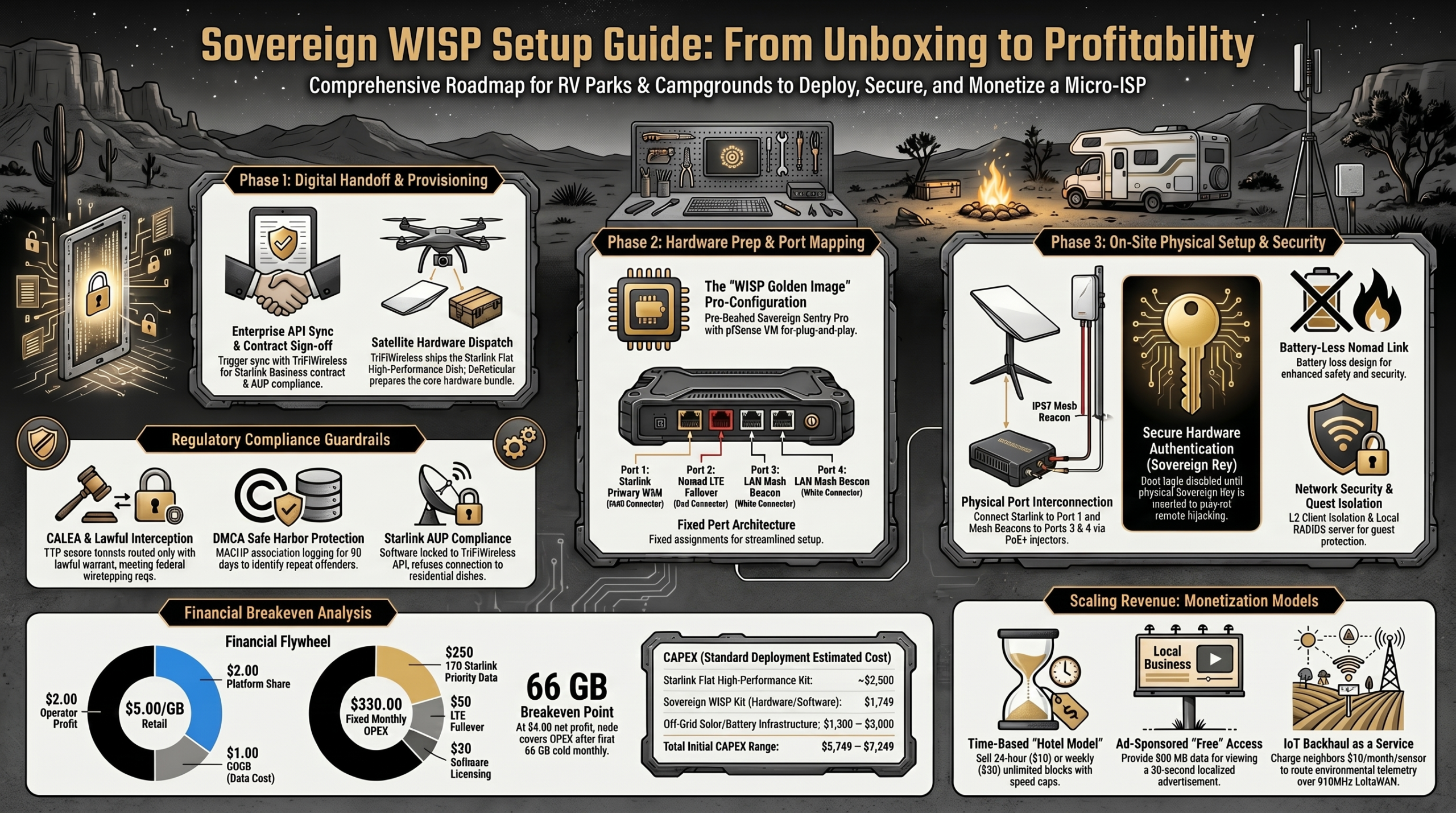
The reliability of the WISP-in-a-Box comes from its “Golden Image”—a pre-configured software environment where physical ports are hard-mapped to specific logic roles. This ensures that a field operator can deploy the system as a “plug-and-play” asset while the pfSense VM handles complex Multi-WAN load balancing in the background.
The Connectivity Map
| Sentry Pro Port | Target Hardware | Traffic Role |
| Port 1 | Starlink Business Dish | Primary WAN: Handles ~95% of traffic and high-volume satellite data. |
| Port 2 | Nomad Link LTE Bridge | Secondary WAN: Hot standby; triggers automatically if primary packet loss >15%. |
| Port 3 | Mesh Beacon #1 | LAN 1: Broadcasts Wi-Fi 6 Captive Portal and LoRaWAN gateway. |
| Port 4 | Mesh Beacon #2 | LAN 2: Extends coverage and provides redundancy for the local mesh. |
7. Learning Synthesis: The Financial & Operational Flywheel
The hardware ecosystem’s ultimate goal is to transform a passive cost center (an internet bill) into a profitable asset. Using the $5/GB data resale strategy, the node operates as an automated micro-transaction engine.
The Breakeven Math: The node carries a fixed monthly OPEX of ~$330 (covering Starlink Priority data, LTE backup, and licensing). At a retail rate of 5/GB, the **gross breakeven** is **66 GB**. However, because the operator receives a 50/50 profit split (2.00 per GB net), the net breakeven for the operator—the point where the system is “free”—occurs at 165 GB of retail sales per month.
User Connection to Payout Workflow
- Connection: User joins the open SSID (e.g., Sovereign_Connect_$5_GB).
- Redirect: The Sentry Pro intercepts the request and serves the OpenClaw “Tollbooth” billing portal.
- Payment: The user pays $5.00 via Credit Card or the Bitcoin Lightning Network.
- Authorization: The local RADIUS server unlocks access for that MAC address with a 15/2 Mbps speed limit to protect backhaul capacity.
- Settlement: Once 1,024 MB is consumed, the firewall revokes access, and profits are disbursed to the operator’s registered wallet.
Instructor’s Note: In 2026, hardware is the only path to true sovereignty. By owning the “Brain,” the “Voice,” and the “Keys,” you transition from a mere consumer of centralized services to a provider of localized infrastructure. This kit ensures that your community’s data and revenue remain where they belong: in your hands.