Strategic Industry Report: The Sovereign Banking Paradigm—Unlocking Capital Velocity through Tokenized RWAs and Regulatory Compliance
1. The 2025 Regulatory Pivot: From Ambiguity to Institutional Rails
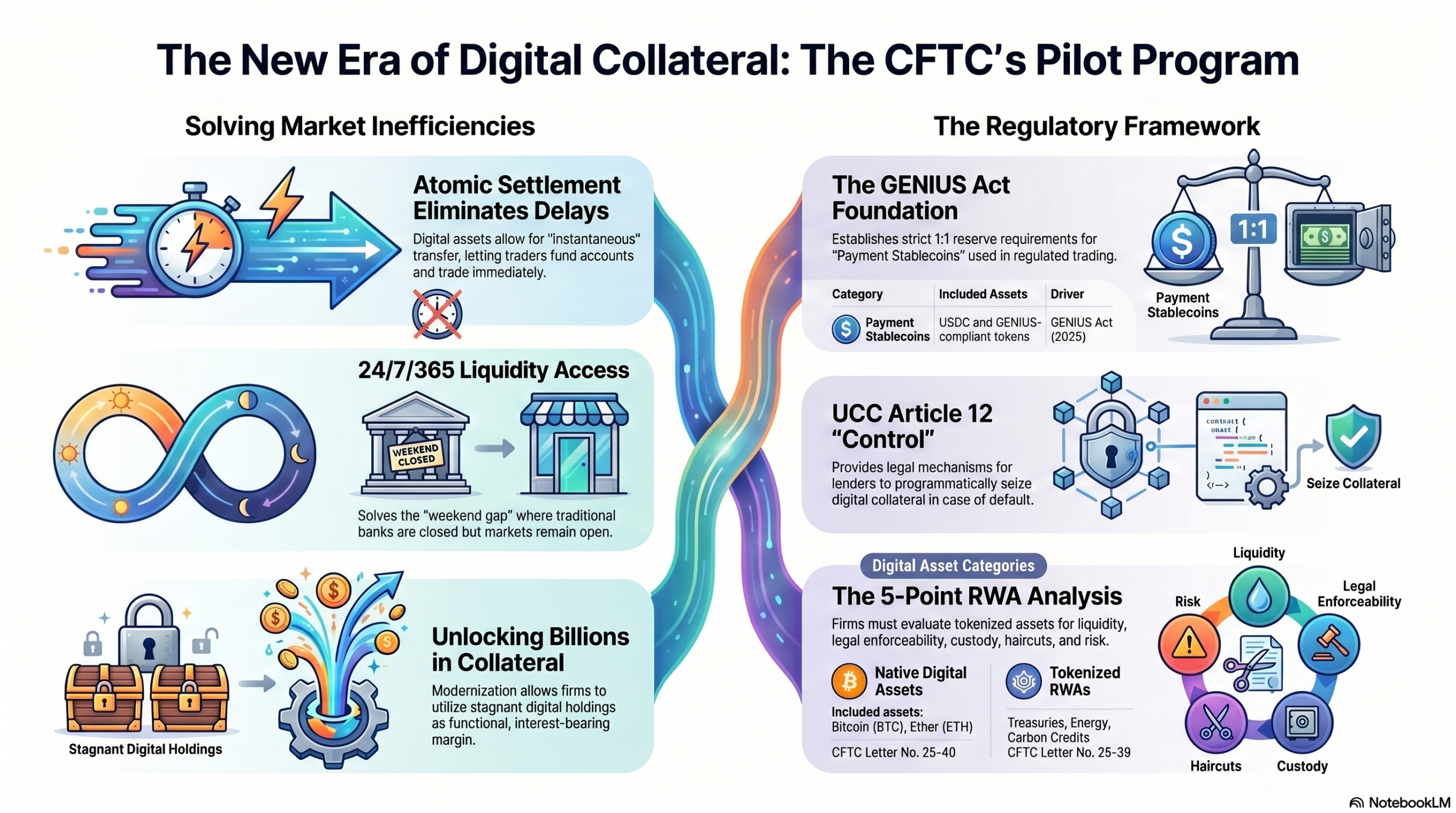
The convergence of the Guiding and Establishing National Innovation for U.S. Stablecoins (GENIUS) Act in July 2025 and the CFTC’s Digital Assets Pilot Program in December 2025 represents a structural regime change for industrial finance. We have moved beyond the era of digital assets as speculative instruments into a landscape where they function as regulated collateral. This pivot provides the institutional rails necessary to transform illiquid industrial production into bankable assets, shifting the onus of risk management directly onto the firm’s internal controls and technological infrastructure.
The Dual-Track Regulatory Framework
The December 2025 framework established a sophisticated bifurcated approach to digital collateral, as evaluated through CFTC Letters No. 25-39 and No. 25-40:
| Principles-based Tokenized RWA Guidance (Letter No. 25-39) | Prescriptive Digital Asset Margin Relief (Letter No. 25-40) |
| Focus: Real-World Assets (RWAs) represented via digital ledger technology (the “Digital Twin” model). | Focus: Native digital assets including Bitcoin (BTC), Ether (ETH), and qualified existing payment stablecoins (e.g., USDC). |
| Strategic Logic: Tokenization does not alter the fundamental risk profile of the underlying RWA; the asset must be eligible for margin under the CEA regardless of its format. | Strategic Logic: Provides “No-Action” relief allowing FCMs to factor specific digital assets into undermargining and segregation calculations during an initial onboarding period. |
| Regulatory Requirements: Case-by-case analysis of liquidity, legal enforceability, and “Haircut Calibration” based on both asset and technological risk. | Onerous Conditions: Mandatory filing of Notice of Intent, weekly balance reporting, and prompt (24-hour) reporting of significant cyber events or operational failures. |
The withdrawal of Advisory 20-34 (via Letter No. 25-41) is perhaps the most significant catalyst for institutional adoption. Legacy constraints, specifically residual-interest restrictions and heightened risk-program obligations, previously created a prohibitive capital charge friction for Futures Commission Merchants (FCMs). By removing these outdated barriers, the CFTC has allowed for the integration of digital assets into standard segregation calculations within the Statutory Trust Framework of the Commodity Exchange Act. While the law now provides the rails, it is the underlying data verification technology that serves as the essential “cargo” for these new financial tracks.
2. The RIOS Engine: Transforming Empirical Feasibility into Financial Truth
Traditional agricultural and industrial assets are historically illiquid due to persistent “trust gaps”—the inability of institutional lenders to verify production data in remote jurisdictions. The Rural Infrastructure Operating System (RIOS) closes these gaps by functioning as a “Truth Machine,” converting physical production into immutable, financial-grade data that meets the rigorous risk management standards now demanded by regulators.
Empirical Data Ingestion
RIOS utilizes on-site sensors to capture “empirical feasibility data” at the point of origin, eliminating human error or manual ledger manipulation. This data is categorized into four critical pillars:
- Production Volume: Real-time mass and weight measurements of harvested materials.
- Quality Metrics: Moisture density and chemical composition analysis.
- Operational Consistency: Energy output from processing units, specifically monitoring the performance of on-site AI servers (the Umoja Compute Core).
- Environmental Integrity: Solar irradiance and localized climate data to predict future yield cycles.
The Zero-Knowledge Verification Layer
To satisfy the “Operational Risks” requirement of CFTC Letter No. 25-39, RIOS integrates Zero-Knowledge Proofs (zkVerify). This allows producers to cryptographically prove production volume and quality to institutional lenders without exposing proprietary processing formulas or trade secrets. For the Regulatory Counsel, this layer is vital: it guards against “information security and technology risks” while providing the lender with absolute certainty of asset existence.
This model enables a radical shift in Capital Velocity. Contrast the “Old Model”—characterized by 6-month payment cycles and trapped equity—with the “RIOS-Enabled Model” of atomic verification. When production is instantly recognized as a bankable asset, the balance sheet is transformed from a dormant cost center into a high-speed liquidity engine.
3. Legal Architecture: Controllable Electronic Records (CERs) and UCC Article 12
The move from physical production to a digital financial instrument requires a robust legal bridge to ensure that tokens represent legally enforceable claims. UCC Article 12, introduced in the 2022 Amendments, provides this bridge by defining the Controllable Electronic Record (CER).
“Control” of a CER is the digital equivalent of “Possession.” Under Article 12, establishing control allows a party to assert an exclusive right to the benefits of the record and the power to prevent others from using it.
The “Article 8 Solution” vs. Article 12 Direct Control
For an FCM to Perfect a Security Interest, two primary models exist:
- The Article 8 Solution: Treating digital assets as “financial assets” credited to a securities account. This is the “business as usual” model, creating a “security entitlement” familiar to traditional banking.
- Article 12 Direct Control: The asset is held directly in a digital wallet. This model is strategically superior for non-security RWAs because it enables “programmatic, unilateral access” via multi-sig or account abstraction. It allows the lender to execute a “Notice of Intent” to seize collateral instantly upon default without intermediary delays.
This architecture fulfills the “Legal Enforceability” requirement of CFTC Letter No. 25-39. By combining CER status with formal written legal opinions, firms can satisfy the “Onerous Conditions” required for FCMs to accept RWA NFTs as margin.
4. Case Study: DeReticular Node 4 and the Sovereign Bank Model
The DeReticular Node 4 project in Kaabong, Uganda, is a blueprint for decentralized industrial infrastructure that self-finances through verified output. This is not a “farming project” but a high-tech node utilizing Agra Dot Energy’s Plasma Gasification technology to create a Carbon Negative asset class.
The Capital Velocity Engine
The Node 4 workflow demonstrates the “Sovereign Banking” lifecycle:
- Physical Output: Production of industrial hemp and carbon-negative energy.
- Atomic Verification: RIOS and zkVerify capture production data and energy consistency.
- Tokenization: The output is wrapped into a Tokenized RWA NFT (the Digital Twin), which carries the Legal Title.
- Collateral Posting: The NFT is posted as margin to an FCM or DCO.
- Immediate Liquidity Injection: The node receives USDC for immediate operational reinvestment.
The strategic shift from “Borrower” to “Sovereign Bank” is complete when the node bypasses traditional gatekeepers. Because the NFT is a self-contained legal/financial vessel carrying title and verified data, it achieves a velocity of capital previously impossible in emerging markets.
5. Strategic Implications for Market Participants: The “Digital Plumber” Pivot
As we enter 2026, the value of utility tokens has shifted from speculative currency to essential infrastructure—the “rails” or “digital plumbing” for regulated asset movement.
High-Value Roles for Utility Tokens
Utility tokens now provide essential services that traditional fiat systems cannot replicate:
- 24/7/365 Atomic Settlement: Traditional banking is “closed on weekends,” but utility tokens power the “gas” for around-the-clock settlement of collateral.
- Programmatic Custody & UCC Compliance: Enabling the smart contracts that allow lenders to automatically take “control” of a CER in default scenarios.
- Tokenizing RWAs: Wrapping physical assets into NFTs that meet the risk standards of Letter No. 25-39.
- DeFi Yield within GENIUS Act Constraints: Section 4(a)(11) of the GENIUS Act prohibits stablecoin issuers from paying interest. This creates a legally sanctioned demand for utility tokens that power DeFi protocols to fill the yield gap.
Furthermore, Section 3(g) of the GENIUS Act prohibits non-permitted stablecoins from being used as margin, creating a regulatory “moat” around compliant issuers and the utility protocols that support them.
6. Conclusion: The New Standard of Industrial Finance
The regulatory and technological convergence of 2025/2026 has permanently altered the DNA of industrial finance. The integration of the GENIUS Act, CFTC Digital Asset Pilot Program, and UCC Article 12 has created a clear, regulated pathway for real-world value to move on-chain.
Industrial sectors are no longer “cost centers” waiting for 180-day payment terms; they are “liquidity centers” capable of self-financing through verified production. By utilizing the RIOS engine to generate empirical feasibility data and packaging it as a Controllable Electronic Record, any industrial node can now function with the efficiency and autonomy of a sovereign bank.
The transition is no longer a matter of “if” but a matter of speed. In the 2026 landscape, the competitive advantage belongs to those who have mastered the “digital plumbing” necessary to move value at the speed of light.