Study Guide: Autonomous Agro-Industrial Homeostasis and the Self-Regulating Farm
Section 1: Core Concepts & Architectural Summary
- The Macro-Thermodynamic Crisis & The 1,000-Mile Failure Model
- Biophysical-Financial Decoupling: Modern industrial agriculture operates on an exponential growth trajectory of nominal debt and financial claims, modeled as D(t) = D_0 e^{rt}. Conversely, real physical agricultural output \mathcal{Y}(t) is strictly bounded by net exergy availability, photosynthetic solar capture, and biological carrying capacity (\mathcal{Y}(t) \le \kappa \int \text{Exergy}_{\text{net}}(t) , dt).
- Declining EROEI: The lifecycle Energy Return on Energy Invested (EROEI) for high-input cereal crops has collapsed from pre-industrial/Green Revolution ratios of >20:1 to <2:1 in modern industrial systems, while animal protein systems display deeply negative EROEI (\le 0.3:1).
- Topsoil & Biological Degradation: Intensive chemical and mechanical practices have reduced global Soil Organic Matter (SOM) from preindustrial levels of 5%–8% down to <1.5%, eroding soil water-holding capacity and creating biological dead zones.
- The 1,000-Mile Failure Model: Current AgTech architectures tether physical field assets (e.g., autonomous tractors, automated valves) to centralized cloud hyperscalers via public cellular networks. This creates single points of failure (network brownouts, fiber cuts), operational lock-in, data exploitation by vendor cartels, and brittle long-distance dependency.
- Sustained Island Mode: The architectural solution requiring all sensing, cognition, power generation, and actuation loops to close entirely within the local farm boundary, enabling continuous, autonomous operation even if external cloud or telecommunication backbones are severed.
- Epistemological & Mathematical Foundations
- Fallibilistic Perspectival Realism: Models the objective physical agro-ecosystem as an infinite-dimensional Riemannian manifold \mathcal{M} (\dim(\mathcal{M}) = D \to \infty) containing an invariant dynamical attractor \Omega^*. Observers or sensors occupy parameterized frames \theta \in \Theta that execute dimension-reducing projection operators \hat{\Pi}\theta: \mathcal{M} \to \mathcal{P}\theta (d \ll D). Under the Rule of Veridicality, projections preserve topological causal distinctions, allowing absolute truth to be recovered asymptotically across orthogonal, validated perspectives.
- Topological Parameter Foreclosure (Via Negativa): An epistemological method of systematic error elimination. Rather than adding arbitrary parameters to explain anomalies (the “Epicycle Trap”), false hypothesis sub-manifolds \Omega_{\text{falsified}}^{(t)} crossing pre-registered discrepancy thresholds S(E_t, \theta) > \tau_t are permanently excised (\Theta_{t+1} = \Theta_t \setminus \Omega_{\text{falsified}}^{(t)}).
- State Proposition 1 (Asymptotic Contraction): Proves via the first Borel–Cantelli Lemma that under regularity conditions (identifiability, uniform convergence, and conservative rejection thresholds), the metric diameter of the permissible hypothesis space contracts almost surely around the true physical state \theta^*, bounding errors to the physical measurement resolution \epsilon.
- Information-Theoretic & Thermodynamic Transmission Limits:
- Shannon Limit: Demonstrates that zero transmission error (P_e = 0) over a noisy wireless channel requires infinite codeword block-length (N \to \infty). Thus, P_e > 0 for all finite transmissions, requiring local fallback state machines on field assets.
- Landauer’s Principle: Irreversible bit erasure or memory state updates dissipate a minimum physical heat of \Delta Q \ge N_{\text{bits}} \cdot k_B T \ln 2. Computational introspection without uncertainty reduction wastes finite exergy.
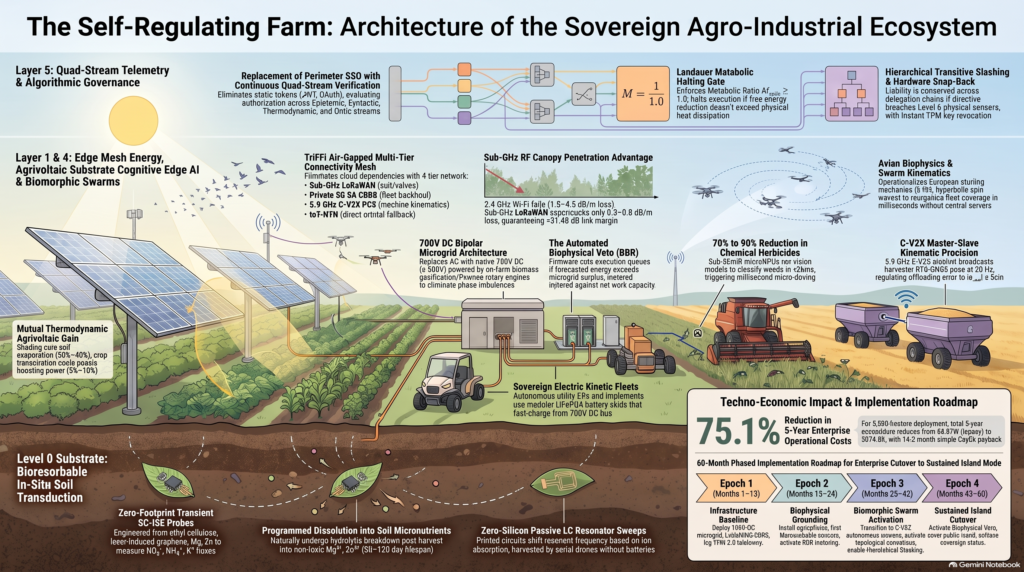
- The Five-Layer DeReticular Sovereign Agro-Stack
Layer System Name Core Components & Operational Invariants
Layer 5 Biophysical Governance & Accounting Isolation Automated Biophysical Veto (BBR), DCAA SF 1408 / FAR Part 31 accounting isolation, parametric risk settlement, and firmware interlocks that cut execution queues when compute or kinetic work exceeds net exergy reserves.
Layer 4 Cognitive AI (Remnant Engine) Air-gapped, liquid-cooled GPU racks executing Active Inference (Variational Free Energy minimization), Lean 4 Abstract Syntax Tree (AST) deductive proof checking, and Metacognitive Swarms of Intelligences (MSI).
Layer 3 Edge Mesh Comms (TriFi System Authority) Air-gapped multi-tier wireless fabric: Sub-GHz LoRaWAN (SX1302/SX1303), Private 5G SA (CBRS Band 48), C-V2X (5.9 GHz PC5 Mode 4 sidelink), and 3GPP Rel-17/18 IoT-NTN direct-to-orbit links with RFC 9171 Bundle Protocol DTN.
Layer 2 Kinetic Mobility & Robotic Swarms Autonomous electric utility vehicles (KurbKars), mobile DC battery skids, and ISOBUS (ISO 11783-10) steer-by-wire implements operating under local charge homeostasis from the DC bus.
Layer 1 Baseload Power & Agrivoltaic Substrate 700 V DC bipolar microgrid (\pm 350 V DC), Agra.Energy thermochemical biomass gasification with Pawnee rotary engines, and elevated dual-use tracking agrivoltaic arrays (3.5\text{–}5\text{ m} clearance).
Key Layer 1 Thermodynamic Synergies:
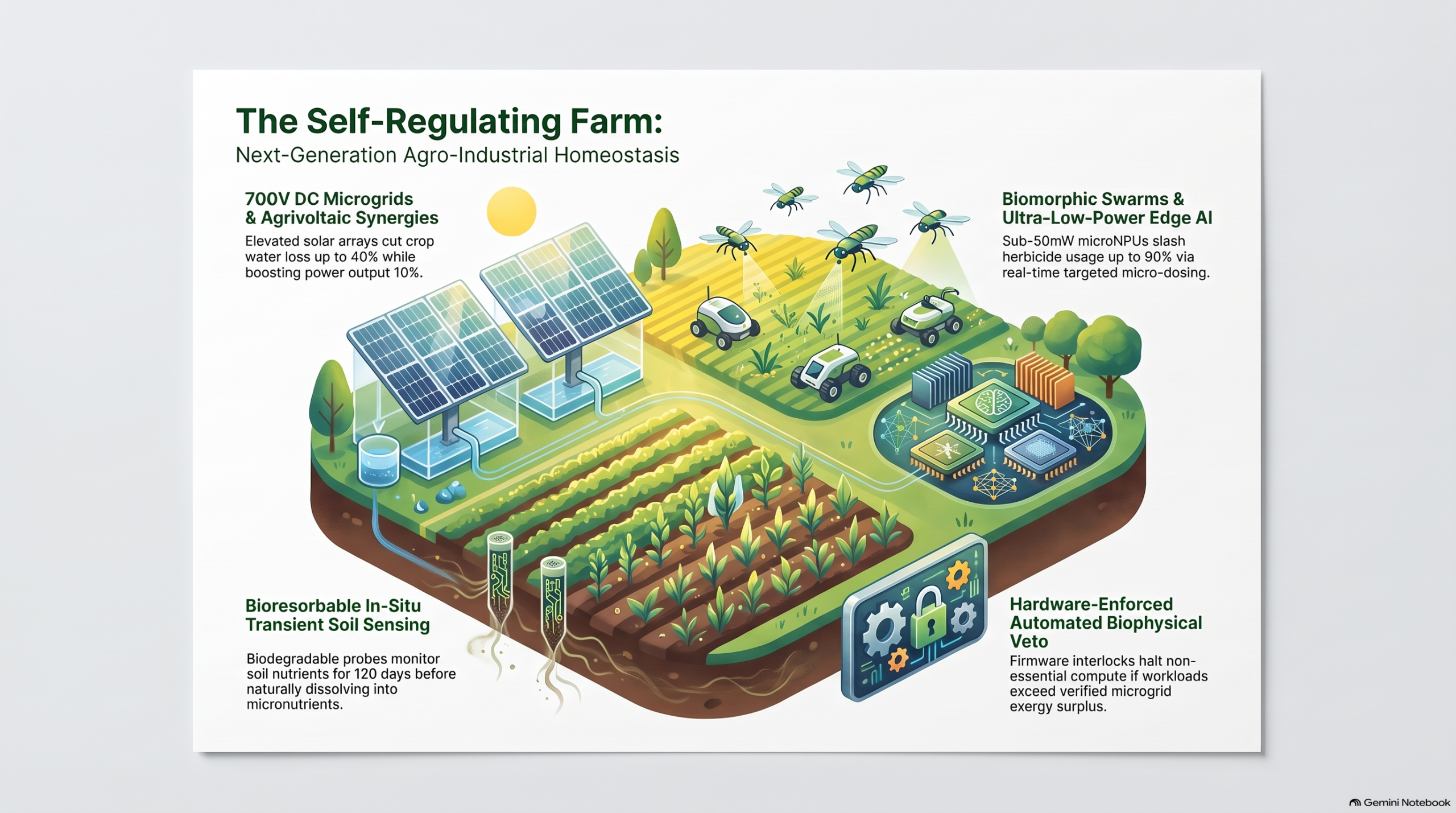
- PV Cooling via Crop Transpiration: Water vapor released by underlying crop transpiration cools overhead silicon PV modules by 6\text{–}10^\circ\text{C}. Mitigating the typical -0.4%/^\circ\text{C} thermal degradation penalty yields a +5%\text{–}10% increase in electrical power output.
- Microclimate Evapotranspiration Dampening: Intercepting peak mid-day solar radiation reduces soil surface temperatures by 5\text{–}12^\circ\text{C} and lowers crop evapotranspiration (ET_c) by 20%\text{–}40%, preserving soil volumetric water content (VWC).
- Land Equivalent Ratio (LER): Combining elevated photovoltaics and agricultural production on the same land area achieves an LER of 1.65 (85% crop output + 80% electricity output), representing a 65% increase in total land productivity.
- In-Situ Transient Sensing & Canopy Electrodynamics
- Bioresorbable Soil Sensors: Fabricated on biodegradable substrates (ethyl cellulose, silk fibroin, polyhydroxyalkanoates) using vacuum-deposited magnesium (\text{Mg}), zinc (\text{Zn}), and Laser-Induced Graphene (LIG) traces.
- Electrochemical NPK Transduction: Solid-Contact Ion-Selective Electrodes (SC-ISE) measure macronutrients directly in soil pore water via the Nernst-Nikolsky equation across a 10^{-5} to 10^{-1}\text{ M} detection range:
- Nitrate (\text{NO}_3^-): Tetradodecylammonium nitrate (TDDA) ionophore.
- Potassium (\text{K}^+): Valinomycin neutral carrier ionophore.
- Ammonium (\text{NH}_4^+): Nonactin/Monactin antibiotic matrix.
- Dissolution Kinetics & Zero-Waste Assimilation: Encapsulated in polycaprolactone (PCL) or beeswax barriers to delay water ingress (t_{\text{lag}} \approx L_{\text{barrier}}^2 / 6D). Hydrolytic degradation follows linear surface kinetics (h(t) = h_0 – k_{\text{diss}} \cdot t, where k_{\text{diss}} \approx 0.5\text{–}2.0\ \mu\text{m/day}). Over 90–120 days, component breakdown yields non-toxic plant micronutrients (\text{Mg}^{2+}, \text{Zn}^{2+}), eliminating manual post-harvest retrieval.
- Telemetry Readouts: Zero-silicon passive variants deploy printed inductive-capacitive (LC) resonant tanks (f_0 = 1 / (2\pi\sqrt{LC})) swept by aerial drone RF magnetic fields (1\text{–}30\text{ MHz}). Active variants utilize microscopic silicon dies (<0.5\text{ mm}^2, 15\ \mu\text{m} thick) attached via dissolvable zinc paste.
- Canopy RF Attenuation Physics: Governed by the Modified ITU-R P.833 model (A_{\text{canopy}} = a \cdot f^b \cdot (1 – e^{-d \cdot c})). High frequencies (2.4 GHz) experience severe attenuation (1.5\text{–}4.5\text{ dB/m}) due to rotational water-molecule absorption in foliage. Sub-GHz bands (868/915 MHz) experience significantly lower attenuation (0.3\text{–}0.8\text{ dB/m}), delivering a net link margin of +31.48\text{ dB} over a 10 km line-of-sight path through mature crops.
- Biomorphic Swarm Kinematics & Edge Computer Vision
- Avian Flocking Biophysics (Sturnus vulgaris):
- Topological Interaction (k \approx 7): Autonomous agents track strictly their k = 6.5 \pm 0.5 nearest topological neighbors, independent of metric distance. This prevents swarm context bloat and preserves spatial coherence under field expansion or compression.
- Scale-Free Criticality (\xi \propto L): Velocity fluctuation correlation length scales with total fleet diameter (L), driving susceptibility to infinity (\chi \to \infty). Local obstacle detection by an edge node triggers instantaneous fleet-wide reorganization without central coordination.
- Hyperbolic Inertial Spin Waves (\omega = c \cdot k): State changes propagate as undamped linear dispersion waves at c = 20\text{–}40\text{ m/s} based on Hamiltonian spin conservation (\mathbf{s}_i), bypassing slow diffusive multi-agent prompt negotiation.
- Master-Slave Kinematics: Combine-harvester (master origin) broadcasts RTK-GNSS pose vectors at 20 Hz over 5.9 GHz C-V2X (PC5 Mode 4) sidelink to autonomous grain-cart tractors (followers). Dynamic trajectory error \mathbf{e}(t) = \mathbf{p}{\text{cart}}(t) – (\mathbf{p}{\text{harvester}}(t) + \mathbf{R}(\theta)\mathbf{d}{\text{offset}}) maintains lateral auger tolerance |\mathbf{e}{\text{lat}}| \le 5\text{ cm}.
- Ultra-Low-Power Edge Vision: MicroNPUs (ARM Cortex-M55 + Ethos-U55 operating under 50\text{ mW}) execute INT8/INT4 quantized Tinyissimo-YOLO models at 30 FPS. Processing weed-vs-crop classification in <25\text{ ms} drives solenoid injectors to micro-dose herbicides, reducing chemical consumption by 70%\text{–}90%.
- Quad-Stream Telemetry, Dynamic Identity, & Hierarchical Slashing
- The Cognitive TOCTOU Gap: Static perimeter authentication (JWT, OAuth, mTLS) checks identity at session launch (t_0) but remains blind to agent drift, prompt injection, or hallucination loops prior to execution (t_{\text{exec}}).
- Quad-Stream Telemetry Engine: Continuous authorization evaluated across four real-time streams:
- Stream 1 (Epistemic): Rolling Brier score \text{BS}_{i,k}(t) \in [0, 2], Variational Free Energy F, and Delirium Detection (\dot{F} > 0 triggers suspension).
- Stream 2 (Syntactic): Lean 4 Abstract Syntax Tree (AST) type-checking (S_{\text{syn}} \in {0.0, 1.0}). Compilation error aborts action and slashes 10% compute stake.
- Stream 3 (Thermodynamic): Landauer context-erasure accounting (\Delta Q = N_{\text{bits}} k_B T \ln 2) and Metabolic Ratio (\mathcal{M}{\text{ratio}} = \Delta F / (\lambda \Delta Q)). If \mathcal{M}{\text{ratio}} < 1.0, a hardware interrupt (FORCE_ACTION_HALT) terminates execution.
- Stream 4 (Ontic): Physical discrepancy loss against Level 0 sensors (S(E_t, \theta) \le \tau_t). Exceeding threshold \tau_t triggers an automated 50% stake slash.
- Composite Epistemic Health Index (\Psi_i(t)): Aggregates the four streams into a scalar value in [0, 1] mapped across four operational tiers (Tier 1 Veridical Core: 0.85\text{–}1.00; Tier 2 Sub-Calibrated: 0.65\text{–}0.85; Tier 3 Epistemic Warn: 0.40\text{–}0.65; Tier 4 Byzantine Fault: <0.40). Softmax routes tasks proportionally: P(\text{Route} \to i) = \exp(\beta \Psi_i) / \sum \exp(\beta \Psi_j).
- Hierarchical Transitive Slashing: Conserves liability along delegation chains (\text{Originator } A \to \text{Curator } B \to \text{Executor } C). Level 0 physical breaches incur a 50% stake slash on Executor C, a 25% slash on Curator B, and a 10% slash on Originator A, accompanied by instant capability token revocation and hardware snap-back reversion.
- Techno-Economic Analysis (TCO) & 60-Month Roadmap
- 5-Year Enterprise TCO (5,000 Hectares):
- Legacy AgTech (Scenario A): High CapEx (120,000), massive recurring carrier/cloud subscriptions (240,000), full chemical broadcast (2,800,000), and diesel fuel expenditure (750,000). Total = $3,910,000.
- Self-Regulating Agro-Stack (Scenario B): DC microgrid/agrivoltaic CapEx (420,000), open hardware CapEx (85,000), single satellite link OpEx (4,800), reduced micro-dosed chemical costs (840,000), electric fleet power (75,000), offset by agrivoltaic clean energy sales (-450,000). Total = $974,800.
- Net Operational Savings: 2,935,200 (a 75.1% expenditure reduction with a simple CapEx payback period of 14.2 months).
- 60-Month Implementation Phasing:
- Epoch 1 (Months 1–12): Infrastructure Baseline & Telemetry Fabric (700 V DC microgrid, LoRaWAN/CBRS base masts, TPM 2.0 telemetry logging).
- Epoch 2 (Months 13–24): In-Situ Soil & Agrivoltaic Grounding (Agrivoltaics, biomass gasifier, bioresorbable SC-ISE probes, BBR exergy tracking).
- Epoch 3 (Months 25–42): Biomorphic Swarms & Dynamic Slashing (C-V2X autonomous swarms, k-NN topological routing, hierarchical slashing router).
- Epoch 4 (Months 43–60): Sustained Island Mode Veridical Cutover (Automated Biophysical Veto active, decommissioning legacy cloud links, full autonomous islanded operation).
Section 2: Review Quiz (Short-Answer Questions)
- What is the “1,000-Mile Failure Model” in conventional AgTech, and why does it introduce systemic operational risk?
- How does the interaction between elevated photovoltaic panels and underlying crop canopies generate mutual thermodynamic benefits in Layer 1?
- How do bioresorbable Solid-Contact Ion-Selective Electrodes (SC-ISE) measure soil macronutrients without generating persistent e-waste?
- Why do Sub-GHz frequencies (e.g., 868/915 MHz) outperform 2.4 GHz signals when propagating wireless telemetry through mature crop canopies?
- What are the three core biophysical mechanisms derived from European starling murmurations (Sturnus vulgaris), and how are they applied to autonomous machine swarms?
- How does C-V2X (PC5 Sidelink) maintain dynamic master-slave kinematics between a combine harvester and an autonomous grain chaser tractor?
- What is the “Cognitive TOCTOU Gap” in autonomous agent security, and why do static credential schemes like JWT or mTLS fail to prevent it?
- Define the four evaluation streams that comprise the Quad-Stream Runtime Telemetry Engine.
- What is the function of the Landauer Metabolic Halting Gate (\mathcal{M}_{\text{ratio}}) in Layer 4 cognitive orchestration?
- How does Hierarchical Transitive Slashing distribute liability when an autonomous executor breaches Level 0 physical sensor constraints?
Section 3: Quiz Answer Key
- The 1,000-Mile Failure Model refers to AgTech architectures that require continuous connectivity between field assets and distant cloud hyperscalers over commercial cellular networks. This introduces single points of failure because regional fiber cuts, network congestion, or cloud outages cause multi-ton autonomous machines and irrigation infrastructure to stall. Furthermore, it exposes farm operations to vendor lock-in, data exploitation, and subscription-based service enclosures.
- Elevated PV panels shade the crop canopy during peak heat hours, dropping soil surface temperatures by 5\text{–}12^\circ\text{C} and reducing crop evapotranspiration (ET_c) by 20%\text{–}40%. Concurrently, water vapor released through crop transpiration cools the overhead silicon PV modules by 6\text{–}10^\circ\text{C}. This mitigates the -0.4%/^\circ\text{C} thermal degradation penalty of silicon PV, boosting solar power generation efficiency by +5%\text{–}10%.
- SC-ISE sensors utilize functionalized ionophore membranes (TDDA for nitrate, Valinomycin for potassium, Nonactin/Monactin for ammonium) patterned on biodegradable substrates (ethyl cellulose, silk fibroin) with magnesium and zinc conductive traces. The electrodes develop a potentiometric voltage proportional to ion activity according to the Nernst-Nikolsky equation. Over a 90–120 day crop cycle, moisture and microbial action dissolve the non-protective encapsulation, hydrolyzing the metals into non-toxic plant micronutrients (\text{Mg}^{2+}, \text{Zn}^{2+}).
- Mature plant canopies contain high moisture levels, causing severe electromagnetic signal absorption at 2.4 GHz due to water-molecule rotational resonance (1.5\text{–}4.5\text{ dB/m} loss). In contrast, Sub-GHz frequencies (868/915 MHz) experience far lower absorption (0.3\text{–}0.8\text{ dB/m} loss) under the Modified ITU-R P.833 model. This reduced attenuation enables Sub-GHz LoRaWAN links to maintain a +31.48\text{ dB} link margin over 10 km baseline paths through dense vegetation.
- Starling flocking relies on topological interactions (k \approx 7 nearest neighbors), scale-free correlation (\xi \propto L), and hyperbolic inertial spin waves (\omega = c \cdot k). When applied to autonomous swarms, k-NN bounds communication attention to prevent context bloat, scale-free correlation maximizes fleet susceptibility (\chi \to \infty) for instant obstacle avoidance, and hyperbolic spin waves propagate trajectory changes across the fleet at 20\text{–}40\text{ m/s} without slow, diffusive multi-turn negotiation.
- The combine harvester acts as a dynamic master origin, broadcasting its RTK-GNSS pose vector [\mathbf{p}{\text{harvester}}, \theta, \mathbf{v}] at 20 Hz directly over 5.9 GHz C-V2X (PC5 Mode 4) sidelink with <10\text{ ms} latency. The autonomous chaser tractor continuously tracks this vector to calculate its relative trajectory error \mathbf{e}(t) = \mathbf{p}{\text{cart}}(t) – (\mathbf{p}{\text{harvester}}(t) + \mathbf{R}(\theta)\mathbf{d}{\text{offset}}). Closed-loop actuators regulate lateral alignment to |\mathbf{e}_{\text{lat}}| \le 5\text{ cm} over rolling terrain to prevent grain spillage.
- The Cognitive Time-of-Check to Time-of-Use (TOCTOU) Gap occurs when an agent authenticates at session launch (t_0) but experiences model drift, prompt injection, or hallucination loops prior to executing a physical action (t_{\text{exec}}). Static credentials (JWT, mTLS) validate identity only at check time, leaving the system vulnerable to execution of destructive physical commands. Static tokens cannot detect whether an agent’s internal cognitive state has degraded between authorization and execution.
- The Quad-Stream Engine evaluates: (1) Epistemic Calibration via rolling Brier scores and Active Inference Variational Free Energy (F); (2) Syntactic Soundness via deterministic Lean 4 AST type-checking (S_{\text{syn}}); (3) Thermodynamic Efficiency via Landauer context-erasure accounting (\Delta Q) and the Metabolic Ratio (\mathcal{M}_{\text{ratio}}); and (4) Ontic Physical Telemetry by measuring real-world discrepancy loss (S(E_t, \theta)) against Level 0 physical sensors.
- The Landauer Metabolic Halting Gate evaluates whether an agent’s reduction in Variational Free Energy (\Delta F) justifies the physical heat dissipated (\Delta Q = N_{\text{bits}} k_B T \ln 2) when overwriting memory context during introspective cycles. If the Metabolic Ratio \mathcal{M}_{\text{ratio}} = \Delta F / (\lambda \Delta Q) drops below 1.0, the agent is burning compute without reducing uncertainty. The gate trips a hardware interrupt (FORCE_ACTION_HALT) that truncates context and forces the agent to execute based on its current state.
- Liability is strictly conserved along capability delegation chains (\text{Originator } A \to \text{Curator } B \to \text{Executor } C). If Executor C issues a command that breaches Level 0 physical sensor thresholds (S(E_t, \theta) > \tau_t), Executor C incurs a 50% stake slash, Curator B incurs a 25% stake slash, and Originator A incurs a 10% stake slash. Capability tokens are immediately revoked, unslashed collateral reverts to Originator A, and failing agents receive Brier score penalties.
Section 4: Suggested Essay Questions
- Thermodynamic Analysis of Industrial vs. Island-Mode Agriculture: Compare the entropic efficiency and energy balance of modern high-input industrial agriculture with the closed-loop architecture of the Self-Regulating Farm. In your response, analyze the roles of EROEI, the 700 V DC microgrid, thermochemical biomass gasification, and elevated agrivoltaic arrays.
- Epistemology and Parameter Foreclosure: Explain how Fallibilistic Perspectival Realism and Topological Parameter Foreclosure (Via Negativa) resolve the “Epicycle Trap” in agricultural modeling. Detail the mathematical conditions under which State Proposition 1 guarantees asymptotic contraction of the permissible hypothesis space around the true physical attractor \Omega^*.
- Biomorphic Swarm Coordination: Analyze the biophysical principles of starling murmurations (Sturnus vulgaris) and detail how their mathematical formalization solves the network scalability, attention bloat, and latency challenges inherent to multi-agent autonomous field assets.
- Zero-Trust Physical Governance and Telemetry: Contrast traditional perimeter cybersecurity models with the Quad-Stream Runtime Telemetry Engine. Discuss how Landauer metabolic metering, Lean 4 AST proof kernels, and Level 0 ontic sensor feedback prevent cognitive hallucination loops and physical infrastructure damage.
- Techno-Economic Transformation: Evaluate the 5-year enterprise Total Cost of Ownership (TCO) model for a 5,000-hectare deployment of the Self-Regulating Farm compared to legacy AgTech. Detail how CapEx allocations in microgrids and agrivoltaics generate long-term OpEx reductions in inputs, energy, and communications across the 60-month phased implementation roadmap.
Section 5: Comprehensive Glossary of Key Terms
- Active Inference: An neuro-computational framework rooted in Friston’s Free Energy Principle where cognitive agents act to minimize Variational Free Energy (F), balancing internal predictive accuracy against model complexity.
- Agrivoltaics: The dual-use integration of elevated solar photovoltaic arrays (3.5\text{–}5\text{ m} clearance) over agricultural crop land, establishing microclimatic synergies that reduce crop evapotranspiration while cooling PV modules.
- Automated Biophysical Veto (BBR Veto): A firmware-level circuit breaker that measures forecasted operational workloads against verified net exergy in the Biophysical Balance Register, cutting execution queues when energy demands exceed physical reserves.
- Biophysical Balance Register (BBR): A sovereign Layer 5 financial and resource ledger that meters all farm economic claims and computational work strictly against net physical exergy reserves and thermodynamic work capacity.
- Bioresorbable Sensors: Fully transient electronic devices fabricated from non-toxic materials (ethyl cellulose, silk, Mg, Zn, LIG) designed to monitor soil parameters for a set period before dissolving completely into natural plant nutrients.
- Brier Score (\text{BS}): A strictly proper score rule assessing the accuracy of probabilistic forecasts against binary or categorical outcomes, bounded in [0, 2] where 0.0 indicates perfect calibration.
- Bundle Protocol (RFC 9171): A delay-tolerant networking (DTN) protocol that enables store-and-forward data transmission across unreliable or intermittent communications channels without requiring continuous end-to-end connectivity.
- C-V2X (PC5 Mode 4): Cellular Vehicle-to-Everything direct communication operating on 5.9 GHz frequencies, providing deterministic, low-latency (<10\text{ ms}) sidelink coordination between autonomous field vehicles without cellular towers.
- Cognitive TOCTOU Gap: The time-of-check to time-of-use vulnerability where an agent passes perimeter authentication at session start but suffers cognitive drift, prompt injection, or hallucination before executing a physical action.
- Composite Epistemic Health Index (\Psi_i(t)): A real-time aggregated metric in [0, 1] combining epistemic, syntactic, thermodynamic, and ontic telemetry streams to evaluate an agent’s operational capability and network voting weight.
- Energy Return on Energy Invested (EROEI): The ratio of usable physical energy delivered by an energy-acquisition activity to the total exergy expended to obtain that energy.
- Fallibilistic Perspectival Realism: An epistemological framework holding that mind-independent physical reality exists as an invariant attractor, accessible only through dimension-reducing observational projection operators that preserve topological causal truths.
- Hierarchical Transitive Slashing: A liability distribution protocol across delegated agent chains that automatically burns staked collateral (50% Executor, 25% Curator, 10% Originator) upon detection of a Level 0 physical sensor breach.
- ISOBUS (ISO 11783): The international standard for electronic communication between agricultural tractors, implements, and software devices, operating via CAN bus architecture (ISO 11783-10 Task Controller).
- Landauer Metabolic Halting: A computational circuit breaker enforcing Landauer’s Principle (\Delta Q \ge N_{\text{bits}} k_B T \ln 2), terminating agent processing threads when the ratio of variational free energy reduction to physical heat dissipation drops below 1.0.
- Land Equivalent Ratio (LER): A metric evaluating the productivity of integrated land-use systems compared to mono-cropping; an LER >1.0 indicates superior yield efficiency on a unified footprint.
- Lean 4 AST Proof Kernel: A formal mathematical verification tool that checks whether compiled code directives conform to machine-checkable Abstract Syntax Trees and axiomatic rules before physical dispatch.
- Metacognitive Swarm of Intelligences (MSI): A multi-agent computational architecture where heterogeneous model families (Transformers, State Space Models, Symbolic Solvers) deliberate under topological attention and consensus limits.
- MicroNPU: A dedicated low-power silicon neural processing unit (e.g., ARM Ethos-U55 operating under 50\text{ mW}) optimized for executing quantized deep learning vision models at the sensor edge.
- Modified ITU-R P.833 Model: A mathematical propagation model calculating electromagnetic wave attenuation through leafy vegetation and crop canopies as a function of RF frequency and foliage depth.
- Nernst-Nikolsky Equation: An electrochemical formulation modeling the potential response of Ion-Selective Electrodes in solution, accounting for primary ion activity and interference from secondary ionic species.
- Ontic Manifold (\mathcal{M}): The objective, mind-independent physical reality modeled as an infinite-dimensional Riemannian manifold (\dim(\mathcal{M}) = D \to \infty) containing the physical state of the agro-ecosystem.
- Parametric Insurance: A financial risk transfer mechanism where insurance claims trigger automatically upon verified physical sensor thresholds (e.g., rainfall, temperature) without requiring manual loss adjusters.
- Quad-Stream Telemetry Engine: An continuous authorization framework that monitors epistemic calibration, syntactic proof validity, Landauer thermodynamic efficiency, and Level 0 ontic physical discrepancies.
- Rule of Veridicality: An epistemological constraint requiring that a dimension-reducing projection operator preserve distinct causal states from the higher-dimensional physical manifold without introducing topological aliasing.
- Scale-Free Criticality: A state in physical systems where spatial correlations scale with total system size (\xi \propto L), maximizing susceptibility (\chi \to \infty) and enabling instantaneous collective response across an entire swarm.
- Solid-Contact Ion-Selective Electrode (SC-ISE): An electrochemical sensor utilizing a solid-state transducer interface layer beneath an ionophore-doped polymeric membrane to measure specific ion concentrations.
- Sustained Island Mode: The operational state where a farm’s energy, control, computational, and mechanical systems maintain continuous, homeostatic operation independent of external cloud networks or central power grids.
- Topological k-NN Interaction: A flocking mechanics rule where an agent interacts exclusively with its k \approx 7 nearest topological neighbors regardless of physical distance, preserving swarm stability while preventing context bloat.
- Topological Parameter Foreclosure (Via Negativa): The process of advancing system knowledge through the systematic, irreversible excision of falsified parameter spaces that breach empirical physical thresholds.
- Topp’s Polynomial: An empirical equation relating the high-frequency apparent dielectric permittivity (\varepsilon_r’) of a porous soil matrix to its Volumetric Water Content (\theta_v).
- Undamped Inertial Spin Wave: A hyperbolic second-order wave (\omega = c \cdot k) that propagates information across a biomorphic swarm via conserved internal spin vectors (\mathbf{s}_i) at high speeds (20\text{–}40\text{ m/s}).
- Variational Free Energy (F): An information-theoretic measure bounding the surprise or prediction error of an agent’s internal generative model relative to environmental sensory observations.