The $130,000 City-in-a-Box: Why the Future of Urban Living is “Island Mode”
Modern municipal infrastructure is built on a foundation of sand. For decades, small cities have been nudged toward centralized cloud providers to manage everything from emergency communications to transit. This reliance creates a terrifying single point of failure: if the external internet connection drops or a global provider suffers a breach, the city—its clinics, its police, its very heartbeat—grinds to a halt.
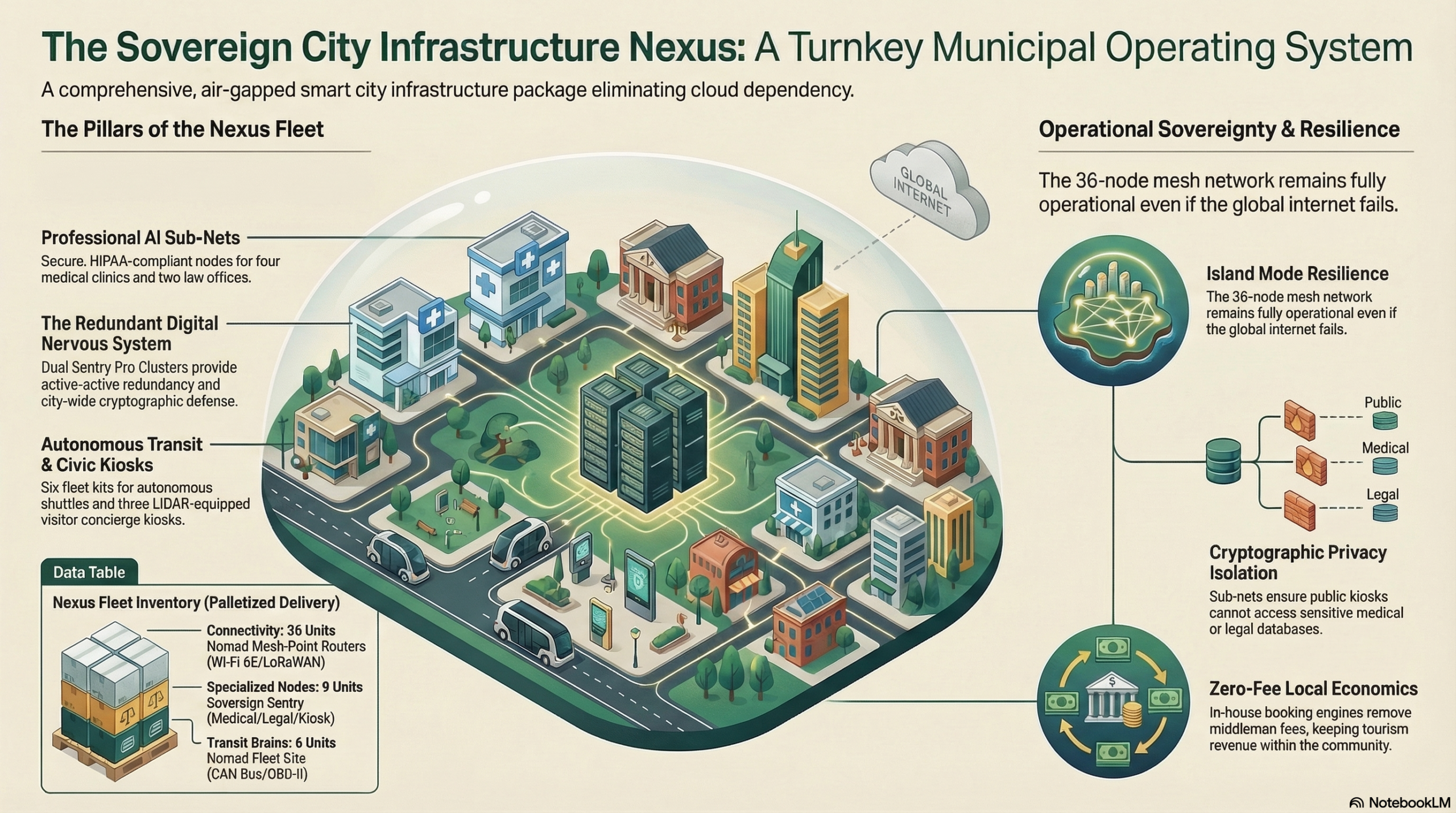
The solution is not more cloud, but “Digital Sovereignty.” This concept moves the critical logic of a city back within its own borders. The “City Infrastructure” Nexus Package represents a radical shift in this direction, offering a turnkey, air-gapped operating system designed specifically for municipalities of 1,000 to 3,000 residents. This isn’t just a software patch; it is a massive physical deployment of 57 hardware units delivered via palletized LTL freight, designed to reclaim a town’s digital destiny.
By prioritizing localized, resilient hardware over fragile global dependencies, small towns can now operate as autonomous digital islands. This isn’t just a tech upgrade; it’s an architectural manifesto for community resilience, delivered in eight heavy-duty, weather-sealed transit crates.
The Digital Nervous System: Engineering Total “Island Mode” Resilience
At the heart of this sovereign city are two high-capacity Sentry Pro Clusters, comprising 6x 1U nodes total. These are deployed in active-active redundancy across two separate municipal data centers—typically City Hall and the Police HQ. This core compute layer runs the city’s Root Certificate Authority (CA), ensuring that the “brain” of the town remains local and un-killable.
This power is distributed through a 36-node Nomad Mesh-Point network. Unlike traditional Wi-Fi that relies on an external ISP, this ruggedized Wi-Fi 6E and LoRaWAN canopy creates a self-healing intranet. Using BGP-style logic, the system is designed for high-stakes survival: if dense urban construction or interference degrades the high-bandwidth video backhaul, the system automatically “downshifts” to 900MHz LoRaWAN. This ensures that even in a total bandwidth crunch, critical text, CRM, and emergency dispatch data always get through.
The entire grid is monitored, load-balanced, and defended by a redundant, multi-cluster Digital Nervous System, guaranteeing absolute digital sovereignty and “Island Mode” resilience.
Evicting the Extraction Economy: The End of the “Middleman Tax”
Modern local economies are often drained by “extraction” fees from global booking platforms. The Nexus Package counters this via three ruggedized Municipal Kiosks. These aren’t just information booths; they run the Sovereign Executive agent, acting as a public-facing local LLM concierge that functions as a zero-fee booking engine for local restaurants and hotels.
By hosting the booking logic locally, the city keeps wealth within its own economy, stripping out the “Airbnb/Expedia extraction” fees. Furthermore, these kiosks serve a dual purpose in civic security. They run Vault Warden software, utilizing integrated sensors for secure, LiDAR-based volumetric monitoring of public squares and transit stops. This turns every kiosk into a silent, privacy-respecting guardian of public safety.
Cryptographic Sanctuary: Professional-Grade Privacy as a Utility
Privacy in a small town is often undermined by the use of public-cloud tools for sensitive work. The Nexus Package addresses this by deploying specialized “Professional Sub-Nets” for healthcare and law, consisting of four medical nodes and two legal nodes. These Sovereign Sentry nodes provide a level of security that the public cloud simply cannot match.
The system enables Cross-Clinic Encrypted Referrals, allowing a general practitioner to securely transfer heavy, OCR’d medical files to a specialist across town via the mesh network, bypassing the public internet entirely. These nodes handle:
- Patient Dictation: Localized Whisper AI for instant, private medical records.
- Document Management: On-site OCR processing for medical and legal archives.
- Automated Drafting: High-security contract generation via local AI.
- Secure Comms: Encrypted VoIP routing that never leaves the municipal mesh.
A Grid That Doesn’t Sleep: SHA-256 Isolation and Redundant Defense
In a truly sovereign city, the infrastructure must be self-healing. If City Hall loses power, the secondary Sentry Pro cluster at the Police HQ instantly assumes Master CA duties. Because the hardware and Mesh-Points run natively on low-voltage DC, they are easily paired with local solar or microgrids, keeping the clinics and transit running even when the macro-grid fails.
Security is enforced through SHA-256 cryptographic isolation. In a standard network, compromising a public kiosk might give a hacker a path to the hospital’s records. In this nexus, the legal and medical sub-nets are mathematically isolated from the public-facing kiosks.
Hardware Roots of Trust: Sub-nets are cryptographically isolated. The legal and medical nodes are programmed to drop any packet not signed by their specific Sub-CA, rendering the public kiosk functionally invisible to them.
Autonomous Transit: The Industrial Foreman and Spatially-Aware Logic
Transportation is the final pillar of the sovereign town. The package includes six Nomad Fleet Kits—mobile edge servers that plug directly into municipal electric shuttles via the CAN Bus. These kits run the Industrial Foreman AI, which manages the fleet without ever needing to “call home” to a global cloud.
When a visitor requests a ride via a municipal kiosk, the system utilizes “spatially-aware edge logic” to coordinate the fleet. The Industrial Foreman analyzes the location and battery load balancing of all six shuttles over the mesh to dispatch the most efficient vehicle. It is a closed-loop, autonomous dispatch system that functions perfectly in “Island Mode,” ensuring the town stays in motion even if the rest of the world goes dark.
Conclusion: A Blueprint for the Sovereign Town
The $129,999 “City Infrastructure” Nexus Package marks the end of the era where small-town functionality was a byproduct of Big Tech’s stability. By providing a turnkey fleet of 57 hardware units—from dual-redundant server clusters to autonomous transit brains—it offers a blueprint for a municipality that owns its data, its economy, and its future.
When those eight weather-sealed crates arrive at the municipal warehouse, they aren’t just delivering hardware; they are delivering the ability to stand alone. As we move into an era of increasing digital instability, the ultimate question for municipal planners changes: the true mark of a “smart city” is no longer how many devices it has connected to the cloud, but how well it functions when the rest of the world goes offline.