The Future is “Island Mode”: How Localized AI is Reclaiming our Cities, Farms, and Factories
Introduction: The Fragile Cloud Hook
Modern civilization is currently suspended by an invisible and increasingly precarious thread: the cloud. From medical records and power grids to high-speed manufacturing lines, our essential infrastructure relies on distant servers owned by a handful of “Big Tech” conglomerates. This dependency is not merely a technical choice; it is a voluntary surrender of municipal and industrial autonomy. It introduces unacceptable latency, creates massive intellectual property vulnerabilities, and subjects local economies to “SaaS extraction”—a perpetual siphoning of wealth through subscription fees and data harvesting.
The DeReticular vision offers an asymmetric alternative: Island Mode. By shifting the “brain” of our infrastructure from the distant cloud to localized, air-gapped clusters running on the RIOS Core, we are entering an era of “Anti-fragility.” This is the Digital Nervous System—infrastructure that remains operational, sovereign, and self-healing even when the global macro-grid fails.
——————————————————————————–
1. When Milliseconds are a Matter of Safety
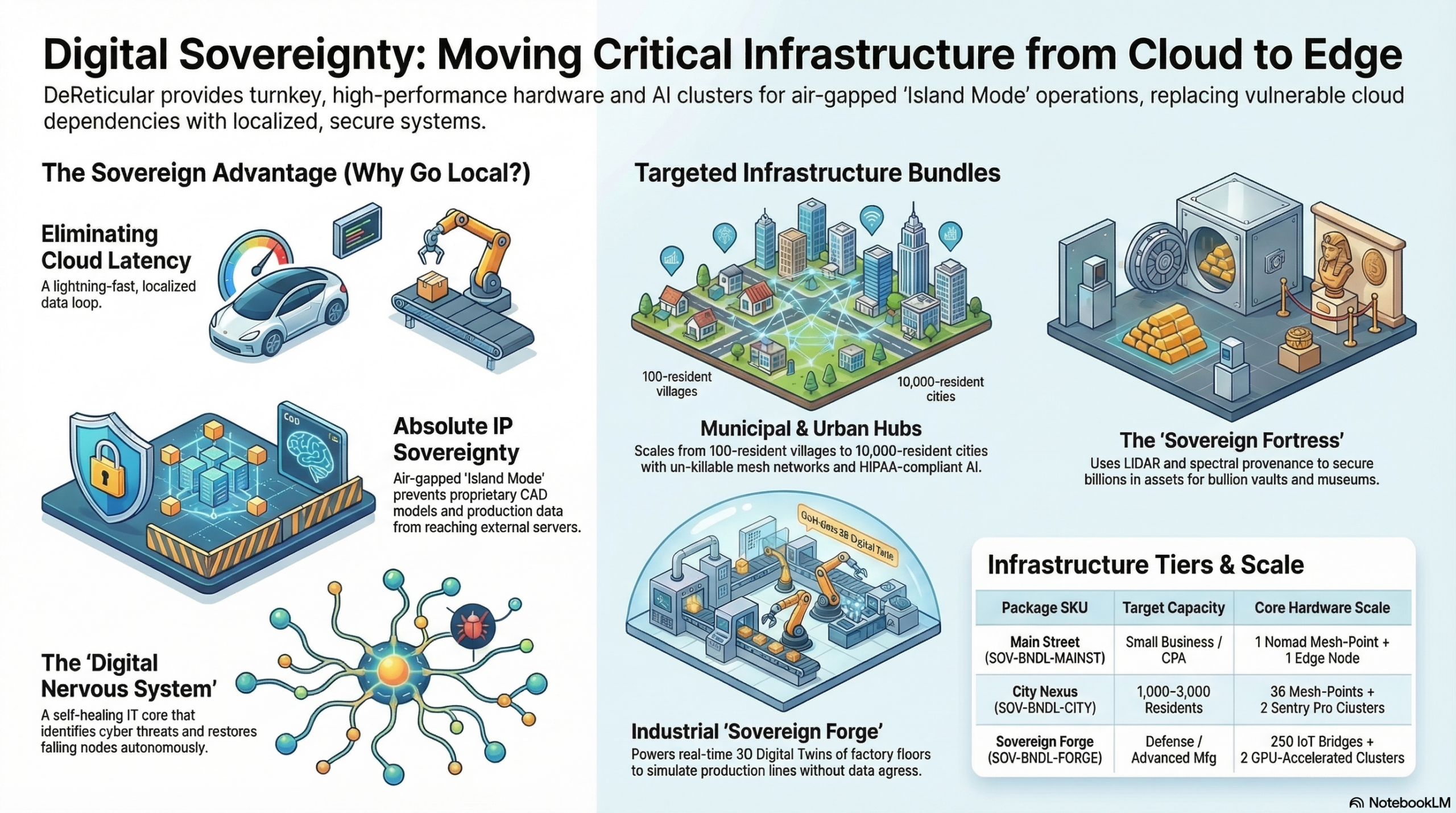
In the world of high-speed industrial robotics and kinetic systems, cloud dependency is a catastrophic risk. Traditional cloud APIs introduce a lag of 5 to 10 milliseconds—an eternity when a robotic arm is moving at high velocity. The Sovereign Forge architecture bypasses this by deploying localized Sentry Pro clusters directly on the factory floor. These nodes enable sub-millisecond decision-making and ensure that data never touches the external internet.
Using the Industrial Foreman node, the system analyzes IoT telemetry locally with <5ms latency. If an anomaly is detected in a CNC spindle or a stamping press, the node triggers a shutdown in just 12 milliseconds. Beyond physical safety, this localized approach provides an impenetrable vault for proprietary data.
“Modern manufacturing relies heavily on robotics, high-speed telemetry, and Digital Twins… However, routing this data through Big Tech cloud servers introduces unacceptable latency for high-speed robotics and creates massive IP vulnerabilities. Defense contractors and advanced manufacturers cannot risk uploading proprietary CAD models or production rates to external servers.”
——————————————————————————–
2. Building a Digital Nervous System That Doesn’t Need the Internet
Resilience is the ability of a system to maintain its integrity under stress. Conventional “smart city” initiatives are brittle; if a global fiber line is severed, the “intelligence” evaporates. The DeReticular architecture provides a scalable Digital Nervous System using the Nomad Mesh-Point canopy. This is not a single-sized solution but a tiered approach to sovereignty: the Village Genesis package blankets smaller communities with 12 nodes, while the Urban Hub scales to 100 nodes to serve up to 10,000 residents.
These networks utilize Tri-Zone High Availability, ensuring active-active-active redundancy across municipal zones. Centralized by the Deep Admin AI, these systems go beyond simple maintenance to perform Active Defense. If the system identifies an SSH brute-force or ransomware probe, the Deep Admin doesn’t just alert a technician; it autonomously null-routes the attacker’s IP at the municipal switch. This self-healing capability keeps first responders and utilities online in a total regional blackout, transforming the city from a tech-tenant into a sovereign entity.
3. Keeping Local Wealth Local by Cutting Out the SaaS “Tax”
The modern digital economy functions on a model of extraction, where a percentage of every transaction is paid as a “SaaS Tax” to distant platforms. The Main Street Commerce and Municipal Kiosk modules are designed to decouple local wealth from these global middlemen.
By utilizing Sovereign Executive AI and OpenClaw agents, a municipality can host its own hospitality and transit booking engines with zero fees. This shifts the economic gravity back to the residents. For small businesses, the Scribe (Voice CRM) and Archivist (OCR) modules provide enterprise-grade efficiency—automatically filing invoices and transcribing client interactions—without ever surrendering sensitive data to a cloud-based LLM.
——————————————————————————–
4. Reclaiming the “Right to Repair” in the Fields
Commercial agriculture has been held hostage by proprietary “software locks.” The Sovereign Harvest package breaks this monopoly by returning control to the farmer. By managing machinery via ISOBUS and CAN Bus protocols, the system allows owners to clear codes and maintain equipment locally, bypassing the cellular connection requirements mandated by “Big Ag.”
This autonomy enables the Autonomous Harvest Loop: soil sensors report moisture and maturity via LoRaWAN, triggering GPS-guided harvesters that coordinate with grain carts to offload—all with zero human intervention. Furthermore, Spectral Provenance utilized by Vault Warden sensors can detect nitrogen deficiency or crop blight at a molecular level before it is visible to the human eye.
“Modern commercial farming has become completely dependent on proprietary Big Ag cloud services. Tractors refuse to run without a cellular connection, yield data is harvested and sold by external tech companies, and automated irrigation fails when the macro-internet drops.”
——————————————————————————–
5. Bridging the Gap Between Digital Simulation and Physical Reality
True sovereignty requires “The Total Asset State”—a condition where physical inventory and digital records are in perfect, verifiable alignment. The Sovereign Fortress package achieves this through a 1:1 Digital Twin, where LiDAR spatial arrays sync physical movement with 3D simulations in real-time.
This system utilizes the Provada Ledger to generate Proof of Existence cryptographic heartbeats. For high-security vaults or museums, multispectral cameras verify the molecular signature of bullion or fine art to prevent forgeries. By using zero-knowledge proof APIs, these facilities can provide mathematical certainty to insurers that their assets are safe, leading to drastically reduced premiums by eliminating “unverifiable” blind spots.
——————————————————————————–
6. Power to the People: Neighbors Negotiating Kilowatts
If the Digital Nervous System is the brain of a community, the Resilient Microgrid is its metabolism. Using the Negotiator protocol, localized nodes turn a neighborhood into a P2P energy network. One farm’s excess solar is no longer sold back to a utility at a loss; instead, it is autonomously routed to a “dump load”—perhaps heating the local clinic’s water boiler or charging a municipal shuttle.
The critical “Island Mode” survival detail lies in the Direct DC architecture. By running the AI brain directly off battery banks via DC-to-DC converters, the system bypasses AC inverter losses and remains online even if the primary inverter fails. This ensures the energy management system stays operational when it is needed most, providing a resilient foundation for the community’s assets.
Conclusion: The Shift Toward Localized Intelligence
We are witnessing the end of the “Cloud-First” era and the birth of “Sovereign-First” infrastructure. The transition to Island Mode represents a move toward an anti-fragile, self-healing world where cities, farms, and factories are no longer vulnerable to distant failures or corporate whims.
As we reclaim our digital lives, we must confront a fundamental political reality: Is your community a sovereign entity, or merely a tenant on a Big Tech estate?