Toward Spherical Resilience: A Briefing on Sovereign Autonomous Infrastructure
Executive Summary
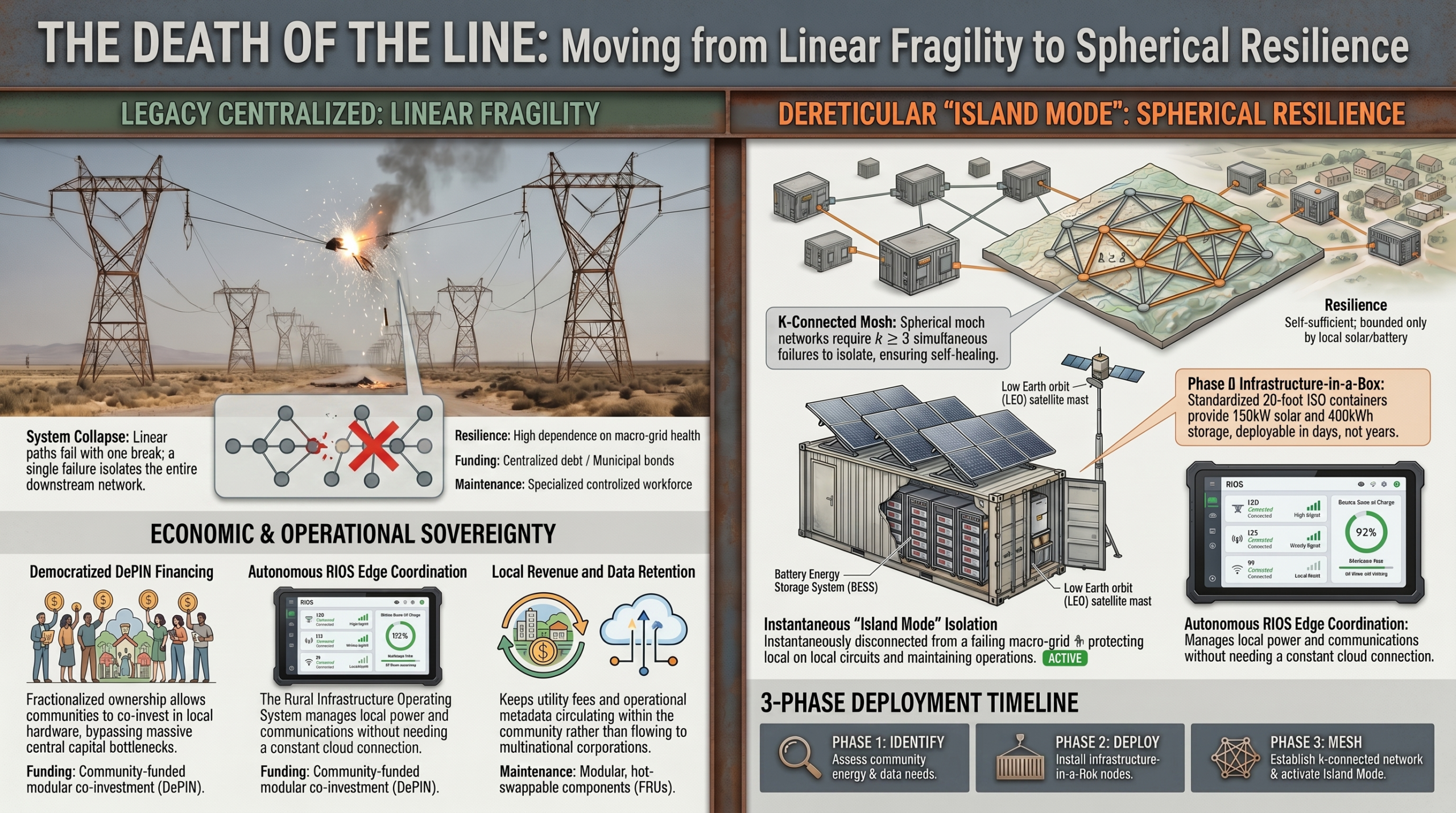
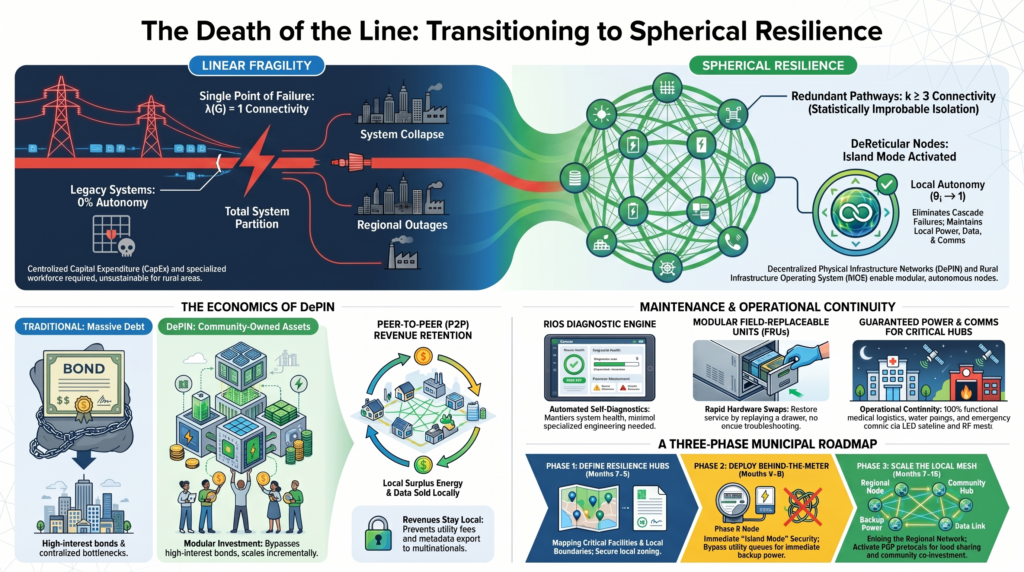
Modern public infrastructure is currently defined by “Linear Fragility,” a design paradigm where centralized production nodes deliver services through high-capacity, single-point-of-failure corridors. The sovereign autonomous infrastructure model, spearheaded by the DeReticular architecture, proposes a transition to “Spherical Resilience.” This model utilizes “Island Mode” node architectures to ensure that regional services—power, data, and communications—remain operational even when disconnected from the macro-grid.
Critical Takeaways:
- Immediate Deployability: The model does not require futuristic technology; it is built on mature open-source software, commodity hardware, edge AI, and decentralized networking.
- Technological Sovereignty: By using a localized stack (RIOS), communities can maintain industrial controls, communications, and data processing independently of foreign cloud providers or centralized telecom.
- Economic Innovation: The Decentralized Physical Infrastructure Network (DePIN) model allows for fractionalized ownership and community-funded assets, bypassing the capital bottlenecks of traditional utility financing.
- Operational Resilience: Through k-connected mesh topologies (k \ge 3), the mathematical probability of systemic failure is drastically reduced, as failures are physically and digitally bounded to their zone of origin.
podcast
1. The Deployment Thesis: From Centralization to Distribution
Traditional infrastructure assumes centralized institutions and stable national telecom systems. Sovereign autonomous infrastructure reverses this by prioritizing modularity and local resilience. This model is particularly suited for regions where legacy infrastructure is dominant or failing, such as rural economies, politically fragmented regions, and disaster recovery zones.
Comparison of Infrastructure Models
| Feature | Hyperscale/Traditional Model | Sovereign Autonomous Model |
| Architecture | Centralized data centers/hubs | Modular, distributed nodes |
| Dependency | High bandwidth, stable national grid | Disconnected, “Island Mode” operation |
| Cost Barrier | Massive CapEx/Hyperscale investment | Low-cost, commodity hardware |
| Governance | Centralized policy enforcement | Local governance and data sovereignty |
| Resilience | Linear fragility (single point of failure) | Spherical resilience (mesh-based) |
video
2. Foundational Pillars of the Autonomous Stack
The shift toward deployable autonomous systems is driven by five technological convergences:
- Open-Source Infrastructure: Utilizing Linux, Kubernetes, and Docker eliminates licensing dependencies and vendor lock-in, ensuring long-term survivability and local modifiability.
- Commodity Hardware: Modern AI workloads can now run on mini PCs, refurbished servers, and Raspberry Pi-class devices, lowering capital barriers for regional deployments.
- Edge AI: Quantized models (7B–14B parameters) allow for offline operational AI, local reasoning agents, and autonomous resource coordination without cloud connectivity.
- Decentralized Networking: Peer-to-peer (P2P) systems, mesh networking (Babel/OLSRv2), and tools like Freenet provide censorship-resistant communications and data persistence.
- Localized Operations: Systems are designed to continue operating during outages, under sanctions, or in disconnected environments, reducing dependence on external political and economic systems.
3. Spherical Resilience and “Island Mode”
The core engineering framework of the DeReticular model is Spherical Resilience, which replaces linear/tree topologies with highly dense multi-directional meshes.
Graph Theory of Resilience
In traditional networks, a single severance leads to system collapse. The DeReticular model utilizes a k-connected mesh (k \ge 3), meaning every node maintains at least three redundant pathways.
- Linear/Tree Vulnerability: Probability of partition approaches 1 as the network scales.
- Mesh Reliability: The probability of isolation is the product of individual path failure probabilities, drastically reducing risk.
- Island Mode Operation: When upstream quality-of-service (QoS) drops, a node increases its “autonomy factor” (\theta_i \to 1). It isolates local electrical and data systems using solid-state transfer switches, maintaining its own reference voltage and data synchronization.
4. Hardware Architecture: Infrastructure-in-a-Box (Phase 0)
The physical seed of this infrastructure is a ruggedized, 20-foot ISO High-Cube shipping container designed for rapid deployment.
Technical Specifications
- Power Generation: 150 kW bifacial monocrystalline solar array with a mechanical scissor-jack mounting system.
- Energy Storage (BESS): 400 kWh Lithium Iron Phosphate (LiFePO4) battery system, chosen for thermal stability and a lifespan of >6,000 cycles.
- Auxiliary Generation: 30 kW hydrogen-ready thermal generator for baseload support during solar anomalies.
- Compute Rack: IP67-rated, three-node high-availability cluster running RIOS with hardware security module (HSM) cryptography.
- Communications Mast: Dual-axis LEO satellite dish, private LTE transceiver, and 900MHz mesh radio.
5. RIOS: The Rural Infrastructure Operating System
RIOS is an edge-native microkernel that manages local resources under degraded or air-gapped conditions. It consists of three primary engines:
- Signal Fusion Engine: Dynamically routes packets over the optimal interface (LEO, LTE, or RF) based on jitter, packet loss, and link cost.
- Autonomous Machine Coordination (AMC): Manages industrial controls, such as balancing solar generation against critical loads like water pumps.
- Local Consensus: Uses modified Raft/PBFT protocols to ensure that administrative actions and local transactions remain functional without global internet access.
6. Economic and Financial Models
The DeReticular model addresses the “Capital Bottleneck” of traditional infrastructure through DePIN (Decentralized Physical Infrastructure Networks).
- Fractionalized Ownership: Local investors and cooperatives can co-invest in hardware assets, with ownership represented on tamper-resistant ledgers.
- Microgrid-as-a-Service (MaaS): Municipalities can lease Phase 0 hardware through power purchase agreements (PPAs), avoiding large upfront CapEx.
- Localized Revenue: Unlike centralized models where utility fees exit the community, this model keeps energy and data transaction revenues circulating locally.
7. Gap Analysis: Transitioning to Spherical Resilience
Bridging the delta between legacy baselines and the target state requires specific interventions.
| Dimension | Legacy Baseline | Target State (Spherical Resilience) | DeReticular Intervention |
| Grid Topology | Linear/Tree; single point of failure | K-connected, autonomous microgrids | Deploy Phase 0 nodes at critical loads |
| Backhaul | Single-path fiber/microwave | P2P localized mesh; multi-layer routing | RIOS Signal Fusion Engine |
| Finance | Centralized bonds; multi-decade debt | Modular, community-funded assets | DePIN/MaaS frameworks |
| Compliance | Rigid PUC rules; long connection queues | Flexible governance; “Island Mode” | Phase 0 Behind-the-Meter (BTM) |
| Operations | Centralized utility technicians | Self-healing autonomous operations | Modular, hot-swappable FRU drawers |
8. Strategic SWOT Analysis
| Strengths | Weaknesses |
| High topological redundancy (k \ge 3)<br>Edge-autonomous “Island Mode” via RIOS<br>Rapid Phase 0 footprint<br>DePIN lowers CapEx barriers | Higher localized unit cost (CapEx/kW)<br>Local technical skill deficit in rural areas<br>Interoperability friction with legacy SCADA<br>Reliance on local weather/solar cycles |
| Opportunities | Threats |
| Rising demand due to weather anomalies<br>Federal/regional resilience grants<br>Crowdsourced community financing<br>Local data/energy sovereignty | Utility monopoly litigation/regulatory pushback<br>Vandalism in unattended zones<br>Supply chain volatility (LFP cells)<br>Rapid evolution of edge hardware |
9. Actionable Deployment Roadmap
Transitioning to decentralized infrastructure is recommended in four distinct phases:
- Phase 1: Resilience Hub Definition (Months 1-3): Map critical facilities (water pumps, shelters), identify legacy interconnection points, and obtain local zoning permits.
- Phase 2: BTM Phase 0 Deployment (Months 4-6): Install nodes directly behind facility meters. This establishes immediate “Island Mode” security without waiting for lengthy grid interconnection reviews.
- Phase 3: Commissioning (Month 6): Deliver the ISO container, extend the solar array, and initialize RIOS to begin immediate energy cost offsetting.
- Phase 4: Mesh Scaling and P2P Integration (Months 7-18): Link adjacent facility nodes to allow for local data routing, load-sharing, and the activation of community co-investment pools.
10. Conclusion and Geopolitical Implications
Infrastructure is increasingly viewed as a strategic sovereign asset. The future may consist of competing autonomous economic ecosystems and sovereign AI blocs. While technical barriers to hardware and software have largely been overcome, the remaining challenges lie in autonomous coordination, machine identity, and interoperability. Organizations that successfully navigate these layers will become foundational players in the next generation of autonomous regional economies.