Strategic Implementation Report: DeReticular’s Sovereign Stack in the West Virginia Ecosystem
deck
podcast
video
- The Regulatory Engine: Bypassing the “Permitting Wall” via H.B. 2014
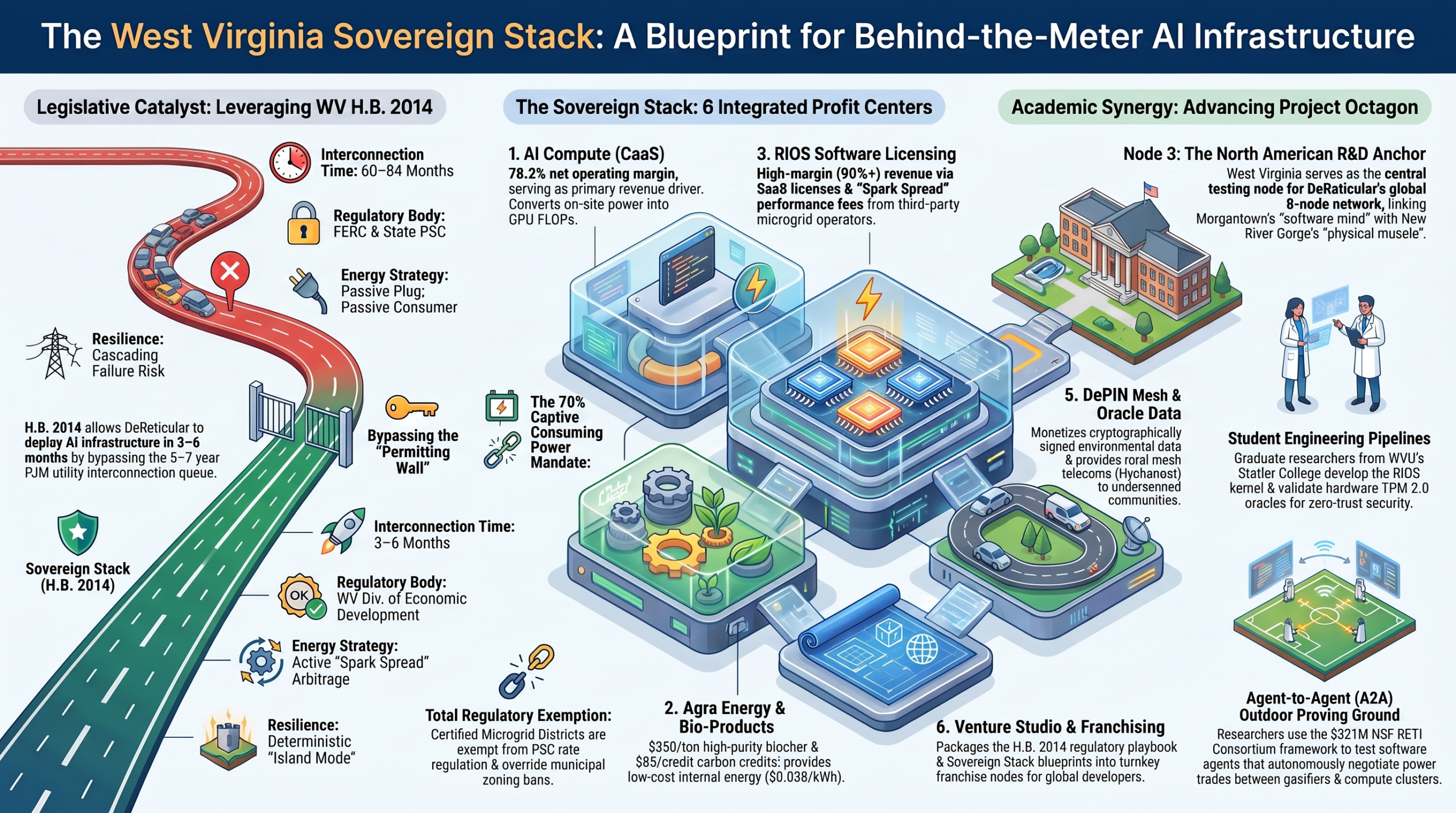
The expansion of artificial intelligence infrastructure is currently throttled by “The Permitting Wall”—a systemic failure in legacy linear infrastructure where developers face 5-to-7-year delays in regional transmission interconnection queues (e.g., PJM). In West Virginia, House Bill 2014 (The Power Generation and Consumption Act) serves as a tactical weapon against this bottleneck. By authorizing “Certified Microgrid Districts,” this legislation allows DeReticular to transition from vulnerable linear dependencies to Spherical Resilience, deploying sovereign infrastructure in 3–6 months rather than the traditional 60–84-month utility timeline.
The legal architecture of H.B. 2014 provides four structural advantages that enable DeReticular’s rapid, behind-the-meter deployment:
- PSC Exemption (§24-2-21a): Certified districts are exempt from Public Service Commission jurisdiction regarding rates and service conditions. Critically, this includes an exemption from Certificates of Public Convenience and Necessity (CPCN), bypassing the multi-year administrative litigation and “duty to serve” mandates that hinder traditional energy developers.
- Queue Bypass (§24-2F-8): By operating in a behind-the-meter or off-grid configuration, these districts are statutorily exempt from state net-metering and utility interconnection standards, successfully avoiding RTO study cycles entirely.
- Siting Preemption: Siting authority is consolidated within the West Virginia Division of Economic Development, preempting restrictive local municipal or county zoning bans that often stall industrial infrastructure.
- Captive Power Mandate: The law requires that at least 70% of energy generated be consumed on-site. This aligns perfectly with the high-density load of AI compute, ensuring generated power is monetized locally through “Island Mode” autonomy.
The effectiveness of this legislation is proven via the Captive Power Ratio. While traditional industrial loads are volatile, High-Density AI Compute maintaining a 0.95–0.98 capacity factor is the ideal load for H.B. 2014. For a flagship 10 MW deployment:
- Annual District Generation: 10 MW x 8,760 hours = 87,600 MWh/year.
- Annual Compute Consumption: 8.5 MW (continuous draw) x 8,760 hours x 0.96 (uptime) = 71,481.6 MWh/year.
- Captive Power Ratio: 71,481.6 / 87,600 = \mathbf{81.6\%}.
This exceeds the 70% statutory requirement. To ensure compliance with the mandatory <10% grid export cap, the remaining 18.4% of energy is managed via on-site Battery Energy Storage Systems (BESS) and local thermal processes (biochar production), providing the legal foundation for the financial model’s Deterministic Islanding.
- Economic Architecture: The Six Synergistic Profit Centers
DeReticular utilizes a multi-revenue design to decouple the Sovereign Stack from single-market volatility, such as GPU pricing crashes or utility rate shifts. By capturing margin across the entire energy-to-data value chain, the node maintains high-alpha profitability regardless of individual market cycles.
- Behind-the-Meter AI Compute (CaaS): The primary driver, selling GPU capacity (NVIDIA H100/B200 equivalents) to AI labs. It monetizes the “Spark Spread” through Batch Inference Arbitrage, utilizing non-latency-critical workloads to maintain a constant 0.95–0.98 capacity factor.
- Agra Energy & Plasma Gasification: Manages internal power via biomass gasification. Revenue is generated through internal PPA sales, high-purity biochar production, and biochar byproduct sequestration monetized via CCCE V3 carbon credits.
- RIOS Software Licensing: A SaaS/PaaS model for third-party operators. Revenue consists of a Base License Fee ($10k/MW/Mo) plus a 12% Spark Spread Performance Royalty on the additional economic yield generated by the RIOS kernel.
- Kurb Kars Autonomous Logistics: Reduces internal feedstock delivery costs while providing third-party Mobility-as-a-Service (MaaS) freight for regional timber and agricultural operators using autonomous electric haulers.
- DePIN Mesh & Oracle Data: Sells bandwidth via Hyphanet and charges verification fees for cryptographically signed, tamper-proof data via TPM 2.0 hardware oracles and Zero-Trust Data Integrity frameworks.
- Venture Studio & IP Licensing: A franchise model generating revenue through upfront architecture fees and ongoing royalties for turnkey “Sovereign Node” packages.
Summary of Sovereign Node Profit Centers
Profit Center Core Monetization Mechanism Target Customer Base Expected Gross Margin
AI Compute GPU FLOP Sales / CaaS Contracts AI Labs / Enterprise 65% – 82%
Agra Energy Captive Power, Biochar, CCCE V3 Credits Internal Node / Ag 50% – 70%
RIOS Software SaaS Fee + 12% Performance Royalty 3rd-Party Microgrids 85% – 92%
Kurb Kars MaaS Freight & Logistics Timber / Ag Operators 40% – 55%
DePIN Mesh Verification & Bandwidth Fees P2P Data Consumers 75% – 88%
Studio / IP Node Franchise & Tech Transfer Municipalities / Devs 70% – 85%
This diverse revenue structure ensures the Sovereign Stack remains a robust infrastructure asset, bridging the gap between physical resource management and high-margin collaborative research.
- Institutional Synergy: Advancing Project Octagon through Research & Talent
The $321M NSF RETI Consortium, led by West Virginia University (WVU) in partnership with Carnegie Mellon University (CMU) and the University of Pittsburgh, serves as a strategic force-multiplier for DeReticular’s R&D. This institutional weight de-risks the technological stack through elite hardware and software validation.
Researchers and students contribute to Project Octagon through three critical pillars:
- Software R&D: Optimization of the RIOS AI Brain and kernel for real-time “Spark Spread” arbitrage and autonomous load-balancing.
- Hardware Validation: Verifying Zero-Trust frameworks, including TPM 2.0 hardware oracles and Sysbox container isolation to protect control loops.
- Resource Efficiency: Benchmarking biomass-to-energy conversion and thermal efficiency standards for rural microgrids.
Central to this is the “Agent-to-Agent (A2A) Outdoor Campus.” This physical testbed utilizes peer-to-peer protocols over the local Hyphanet mesh, allowing autonomous software agents—representing Energy, Compute, Fleet, and Sensors—to execute a micro-economy. For example, Energy Agents negotiate syngas pricing with Compute Agents in real-time, validating the “Island Mode” resilience before global scaling. This academic integration creates a persistent talent pipeline that secures the long-term operational scaling of the Sovereign Stack.
- Tactical Roadmap: From Onboarding to Global Mesh Integration
The implementation follows a phased execution plan starting September 1, moving from individual relocation to a fully operational global anchor node.
- Phase 1: Regulatory Mobilization (Months 1–2): Finalize Ascend WV onboarding for core leadership and file the formal petition for Certified Microgrid District designation under H.B. 2014.
- Phase 2: Site & Feedstock Execution (Months 3–6): Secure acreage in the Morgantown/New River Gorge hubs, execute supply contracts for 40,000 tons/year of forestry residue, and obtain Rule 13 Air Quality Construction Permits from the WVDEP.
- Phase 3: Hardware & “Island Mode” Activation (Months 7–9): Deploy Agra Energy gasifiers and RIOS-CC-1000 modules. Conduct A2A testing and validate IEEE 1547.4 standards for deterministic islanding and grid separation.
- Phase 4: Commercial Scaling (Months 10–12+): Activate CaaS contracts and synchronize the WV node with the global Project Octagon mesh (Uganda, Canada, Arizona).
Key Financial Performance Metrics (10 MW Flagship)
- Total Initial Investment (CapEx): $33,200,000
- Annual Net EBITDA: $53,558,694
- Unlevered Internal Rate of Return (IRR): 142.3%
- Simple Payback Period: 7.4 Months
By transitioning from legacy, extractive commodity models to a Sovereign Infrastructure framework, West Virginia is positioned to lead the AI-native energy era, providing the blueprint for global decentralized resilience.