Compliance Framework: Operational Isolation and Regulatory Safeguards for RIOS Dual-Use Nodes
1. The Doctrine of “Separation of Concerns”
In the deployment of RIOS Tier 2 “Anchor” nodes, the strategic doctrine of “Separation of Concerns” serves as the primary mechanism for institutional resilience. This doctrine mandates a rigorous, non-permeable boundary between regulated industrial financial services—specifically the HempGrade AI ecosystem—and unregulated peer-to-peer (P2P) communication services provided by the Freenet stack. For a “Chief Infrastructure Compliance & Security Strategist,” maintaining this boundary is the only viable method for preventing “regulatory contagion,” wherein the anonymous, uncensored nature of P2P traffic could compromise the KYC (Know Your Customer) and CFTC-compliant status of the node’s financial operations. Grounded in the legislative framework of the GENIUS Act, this separation ensures that the node operates within authorized CFTC pilot programs for Real-World Asset (RWA) tokenization while simultaneously serving as a community utility.
The following table delineates the divergence between these two operational environments:
| Dimension | Industrial/Financial Zone (HempGrade) | Public Communication Zone (Freenet) |
| Core Function | AI-driven agricultural grading; RWA tokenization. | Censorship-resistant messaging; decentralized web. |
| Regulatory Status | Regulated (GENIUS Act, CFTC-compliant). | Unregulated (Anonymous P2P). |
| Data Sensitivity | High (Financial ledgers, Identity data). | Low-to-Medium (Encrypted public fragments). |
| Target Network | Private Ledgers / Regulated Banking. | Global Swarm (Hyphanet) / Contract Layer (Locutus). |
This framework codifies a philosophical shift from “Passive Utility” to a “Sovereign Edge” model. By transitioning from a model of centralized liability to distributed resilience, the RIOS node becomes a self-sufficient hub that manages its own compliance overhead. This sovereign architecture is not merely a software configuration; it is enforced through physical hardware isolation.
2. Hardware-Level Isolation: The “Air-Gap in the Box”
Physical hardware partitioning constitutes the first line of defense in a compliance-first architecture. By enforcing isolation at the silicon layer, the RIOS node guarantees that a software compromise within the public-facing network cannot migrate to the secure financial datastore. This “Air-Gap in the Box” strategy ensures that untrusted data is physically confined to secondary hardware, preventing cross-contamination and ensuring the integrity of the primary system.
Based on the Standard Operating Procedure (SOP) and Bill of Materials (BOM), the hardware isolation strategy utilizes the following technical specifications:
- STR-01 (Secondary NVMe): A dedicated 2TB high-endurance drive designated as “PUBLIC_UNTRUSTED.” Per SOP Step 1.3, this drive is formatted as XFS (Encrypted) and serves exclusively as the store for the Hyphanet (Classic P2P) and Locutus (Contract-based) data.
- Primary NVMe (8TB): The primary drive is formatted as ext4 (Encrypted) and mounted at
/mnt/secure_finance. This drive is physically and logically inaccessible to the Freenet application stack. - TPM 2.0 (Trusted Platform Module): A hardware root-of-trust used to initialize node ownership. It generates and stores the Ed25519 identity keys, which are non-extractable from the physical hardware, ensuring that data attestation cannot be forged.
- SEC-01 YubiKey: A FIPS-certified hardware security key required for any authenticated access to the “Secure Zone” (HempGrade), preventing unauthorized remote entry into the financial container.
To ensure no hardware-level cross-contamination occurs, the Factory Provisioning phase mandates the following requirements:
- Activation of VT-d / IOMMU in the BIOS to enable hardware-level virtualization and directed I/O isolation.
- Physical labeling of drive bays to prevent “PUBLIC_UNTRUSTED” media from being inserted into primary slots.
- TPM ownership initialization using the DeReticular Master Key before the node leaves the assembly facility.
- Logic-gate verification to confirm that the HempGrade application has no physical or virtual path to mount the STR-01 XFS volume.
With the physical layer secured, the strategy moves to “Hard” containerization to govern real-time operational traffic.
3. Containerized Security and “Hard” Isolation
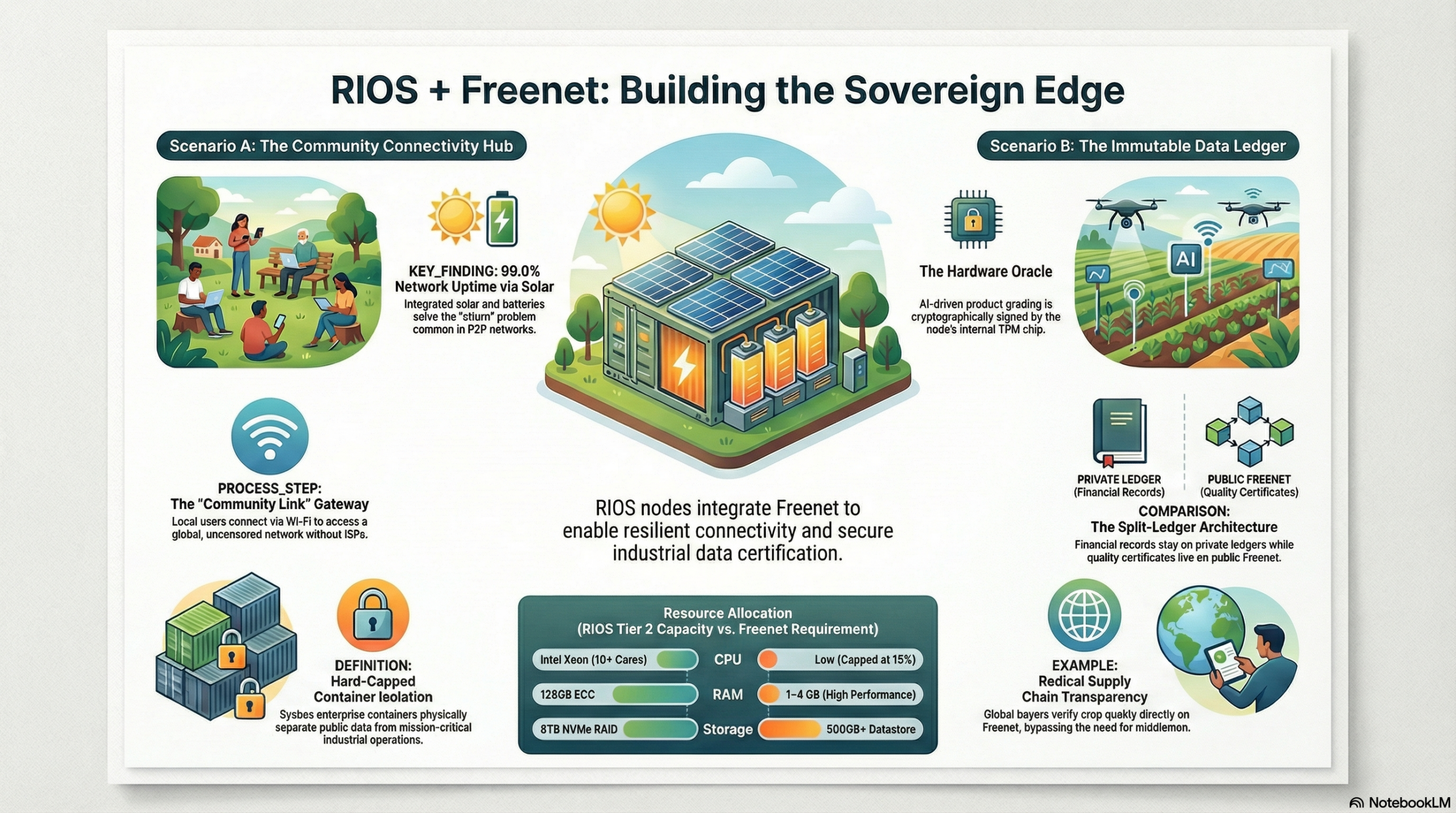
Strategic isolation is further reinforced through the “Sovereign Container Stack,” utilizing Sysbox Enterprise for “Hard” container isolation. Unlike standard container runtimes, Sysbox creates a jailing effect that effectively sandboxes untrusted P2P traffic, preventing it from interacting with the Host OS or the adjacent industrial containers.
The architecture enforces a strict dual-container comparison model:
- Container A: [SECURE_ZONE] (HempGrade AI)
- Access Rights: Strictly verified via physical SEC-01 YubiKey.
- Network Tunnel: Dedicated encrypted uplink to CFTC-compliant ledgers.
- Hardware Resource Priority: Exclusive access to the NVIDIA A2 GPU for YOLOv8 AI inference; Priority 1 CPU scheduling.
- Container B: [PUBLIC_ZONE] (Freenet Node)
- Access Rights: Open-access for community Wi-Fi (Hyphanet Proxy).
- Network Tunnel: Global P2P swarm via UDP.
- Hardware Resource Priority: Zero GPU access; hard-capped storage on STR-01; sandboxed vETH interface.
A critical compliance measure is the “Sidecar” deployment model. Resource capping is implemented to ensure that mission-critical financial operations are never throttled by spikes in public communication traffic. The Freenet container is subject to a 15% CPU limit, and network protocols are configured so that Freenet utilizes only unused uplink capacity. This ensures that Port 443 (HTTPS) HempGrade syncs are never degraded by P2P activity. This isolation is finalized through network-level segment governance.
4. Network Governance and VLAN Segmentation
To protect the node’s financial integrity, the architecture employs a “Logical Air-Gap” through virtual networking. While data may share the same physical Starlink or 4G uplink, it is segmented into virtual lanes that are forbidden from interacting by the core routing logic.
The node implements a rigorous VLAN Configuration Strategy:
- VLAN 10 (MANAGEMENT/HempGrade): The secure lane for all industrial and financial traffic, including Starlink management.
- VLAN 20 (GUEST_PUBLIC/Freenet): The untrusted lane for all community Wi-Fi traffic and anonymous P2P packets.
- Firewall Protocol: A mandatory “DENY ALL” rule is enforced between VLAN 20 and VLAN 10, preventing any possibility of lateral movement from the public zone to the secure financial engine.
The node maintains stability through “Smart Throttling” and Quality of Service (QoS) protocols. These rules prioritize Port 443 (HTTPS/HempGrade) over all Freenet UDP ports to prevent bandwidth saturation during peak agricultural grading cycles.
This culminates in the “Local Gateway” model. The RIOS node functions as a local ISP, broadcasting a “RIOS_Free_Link” Wi-Fi signal. Local users connect to a captive portal and access the decentralized web via the FProxy interface (Hyphanet). This allows the community to benefit from the node’s satellite connection and cached data without ever gaining exposure to the secure financial uplink. This technical architecture is supported by an equally robust legal defense strategy.
5. Legal Safeguards and “Common Carrier” Status
To shield DeReticular and its operators from liability regarding third-party content, the framework adopts a “Common Carrier” legal status. This strategy is essential for navigating the complexities of hosting encrypted, decentralized data swarms in varied jurisdictions.
By operating as a neutral intermediary—essentially a router/ISP—the node claims protection under DMCA Section 512 Safe Harbor provisions. Because the RIOS operator is technically unable to view or moderate the encrypted files stored in the “Encrypted Store” (STR-01), they cannot be held liable for the hosting of third-party content they did not curate.
To satisfy global data privacy standards (GDPR/CCPA), the node utilizes a “Blind Hashing” protocol. This separates Product Data (physics and chemistry of the hemp bale, stored on the public Freenet layer under the GENIUS Act) from Identity Data (farmer PII and banking info, stored only on private, deletable ledgers). This ensures radical transparency for the commodity without compromising the privacy of the individual.
The framework manages institutional risk via a Risk-Mitigation Hierarchy:
- Regulatory Contagion: Remedied via Sysbox “hard” isolation and physical drive partitioning (ext4 vs. XFS).
- Illegal Content: Remedied by “Common Carrier” status and the technical inability to moderate the encrypted P2P datastore.
- Bandwidth Saturation: Remedied by QoS “Smart Throttling” that prioritizes Port 443 over UDP.
This compliance chain is finalized through physical verification and cryptographic attestation.
6. Operational Integrity and Tamper-Evidence
Physical attestation is required to prove the integrity of the dual-use node to global auditors. This ensures that the data published to the public layer is trustworthy and originated from an untampered device.
The Tamper-Evident Protocol utilizes LBL-01 Holographic Seals applied to the server chassis and camera housings. Upon deployment, a “Genesis Image” (a high-resolution photograph of the intact seals) is taken and uploaded to a Freenet contract (via the Locutus Rust kernel). This creates an immutable, timestamped record of the node’s physical state.
To solve the “Oracle Problem,” the architecture mandates a Hardware Oracle model. All data published to the public layer is cryptographically signed using the TPM-bound identity keys (Ed25519). Because these keys are non-extractable from the silicon, they provide a “Hardware Root of Trust,” ensuring that grading data is signed by the physical node at the point of origin, eliminating the risk of sensor-spoofing or “Garbage In” attacks.
The final Split-Ledger Workflow demonstrates the framework’s efficacy:
- Scanning: The node scans a hemp bale using YOLOv8 AI inference.
- Public Certification: A JSON object of the grade is signed by the non-extractable TPM key and published to Freenet/Locutus for immutable public transparency.
- Private Settlement: The private ledger (VLAN 10) references the Freenet Key to trigger a financial payment to the farmer’s bank account.
This multi-layered framework transforms a utility container into a “Civilization Anchor.” It provides a dual-stack solution that is both legally compliant with global financial regulations and technologically sovereign, securing the community’s voice and their harvest in a single, resilient architecture.