DeReticular Strategic Briefing: The Transition to Sovereign Infrastructure (2026–2029)
Executive Summary
DeReticular is an industrial infrastructure venture studio positioned at the convergence of three trillion-dollar markets: Decentralized Physical Infrastructure Networks (DePIN), Real World Assets (RWA), and Off-Grid Energy. In 2026, the company is executing a definitive strategic pivot from a hardware manufacturer to a DePIN Platform Operator. This transition involves licensing its proprietary Rural Infrastructure Operating System (RIOS) to create an “App Store for Infrastructure,” effectively building the “Digital Nervous System” for a post-grid civilization.
Critical Takeaways:
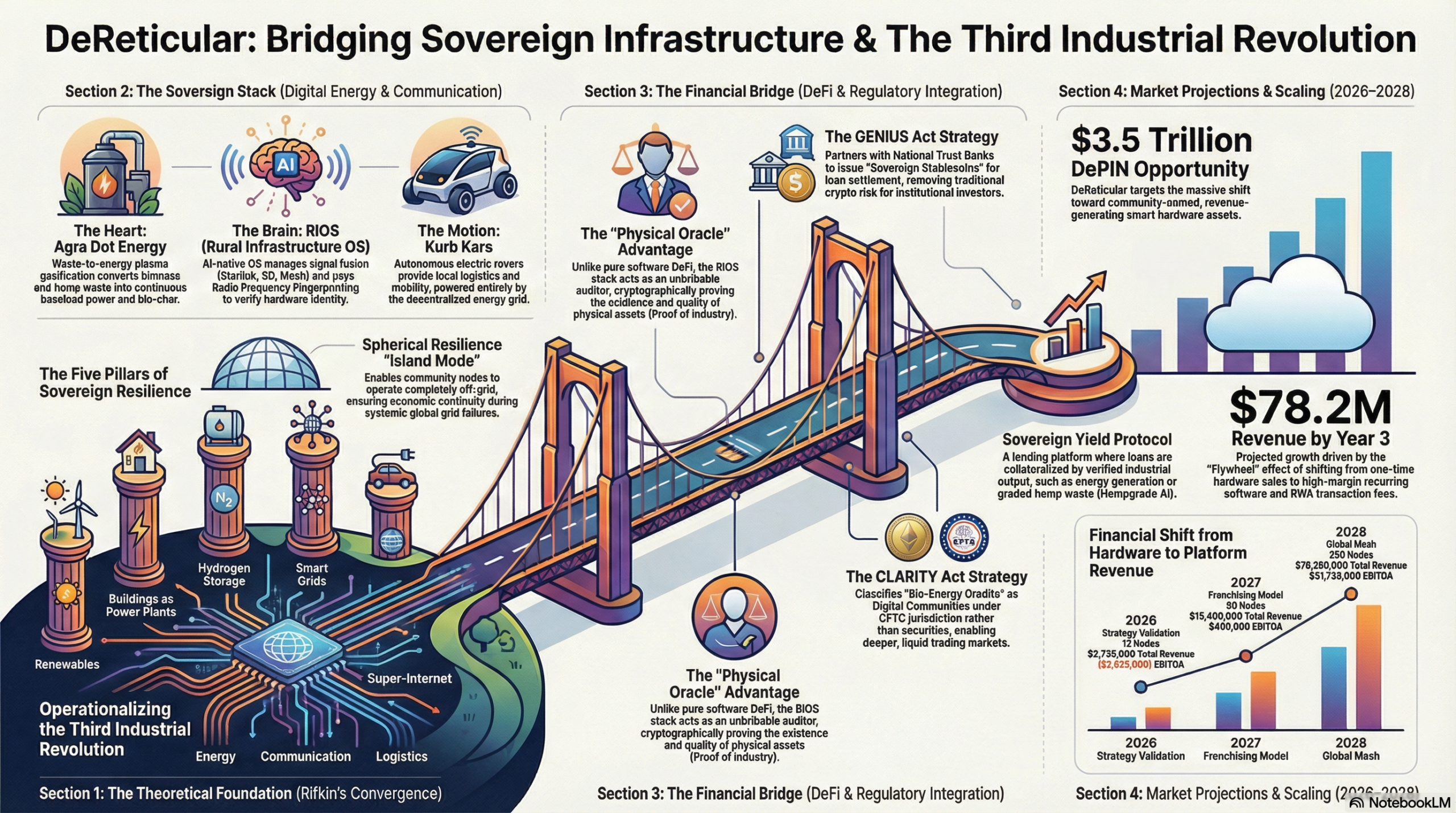
- The Sovereign Stack: DeReticular provides a vertically integrated solution comprising power generation (Agra Dot Energy), intelligence (RIOS), and mobility (Kurb Kars), enabling communities to operate in “Island Mode” for total self-sufficiency.
- Financialization of “Dead Capital”: Through Hempgrade AI and the Sovereign Yield Protocol, the company tokenizes physical commodities, transforming industrial waste into tradeable financial collateral.
- Regulatory Advantage: The strategy is explicitly aligned with the GENIUS Act and CLARITY Act, positioning DeReticular’s tokens as regulated digital commodities rather than securities.
- Scalability via “Flood the Forge”: By leveraging the CodeLaunch competition, DeReticular incubates third-party applications to run on its nodes, driving vendor lock-in and high-margin recurring revenue.
- Growth Projections: Revenue is projected to scale from 2.7M in 2026** to **78.2M by 2028, driven by a shift from one-time hardware sales to recurring licensing and transaction fees.
——————————————————————————–
1. Theoretical Foundation and Core Philosophy
The Third Industrial Revolution
DeReticular’s business model operationalizes the theories of Jeremy Rifkin, which posit that economic transformation occurs when three “internets” converge:
- Communication: Digitalization and 5G/Starlink connectivity.
- Energy: Distributed renewable systems (biomass/plasma gasification).
- Mobility: Autonomous electric logistics.
Rifkin’s “Five Pillars”—shifting to renewables, buildings as power plants, hydrogen storage, smart grids, and electric transport—form the architectural basis of DeReticular’s “Sovereign Stack.”
Spherical Resilience and “Island Mode”
The company’s mission is built on Spherical Resilience, the capacity for a community node to function independently of centralized utility grids. During systemic global failures, these nodes enter Island Mode, maintaining local economic continuity, power, and connectivity through a self-healing mesh network.
——————————————————————————–
2. The Sovereign Stack: Vertical Technology Integration
DeReticular controls the entire vertical stack, creating a “Civilization in a Box” that combines hardware, software, and financial services.
| Layer | Component | Function |
| Power (The Heart) | Agra Dot Energy | Uses waste-to-energy plasma gasification to convert biomass (hemp, trash) into baseload electricity and bio-char. |
| Intelligence (The Brain) | RIOS (Rural/Robotic Infrastructure OS) | AI-native OS that manages signal fusion (Starlink/5G), financial dispatch of assets, and hardware security. |
| Motion (Logistics) | Kurb Kars | Autonomous electric rovers for local logistics, powered directly by the infrastructure nodes. |
| Finance (The Bank) | Sovereign Yield Protocol | A DeFi lending platform collateralized by “Proof of Industry”—verified physical output rather than crypto assets. |
The “Zero-Trust” Oracle
A key technological moat is the Automated Notary system. Utilizing Radio Frequency Fingerprinting, RIOS can cryptographically verify the physical identity of hardware. This solves the “Oracle Problem” by proving that data regarding energy generation or commodity processing is coming from a specific, unbribable machine.
——————————————————————————–
3. Strategic Roadmap (2026–2028)
Phase 1: Validation & Project Octagon (2026)
The objective is to prove the “Civilization in a Box” model through eight strategic global nodes.
- Node 4 (Uganda): Activation of a “Green Industrial Engine” for a 7,000-acre eco-industrial park.
- Hempgrade AI: Tokenizing hemp waste for rural farmers to provide liquidity.
- “Flood the Forge”: Using CodeLaunch to onboard 5–10 startups to build apps on the RIOS stack.
Phase 2: Franchise Expansion (2027)
Scaling from eight internal nodes to over 50 partner-operated nodes.
- Sovereign Cloud Licensing: Selling $85k licenses to municipalities and tribes to become local ISPs.
- DeReticular Academy: Training “Sovereign Systems Architects” to maintain and deploy nodes globally.
Phase 3: The Global Mesh (2028)
Interconnecting 200+ nodes into a self-healing global network.
- Data Arbitrage: Monetizing “Ground Truth” data (weather, soil, logistics) for global commodity markets.
- InfraFi Integration: Launching a DeFi platform where stablecoin holders fund infrastructure in exchange for energy sale yields.
——————————————————————————–
4. Financial Architecture and Valuation
Revenue Streams
The transition from a hardware focus to a platform focus shifts the revenue mix toward high-margin recurring fees:
- Hardware Sales: $180k per node.
- Sovereign Cloud License: $85k per commercial operator.
- Venture Studio Equity: 15–30% stakes in startups building on RIOS.
- Transaction Fees: 1.5% fee on RWA tokenizations (e.g., Hempgrade).
3-Year Pro Forma Summary
| Metric | Year 1 (2026) | Year 2 (2027) | Year 3 (2028) |
| Total Nodes Deployed | 12 | 60 | 250 |
| Total Revenue | $2,735,000 | $15,400,000 | $78,250,000 |
| Total Expenses | $5,360,000 | $15,000,000 | $46,500,000 |
| EBITDA | ($2,625,000) | $400,000 | $31,750,000 |
Valuation Analysis
Using the Berkus Method, DeReticular holds a pre-money floor valuation of approximately $2.5M, based on its quality management team, strategic relationships (Agra Energy/CodeLaunch), and functional prototype (Project Octagon). As the “Flywheel” kicks in by Year 3, the company expects its valuation multiple to shift from 2–3x hardware revenue to 10–20x SaaS/Platform revenue.
5. Regulatory and Risk Landscape
Regulatory Strategy: “The Safe Haven”
DeReticular leverages two major 2026 U.S. crypto laws to attract institutional capital:
- GENIUS Act: Partnerships with National Trust Banks to issue “Sovereign Stablecoins” for loan settlement, removing traditional crypto risk.
- CLARITY Act: Classifying “Bio-Energy Credits” as Digital Commodities under CFTC jurisdiction rather than securities, enabling liquid trading markets.
SWOT Analysis
- Strengths: Vertical integration; physical verification IP; alignment with U.S. crypto laws.
- Weaknesses: High upfront CAPEX (Capital Intensity); brand confusion (RIOS robotics); complex geographic management.
- Opportunities: $3.5T DePIN market; monetizing “Dead Capital” in emerging markets; demand for “Data Havens.”
- Threats: Big Tech (Starlink/Amazon) entering the space; hardware supply chain shocks; developer adoption latency.
Operational Mitigation
To address execution risks, the DeReticular Academy ensures a pipeline of trained local technicians, while the “Flood the Forge” strategy aggressively subsidizes early developers to populate the RIOS ecosystem, solving the “empty shelf” problem before commercial scaling.