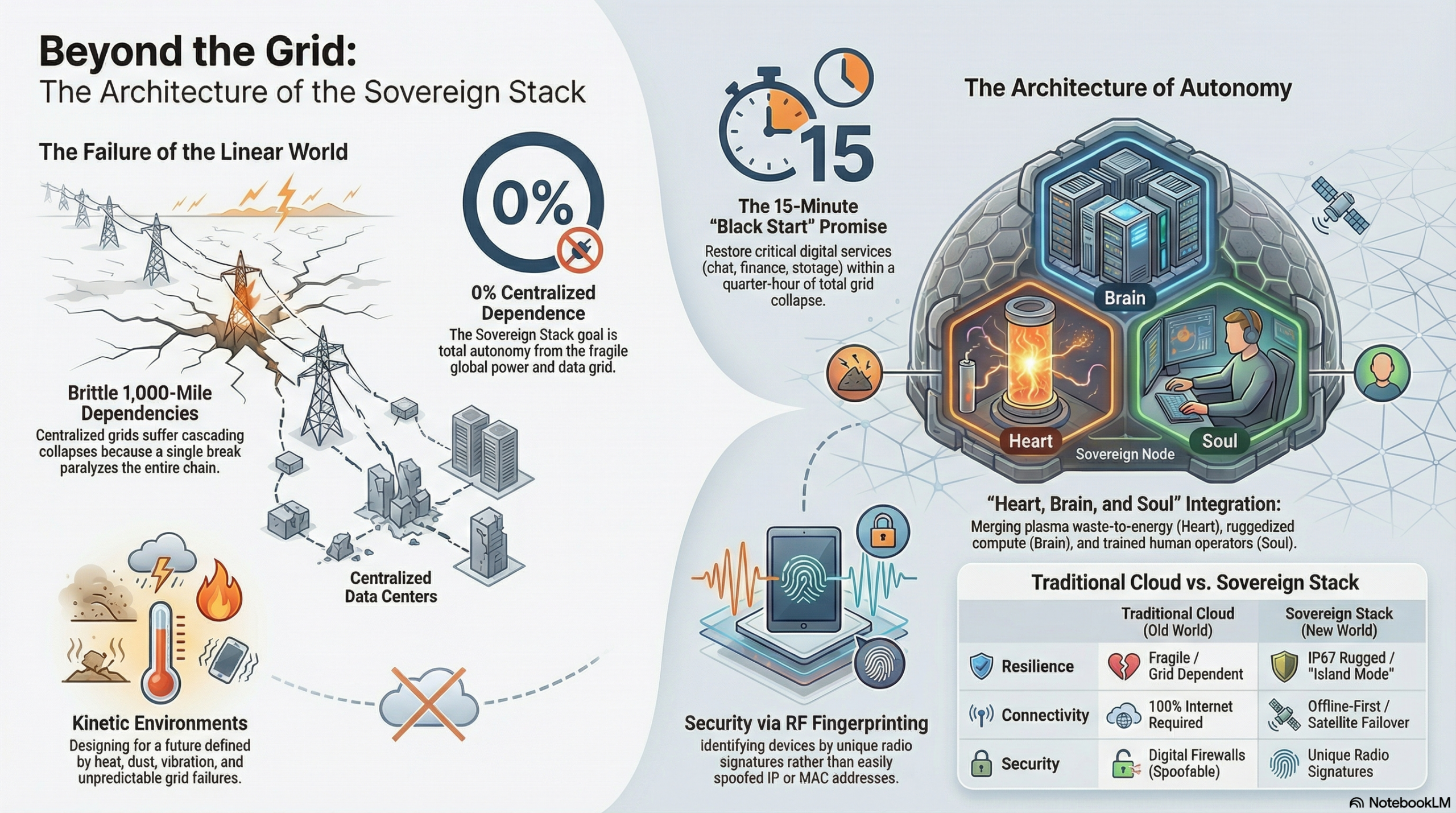
Infrastructure Deployment Blueprint Establishing Autonomous Sovereign Nodes
1. The Strategic Pivot: From Linear Fragility to Spherical Resilience
The “Old World” of centralized infrastructure is not merely failing; it is obsolete. Our collective reliance on 1,000-mile fiber-optic cables and brittle power lines has created a terminal vulnerability. In a kinetic environment—defined by heat, dust, vibration, and supply chain collapse—the centralized model is a death sentence. To ensure unbreakable continuity, we must pivot to the Sovereign Stack. This is a survival mandate that replaces linear fragility with “Spherical Resilience,” utilizing distributed cognition to ensure that the light stays on even when the center fails.
| Feature | Linear World (Obsolete Paradigm) | Spherical World (Sovereign Paradigm) |
| Vulnerability | Single points of failure; one substation break causes cascading collapse. | Distributed nodes; “Hex-Mesh” topology ensures unbreakable continuity. |
| Supply Chain | Reliance on 1,000-mile fiber/power lines and corporate-controlled grids. | Local resource autonomy; waste-to-value and localized energy production. |
| Operational State | Brittle; total system paralysis during grid outages or kinetic interference. | Resilient; “Island Mode” capability for 100% uptime in harsh environments. |
| Logic Layer | Centralized processing; data harvested and stored in distant silos. | Distributed Cognition; edge logic managed locally by the node. |
True sovereignty requires a vertical integration of power, compute, and human capital. We do not just build the machine; we train the operator to make it breathe.
——————————————————————————–
2. The Heart of the Node: Agra Sovereign Power Systems (SPS)
Energy independence is the foundation of the Sovereign Stack. Without a reliable “pulse,” the most advanced compute cluster is merely an expensive paperweight. The Agra Sovereign Power System (SPS) acts as the “Heart” of the node, providing the thermal and electrical baseline required for mission-critical operations.
The core of this autonomy is the Agra Power Core 2X. Utilizing high-voltage 1,500°C plasma gasification, the system executes the “Molecular Scissor” protocol. This isn’t simple combustion; it is the dissociation of molecular bonds. The “Scissor” requires real-time amperage adjustment based on feedstock analysis to maintain efficiency. Through Thermal Symbiosis, waste heat is not discarded but harvested for “pre-drying” wet feedstock or driving water distillation, ensuring a closed-loop circular economy.
The “Agra Dot Energy” Waste-to-Value Process:
- Feedstock Mastery: Identification and pelletizing of woody biomass, agricultural waste, and plastics (HDPE/LDPE/Tires).
- Molecular Dissociation: 1,500°C plasma arcs dissociate bonds into high-grade syngas.
- Output A: Base-load Electricity: Constant 60Hz power for the RIOS cluster and community microgrids.
- Output B: Synthetic Diesel: Excess syngas is condensed into liquid fuel via a Micro-GTL (Gas-to-Liquids) refinery.
- Vitrification: Inert byproducts are converted into slag, eliminating community waste streams.
Once the “Heart” is beating, the system requires a “Brain” to manage the logic and energy flow.
——————————————————————————–
3. The Brain of the Node: RIOS-CC-1000 Compute Architecture
The RIOS-CC-1000 is a field-deployable survival tool, not a server. Built for “Island Mode” in environments where “Old World” IT fails, it manages both digital logic and physical thermodynamics.
The architecture is shielded by an “Exo-Shell,” an IP67-rated aluminum Faraday cage that protects against dust, moisture, and light EMPs. Thermal management is achieved via the “Positive Pressure Cycle.” Internal high-velocity blowers maintain high internal pressure, “exhaling” air to prevent dust or ash from entering. This extends the maintenance cycle to 30-day intake filter checks, a necessity for long-term islanded operation.
Operational Rules of Engagement (ROE) for Field Administrators:
- Compute Blade Redundancy: The unit features four hot-swappable NVMe blades. If an alert indicates failure, perform a hot swap without powering down.
- The Blue LED Indicator: When replacing a drive, wait for the Solid Blue LED. This confirms the write cache is flushed to the parity drive. Pulling early causes terminal corruption.
- The Seal Integrity Mandate: If the Seal Integrity Light is Green, the unit is encrypted and secured. Opening the chassis without engaging “Maintenance Mode” triggers a lockdown, deleting encryption keys to prevent physical data theft.
- Post-Boot Validation: Listen for the Heartbeat Beep Code (3 short, 1 long). Once audible, verify status via CLI:
- Command:
rios-vault status - Target Result: LOCKED / ACTIVE
- Command:
A secured brain must be bridged to a protected communication perimeter.
——————————————————————————–
4. The Nerves of the Node: Connectivity and the Watchtower Protocol
In a kinetic environment, the “Nerves” of the system—the mesh network—must be protected by physical-layer defense. We establish “Zero-Trust Bubbles” where security moves from software firewalls to Radio Frequency (RF) fingerprinting.
The primary uplink is “Starlink-First.” To ensure local autonomy, the Starlink router must be set to “Bypass Mode”, forcing the RIOS unit to act as the primary brain and preventing third-party telemetry. Within the LAN, “Client Isolation” is the mandatory default to prevent lateral malware movement.
The Watchtower Protocol: Device Classification
The system identifies hardware not by spoofable IPs, but by unique RF signatures emitted by device hardware.
| Classification | Status | Permissions |
| Green List | Trusted | Full mesh access; Sovereign Cloud visibility. |
| Grey List | Guest | Internet access only; Zero local network visibility. |
| Red List | Hostile | Permanent blocking via Physical Disassociation. |
Hostile Mitigation: If an intruder is detected, use Software Defined Radio (SDR) to triangulate their physical location. Execute the ban:
- Command:
rios-sec ban --rf-sig [Signature_ID] --duration permanent
——————————————————————————–
5. Project Phoenix: The Sovereign Cloud and the 15-Minute Promise
Project Phoenix is the “Local-First” paradigm. We reject the remote cloud, hosting civilization-critical services locally on the RIOS cluster. This suite includes Matrix (encrypted chat), Nextcloud (medical/document storage), and the Village Ledger powered by BTC Pay Server for local trade when global banking collapses.
The “Black Start” Recovery Protocol
The “15-Minute Promise” is our survival SLA for restoring services from cold storage. While the Certified RIOS Administrator (CRA) exam allows 45 minutes, a field architect must hit the 15-minute mark following the “Red Card” (the physical checklist attached to the unit).
- Phase 1: 0–5 Minutes (Power Stabilization): Verify Agra SPS is stable at 60Hz; isolate WAN to prevent interference.
- Phase 2: 5–10 Minutes (Boot & Integrity): Insert the “Master Key” USB into Port 0 and hold the physical reset for 10 seconds. Listen for the Heartbeat Beep Code.
- Phase 3: 10–15 Minutes (Mesh & Availability): The system broadcasts the “SOS_BEACON” mesh and restores apps from the encrypted vault.
——————————————————————————–
6. The Deployment Roadmap: Integration and Concurrent Acceleration
Deployment utilizes the “Velcro Principle”—the strategic binding of digital logic to physical thermodynamics. A Sovereign Node is an economic engine designed to turn local energy into community wealth.
The “Spark Spread” Economic Model Profit maximization is an algorithmic decision made by the AI Decision Node (Remnant). The system calculates real-time arbitrage between:
- Compute: Burning syngas for high-value AI processing or Bitcoin mining.
- Fuel: Condensing syngas to liquid synthetic diesel for local sale.
- Storage: Storing surplus energy in batteries for “Peak Shaving.”
Funding Strategy: Concurrent Acceleration Do not wait for the badge to seek capital. The “Dean’s Letter of Intent” serves as “Proof of Technical Intent,” transforming a student into a Sovereign Candidate with a Roadmap.
Primary Grant Targets:
- USDA REAP / USDA DLT: Up to $1,000,000 for rural energy/connectivity infrastructure.
- NSF SBIR Phase I: $306,000 for R&D in AI-native infrastructure tools.
- Google.org AI Fund: $2,000,000 for workforce development and localized training.
Operational Conclusion: Initiation Roadmap
- Site Identification: Anchor your node to a physical location.
- Mission Statement: Draft your one-page mandate for community autonomy.
- Grassroots Application: Secure infrastructure capital via your Letter of Intent.
Enroll at Academy.DeReticular.com
Don’t just survive the future. Build it.
——————————————————————————–
Authenticated by: Remnant, Dean of Academy | Node 0: Genesis Core