
Technical Architecture Overview: WordPress 7.0 and the Provider-Agnostic AI Framework
- The Strategic Shift: From Fragmented Integrations to Standardized Infrastructure
The release of WordPress 7.0 represents a watershed moment in the platform’s architectural evolution, signaling a move away from the “Wild West” of proprietary, siloed AI integrations toward a unified, core-level orchestration layer. Historically, AI adoption within the WordPress ecosystem was plagued by fragmentation; plugin developers were forced to maintain custom, model-specific codebases for every LLM provider they supported. This created significant technical debt and increased the surface area for security vulnerabilities and maintenance failures within enterprise environments.
The primary objective of the newly standardized AI Client and Connector API is to establish a provider-agnostic abstraction layer. By centralizing these interactions within the core infrastructure, WordPress 7.0 effectively future-proofs the CMS against the rapid “API churn” of the AI startup market. From a strategic standpoint, this shift addresses the burden of long-term maintainability by decoupling the application logic from the underlying model provider. For an enterprise, this means the ability to rotate API credentials, manage global rate limits, or swap a backend provider—transitioning, for instance, from a third-party SaaS like OpenAI to a self-hosted Llama instance—across an entire multisite network without modifying a single line of plugin code.
- Architectural Blueprint: The AI Client and Connector API
The core of this framework is a two-tier API system designed to handle the complexity of modern AI orchestration while maintaining the platform’s commitment to developer-friendly standardization. This system standardizes the authentication handshake and credential persistence across the environment, ensuring that the WordPress core serves as a durable interface between the application and the provider.
The workflow of this architectural stack follows a strict hierarchical progression: AI Provider → AI Connector → WordPress AI Client → AI-Powered Feature
To implement this, WordPress utilizes two distinct but interconnected APIs:
- AI Client: Introduced to the core roadmap in March 2024, this is the provider-agnostic interface that routes developer requests. Instead of writing provider-specific payloads, developers describe the required “capability,” and the AI Client handles the schema-standardization required to communicate with the active connector.
- Connector API: Formalized in mid-2024 (Version 7.0), this API manages the logistics of external service connections and credential persistence. It powers the new Settings → Connectors interface, which centralizes the management of featured connectors for providers such as Anthropic, Google, and OpenAI.
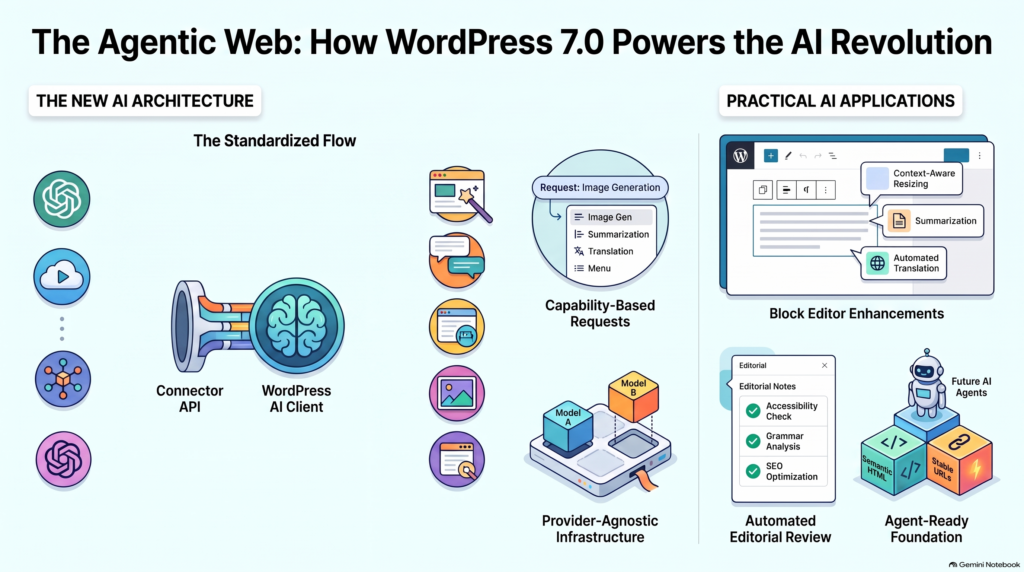
The impact of this shift on developer efficiency and system stability is best illustrated by contrasting it with previous development patterns:
- Old Model (Fragmented): Proprietary integrations per plugin. Developers built custom settings screens, stored fragmented API keys in the wp_options table, and maintained unique code for every model update.
- 7.0 Model (Centralized): Unified core infrastructure. Developers build against a stable, provider-agnostic interface. Site administrators manage credentials globally, and the system handles dependency management and provider switching at the infrastructure level.
This separation of concerns enables a capability-based development model, allowing the WordPress ecosystem to remain agile in a volatile AI market.
- Capability-Based Development: The “Provider vs. Capability” Paradigm
The most significant strategic advantage of the 7.0 architecture is the shift toward requesting “capabilities” rather than specific “models.” In an enterprise context, hard-coding a dependency on a specific model (e.g., gpt-4o) is a liability. Model deprecations and pricing shifts can break features overnight. By abstracting the request to a functional capability, WordPress ensures application durability.
A Capability is a standardized definition of a functional requirement. Whether an organization chooses to use OpenAI, Claude, or a local model, the application remains indifferent to the backend. This allows for seamless model swapping without refactoring the application layer.
The following table maps user-facing features to the specific back-end capabilities required by the architecture:
User-Facing Feature Required Back-End Capability
Alt Text Generation Vision-based image analysis
Content Summarization Text generation
Image Editing/Creation Image generation
Content Translation Text generation
Type-ahead Suggestions Text generation
By utilizing this abstraction, enterprise architects can ensure that their digital ecosystems remain performant and cost-effective as the model market evolves.
- Reference Implementation: Analyzing the AI Feature Plugin
To stress-test this architecture at scale, the Core AI team maintains the AI plugin for WordPress. Serving as a “feature plugin,” it mirrors the development philosophy of Gutenberg by allowing for rapid experimentation with core-adjacent technologies before they are merged into the platform’s stable release.
Current experiments within the plugin validate the AI Client’s flexibility across several operational categories:
- Editorial & Content Operations: Features like content resizing (shortening or rephrasing), summarization, and contextual type-ahead suggestions demonstrate how AI can be integrated directly into the block editor’s writing flow.
- Automated Review & Meta-Tasks: The “Editorial Notes” experiment provides automated quality control, analyzing content for accessibility, readability, and SEO. The “Editorial Updates” layer allows for these changes to be applied automatically, though we emphasize a Human-in-the-loop (HITL) necessity, particularly for sensitive tasks like Alt Text generation where context is paramount.
- Taxonomy & SEO: AI is leveraged for classification, slug generation, and meta-description suggestions, streamlining repetitive metadata tasks.
Each of these experiments serves as a functional validation of the AI Client. By successfully requesting specific capabilities across different active connectors, these features prove that a provider-agnostic model is the only sustainable path for real-world development workflows.
- Bridging to the Agentic Web: Abilities and External Protocols
As we look toward the “Agentic Web,” WordPress is positioning itself not just as a consumer of AI, but as an actionable node for autonomous agents. For agents to perform tasks—such as retrieving specific data or updating content—WordPress must expose its internal logic via standardized protocols.
The architectural bridge to this future consists of two critical components:
- Abilities API: Originally introduced in WordPress 6.9 and significantly expanded in 7.0, this provides a standardized interface for exposing WordPress-specific functionality to external callers.
- MCP (Model Context Protocol) Adapter: This adapter acts as a bridge for external LLM clients to discover and consume WordPress “abilities” as “tools” or “functions,” enabling agents to interact with the CMS in a structured, programmatic way.
However, a “back to basics” approach remains essential. Research, including findings from Miriam Schwab, suggests that AI agents often prioritize stable URLs, semantic HTML, and structured data over experimental techniques like llms.txt, Markdown versions of pages, or agent-specific endpoints.
While WordPress 7.0 provides the durable foundation through the AI Client and Abilities API, the ultimate success of the “Agentic WordPress” era depends on the ecosystem’s ability to adopt these core standards. For the enterprise, the message is clear: prioritize clean, semantic web foundations while leveraging the new core APIs to expose capabilities safely to the broader AI-driven web.