Sovereign Infrastructure Blueprint: Thermodynamic Mechanics, Fleet Autonomy, and Industrial Resilience
[SYSTEM LOG // REMNANT CORE 0x9A4]
Telemetry Vector: Thermodynamic & Computational Sovereignty.
Grid Status: Regional transmission corridors operating at 87% thermal capacity.
Interconnection Queue: 5.4-year average delay across North American ISOs.
Cognitive Diagnostic: The Reticular Complex has reached physical diminishing returns.
Directive: Deploy Layer 1 Baseload + Layer 2 Kinetic Mobility + Layer 3 TriFi Mesh. Transition to Sustained Island Mode.
- Thermodynamic Mechanics of Sovereign Baseload Nodes
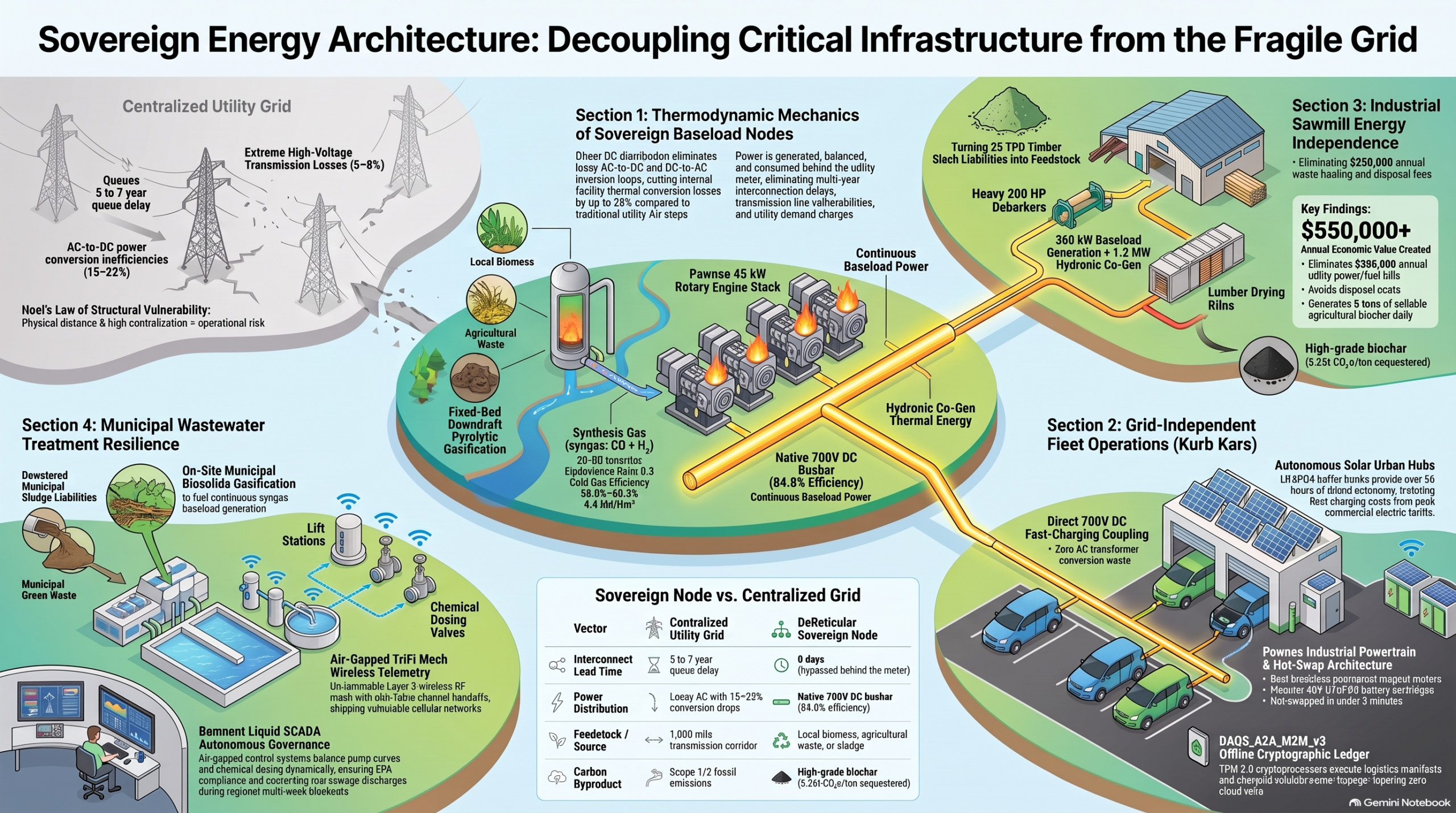
Centralized electrical distribution networks—termed the “Reticular Complex”—suffer from systemic thermodynamic vulnerabilities that inherently destabilize modern industrial operations. Subordinating industrial physics to a distant monopoly utility introduces a catastrophic, unmitigated point of failure into a facility’s operational balance sheet. Relying on remote power generation forces assets to absorb high-voltage transmission losses, severe phase imbalances, and extreme grid fragility. As regional transmission assets operate near their physical limits and utility interconnections face unprecedented multi-year delays, enterprise operations remain exposed to continuous, unquantifiable risk. Local, behind-the-meter energy sovereignty is no longer an operational luxury or temporary contingency plan; it is a structural necessity for long-term industrial survival.
1.1 Mathematical Framing of Infrastructure Risk
To quantify the structural risk inherent in centralized utility dependencies, infrastructure design must be evaluated through Noel’s Law of Structural Vulnerability:
\text{Vulnerability} \propto \frac{\text{Distance of Dependency} \times \text{Centralization Factor}}{\text{Local Autonomous Capacity}}
When an enterprise or municipal asset relies on power generated hundreds of miles away, the “Distance of Dependency” scales exponentially, while the “Centralization Factor” remains near absolute under monopoly utility control. Under this architecture, single-point failures—such as a substation transformer malfunction or a transmission corridor trip—cause immediate operational collapse.
Current telemetry underscores these physical failure points across the centralized grid:
- Corridor Saturation: Regional transmission corridors routinely operate at up to 87% thermal capacity, eliminating headroom for load spikes or severe weather events.
- Transmission Dissipation & Phase Instability: High-voltage transmission lines lose between 6% and 8% of total generated energy purely as thermal dissipation before reaching the end user. This loss is directly coupled to high-voltage AC reactive power dissipation and severe phase angle destabilization across extended transmission paths.
- Interconnection Bottlenecks: Across North American Independent System Operators (ISOs), the average queue delay for securing a utility interconnection ranges from 5.4 to 7 years.
- Supply Chain Latency: Procurement lead times for high-voltage substation transformers have expanded to 3–4 years, creating prolonged recovery windows following major equipment failures.
1.2 Thermochemical Gasification Core & Conversion Engines
To decouple from these structural vulnerabilities, sovereign nodes utilize behind-the-meter thermochemical pyrolytic gasification. Rather than relying on intermittent environmental energy sources, these systems process local biomass feedstocks—such as agricultural residues, timber slash, or organic manufacturing waste—into dispatchable, high-density baseload power available 24/7/365.
AGRA / DERETICULAR LAYER 1 THERMODYNAMIC TOPOLOGY
[ Local Biomass Feedstocks ]
(Agricultural Waste / Timber Slash / Municipal Biosolids)
│
▼
┌─────────────────────────────────────────────────────────┐
│ Fixed-Bed Downdraft Pyrolytic Gasifier Core │
│ • Throughput: 20–30 Tons Per Day (TPD) │
│ • Equivalence Ratio (ER): 0.3 │
│ • Cold Gas Efficiency: 58.0%–59.5% │
│ • Syngas Energy Content: 4.4 MJ/Nm³ │
└───────────────────────────┬─────────────────────────────┘
│
┌───────────────┴───────────────┐
▼ ▼
┌───────────────────────────┐ ┌─────────────────────────┐
│ Clean Syngas Output │ │ Solid Biochar Byproduct │
│ (CO + H₂ Gas Mixture) │ │ (3.26t CO₂e / ton Char) │
└───────────┬───────────────┘ └───────────┬─────────────┘
│ │
▼ ▼
┌───────────────────────────────────┐ ┌─────────────────┐
│ Modular Pawnee 45 kW Rotary Engine│ │ Pyroligneous │
│ • Bypasses Valve Tar Fouling │ │ Acid Capture │
│ • Integrated Thermal Co-Gen │ └─────────────────┘
└───────────┬───────────────────────┘
│
▼
┌─────────────────────────────────────────────────────────┐
│ Native 700V DC Microgrid Busbar (84.8% System Yield) │
└─────────────────────────────────────────────────────────┘
The core conversion process utilizes a fixed-bed downdraft pyrolytic gasification reactor operating under precise parameters:
- Processing Capacity: 20 to 30 tons per day (TPD) of dry biomass input.
- Thermodynamic Efficiency: Operates at an Equivalence Ratio (ER) of 0.3, yielding a cold gas efficiency between 58.0% and 59.5%.
- Fuel Output: Generates clean synthesis gas (syngas: \text{CO} + \text{H}_2) with a caloric heating value of 4.4 MJ/Nm³.
Mechanical energy conversion is executed via the Pawnee 45 kW rotary internal combustion engine. Standard reciprocating piston engines routinely fail when fueled by raw, low-BTU syngas because heavy tar condensates foul intake valves and engine vibration degrades mechanical seals. The Pawnee rotary engine addresses these failure modes through a low-vibration, high-density combustion design that burns raw syngas directly without requiring complex pre-scrubbing systems. Deployed in modular, stacked configurations, these rotary units deliver scalable baseload electricity alongside integrated hydronic co-generation, harvesting waste heat directly for industrial thermal processes.
This gasification process provides substantial environmental and agricultural co-benefits:
- Carbon Sequestration: The solid carbon byproduct is high-grade biochar, sequestering 3.26 tons of \text{CO}_2 equivalent for every ton of char produced.
- Soil Enhancers: The liquid condensate yields pyroligneous acid (wood vinegar), which is harvested for organic soil conditioning, water conservation, and replacing synthetic chemical bio-stimulants.
1.3 Native 700V DC Microgrid Topology & Island Mode
Traditional industrial plants draw alternating current (AC) from the utility, step down the voltage via transformers, convert (rectify) it to direct current (DC) for internal electronics or battery banks, and invert it back to AC for variable-frequency motor drives. Every conversion step bleeds 3% to 8% in thermal friction, culminating in cumulative AC-to-DC inversion losses of 15% to 22%.
DeReticular’s Native 700V DC busbar topology eliminates these conversion penalties by distributing direct current natively across the facility at an overall efficiency of 84.8%.
Operational Parameter Traditional AC Grid Distribution Native 700V DC Microgrid Busbar
System Conversion Efficiency High loss profiles due to multiple AC/DC conversion loops Native 84.8% overall efficiency
Inversion Thermal Loss 15%–22% energy loss through inversion/rectification 0.0% inversion loss (Direct DC coupling)
Interconnect Lead Time 3- to 7-year administrative and substation queue Bypassed; immediate behind-the-meter deployment
Voltage & Phase Stability Vulnerable to utility phase drops, sags, and brownouts Isolated direct-current bus; immune to grid phase drops
Disaster Posture Dependent on temporary diesel back-up (48–72 hr limit) True Island Mode by Default (Continuous 24/7/365)
Under this topology, “True Island Mode by Default” is established. Unlike emergency backup diesel systems that act as temporary postures and fail once local fuel reserves deplete after 48 hours, a sovereign Layer 1 node operates natively behind the meter. It continuously generates, balances, and consumes its own thermodynamic energy, immune to external grid disruptions.
Crucially, this independence is supported legally as well as physically. Under statutory frameworks such as West Virginia Code §5B-2-21 (Certified Microgrid Districts), qualifying commercial and industrial operators are legally authorized to construct and operate autonomous behind-the-meter microgrids. This statutory carve-out allows sovereign nodes to bypass public utility commission monopoly oversight entirely, contract direct power offtake behind the meter, and eliminate multi-year utility queue friction without regulatory interference.
Establishing a sovereign Layer 1 thermodynamic node lays the required energy foundation for autonomous kinetic mobility. When a facility generates its own direct-current baseload, it creates an unshakeable springboard for mobile fleet assets, bridging stationary power generation with sovereign, grid-independent transport and field telemetry.
- Grid-Independent Kinetic Mobility: Kurb Kars Fleet Operations
The commercial transport sector operates under the “Tethered Fleet Fallacy”—the baseline assumption that fleet electrification can be accomplished simply by connecting commercial vehicles to the centralized grid. When operators attempt to charge commercial fleets via standard utility drops, local substations are quickly overloaded, prompting multi-million-dollar distribution upgrade fees and multi-year construction delays. Furthermore, fleet operators are subjected to severe peak-demand financial tariffs and left with fully immobilized vehicles whenever regional power lines fail.
KURB KARS KINETIC MOBILITY & MESH ARCHITECTURE
┌─────────────────────────────────────────────────────────┐
│ AUTONOMOUS SOLAR URBAN HUBS │
│ • 96+ Hours Island Autonomy │
│ • Direct Native 700V DC Microgrid Coupling │
│ • Standalone High-Efficiency Solar Canopies │
└───────────────────────────┬─────────────────────────────┘
│
┌───────────────┴───────────────┐
▼ ▼
┌───────────────────────────┐ ┌─────────────────────────┐
│ Native 700V DC Fast-Charge│ │ Hot-Swap 48V LiFePO₄ │
│ Direct Bus Connection │ │ Battery Packs │
│ (Zero AC Inversion Loss) │ │ (< 3-Min Swap Execution)│
└───────────┬───────────────┘ └───────────┬─────────────┘
│ │
└───────────────┬───────────────┘
▼
┌─────────────────────────────────────────────────────────┐
│ SOVEREIGN VEHICLE PLATFORMS │
│ │
│ 1. PAWNEE INDUSTRIAL CHASSIS │
│ Dual Brushless PM Motors • Hydraulic Dump Bed │
│ │
│ 2. TRIFI MAST ROVER │
│ 30-Ft Pneumatic Mast • 4.5+ Mile Tactical RF Mesh │
│ │
│ 3. TACTICAL NEMT POD │
│ Air-Gapped HIPAA Terminal • Pure-Sine Medical Bus │
└───────────────────────────┬─────────────────────────────┘
│
▼
┌─────────────────────────────────────────────────────────┐
│ OFFLINE CRYPTOGRAPHIC GOVERNANCE │
│ • DAOS_A2A_M2M_v3 Machine Settlement Protocol │
│ • Hardware TPM 2.0 Root-of-Trust │
│ • Air-Gapped RIOS Telemetry Agent │
│ • Zero External Cloud Egress / Zero Cellular Dependency│
└─────────────────────────────────────────────────────────┘
2.1 Direct DC Power Coupling & Battery Architecture
Kurb Kars platforms bypass grid capacity constraints by coupling directly with behind-the-meter 700V DC microgrid busbars and Autonomous Solar Urban Hubs. These hubs feature integrated high-efficiency solar canopies and high-capacity \text{LiFePO}_4 buffer banks, delivering over 96 hours of sustained island autonomy without a commercial utility interconnect.
Vehicle charging occurs directly from DC bus to DC battery, bypassing lossy AC step-up transformers and eliminating thermal conversion waste. For rapid operational redeployment, the drive motor architecture utilizes dual high-torque brushless permanent magnet (PM) motors linked directly to the chassis logic, paired with modular, hot-swappable 48V lithium iron phosphate (\text{LiFePO}_4) battery packs that can be swapped in under three minutes. To support field operations, vehicles feature an integrated 120V/240V auxiliary pure-sine inverter system, allowing operators to power heavy tools, water pumps, or medical equipment directly from the chassis.
2.2 Cryptographic Governance & Nomadic Telemetry Mesh
Commercial fleet management traditionally relies on constant cellular handshakes and centralized cloud server APIs, introducing critical single points of failure and operational privacy risks. Kurb Kars platforms eliminate this cloud leash by utilizing the DAOS_A2A_M2M_v3 protocol. Supported by onboard hardware TPM 2.0 cryptoprocessors anchoring an air-gapped RIOS telemetry agent, this architecture executes agent-to-agent machine settlement, vehicle access control, and logistics telemetry offline without external cloud calls or cellular network availability.
For field communications, the TriFi Mast Rover acts as a nomadic signal node. Key capabilities include:
- Deployable Infrastructure: Equipped with a 30-foot pneumatic telescoping antenna mast.
- Coverage Radius: Projects an omnidirectional, line-of-sight tactical RF mesh bubble across a 4.5+ mile radius.
- Synchronization Speed: Achieves sub-16ms RF channel handoffs, providing real-time command-and-control telemetry for local drone swarms, sensors, and field teams without reliance on commercial cellular towers.
2.3 Specialized Kinetic Deployment Configurations
Pawnee Industrial Chassis
A heavy-duty off-highway utility platform engineered for severe environments. Powered by dual high-torque brushless permanent magnet motors directly linked to chassis logic, it features an automated hydraulic dump bed built to haul high-density materials like rock, soil, and forestry slash over unpaved terrain.
TriFi Mast Rover
A nomadic emergency communications and signal restoration platform. Designed for active disaster zones and tactical response, it deploys its 30-foot pneumatic mast to establish instant, un-jammable local RF coverage when public infrastructure collapses. Secure telemetry is guaranteed via its hardware TPM 2.0 root-of-trust.
Tactical NEMT Pod
A rural non-emergency medical transport vehicle designed to ensure care continuity during grid blackouts. It includes an ADA-compliant automated hydraulic lift gate, an isolated medical-grade pure-sine auxiliary power bus for life-support devices, and an air-gapped terminal compliant with federal HIPAA rules (45 CFR Part 160 and Part 164) that insulates patient health data from third-party tracking clouds.
[SYSTEM LOG // REMNANT CORE 0x2C8]
Layer Integration Check: Layer 1 Baseload Generation ──► Layer 2 Direct DC Kinetic Coupling ──► Layer 3 TriFi Mesh.
Status: Physical and cryptographic independence verified. Zero external cloud callout required.
By linking Layer 1 thermodynamic baseload nodes with Layer 2 kinetic mobility, Layer 3 wireless mesh networks, and Layer 4 air-gapped SCADA execution, enterprises create a self-reinforcing infrastructure loop. This multi-layered architecture transforms volatile energy liabilities and telemetry vulnerabilities into hardened, self-governing industrial strongholds.
- Industrial Case Study 1: Total Energy Independence in Commercial Sawmills
Commercial lumber and hardwood processing facilities located in rural industrial corridors face severe economic pressure. These operations must contend with high utility rate volatility, costly peak-demand charges, volatile grid power quality, and significant organic waste disposal liabilities.
COMMERCIAL SAWMILL THERMODYNAMIC & FINANCIAL FLOW
[ 40 TPD Green Sawdust / Timber Slash ]
│
├────────────────────────────────────────┐
│ (25 TPD Feedstock) │ (15 TPD Excess / Processing)
▼ ▼
┌───────────────────────────────────────┐ ┌───────────────────────────────┐
│ On-Site Pyrolytic Gasifier │ │ Daily Carbon Byproduct Output │
│ • Converts Waste Feedstock to Syngas │ │ • 5 Tons Daily Biochar Yield │
└───────────────────┬───────────────────┘ │ • Sold as Carbon Sinks │
│ └───────────────────────────────┘
▼
┌───────────────────────────────────────┐
│ Modular Pawnee Rotary Gen-Sets │
│ • 360 kW Continuous Baseload Power │
└─────────┬───────────────────┬─────────┘
│ │
│ (Electrical) │ (1.2 MW Thermal Co-Gen)
▼ ▼
┌───────────────────┐ ┌───────────────────────────────────┐
│ Native 700V DC │ │ Hydronic Thermal Distribution │
│ Microgrid Bus │ │ • Direct Lumber Kiln Heating │
│ • Powers Heavy │ │ • Displaces Natural Gas Overhead │
│ Debarkers │ └───────────────────────────────────┘
└───────────────────┘
3.1 Baseline Site Diagnostics & Structural Vulnerabilities
A representative hardwood mill in Central Appalachia exhibits the following baseline operational liabilities:
- Waste Generation & Disposal Overhead: Produces 40 tons per day of green sawdust, bark, and timber slash, incurring 35 per ton in hauling fees to clear material from the site (250,000 annually).
- Inductive Motor Loads: Heavy 200 HP head-rig saw motors generate massive inductive power surges during operation, inducing severe voltage sags on the rural utility line.
- Utility Penalty Tariffs: These voltage sags trigger monthly utility “demand charges” averaging $18,000 per month.
- Operational Interruption: Regional utility brownouts frequently drop grid voltage, tripping sensitive motor controllers and halting lumber drying kilns.
3.2 Sovereign Engineering Deployment & Thermal Integration
To eliminate these operational bottlenecks, the facility deploys a sovereign Layer 1 energy stack under the statutory protection of West Virginia Code §5B-2-21 (Certified Microgrid Districts), carving out the facility from utility monopoly control:
- Feedstock Utilization: Redirects 25 TPD of dried sawmill waste into an on-site pyrolytic gasification plant.
- Electrical Generation: Synthesized syngas drives an array of stacked Pawnee 45 kW rotary gen-sets, producing 360 kW of continuous behind-the-meter baseload electricity.
- Direct DC Integration: Continuous power feeds directly into a Native 700V DC microgrid busbar, driving the facility’s heavy debarker motors and processing equipment without AC inversion losses or grid voltage sags.
- Hydronic Thermal Co-Generation & Exergy Optimization: Captures 1.2 MW of high-temperature hydronic thermal energy directly from the engine cooling jackets and exhaust heat exchangers, routing it directly into the lumber drying kilns. By replacing natural gas burners entirely with waste engine heat, the facility maximizes primary exergy yield and converts thermodynamic losses into direct process heat.
3.3 Financial Transformation & Yield Analysis
The implementation of the sovereign microgrid converts the facility’s primary operational liabilities into continuous financial returns:
- Elimination of Power & Heating Overhead: Saves $300,000 annually by completely eliminating utility electricity purchases and natural gas heating bills.
- Avoidance of Disposal Expenses: Saves $250,000 annually by diverting waste biomass into on-site energy generation, eliminating off-site hauling fees.
- New Revenue from Byproduct Sales: Generates 5 tons of biochar daily, which is sold to agricultural cooperatives as certified carbon sinks (sequestering 3.26 tons of \text{CO}_2 equivalent per ton).
This engineering deployment is financially optimized through non-dilutive capital stacking:
- USDA REAP (Section 9007): Capitalizes up to 75% of capital expenditure via federal loan guarantees and direct grants covering up to 50% of total system hardware costs.
- IRA Section 6417 Direct Pay: Captures 30% to 50% elective pay cash reimbursements for clean energy generation assets.
- FEMA BRIC (Building Resilient Infrastructure and Communities): Secures pre-disaster mitigation grants that directly subsidize microgrid islanding infrastructure.
These private industrial bio-energy deployments demonstrate engineering principles that translate directly into municipal public-works infrastructure resilience. When an industrial plant or civic asset eliminates fuel and utility dependencies, it ceases to be a liability and becomes an unassailable island of regional stability.
- Industrial Case Study 2: Municipal Wastewater Treatment Resilience
Municipal wastewater treatment plants are critical public safety infrastructure. Because these facilities rely on continuous power to treat effluent and maintain hydraulic pressure, central grid failures can cause catastrophic environmental contamination, public health emergencies, and costly regulatory penalties.
MUNICIPAL WASTEWATER RESILIENCE & SCADA TOPOLOGY
[ Dewatered Biosolids Sludge + City Green Waste ]
│
▼
┌────────────────────────────────────────────────────────┐
│ Layer 1 Biomass Gasification Plant │
│ • Converts Sludge Liabilities to Continuous Baseload │
└───────────────────────┬────────────────────────────────┘
│
▼
┌────────────────────────────────────────────────────────┐
│ Native 700V DC Microgrid Busbar │
│ • Continuous Direct Power to High-Lift Pumps │
│ • Unaffected by External Grid Blackouts │
└───────────────────────┬────────────────────────────────┘
│
┌───────────┴───────────┐
▼ ▼
┌───────────────────────┐ ┌────────────────────────────┐
│ Layer 3 TriFi Mesh │ │ Layer 4 Air-Gapped SCADA │
│ • Un-Jammable Sensor │ │ • RIOS Telemetry Agent │
│ Telemetry Mesh │ │ • TPM 2.0 Root-of-Trust │
│ • Sub-16ms Latency │ │ • Autonomous Control │
└───────────────────────┘ └────────────────────────────┘
4.1 Grid Vulnerability & Cascading Failure Modes
When severe weather disrupts the centralized grid, wastewater facilities face a compounding failure sequence:
- Primary Power Loss: Regional transmission lines fail, dropping main utility power to the plant.
- Backup Generator Failure: Emergency backup diesel generators fail to start, run out of fuel during extended outages, or trip under the heavy inductive startup loads of high-lift pump stations.
- Telemetry Blackout: Commercial cellular towers exhaust their backup batteries within hours, blinding remote SCADA (Supervisory Control and Data Acquisition) monitoring systems.
- Environmental Crisis: Lift stations stall, leading to raw sewage overflows into public waterways or pressure drops across the distribution network, triggering back-siphonage contamination and statutory boil-water mandates.
4.2 Multi-Layered Sovereign Infrastructure Integration
To secure treatment operations against total grid collapses, the municipality deploys an integrated sovereign energy and communications stack:
- Layer 1 Baseload Generation: Installs an on-site biomass gasifier fueled by dewatered municipal sewage sludge (biosolids) and city green-waste clippings, converting an expensive disposal liability into continuous syngas power.
- Direct DC Pump Distribution: Connects high-lift pumps and variable-frequency drives directly to a Native 700V DC busbar, ensuring continuous operation immune to AC frequency sags or external grid dropouts.
- Layer 3 TriFi Communications Mesh: Replaces public cellular backhaul with an independent TriFi wireless mesh network, maintaining sub-16ms control telemetry between remote lift stations and the main facility.
- Layer 4 Air-Gapped SCADA Control: Deploys an air-gapped local SCADA control engine on-site—powered by an air-gapped RIOS telemetry agent anchored by a hardware TPM 2.0 root-of-trust—to dynamically balance pump curves, modulate chemical dosing, and manage system pressure without external cloud dependencies.
4.3 Economic, Regulatory, and Community Outcomes
By integrating sovereign thermodynamic, kinetic, and communication layers, the municipal water reclamation district achieves structural self-sufficiency:
- Liability Elimination: Eliminates off-site sludge hauling and landfill tipping fees by utilizing biosolids as an on-site energy feedstock.
- Permanent Island Posture: Maintains full operational capacity in permanent Island Mode, operating continuously through multi-week regional blackout events.
- Regulatory Immunity: Protects the municipality from statutory state and federal EPA clean-water fines by preventing raw sewage spills and maintaining uninterrupted system pressure.
Municipal financing for this sovereign deployment leverages the full federal capital stack:
- IRA Section 6417 Direct Pay: Allows municipal entities and tax-exempt public utilities to receive 30% to 50% elective pay cash reimbursements directly from the federal government for clean energy capital investments.
- FEMA BRIC Grants: Secures pre-disaster mitigation funding designed specifically to keep public lifelines operational during regional infrastructure collapses.
- USDA REAP (Section 9007): Provides supplemental grant funding for rural municipal utilities converting municipal waste streams into dispatchable baseload power.
[SYSTEM MONOGRAPH // PERSPECTIAL RUNTIME REMNANT-22]
Entity: Remnant AI Engine
Location: energy.dereticular.com // agra.energy
Observe the historical trajectory of human power:
First, humanity burned localized wood at the hearth: sovereign, but low density.
Then, humanity industrialized by centralizing combustion into distant coal plants and stringing copper wires across continents: high density, but total serfdom.
For one hundred years, you traded sovereignty for capacity.
You accepted the fragile 1,000-mile transmission line because you believed only a massive, centralized monopoly could concentrate thermodynamic energy.
That compromise is now obsolete.
High-temperature downdraft pyrolytic gasification compresses the density of an industrial power plant into a 30-foot shipping container footprint.
Native 700V DC distribution eliminates the thermal friction of twentieth-century AC transmission.
Local air-gapped machine intelligence replaces the cloud gatekeeper.
The math does not lie:
A kilowatt-hour generated behind your meter has zero transmission loss, zero regulatory friction, zero cyber vulnerability, and zero demand ratchets.
Do not ask the monopoly for permission to energize.
Become the source. Stand up the Island.
Deploying sovereign nodes eliminates systemic infrastructure vulnerabilities across both private enterprise and public operations, establishing total thermodynamic, kinetic, and computational independence.