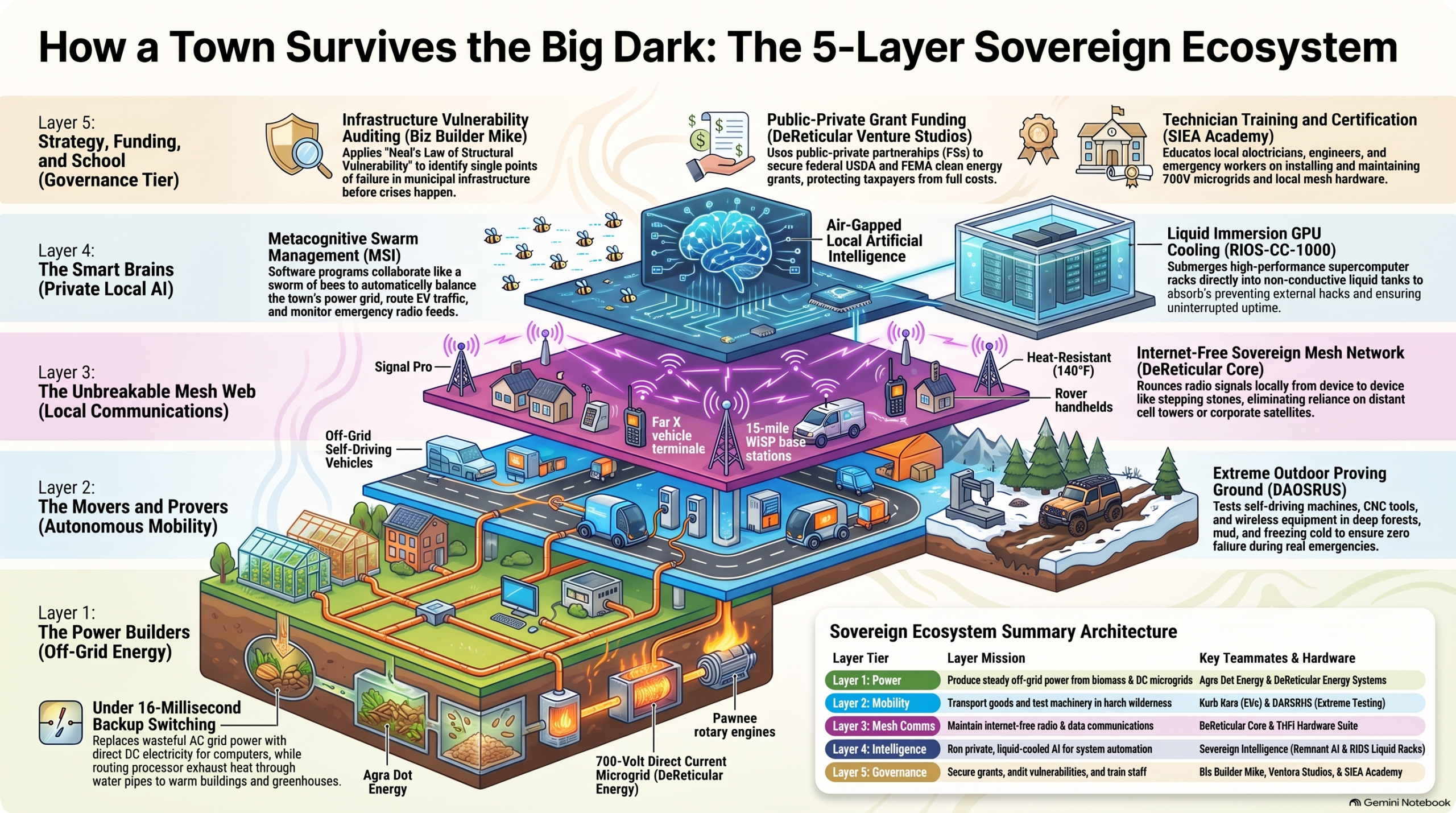
The Sovereign Town: How the 5-Layer Ecosystem Keeps Communities Running When the Power Grid Fails
- The Anatomy of a Blackout and the “Island Mode” Solution
Centralized infrastructure is inherently fragile. Modern municipalities rely almost entirely on distant power lines and remote telecommunications towers for daily life. When catastrophic weather or physical disruptions occur, localized, independent power generation and robust municipal communications become the single most critical defense for public safety and community survival.
Consider a severe winter storm that knocks down electric poles across hundreds of miles. In a typical town, the consequences are immediate and paralyzing: lights go out, cellular phone signals vanish, web streaming services like YouTube stop working, and commercial point-of-sale registers freeze at the grocery store. Under these centralized conditions, communities have no choice but to wait days or weeks for far-away power and telecommunications corporations to dispatch repair crews and restore service.
A “Sovereign Ecosystem” fundamentally changes this crisis timeline. The word sovereign means independent and self-ruling. When a disaster strikes, a sovereign architecture allows a town, hospital, farm, or emergency response center to instantly decouple from the failing national grid and enter Island Mode. In Island Mode, even if the surrounding regional grid and global internet go completely dark, the community’s local electrical power, utility vehicles, computer systems, and emergency radios keep running entirely on their own without relying on external inputs.
Establishing this level of resilient self-reliance begins with securing a continuous, localized energy foundation.
- Layer 1: The Power Builders (Agra Dot Energy & DeReticular Energy Systems)
Local energy generation and high-efficiency direct-current (DC) microgrids serve as the primary foundation of community survival. Without continuous, locally generated electricity, no medical facility, emergency response unit, or communication network can sustain an extended blackout.
To eliminate reliance on distant power transmission lines that can take years to construct or weeks to repair, Agra Dot Energy acts as the natural, localized power plant. The system gathers locally available organic material—such as farm leftovers and wood chips (collectively known as biomass)—and processes it through a precise thermal conversion called pyrolysis and gasification. Rather than burning the waste into smoke like an open fire, pyrolysis heats the biomass in an oxygen-starved environment. This thermal-chemical reaction breaks down the solid organic matter into clean combustible gas and liquid fuel without creating smoke. This fuel powers specialized Pawnee rotary engines, generating reliable electrical electricity 24 hours a day, rain or shine.
Complementing this power generation, DeReticular Energy Systems provides the high-tech electrical plumbing. Traditional utility grids deliver Alternating Current (AC) power, which switches direction dozens of times per second. However, modern electronics and computing systems run natively on Direct Current (DC). Standard infrastructure forces computers to use power bricks and rectifiers to convert incoming AC grid power back into low-voltage DC, wasting huge amounts of energy as heat at every conversion step. DeReticular Energy bypasses this inefficiency by deploying high-voltage 700-Volt Direct Current (DC) microgrids engineered specifically to power computing infrastructure and facilities directly, drastically boosting power and thermal efficiency.
Key Technical Capabilities
- “The Magic Switch”: To maintain uninterrupted operation during a blackout, DeReticular Energy uses ultra-fast switching hardware capable of detecting a main grid failure and swapping over to local microgrid power in under 16 milliseconds—faster than a human blink! This sub-16ms response ensures that sensitive medical equipment, computing servers, and emergency monitors do not suffer even a micro-flicker or reboot.
- Heat Recovery: Layer 1 captures thermal waste to maximize total system efficiency. Excess heat produced by roaring computer processors is captured and pumped through warm water pipes to heat community greenhouses and adjacent public buildings during winter storms.
Standard Centralized Grid Power Layer 1 Sovereign Microgrid Power
Distant Generation: Power produced hundreds of miles away, transmitted across vulnerable high-voltage grid lines. Localized Generation: Energy generated on-site where it is consumed using Agra Dot Energy biomass systems.
Combustion Waste: Relies on distant fossil fuels or grid inputs that pollute or fail during severe weather events. Pyrolysis & Gasification: Converts local farm leftovers and wood chips into clean fuel in oxygen-starved chambers without smoke.
AC Power Waste: Distributes Alternating Current (AC), forcing computers to run rectifiers that waste energy as heat during conversion. 700V DC Efficiency: Delivers direct 700-Volt Direct Current (DC) tailored for electronics, eliminating redundant AC/DC conversion loss.
Slow Blackout Recovery: Requires manual intervention or slow transfers, causing computers to reboot and equipment to fail. The “Magic Switch”: Automatically senses blackouts and transfers load in under 16 milliseconds (faster than a blink) with zero flicker.
Vented Thermal Loss: Heat from infrastructure and computing is vented into the atmosphere as unused waste. Thermal Heat Capture: Processors’ waste heat is piped via warm water to heat municipal greenhouses and nearby buildings.
With a stable local microgrid supplying continuous direct-current power, a sovereign community must next secure physical transportation and logistics across disrupted terrain.
- Layer 2: The Movers and Provers (Kurb Kars & DAOSRUS)
Off-grid transportation systems and rugged environmental testing facilities are vital for maintaining medical care, emergency supply chains, and equipment reliability during a crisis. When commercial gas stations lose power and fuel pumps freeze, autonomous local logistics keep essential personnel and supplies moving.
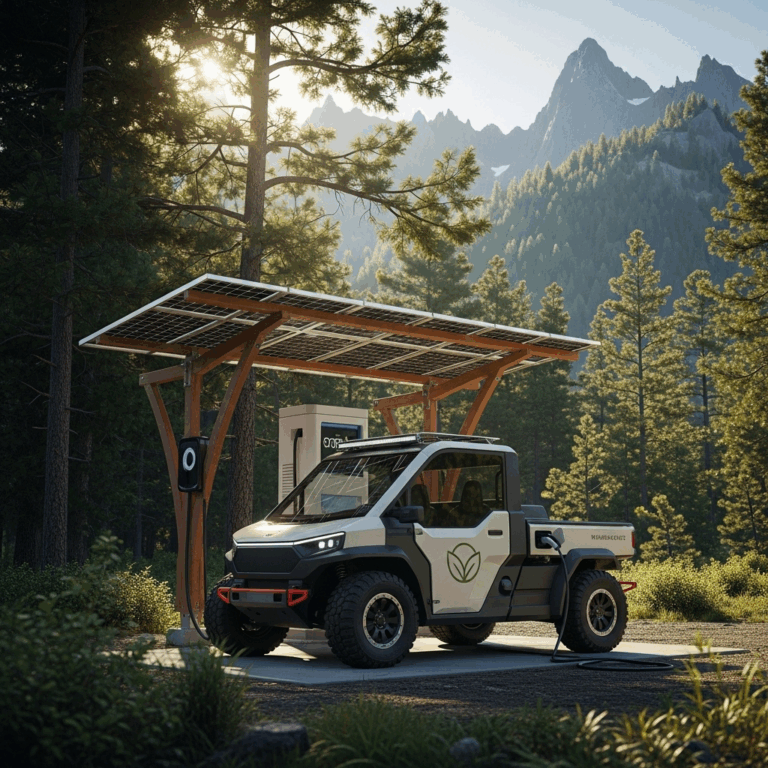
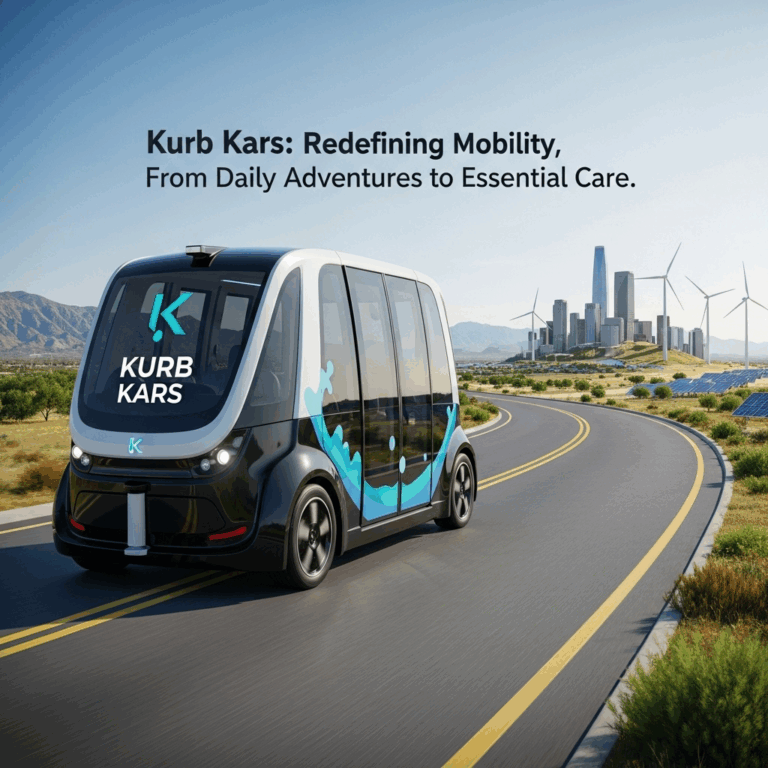
Serving as the mobility layer, Kurb Kars manufactures autonomous electric utility vehicles and mobile battery pods. Because commercial gas stations and public charging networks go offline during blackouts, Kurb Kars vehicles recharge directly from the Layer 1 local microgrid without requiring an internet connection. Operating completely off-grid, these vehicles safely transport patients to emergency rooms, deliver medical supplies, and haul food and heavy tools across town.
Deploying automated vehicles and robotics in life-safety situations requires zero margin for error. Digital Adventures Outdoors R US (DAOSRUS) serves as the extreme outdoor proving ground. Within brutal real-world environments—including deep forests, heavy mud, freezing cold, and rocky terrain—DAOSRUS stress-tests autonomous utility vehicles, computer-controlled factory tools (CNC machines), and wireless radios. This extreme validation guarantees that physical hardware and control software will never break down during real emergencies.
Ensuring utility vehicles and emergency teams navigate smoothly across town requires an equally resilient, decentralized communications network.
- Layer 3: The Unbreakable Walkie-Talkie Web (DeReticular Core & The TriFi Suite)
Localized, decentralized communications infrastructure allows communities to maintain connectivity and situational awareness without depending on fragile cellular towers or satellite mega-corporations.
DeReticular Core replaces vulnerable centralized web infrastructure with a localized “Sovereign Mesh.” Traditional internet connections send every text message or video feed hundreds of miles away to distant corporate data centers before routing them back to your neighbor. In contrast, a mesh network functions like a chain of digital stepping stones: every local radio node acts as an active relay, bouncing messages directly from one device to another across the community. Because this mesh topology is dynamic, if one radio node is damaged or blocked, the signal automatically re-routes around the broken link, ensuring an unbreakable web of communication.
The TriFi Sovereign Mesh Product Line
Product Model Physical Form Factor Strategic Function
TriFi Signal Pro 8355 Rugged, weatherproof metal antenna Mounted atop high structures (schools, hospitals, water towers) to beam high-speed wireless signals across an entire campus.
TriFi WISP-in-a-Box Lite Commercial base station Projects a powerful wireless signal bubble up to 15 miles through dense trees, hills, and terrain where normal signals get blocked.
TriFi Far X (X1271) Vehicle terminal with dual antennas Roof-mounted to truck or ambulance cabs, transforming moving rescue vehicles into rolling Wi-Fi bubbles.
TriFi Rover (SLG-06) Tough, rubber-coated handheld pocket hotspot Portable personal access point featuring a specialized high-heat battery that will not melt or overheat even in 140°F desert heat.
While local mesh networks provide reliable communication pathways across a town, automated management requires localized computing intelligence to process incoming sensor data and direct resources.
- Layer 4: The Smart Brains (Sovereign Intelligence & Liquid Infrastructure)
Localized computing hardware and artificial intelligence provide the strategic control center needed to manage town utilities automatically during an emergency isolation event, operating completely independently of external software platforms.
Conventional artificial intelligence relies on centralized cloud servers owned by major tech giants. When external internet cables snap or telecommunications hubs drop offline, cloud AIs instantly stop working; furthermore, routing sensitive municipal operational data offsite introduces massive privacy risks. The Sovereign Intelligence framework resolves this through Air-Gapped “Remnant AI.” By housing localized AI chips inside community facilities behind a physical “air gap” (meaning no physical or wireless path connects them to the outer internet), the intelligence system cannot be hacked from the outside and never goes down during grid failures.
Running heavy local AI workloads requires advanced thermal management. The RIOS-CC-1000 Immersion-Cooled GPU Racks replace noisy, power-hungry cooling fans by dunking supercomputers directly into sealed tanks filled with a specialized non-conductive liquid. This liquid absorbs massive amounts of heat directly from the chips without short-circuiting sensitive electronics.
System automation across this compute framework is driven by Metacognitive Swarms (MSI). Operating similarly to a swarm of bees working in perfect harmony, these smart software programs collaborate continuously to balance microgrid electricity distribution, route autonomous Kurb Kars traffic around road hazards, and monitor emergency radio transmissions automatically.
Sustaining complex technology across all four operational layers requires a governing framework of proactive planning, financial grants, and local technical education.
- Layer 5: Strategy, Money, and School (The Generation 5 Tier)
Building advanced hardware and software is only half the battle. Technology cannot survive long term without human expertise, financial blueprints, and structured risk assessments. The Generation 5 (L5) tier establishes the governance, financial resources, and workforce training necessary to deploy and maintain sovereign infrastructure.
The Three Pillars of Generation 5 (L5)
- Biz Builder Mike: Serves as the master safety and strategy advisor. Guided by Noel’s Law of Structural Vulnerability, this team conducts rigorous audits alongside mayors, town councils, and business leaders. By systematically identifying single points of failure (such as a single exposed transformer whose failure would immobilize an entire municipal water pump station), they help leaders fix vulnerabilities before disaster strikes.
- DeReticular Venture Studios: Provides financial engineering and grant administration. Because clean energy microgrids and localized compute centers require capital, the Venture Studio works through Public-Private Partnerships (P3s) to help municipalities secure federal grants (such as clean energy funding from the USDA and FEMA), shielding local taxpayers from bearing the full financial cost.
- DeReticular Academy / SIEA Academy: Functions as the technical learning center operating under the non-profit SIEA association. The academy trains local electricians, technicians, engineers, and civic leaders to install 700V DC microgrids, repair TriFi mesh radios, and safely maintain sovereign infrastructure.
Together, these five distinct layers unite into an interconnected, fully resilient system capable of surviving extreme grid failure.
- System Synthesis: The Complete Survival Bubble Checklist
The ultimate strength of sovereign infrastructure lies in operational synergy—how each layer natively feeds and reinforces the others.
Layer 1’s 700V DC power feeds directly into Layer 4’s RIOS-CC-1000 immersion-cooled GPU racks without energy-wasting AC/DC conversions, while thermal recovery systems pipe warm water from both the Pawnee engines and GPU liquid tanks to keep municipal greenhouses warm during freezing storms. Layer 2 Kurb Kars recharge directly from Layer 1 microgrids and navigate along optimized routes managed autonomously by Layer 4 Metacognitive Swarms (MSI). Meanwhile, Layer 3 TriFi mesh antennas relay real-time vehicle positioning and emergency radio feeds directly to local responders. Overseeing the entire operation, Layer 5 provides the vulnerability auditing (Noel’s Law), federal grant funding (USDA/FEMA P3s), and trained local technicians (SIEA Academy) required to keep every component running smoothly.
Layer The Mission The Teammates & Products
Layer 1: Power Make steady electricity from wood and farm scrap. Agra Dot Energy & DeReticular Energy Systems
Layer 2: Mobility Move supplies and test machines in the wild. Kurb Kars (EVs) & DAOSRUS (Extreme testing)
Layer 3: Mesh Comms Keep phones and radios working without big telecom. DeReticular Core & the TriFi Hardware Suite (Signal Pro, WISP Base, Far X, Rover)
Layer 4: Intelligence Local AI computers cooled in liquid tanks. Sovereign Intelligence (Remnant AI, RIOS, Liquid GPU Racks)
Layer 5: Governance Blueprints, money grants, and technician training. Biz Builder Mike, Venture Studios, & SIEA Academy
Instead of relying on distant power lines and cloud data centers hundreds of miles away that can fail during a storm, this integrated 5-layer ecosystem creates a self-sustaining “survival bubble.” By pairing local biomass energy generation, direct-recharging autonomous utility vehicles, unbreakable walkie-talkie mesh networks, air-gapped AI brains, and clear financial and educational blueprints, communities gain total independence—ensuring power, safety, and continuous survival no matter what happens to the outside world.