
Sovereign Infrastructure Consortium: Commercial, Curricular, and Architectural Briefing
This briefing document provides a comprehensive synthesis of the operational, commercial, and technical architecture of the Sovereign Infrastructure Consortium. It outlines the strategic move toward institutional autonomy through the “Sovereign Stack”—a vertically integrated model spanning energy, telecommunications, and intelligence.
Executive Summary
The Sovereign Infrastructure Consortium, led by Principal Architect Michael Noel, operates as a unified ecosystem of eight digital properties designed to monetize high-margin knowledge and infrastructure services. The core mission is to transition municipalities, agricultural cooperatives, and institutional campuses from passive consumers of fragile public utilities into autonomous producers.
Critical Takeaways:
- The Sovereign Stack Doctrine: A commitment to “Island Mode” operations, where infrastructure (Power → Mobility → Comms → Intelligence → Governance) functions indefinitely without dependency on public grids or hyperscaler clouds.
- Diversified Revenue Pillars: The economic model integrates high-margin consulting (85%+ net margin), technical workforce credentialing (90%+ net margin), hardware kitting, and recurring telecommunications revenue.
- Lean Operational Architecture: Strict adherence to the “Lean Plugin Rule,” utilizing a zero-bloat, headless checkout system via Stripe to maintain sub-second edge performance and DCAA/FAR ledger compliance.
- Technological Differentiators: Deployment of Generation 5 (Gen 5) modular skids, carrier-free TriFi Wireless mesh networking, and air-gapped Remnant AI to ensure absolute privacy and deterministic control of critical assets.
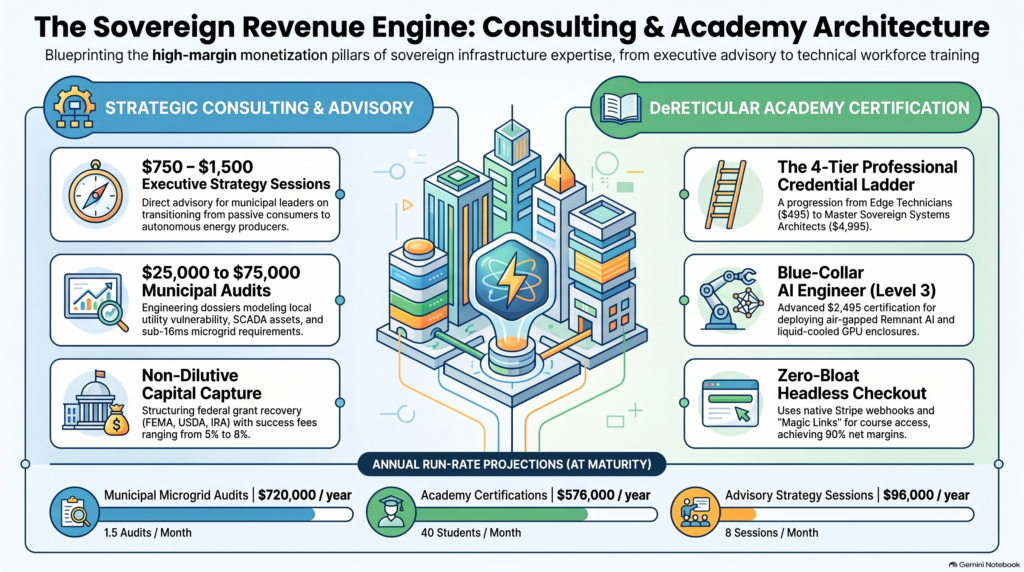
- Strategic Revenue Engines: Consulting and Advisory
The consortium’s highest-margin vertical is its advisory division, which translates theoretical doctrine into paid institutional engagements. This division systematically funnels clients into hardware procurement and recurring service contracts.
1.1 Executive Advisory (Biz Builder Mike)
Operated through bizbuildermike.com, this pillar focuses on operationalizing Noel’s Law: the imperative that passive consumers of energy and compute must become autonomous operators to survive the “1,000-Mile Failure Model” of centralized systems.
Service Target Clientele Pricing Structure
Strategic Triage Qualifying leads for grants/regulatory constraints 15-Min Free
Campus Strategy Session Higher Ed, Municipalities, Tribal Councils $750 (Private) / $1,500 (Inst.)
1.2 Municipal and Sovereign Infrastructure Audits
Hosted via dereticular.com, these audits provide comprehensive engineering and financial dossiers. They model local utility vulnerabilities and island-mode requirements for critical SCADA assets (water treatment, 911 dispatch, and hospital loops).
- Standard Audit ($25,000): Focuses on single-facility microgrids.
- Comprehensive Audit ($75,000): Models a full “Municipal Triad” (City Hall + SCADA + Emergency Services) with sub-16ms transition requirements.
1.3 Venture Studio and Capital Structuring
The venturestudio.dereticular.com property specializes in non-dilutive capital capture. It assists rural communities in deploying infrastructure via federal grant recovery (FEMA, USDA, BEAD, and IRA Section 6417).
- Retainer: $10,000 – $25,000 (DCAA SF 1408 compliant).
- Success Fee: 5%–8% of secured non-dilutive capital.
- DeReticular Academy: Workforce Credentialing
Operating under the Sovereign Infrastructure Education Alliance (SIEA), the Academy provides verified training to create the workforce required for the sovereign economy. The curriculum is delivered via a 4-tier professional certification ladder.
2.1 The Professional Certification Ladder
Level Certification Focus Areas Tuition
Level 1 CSET (Sovereign Edge Technician) TriFi RF alignment, BESS wiring, DC safety. $495
Level 2 CRMA (RIOS Microgrid Administrator) RIOS config, ATS switching, Pawnee GenSet sync. $1,495
Level 3 CBAIE (Blue-Collar AI Engineer) Remnant AI, TPM 2.0 SCADA defense, MSI swarms. $2,495
Level 4 MSSA (Master Systems Architect) Vertical stack synthesis, HB 2014, Field Practicum. $4,995
2.2 Specialized Masterclasses
The Academy also offers standalone, self-paced technical dossiers:
- Metacognitive Swarms of Intelligences (MSI) Executive Briefing: $195.00
- Non-Dilutive Infrastructure Finance: $295.00
- Generation 5 Infrastructure & Thermal Loop Architecture: $350.00
- The Agentic Web (Autonomous A2A Commerce): $195.00
- Technical Architecture: The Sovereign Stack
The consortium models all engineering deliverables across three interdependent layers designed for “Spherical Resilience.”
3.1 The Physical Layer (Energy & Mobility)
- Agra Syngas Gasification: Converts agricultural and forestry waste into synthesis gas and clean hydrogen.
- Parabolic Solar Thermal: Generates 350°C industrial steam to preheat gasifiers, achieving 97.7% power chain efficiency when paired with Pawnee 45 kW rotary GenSets.
- Project Octagon Skids: Intermodal ISO containerized units housing modular microgrids and precision fabrication shops for remote deployment.
3.2 The Operational Layer (RIOS & Telecommunications)
- RIOS (Resilient Infrastructure Operating System): A deterministic real-time OS providing sub-16ms automatic transfer switching (ATS) for instantaneous islanding.
- TriFi Wireless: A carrier-free, self-healing multi-band (5.8 GHz & 60 GHz) RF mesh protocol capable of 15-mile non-line-of-sight connectivity.
3.3 The Cognitive Layer (Sovereign Intelligence)
- Remnant AI Engine: Private, on-premises foundational models that operate 100% air-gapped on local silicon to eliminate telemetry leakage and hyperscaler dependency.
- Metacognitive Swarms of Intelligences (MSI): Autonomous multi-agent swarms that balance microgrid loads, thermal loops, and cyber-physical defense in real-time.
- Hardware and Recurring Revenue Matrix
The telecommunications vertical bridges direct hardware sales with high-reliability industrial infrastructure.
Product Model Role Hardware Price Monthly Service (MRR)
Signal Pro (8355) Weatherproof 5G/Fixed Wireless $650 $120
Far X (X1271) Rural/RV Router (Wi-Fi 6) $250 $120
Rover (SLG-06) Portable 4G LTE Hotspot $80 $120
WISP-in-a-Box Lite Municipal Base Station $899 $120
Note: All hardware orders include a mandatory $45 staging and fulfillment fee handled by Anchor Distributing (Minnesota).
- Zero-Bloat Commerce and Deployment
To maintain high performance and “Lean” standards, the consortium prohibits the use of traditional e-commerce plugins (WooCommerce, LearnDash) on satellite properties.
5.1 The Stripe-Native Pipeline
- Checkout: All conversions occur via Native Stripe Hosted Checkout links.
- Payment Diversity: Supports Credit Cards, Apple/Google Pay, and USDC Crypto (Solana, Ethereum, Polygon) for 1.5% transaction fees.
- Automated Provisioning: Stripe webhooks fire to Cloudflare Workers or WP Engine REST endpoints to generate cryptographically signed “Magic Links” for course access or to trigger hardware fulfillment at Anchor Distributing.
5.2 Regulatory and Statutory Speed
By co-locating AI compute as a “captive power consumer” (utilizing West Virginia H.B. 2014), the consortium bypasses Public Service Commission rate regulations and transmission queues. This allows for commercial microgrid deployment in 60 to 90 days, compared to the 4–7 year average for legacy interconnection.
- Consolidated Financial Projections
At maturity, the blended revenue model—combining one-time consulting, workforce training, hardware margins, and recurring data fees—projects a resilient annual run-rate.
Revenue Vertical Unit Volume / Frequency Annual Run-Rate
Advisory Strategy Sessions 8 Sessions / Month $96,000
Municipal Microgrid Audits 1.5 Audits / Month $720,000
Venture Studio Grant Fees 4 Awarded Grants / Year $180,000
Academy Certifications 40 Students / Month $576,000
Academy Masterclasses 60 Purchases / Month $180,000
Hardware Upfront Margins 30 Nodes / Month $54,000
TriFi Unlimited Data (MRR) 500 Active Nodes $144,000
TOTAL PROJECTED REVENUE Annualized $1,950,000
- Operational Implementation Roadmap
The following 30-day plan is established to operationalize the consulting and courseware verticals:
- Week 1: Payment Infrastructure: Create Stripe Payment Links for strategy sessions and audit deposits; configure Cal.com routing for post-payment scheduling.
- Week 2: Course Packaging: Finalize video masterclasses for CSET (Level 1) and CRMA (Level 2); ingest audio assets into Castos CDN.
- Week 3: Gated Access: Deploy the lightweight magic link webhook for student entitlement and secure the /study-vault/ directories.
- Week 4: Traffic Routing: Verify cross-domain routing between the eight satellite properties; perform end-to-end testing of the fulfillment handshake with Anchor Distributing.