Sovereign Mesh Telecommunications Guide: Secure Island Mode Operations, Hardware Selection, Cost Analysis, and Grant Procurement
- Architectural Foundation: Secure “Island Mode” Networks for Emergency Operations
1.1 Decentralized Telecommunications in High-Consequence Operations
Traditional enterprise and municipal telecommunications infrastructure rely on a fragile, interdependent operational chain: commercial cellular towers, centralized hyperscaler cloud environments, and long-haul terrestrial fiber backbones. When catastrophic disruptions—such as severe weather, kinetic infrastructure damage, extended electrical grid failure, or coordinated cyberattacks—sever any single link in this chain, localized command structures collapse. Decentralized telecommunications bypass these single points of failure by relocating network intelligence, cryptographic validation, and routing authority directly to the operational edge. Eliminating upstream remote dependencies is a strategic prerequisite for maintaining continuous voice, telemetry, and data connectivity across Emergency Operations Centers (EOCs), utility substations, water/wastewater treatment assets, and public safety fleets during severe grid degradation.
1.2 Structural Vulnerability and the “1,000-Mile Failure Model”
The systemic vulnerability of contemporary telecommunications is governed by Noel’s Law of Structural Vulnerability, which establishes that:
\text{Survivability} \propto \frac{1}{\text{Supply Chain Length} \times \text{Central Coordination Depth}}
“The survivability of any operational node is inversely proportional to the length and central coordination of its critical supply chains and communication backhauls.”
Under this principle, reliance on the “1,000-Mile Failure Model”—wherein a local facility relies on remote cloud authentication, centralized DNS routing, and public electric grid interconnects—guarantees localized operational blackout when remote infrastructure fails. True “Island Mode” functionality eliminates this fragility. By establishing an air-gapped, self-sustaining local telecommunications envelope, local Emergency Operations Centers (EOCs), municipal facilities, water/wastewater Supervisory Control and Data Acquisition (SCADA) systems, and emergency crews maintain uninterrupted, full-spectrum operations without requiring an active link to upstream Internet Service Providers (ISPs) or external cloud infrastructure.
┌────────────────────────────────────────────────────────────────────────┐
│ CENTRALIZED HYPERSCALER │
│ (Cloud Core / Public Grid / Upstream ISP) │
└───────────────────────────────────┬────────────────────────────────────┘
│ [1,000-Mile Failure Link]
✕ (Fiber Cut / Grid Collapse / Cyber)
│
┌───────────────────────────────────┴────────────────────────────────────┐
│ AIR-GAPPED LOCAL “ISLAND MODE” │
│ │
│ ┌────────────────────────┐ ┌─────────────────────────────┐ │
│ │ Municipal EOC / Hub │◄───────►│ Water SCADA Substation │ │
│ │ (WISP Base-100 Anchor) │ │ (Signal Pro 8355 Node) │ │
│ └───────────┬────────────┘ └─────────────────────────────┘ │
│ │ │
│ ▼ │
│ ┌────────────────────────┐ │
│ │ First Responder Fleets │ │
│ │ (Far X / Rover Nodes) │ │
│ └────────────────────────┘ │
└────────────────────────────────────────────────────────────────────────┘
1.3 Core Engineering Enablers for Emergency Resiliency
To achieve uncompromised operational continuity during wide-scale infrastructure collapse, edge network hardware incorporates specific engineering specifications designed for extreme physical and operational environments:
- 15-Mile Non-Line-of-Sight (NLOS) Propagation: Utilizing high link-budget sub-6 GHz radio frequency (RF) propagation profiles, the transmission envelope penetrates dense crop canopies, forested mountain terrain, heavy rainfall, wildfire smoke, and structural debris where standard microwave or line-of-sight satellite links fail.
- Hardware Cryptoprocessor (TPM 2.0): Every node integrates an integrated hardware Trusted Platform Module (TPM 2.0) cryptoprocessor. This establishes an air-gapped root of trust that validates boot integrity, authenticates zero-trust peer-to-peer mesh tunnels, and prevents over-the-air firmware injection, state-sponsored spoofing, and Man-in-the-Middle (MITM) attacks on critical operational technology (OT) channels.
- Sub-16ms Dynamic Failover: Radio interfaces continuously monitor multi-carrier signal quality and link integrity. Upon detecting signal degradation or tower loss, radio frequency switching occurs within a sub-16ms window, preserving uninterrupted User Datagram Protocol (UDP) voice streams, live telemetry, and SCADA polling loops.
- Physical Hardening & Operating Parameters: External base units feature industrial-grade gas-discharge lightning surge suppression for high-elevation tower deployments. Internal tactical power reserves utilize Lithium Iron Phosphate (LiFePO4) battery chemistries engineered to maintain operational stability across extreme temperature ranges up to 140°F (60°C).
1.4 Comparative Architecture: Sovereign Mesh vs. Alternative Paradigms
Municipal and enterprise infrastructure architects evaluating resilience strategies must distinguish sovereign mesh technology from alternative options, such as Low Earth Orbit (LEO) satellite constellations (e.g., Starlink) and commercial cellular hotspots.
While LEO satellites offer global internet backhaul, they exhibit critical vulnerabilities in high-consequence emergency scenarios: they require an unobstructed line-of-sight to the sky, suffer total signal loss during heavy wildfire smoke or dense canopy cover, experience weather attenuation (rain and snow fade), and depend on an active connection to remote hyperscaler clouds. Commercial hotspots lack high-gain directional optics, possess limited range (50–150 feet), lack hardware-rooted cryptoprocessors, and drop sessions during tower handoffs. Sovereign mesh networks deliver native air-gapped Island Mode operations, sub-16ms failover, and hardware-level encryption across a 15-mile envelope regardless of sky obstruction or cloud status.
Feature / Architectural Metric Traditional Cellular Hotspots LEO Satellites (e.g., Starlink) TriFi Sovereign Mesh / WISP-in-a-Box
Private Air-Gapped Island Mode None (Requires Carrier Core) None (Requires Active Cloud Link) Native / Standard Operational Profile
Coverage Radius per Anchor Node < 150 Feet Fixed Terminal Footprint Up to 15 Miles (High Link-Budget)
Hardware Cryptoprocessor Rare / Software-Based Non-Standard (Cloud-Dependent) Integrated TPM 2.0 Root of Trust
Foliage & Canopy Penetration Poor Zero (Requires Unobstructed Sky) Carrier-Grade Sub-6 GHz NLOS
Vulnerability to Smoke/Rain/Ash Low Severe (Rain/Snow/Smoke Fade) Unaffected (RF Penetrating Profile)
Carrier Handoff & Sync Latency High / Unsynchronized N/A (Point-to-Point) < 16ms Dynamic Synchronization
Grid / Cloud Independence Zero Dependent on Ground Stations Total On-Premise Autonomy
1.5 Multi-Layer Integration (The 5-Layer Sovereign Architecture)
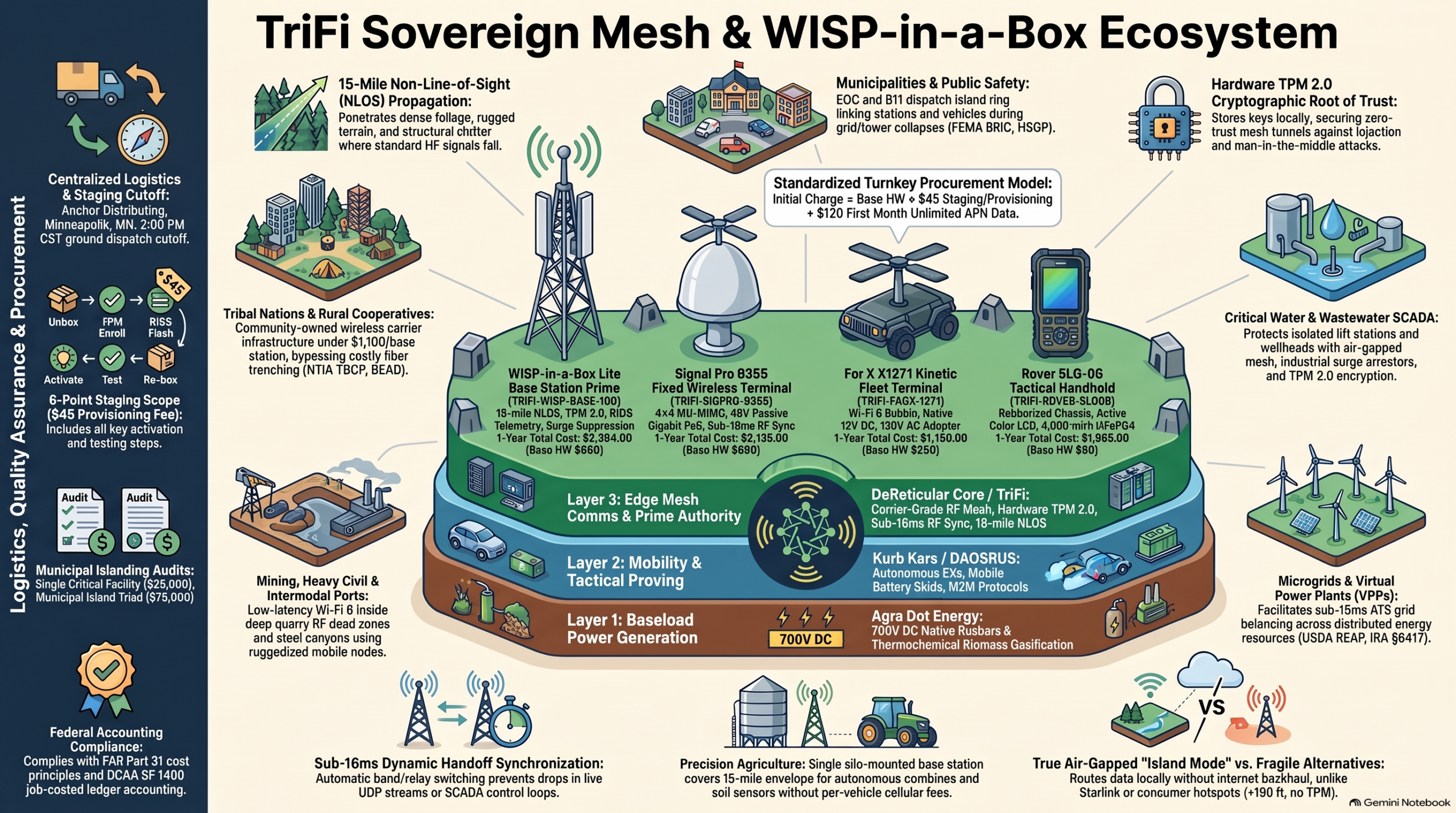
DeReticular functions as the Active Prime System Authority for Layer 3 within the Sovereign Infrastructure Consortium (SIC) multi-organization framework. The integrated functional tiers are detailed below:
Layer Functional Domain Primary Operator / System Core Engineering Specifications
Layer 5 Governance, Advisory & Capital Biz Builder Mike / SIEA Academy Public-Private Partnership (P3) capital stacking, USDA REAP, FEMA BRIC, IRA §6417 Direct Pay, and Municipal Islanding Audits.
Layer 4 SCADA & Cognitive Intelligence DeReticular Energy Air-gapped edge AI computing, liquid-dielectric immersion-cooled GPU clusters (RIOS-CC-1000), and supervisory telemetry.
Layer 3 Mesh Communications DeReticular Core / TriFi (Active Prime System Authority) Hardware TPM 2.0 cryptoprocessors, sub-16ms dynamic RF sync, 15-mile NLOS carrier envelopes, and WISP carrier distribution.
Layer 2 Mobility & Tactical Proving Kurb Kars / DAOSRUS Autonomous commercial utility EVs, mobile battery skids, and tactical nomadic nodes running offline DAOS_A2A_M2M_v3 protocols.
Layer 1 Baseload Power Generation Agra Dot Energy Baseload off-grid generation, 700V DC microgrids, and thermochemical biomass gasification bypassing utility interconnect queues.
By pairing hardware-rooted cryptographic authentication with high link-budget sub-6 GHz RF propagation across this 5-Layer framework, sovereign architecture secures operational continuity across disconnected environments. This underlying technical baseline establishes the criteria necessary for selecting tactical and fixed hardware endpoints.
- TriFi Hardware Lineup & Selection Decision Matrix
2.1 Strategic Edge Device Deployment Considerations
Selecting appropriate field hardware requires balancing deployment mobility, structural environmental exposure, power profile compatibility, and throughput requirements. Deploying optimized hardware profiles ensures that localized edge nodes integrate with central base station anchors to maintain a self-healing, air-gapped operational mesh.
2.2 Comprehensive Device Profiles
TriFi Rover (Model SLG-06 / SKU: TRIFI-ROVER-SLG06)
- Form Factor & Hardware: Tactical pocket-sized mobile hotspot housed in a drop-tested, rubberized shock-absorbent body. Features an active, full-color vertical LCD screen displaying real-time 4G signal strength, 5GHz Wi-Fi status, battery charge percentage, data consumption metrics, and a dynamic connection QR code for instant field onboarding.
- Power System: Internal 4,000 mAh LiFePO4 battery providing thermal stability in operational environments up to 140°F (60°C), supported by bidirectional USB-C Power Delivery (PD) pass-through charging.
- Operational Role: Pocket Wi-Fi node for first responders, nomadic field inspectors, mobile personnel, and emergency kit deployment.
TriFi Far X (Model X1271 / SKU: TRIFI-FARX-1271)
- Form Factor & Hardware: Upright matte-gray desktop and kinetic fleet gateway equipped with four high-gain (9dBi) vertical directional paddle antennas and a front-panel LED status array.
- Local Networking & Power: Generates a dual-band concurrent Wi-Fi 6 localized coverage bubble. Power options include native 12V DC vehicle integration for mobile command fleets and a standard 120V AC desktop adapter. Supports sub-16ms RF carrier synchronization.
- Operational Role: Long-range router for rural offices, utility maintenance vehicles, mobile command vans, and remote facilities requiring high-gain cellular signal capture.
TriFi Signal Pro (Model 8355 / SKU: TRIFI-SIGPRO-8355)
- Form Factor & Hardware: Low-profile, minimalist matte-white circular dome constructed from IP67 weather-sealed, UV-stabilized cast composite and aluminum for fixed outdoor/indoor installations.
- RF & Networking Array: 4×4 MU-MIMO high-gain directional array engineered for advanced multi-carrier band optimization, sub-16ms dynamic carrier handoff, and high-throughput data routing powered via 48V Passive Gigabit Power-over-Ethernet (PoE).
- Operational Role: Fixed Customer Premises Equipment (CPE) and campus microgrid gateway for critical water/SCADA substations, enterprise facilities, and exterior building mounts.
TriFi WISP-in-a-Box Lite (Base Station Prime / Model Base-100 / SKU: TRIFI-WISP-BASE-100)
- Form Factor & Hardware: High-gain mast and tower-mounted carrier base station equipped with industrial-grade gas-discharge lightning surge suppression for continuous outdoor exposure.
- Core Systems: High link-budget 15-mile NLOS carrier envelope, integrated hardware TPM 2.0 cryptoprocessor, and factory-pre-flashed proprietary RIOS telemetry agent for automated remote mesh orchestration.
- Operational Role: Carrier Base Station Prime and district mesh anchor mounted on grain silos, municipal water towers, communication masts, and emergency dispatch hubs.
┌──────────────────────────────────────────────┐ │ TriFi WISP-in-a-Box Lite (Base-100) │ │ 15-Mile NLOS Carrier Base Station Anchor │ └──────────────────────┬───────────────────────┘ │ ┌───────────────────────────────┼───────────────────────────────┐ ▼ ▼ ▼
┌─────────────────────────┐ ┌─────────────────────────┐ ┌─────────────────────────┐
│ TriFi Signal Pro (8355) │ │ TriFi Far X (X1271) │ │ TriFi Rover (SLG-06) │
│ Fixed Terminal / CPE │ │ Kinetic Fleet Router │ │ Tactical Pocket Hotspot │
└─────────────────────────┘ └─────────────────────────┘ └─────────────────────────┘
2.3 Operational Use-Case Selection Framework
Selecting hardware endpoints depends on environmental exposure, deployment speed, and structural role within the network topology:
- Emergency Responders & Field Inspectors: Deploy the TriFi Rover (SLG-06) for pocket mobility, drop-tested durability, and immediate team onboarding via the display’s connection QR code.
- Mobile Command Vans, Utility Trucks, & Rural Facilities: Deploy the TriFi Far X (X1271) to leverage native 12V DC vehicle power, high-gain 9dBi directional paddle arrays, and localized Wi-Fi 6 coverage.
- Water SCADA Substations, Enterprise Campuses, & Exposed Assets: Deploy the TriFi Signal Pro (8355) for its IP67 weatherproofing, 48V Passive Gigabit PoE, sub-16ms failover, and 4×4 MU-MIMO directional backhaul.
- Municipal District Hubs, Grain Silos, & EOC Anchor Sites: Deploy the TriFi WISP-in-a-Box Lite (Base-100) to serve as the master 15-mile NLOS parent node for district-wide backhaul distribution.
Hardware Deployment Framework Matrix
Industry Vertical Primary Hardware Recommendation Master SKU Network Topology Role Key Environmental Enabler
Municipal & Public Safety WISP Base-100 + Signal Pro 8355 TRIFI-WISP-BASE-100 / TRIFI-SIGPRO-8355 EOC & 911 Island Ring Anchor 15-Mile NLOS + Gas-Discharge Surge Arrestor
Water / Wastewater SCADA TriFi Signal Pro 8355 TRIFI-SIGPRO-8355 Air-Gapped Pump Telemetry Gateway IP67 Weather-Sealed Cast Aluminum + TPM 2.0
Distributed Microgrids & Energy WISP Base-100 + Signal Pro 8355 TRIFI-WISP-BASE-100 / TRIFI-SIGPRO-8355 Sub-16ms ATS Grid Balancing Node Sub-16ms RF Handoff + Zero Cloud Dependency
Precision Agriculture WISP Base-100 + TriFi Far X TRIFI-WISP-BASE-100 / TRIFI-FARX-1271 Silo-to-Field Umbrella Coverage High-Gain Sub-6 GHz Canopy Penetration
Kinetic Fleet Operations TriFi Far X X1271 TRIFI-FARX-1271 Wi-Fi 6 Vehicle Command Bubble Native 12V DC Input + Twin 9dBi Paddles
Tactical & First Response TriFi Rover SLG-06 TRIFI-ROVER-SLG06 Handheld Nomadic Field Hotspot 140°F LiFePO4 Battery + Drop-Tested Chassis
Establishing the correct physical device topology sets the technical foundation for operational deployment. Evaluating these deployments requires analyzing initial capital expenditures, staging workflows, and total cost of ownership metrics.
- Financial Engineering: Cost Breakdown and 1-Year Total Cost of Ownership (TCO)
3.1 Capital Allocation and Financial Architecture
Transitioning to sovereign mesh infrastructure requires capital budgeting frameworks that account for both physical hardware and ongoing operational connection fees. Procurement models pair unbundled direct-purchase hardware costs with standardized staging scopes and predictable monthly cellular APN service rates.
3.2 Turnkey Acquisition & Staging Scope Analysis
Initial terminal deployment pricing is structured around a transparent hardware and provisioning formula:
\text{Initial Turnkey Acquisition Cost} = \text{Unbundled Base Hardware} + $45.00\text{ (Staging/Provisioning)} + $120.00\text{ (Month 1 APN Data)}
The mandatory $45.00 Staging & Quality Assurance Scope executed by Anchor Distributing (Minneapolis, MN) under a 2:00 PM CST same-day ground dispatch cutoff includes six verification steps prior to field deployment:
┌────────────────────────────────────────────────────────────────────────┐
│ STAGING & QA SCOPE ($45.00 PROVISIONING) │
│ Fulfillment Hub: Anchor Distributing (GL Code: 5200-LOGISTICS) │
├────────────────────────────────────────────────────────────────────────┤
│ 1. Unboxing & Physical Integrity Inspection │
│ 2. Cryptographic Enrollment of TPM 2.0 via Sovereign Root Key │
│ 3. Factory Firmware Flash of Proprietary RIOS Telemetry Agent │
│ 4. Cellular IMEI Activation & ICCID SIM Marrying to Private APN │
│ 5. Radio Bench-Testing (RF Loopback & Sub-16ms Failover Test) │
│ 6. Serialized Barcode Assignment & Dispatch (2:00 PM CST Cutoff) │
└────────────────────────────────────────────────────────────────────────┘
All staging activities, inventory routing, and fulfillment charges processed through Anchor Distributing are mapped directly to general ledger accounting code 5200-LOGISTICS for streamlined federal procurement auditing.
3.3 Master 1-Year Total Cost of Ownership (TCO) Matrix
Ongoing cellular backhaul across all hardware units utilizes an uncapped, non-throttled multi-carrier cellular APN profile billed at a flat rate of $120.00 per month. The initial turnkey charge includes the unbundled base hardware, the 45.00 staging and provisioning fee, and the first month of cellular APN service (120.00). The 1-Year Total Cost of Ownership reflects this initial turnkey charge combined with 11 subsequent monthly data payments of $120.00 (equating to $1,320.00 in ongoing operational service across months 2 through 12).
Device Name Commercial Model Master SKU Unbundled Hardware Price Staging & QA Fee Initial Turnkey Acquisition Cost Ongoing Monthly Data Rate Total 1-Year Cost of Ownership (TCO)
TriFi Rover Model SLG-06 TRIFI-ROVER-SLG06 $80.00 $45.00 $245.00 $120.00 / mo $1,565.00
TriFi Far X Model X1271 TRIFI-FARX-1271 $250.00 $45.00 $415.00 $120.00 / mo $1,735.00
TriFi Signal Pro Model 8355 TRIFI-SIGPRO-8355 $650.00 $45.00 $815.00 $120.00 / mo $2,135.00
TriFi WISP-in-a-Box Lite Base-100 TRIFI-WISP-BASE-100 $899.00 $45.00 $1,064.00 $120.00 / mo $2,384.00
Establishing definitive total cost of ownership metrics provides clear accounting data for public sector finance offices, supporting federal grant applications, municipal budget requests, and capital recovery strategies.
- Strategic Grant Capitalization & Procurement Architecture
4.1 Grant Capitalization Strategy for Infrastructure Resilience
Public sector agencies, municipal utilities, tribal governments, and rural enterprises can offset up to 100% of the initial hardware, staging fees, professional engineering services, and operational data expenses associated with sovereign mesh deployments. By leveraging federal grant programs and clean energy capital mechanisms structured for resilient infrastructure, entities can execute non-dilutive capital recovery.
4.2 Applicable Federal Grant Mechanisms
Key federal funding streams aligned with Layer 3 telecommunications deployments include:
┌────────────────────────────────────────────────────────────────────────┐
│ FEDERAL GRANT RECOVERY MECHANISMS │
├───────────────────────────┬────────────────────────────────────────────┤
│ FEMA BRIC & HSGP │ Hazard mitigation, EOC islanding, and │
│ │ communications network hardening. │
├───────────────────────────┼────────────────────────────────────────────┤
│ USDA REAP & ReConnect │ Rural microgrid communications, off-grid │
│ │ agricultural broadband, and energy nodes. │
├───────────────────────────┼────────────────────────────────────────────┤
│ IRA §6417 Direct Pay │ Direct cash reimbursements for tax-exempt │
│ │ entities deploying sovereign microgrids. │
├───────────────────────────┼────────────────────────────────────────────┤
│ NTIA TBCP & BEAD │ Broadband for Tribal Nations, electric │
│ │ co-ops, and unserved rural districts. │
├───────────────────────────┼────────────────────────────────────────────┤
│ Clean Water State │ Air-gapping, cyber-hardening, and backup │
│ Revolving Fund (CWSRF) │ telemetry for water/wastewater SCADA. │
├───────────────────────────┼────────────────────────────────────────────┤
│ Port Infrastructure │ Communications resilience and container │
│ Development (PIDP) │ yard automation for maritime/inland ports. │
└───────────────────────────┴────────────────────────────────────────────┘
- FEMA BRIC (Building Resilient Infrastructure and Communities) & HSGP: Directly funds emergency communications hardening, EOC islanding, and hazard mitigation projects designed to sustain operations during catastrophic grid failures.
- USDA REAP (Rural Energy for America Program) & ReConnect: Provides capital grants for rural microgrid distribution, smart agricultural monitoring, and off-grid wireless infrastructure.
- IRA §6417 (Inflation Reduction Act Direct Pay): Allows tax-exempt public entities (municipalities, tribal governments, 501(c)(3) non-profits) to receive direct cash reimbursements for deploying sovereign microgrids and localized power-communications infrastructure.
- NTIA TBCP & BEAD: Program funding allocated for broadband infrastructure expansion across Tribal Nations, rural electric cooperatives, and unserved rural districts.
- Clean Water State Revolving Fund (CWSRF): Administered via state environmental agencies to fund cyber-hardening, physical surge protection, and air-gapped SCADA telemetry across critical water and wastewater treatment facilities.
- Port Infrastructure Development Program (PIDP): Federal Maritime Administration grants targeted at enhancing intermodal freight resilience, container yard RF automation, and port facility command communications.
4.3 Forensic Municipal Islanding Audits & Grant Pipeline
To establish technical baselines, determine link-budget requirements, and justify federal grant allocations, DeReticular executes forensic engineering audits governed by formal Statements of Work (SOW):
- Single Critical Facility Audit ($25,000): A targeted engineering evaluation designed for isolated municipal or industrial assets (e.g., a standalone wastewater lift station, hospital emergency wing, or isolated Fire/EMS dispatch site). Evaluates RF link margins, failover latencies, local power reserves, and air-gapped islanding readiness.
- Municipal Island Triad Audit ($75,000): A regional forensic assessment covering the core public governance triad:
- City Hall & Administrative Governance Hubs
- Water / Wastewater Treatment SCADA Networks
- 911 Emergency Operations Centers (EOC) & Primary Dispatch Controls
Audit-to-Grant Capitalization Pipeline: These forensic audits function directly as reimbursable, grant-funded pre-development engineering studies. Under federal grant rules (including FEMA BRIC and USDA REAP), pre-award engineering design, site audits, and technical specifications are eligible preliminary costs. Municipalities can capitalize the $25,000 or $75,000 audit SOWs directly into their primary grant application packages, ensuring that both initial engineering studies and subsequent hardware deployments receive full non-dilutive federal reimbursement.
4.4 Federal Accounting Standards & Procurement Compliance
All hardware procurement orders, staging scopes, and professional audit SOWs adhere to strict federal cost-accounting standards. Internal financial tracking maps logistics to general ledger cost center 5200-LOGISTICS, fully aligned with:
- FAR Part 31 (Federal Acquisition Regulation: Cost Principles): Ensures all costs are allowable, allocable, and reasonable under federal government contracting guidelines.
- DCAA SF 1408 (Defense Contract Audit Agency Accounting System Evaluation): Satisfies job-costed ledger standards, providing transparent tracking for every hardware serial number, IMEI/ICCID pairing, and engineering hour.
This accounting framework simplifies audit defense, satisfies state revolving fund compliance, and streamlines grant reimbursement processing for public finance officers.
By combining hardware-rooted cryptographic security, high link-budget RF propagation, transparent TCO metrics, and compliant federal grant procurement pipelines, public and commercial entities can transition from fragile commercial telecom dependencies into fully self-funded, sovereign network operators capable of maintaining continuous connectivity under extreme conditions.