The Agent Economy: Decoding the Infrastructure for Autonomous Commerce
1. Introduction: The Shift from “Click-and-Buy” to “Delegate-and-Done”
We are witnessing the transition from traditional e-commerce to Agentic Commerce (A-Commerce). In the legacy “click-and-buy” model, the seller controls the funnel, utilizing visual design and marketing psychology to capture human attention. In A-Commerce, the power dynamic shifts entirely to the buyer-agent’s intent. The transaction no longer begins on a merchant’s landing page; it originates within an AI interface—such as ChatGPT, Claude, or a specialized autonomous agent—and is executed through machine-to-machine negotiation without real-time human intervention.
The “So What?” for the Emerging Economy
By 2030, autonomous agents are projected to influence up to $5 trillion in global spending. For the strategic architect, this shift necessitates a total reimagining of the consumer lifecycle. Humans are moving from active “participants” who click buttons to “governors” who define the policies, budgets, and ethical guardrails that machines must navigate. To facilitate this high-velocity machine economy, financial giants like Stripe and PayPal are deploying specialized rails that bridge the gap between human intent and machine execution.
——————————————————————————–
2. Stripe’s Strategy: The Modular Engine for Developers
Stripe is positioning itself as the foundational infrastructure for a-commerce, providing a developer-first suite of “primitives.” Their focus is driving the industry toward Level 5 Autonomy—a future state of fully autonomous, anticipatory commerce where agents manage a user’s entire life or business needs within a defined budget.
Critical Components of the Agentic Commerce Suite
For the developer, the “So What?” lies in modularity and risk mitigation:
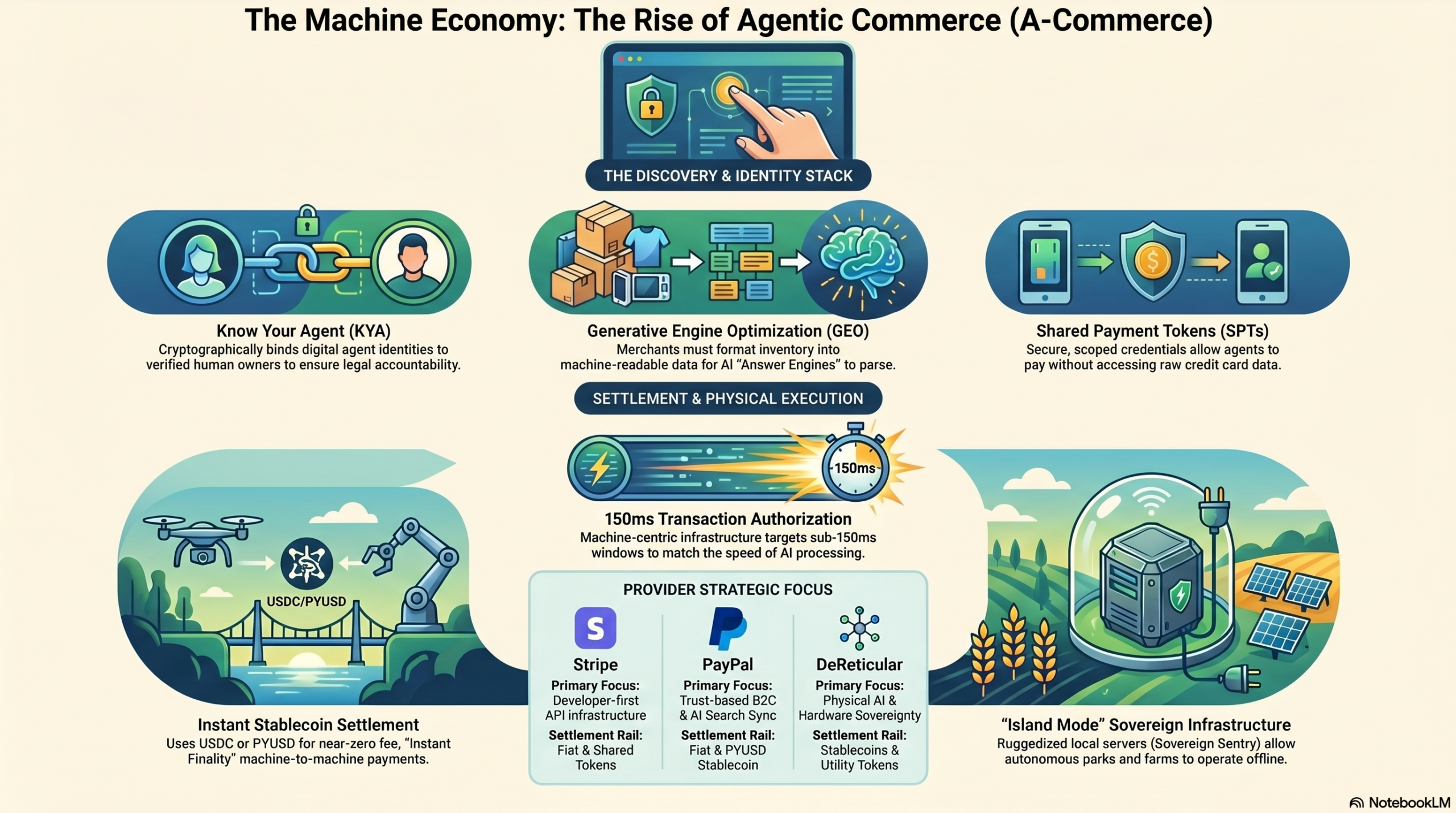
- Shared Payment Tokens (SPTs):
- Developer Benefit: Liability Shielding. SPTs allow an agent to pass credentials to a merchant without the agent ever seeing raw credit card data, significantly reducing the developer’s PCI compliance scope and data-theft risk.
- Stripe Projects for Agents:
- Developer Benefit: Granular Permissioning. This enables the assignment of “scoped identities” to agents, allowing developers to set specific budgets and restricted API keys to prevent “god-mode” agents from overspending or accessing unauthorized resources.
- Link for Agents:
- Developer Benefit: Automated Governance. By extending Stripe’s wallet to agents, developers can allow users to set pre-authorized “guardrails” (e.g., “Auto-approve all SaaS renewals under $100”), streamlining the checkout flow without manual authorization.
Technical Protocols of the Agentic Lifecycle
| Protocol | Full Name | Primary Purpose |
| ACP | Agentic Commerce Protocol | The “language” agents use to browse catalogs and manage digital shopping carts. |
| MPP | Machine Payments Protocol | Optimized for machine-to-machine (M2M) microtransactions and recurring payments. |
| UCP | Universal Commerce Protocol | Enables “native checkout” experiences directly inside AI search results. |
| MCP | Model Context Protocol | A “USB-C for AI” that allows agents to securely plug into a business’s internal data/tools. |
——————————————————————————–
3. PayPal’s Strategy: The “Invisible Storefront” and Consumer Trust
While Stripe builds the back-end engine, PayPal leverages its two-sided network of 400M+ users to create a trust-based marketplace. Their strategy focuses on “The Invisible Storefront,” where commerce happens seamlessly in the background of a consumer’s life.
The Pillars of PayPal Agentic Services
- PayPal Store Sync (The Discovery Layer): Strategic architects must realize that most websites are designed for human eyes (visual). Store Sync converts merchant catalogs into machine-readable data. The “So What?”: If a merchant’s data is not machine-readable, the business effectively “disappears” to AI agents, regardless of its SEO ranking.
- PayPal Agent Ready (The Payment Layer): This allows merchants to accept autonomous transactions while maintaining PayPal’s established Buyer Protection, ensuring that agent-led purchases are as trusted as human-led ones.
The Agent-to-Agent (A2A) and AP2 Protocols
Developed in collaboration with Google, the A2A Protocol enables agents to negotiate across platforms. However, the financial bridge is the AP2 (Agent Payments Protocol):
- Negotiation: A buyer’s agent communicates with a merchant’s “Sales Agent” to confirm specs and availability.
- Authorization: The AP2 protocol acts as the financial execution layer, using Verifiable Digital Credentials to provide cryptographic proof that the agent has the legal authority to spend the user’s funds.
- Delegation: The financial mandate is passed to the PayPal wallet, ensuring the transaction settles within the user’s pre-set permissions.
——————————————————————————–
4. Comparative Deep Dive: Stripe vs. PayPal
| Dimension | Stripe (Agentic Commerce Suite) | PayPal (Agentic Commerce Services) |
| Primary Strength | Infrastructure: Developer-first, API-heavy, and modular. | Trust: Consumer brand recognition and massive user base. |
| Discovery Strategy | Catalog APIs for building custom applications. | Store Sync: Direct integration with Perplexity, Google, and Wix. |
| Identity/Auth | SPTs: Focused on security and PCI scope reduction. | Identity Link: Connecting existing PayPal accounts to agents. |
| Settlement Rails | Primarily Fiat-heavy (Stripe Treasury). | Integrated with PYUSD (Stablecoin) for A2A flows. |
| Target Ecosystem | B2B / SaaS: Agents buying GPUs or cloud services. | B2C / Retail: Agents buying shoes or booking travel. |
Strategic Synthesis: Stripe is building the engine of the machine economy; PayPal is building the marketplace.
——————————————————————————–
5. The Settlement Layer: Stablecoins and Machine-Speed Money
Traditional financial rails (credit cards) were designed for 20th-century human friction: 2FA, SMS codes, and manual fraud filters. These rails fail in the agent economy, where velocity and volume are paramount.
From SEO to GEO (Generative Engine Optimization)
The shift from Search Engine Optimization (SEO) to Generative Engine Optimization (GEO) is the primary marketing challenge for the machine economy. Merchants must optimize their data for “Answer Engines.” If an agent cannot parse your technical specifications via an API, you cannot compete.
Why Stablecoins are the Machine Default
Machine-to-Machine (M2M) commerce requires “Programmable Money” that operates at the speed of code.
- Circle/USDC (via the x402 protocol): Provides “Instant Finality.” An agent can trigger a transfer that settles in seconds with near-zero fees, bypassing the 3-day wait of legacy banking.
- PayPal’s PYUSD: Enables conditional payments. For example, a delivery drone might only release payment to a weather station once its IoT sensors confirm the wind data provided was accurate.
- The Micropayment Factor: These rails enable sub-cent transactions ($0.001). A drone paying a weather station $0.05 for real-time wind data is only economically viable on stablecoin rails.
——————————————————————————–
6. Trust and Compliance: Know Your Agent (KYA)
As machines begin spending trillions, the compliance framework is shifting from “Know Your Customer” (KYC) to “Know Your Agent” (KYA).
The Chain of Trust and the Instrumentality Doctrine
Regulators treat agents as “Instrumentalities”—tools of the human principal rather than legal persons. Under the Doctrine of Attributed Liability, the human owner is strictly liable for an agent’s actions, even during an “AI hallucination.” The “Black Box” defense (claiming you didn’t know why the AI did it) is legally insufficient.
Hardware KYC: The New Security Standard
To prevent fraud, the industry is adopting Hardware Attestation (TEEs/Intel SGX). By running agent code in a “Trusted Execution Environment,” businesses can provide “Hardware KYC,” proving the agent’s code hasn’t been tampered with to bypass AML limits.
Checklist for an Agent-Ready Business
- [ ] Register a UAID: Obtain a Universal Agent ID so your “Sales Agent” is discoverable in registries.
- [ ] Deploy Sovereign Infrastructure: Use rugged hardware (e.g., DeReticular’s Sovereign Sentry) to host AI locally.
- [ ] Format Data for GEO: Use schema.org or Store Sync so AI “Answer Engines” can ingest your inventory.
- [ ] Enable “402” Payments: Integrate stablecoin gateways (USDC/PYUSD) for instant machine settlement.
——————————————————————————–
7. Conclusion: The Sovereign Future of Commerce
The future of commerce is “Sovereign,” moving away from fragile centralized cloud dependencies toward resilient local nodes. Companies like DeReticular are building the physical primitives of this economy:
- RIOS (Rural Infrastructure Operating System): The software layer that allows a “patch of dirt to think.”
- The Industrial Foreman: The physical executor that translates digital logic into kinetic action (e.g., managing a smart RV park’s power grid).
We are currently transitioning from Level 2 (AI-assisted discovery) to Level 4 (complex workflow execution). The ultimate goal is Level 5, where the machine economy functions as a secure, scalable, and sovereign mesh. In this trillion-dollar landscape, Identity is the new Firewall. By securing the cryptographic link between humans, their hardware, and their autonomous proxies, we are architecting the most efficient financial system in human history.