Market Entry Strategy: Positioning Karamoja “Green Marble” in the Global Luxury Construction Sector
1. Executive Strategic Vision
The Karamoja region is currently undergoing a radical industrial pivot, transitioning from a frontier raw-material exporter to a vertically integrated, high-value “Green Marble” ecosystem. This strategy is predicated on the “Project Oasis” model, which moves advanced processing to the point of extraction to capture the significant economic spread between raw stone and finished luxury architectural products.
The “Green Island” Paradigm
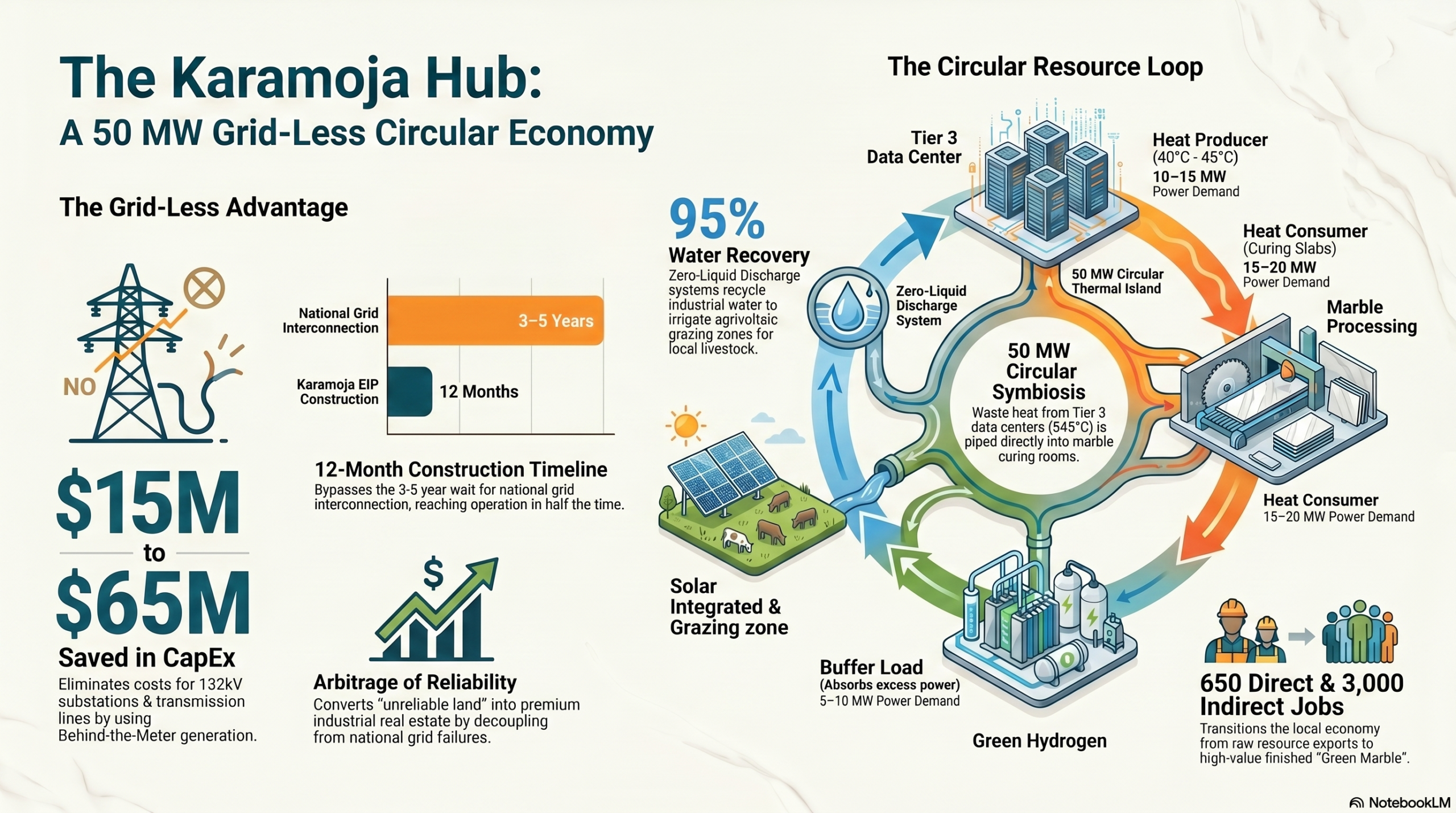
Our strategic advantage is anchored in “Behind-the-Meter” (BTM) generation. By establishing the 50 MW “Karamoja Symbiosis Hub” co-located with industrial assets, we effectively decouple growth from national grid volatility. This model eliminates between $15 million and $65 million in infrastructure costs—specifically 132kV substations and transmission lines—while bypassing 3–5 year grid-interconnection delays. To ensure Tier-1 investor-grade reliability, the microgrid utilizes an advanced Microgrid Controller (EMS) and a 200 MWh Battery Energy Storage System (BESS), providing the critical “Black-Start Capability” required to restart industrial operations independently of the national grid.
The Value-Addition Mandate
This project serves as a definitive response to the Uganda Mining and Minerals Act (2022). By transforming “Bianco Zebrino” blocks into polished slabs on-site, we fulfill the legal mandate for domestic value addition, securing long-term tenure and export priority. This alignment transforms regulatory compliance into a barrier to entry for competitors unable to match our integrated energy-industrial footprint.
Energy independence forms the baseline for the environmental certifications required to command a premium in the global marketplace, ensuring that every slab produced is backed by a guarantee of operational continuity.
2. Competitive Differentiator: The Circular Thermal Island
The project’s superior 38% net profit margin is driven by industrial symbiosis. By treating the park as a single organism, we utilize waste-to-value loops that are impossible for traditional, siloed industrial models to replicate.
Thermal and Resource Symbiosis Analysis
The following table details the multi-stage thermal loop that reduces OpEx by 22% compared to standalone facilities:
| Loop Stage | Source | Consumer | Efficiency Gain / Benefit |
| Stage 1: Low-Grade (40^\circC) | Tier 3 Data Center | Marble Curing Rooms | Piped heat cures “Bianco Zebrino” resins; saves ~3.2 GWh annually. |
| Stage 2: Medium-Grade (70^\circC) | Green Hydrogen Electrolyzer | MED Distillation Units | Multi-Effect Distillation (MED) purifies water for data cooling and Manyattas. |
| Stage 3: Cold-Chain (60^\circC) | Meat Processing (Compressors) | Green Hydrogen Electrolyzer | Rejection heat pre-heats electrolyzer water, boosting H_2 efficiency by 10–15%. |
Water Neutrality as a Market Asset
In the semi-arid Karamoja plateau, water management is a primary operational risk. We mitigate this through a “Net-Zero Water” strategy, utilizing Air-Cooled Condensers (ACC) to preserve groundwater. Within the marble processing unit, 95% of blade-lubrication water is recycled via a Zero-Liquid Discharge (ZLD) system. This fulfills the rigorous “Water Recycling” requirements of ANSI/NSI 373 Platinum, positioning the project as a global leader in sustainable mineral processing.
——————————————————————————–
3. The Legal Path to “Green Marble” Authority
Global luxury markets no longer view sustainability as optional; it is now a legal prerequisite. We secure our market authority through a “Triple-Lock” legal framework.
International Standards Compliance: ANSI/NSI 373 Platinum
Achieving the Platinum tier—the industry’s highest—requires verified adherence to:
- [ ] Water Recycling: Certified 95% recovery rate via ZLD.
- [ ] Site Reclamation: Legally binding restoration of the “Bianco Zebrino” quarry sites.
- [ ] Social Responsibility: Documented safe labor practices and community benefit sharing.
- [ ] Renewable Energy: 100% utilization of the on-site 50 MW hybrid plant.
EU Market Entry (CBAM & CSRD)
The EU Carbon Border Adjustment Mechanism (CBAM) effectively taxes the “embedded carbon” of imports. Our 100% renewable energy profile yields a “Cradle-to-Gate” Embodied Carbon of 0.00 kg CO2e, granting a decisive tax exemption and a significant price advantage over high-carbon competitors from fossil-fuel-dependent regions.
The Blockchain Transparency Layer
Every “Bianco Zebrino” slab is assigned a “Blockchain Ledger” entry via our co-located Data Center. This ledger tracks energy provenance and water usage, satisfying the EU Green Claims Directive and ensuring eligibility for LEED v4.1 credits. This level of transparency is essential for architects targeting “Net-Zero” certifications in London, New York, and Dubai.
——————————————————————————–
4. Market Dynamics and Financial Valuation
The investment thesis for the Karamoja EIP focuses on capital efficiency and high-conviction “Impact Alpha.”
Capital Allocation and Margin Expansion
The project requires a total CapEx of $45.0 million, allocated as follows:
- Generation (Solar/Wind/BESS): $28.0M (62%)
- Industrial Hub (Marble/Meat/ZLD): $11.5M (26%)
- Data Center Core: $4.0M (9%)
- Logistics & Soft Costs: $1.5M (3%)
This investment enables a massive margin expansion: while raw blocks trade at 180/ton**, finished “Bianco Zebrino” slabs command **1,200/ton. The unit projects an Internal Rate of Return (IRR) of 26.4%.
The “Green Premium” and Material Transparency
High-end architects require a Material Ingredient Report (MIR) for specify-grade projects. Our MIR confirms the technical purity of our stone (98.8% Calcium Carbonate, <1.0% Magnesium Carbonate) and its non-emitting status (0 g/L VOCs). This transparency, combined with a 10-year carbon sequestration projection of 9,450 tons CO2e from our Agrivoltaic zone, justifies a 15% price premium in global luxury markets.
——————————————————————————–
5. Operational Logistics: From Quarry to Global Port
We transform the logistical challenge of Karamoja’s remoteness into a “Green Logistics” rating through a carbon-efficient, 920km multi-modal strategy.
The “Northern Corridor” Execution Plan
- Leg 1 (Road): Finished slabs are transported 260km from the Hub to the Malaba railhead using 30-ton flatbed trucks fueled by the park’s Green Hydrogen pilot, maintaining a carbon-neutral chain.
- Leg 2 (Rail): From Malaba, cargo transitions to the Standard Gauge Railway (SGR) for the 660km journey to the Port of Mombasa. Rail transport reduces costs by 35% and minimizes vibration-related breakage.
Technical Protection Protocols
To ensure zero-defect delivery, we adhere to the following:
- A-Frame Racking: Slabs are secured on steel frames at a 5-degree angle.
- Vacuum Suction Lifting: Eliminates “point-loading” stress during transfer.
- G-force Shock Monitoring: Containers are equipped with sensors; any impact exceeding a >2G threshold triggers an automated quality-control inspection before the product reaches the ship.
——————————————————————————–
6. ESG Integration and Social License to Operate
In Karamoja, community integration is our “Security Shield.” By anchoring the asset in local prosperity, we mitigate sovereign and operational risks.
Socio-Economic Impact Matrix (Projection to 2030)
| Impact Category | Target / Metric | Community Benefit |
| Direct Employment | 415–650 Jobs | High-skill training in stone processing and energy. |
| Indirect Employment | 2,000–3,000 Jobs | Multiplier effect (4.8x) for local trade and retail. |
| The “Manyatta Dividend” | 50,000 Liters/Day | Surplus purified water provided to local homesteads. |
| Household Income | 40% Increase | Driven by value-added dairy and meat processing. |
Agrivoltaic Symbiosis: The “Peace Herd”
Our 150-hectare Agrivoltaic zone utilizes elevated panels to create a shaded micro-climate, reducing soil evaporation by 25-30%. This increases carrying capacity from 37 to 54 cattle, allowing for a “Peace Herd” of cattle and goats to graze beneath the array.
- Dairy Transformation: Access to consistent water and shade increases individual cow milk yields from 1.5L to 2.5L per day.
- Economic Impact: Local pasteurization and cold-storage access prevent spoilage, boosting household incomes by 40% for participating pastoralists.
Final Strategic Summary
The “Project Oasis” thesis is proven: by decoupling industrial growth from national grid failure and integrating circular resource management, we create a high-barrier-to-entry asset. This model secures superior ESG-driven EBITDA margins while establishing Karamoja “Bianco Zebrino” as the global benchmark for sustainable luxury.