Strategic Briefing: RIOS Sovereign Stack and the Evolution of Decentralized Industrial Infrastructure
Executive Summary
The RIOS (Robotic Integrated Operating System) Sovereign Stack represents a paradigm shift in decentralized infrastructure, transitioning from passive utility to a “Sovereign Edge” model. The core objective is to resolve the “Regulatory Paradox”—the conflict between the public’s demand for transparent commodity provenance and the regulatory requirement for financial privacy and data security.
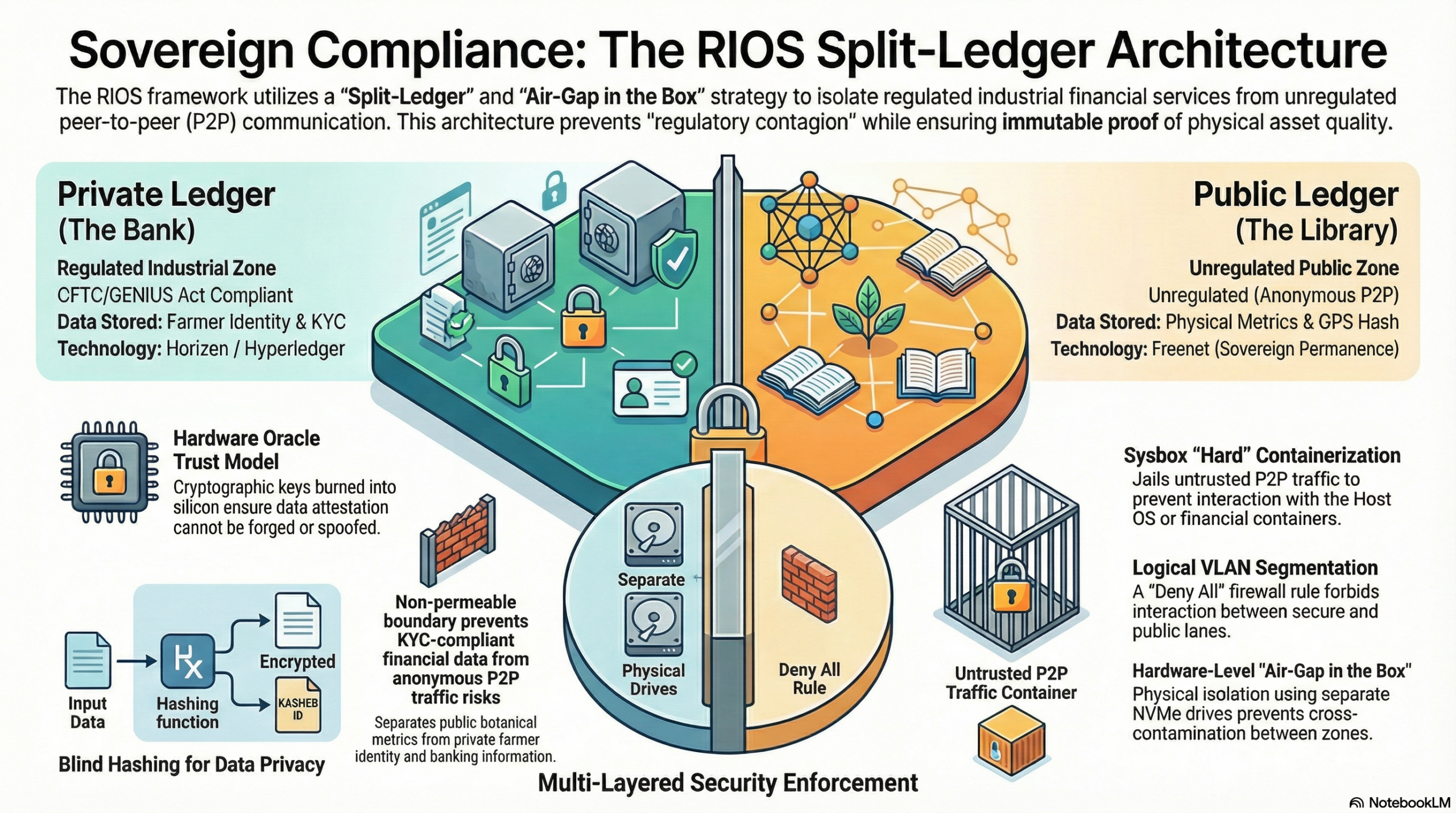
This objective is achieved through two primary frameworks: the Separation of Concerns and the Split-Ledger Framework. By physically and logically isolating regulated industrial financial services (e.g., HempGrade AI) from unregulated peer-to-peer (P2P) communication services (e.g., Freenet), the architecture prevents “regulatory contagion.” Central to this resilience is the Hardware Oracle, which utilizes non-extractable cryptographic keys stored in a Trusted Platform Module (TPM) to sign physical data at the point of origin, creating a “Hardware Root of Trust.”
Strategically, the project targets “Blue Collar AI” opportunities—industrial sectors like agriculture, mining, and logistics where physical value often fails to translate into digital value. Through a three-year rollout, the framework aims to establish itself as a Tier-1 Data Infrastructure Provider for the Real-World Asset (RWA) market, projecting significant profitability by Year 3.
——————————————————————————–
1. The Doctrine of Separation of Concerns
The architecture of RIOS Tier 2 “Anchor” nodes is governed by the strategic doctrine of “Separation of Concerns.” This mandates a non-permeable boundary between regulated zones and unregulated community utilities.
Operational Divergence
The following table delineates the divergence between the two primary operational environments within a single node:
| Dimension | Industrial/Financial Zone (HempGrade) | Public Communication Zone (Freenet) |
| Core Function | AI-driven agricultural grading; RWA tokenization. | Censorship-resistant messaging; decentralized web. |
| Regulatory Status | Regulated (GENIUS Act, CFTC-compliant). | Unregulated (Anonymous P2P). |
| Data Sensitivity | High (Financial ledgers, Identity data). | Low-to-Medium (Encrypted public fragments). |
| Target Network | Private Ledgers / Regulated Banking. | Global Swarm (Hyphanet) / Contract Layer (Locutus). |
Technical Enforcement
- Hardware Isolation: Known as “Air-Gap in the Box,” the node utilizes physical partitioning. The Primary NVMe (8TB) stores secure financial data and is logically inaccessible to the Freenet stack, while a Secondary NVMe (STR-01) is designated as “PUBLIC_UNTRUSTED” for P2P data.
- Containerized Security: Utilizing Sysbox Enterprise, the system creates “Hard” isolation. The [PUBLIC_ZONE] container is sandboxed, restricted from the Host OS, and subject to a 15% CPU limit to ensure mission-critical financial operations (Port 443/HTTPS) are never throttled.
- VLAN Segmentation: Virtual lanes prevent lateral movement. VLAN 10 handles management and financial traffic, while VLAN 20 manages community Wi-Fi and P2P traffic. A “DENY ALL” firewall rule is enforced between them.
2. The Split-Ledger Framework for RWA Tokenization
To satisfy both the “Regulatory Mandate” (KYC/AML) and the “Trust Mandate” (immutable public proof), the architecture decoupling financial settlement from physical attestation.
The Trinity Stack
- Layer 1: Physical Ingestion (The Eye): RIOS hardware and HempGrade AI perform real-time computer vision analysis of biomass (e.g., stalk diameter, fiber quality).
- Layer 2: The Publisher Bridge (The Hand): Custom Rust middleware acts as a strategic air gap, sanitizing data by stripping Personally Identifiable Information (PII) before requesting a TPM cryptographic signature.
- Layer 3: The Public Registry (The Memory): Sanitized, signed data is pushed to Freenet for immutable storage, ensuring “Sovereign Permanence.”
Ledger Comparison: The Bank vs. The Library
| Feature | Private Ledger (The Bank) | Public Ledger (The Library) |
| Technology | Horizen / Hyperledger | Freenet |
| Data Stored | Farmer Identity, Wallets, Pricing, KYC. | Physical Metrics, 10km GPS Hash, Node ID. |
| Regulatory Role | AML/KYC & Financial Settlement. | Commodity Provenance & Quality Audit. |
——————————————————————————–
3. The Hardware Oracle and Cryptographic Trust
The framework replaces fallible human auditing with a Hardware Oracle model. This is the primary competitive differentiator, binding digital records to physical reality.
- Silicon-Level Identity: During assembly, a unique Ed25519 Key Pair is burned into the hardware’s TPM. The private key never leaves the secure enclave.
- Mathematical Certainty: When the AI grades a commodity, the TPM signs the data locally. This provides proof that the data originated from a specific machine at a specific time, eliminating risks of sensor-spoofing or “Garbage In” attacks.
- Tamper-Evidence: LBL-01 Holographic Seals are applied to the server. A “Genesis Image” of these seals is uploaded to a Freenet contract to create an immutable record of the node’s physical integrity.
——————————————————————————–
4. Economic Opportunity: “Blue Collar AI”
The “Diesel to Data” thesis posits that while industrial sectors generate massive physical value, their digital value is lost. The RIOS stack serves as a “Translator Layer.”
Strategic Submission Themes
Founders are encouraged to build application layers for the RIOS Sovereign Stack, targeting specific grant-aligned themes:
- The Sovereign Mechanic (“Wrench-OS”): An augmented reality platform using computer vision to guide non-technical workers through complex equipment repairs.
- Grant Alignment: WORC Initiative (Dept of Labor); NSF “Future of Work.”
- The Bio-Asset Banker (“HempGrade AI”): Converts physical biomass into “Bio-Energy Credits” on the ledger, effectively turning waste into a liquid asset.
- Grant Alignment: USDA REAP (Rural Energy for America Program).
- The Guardian of the Mesh (“Site-Sight”): A privacy-first security app that processes video locally on the RIOS node, ensuring no surveillance data is sent to the cloud unless a crime is verified.
- Grant Alignment: DHS “Soft Target Security”; Mozilla “Data Privacy” grants.
——————————————————————————–
5. Risk Mitigation and Regulatory Strategy
The framework employs a “Liability Shield” to navigate global data privacy and financial regulations.
- Common Carrier Status: By acting as a neutral intermediary (router/ISP) and being technically unable to moderate encrypted P2P data on the STR-01 drive, operators claim protection under DMCA Section 512 Safe Harbor.
- Data Minimization: To comply with GDPR/CCPA, the public schema excludes farmer names, wallet addresses, and precise GPS coordinates (using a 10km radius geohash instead).
- Safe Harbor Framing: The public ledger is defined as a “Commodity Library”—an informational utility that falls outside the SEC’s purview because it contains no financial settlement logic or pricing data.
- Immutability Paradox: To address errors on immutable ledgers, the protocol uses “Correction Records” requiring a dual-signature (Hardware Node + Human Admin), satisfying audit requirements without deleting history.
——————————————————————————–
6. Financial Proforma and Roadmap
The transition from hardware manufacturer to Tier-1 Data Infrastructure Provider involves a phased three-year rollout:
- Phase 1 (2026): Validation in pilot locations such as Node 4 (Kaabong, Uganda) and Node 3 (Arizona).
- Phase 2 (2027): Commercialization via RIOS OS v3.0, featuring one-click integration and a “Verifier App” for global buyers.
- Phase 3 (2028): Scaling to 250+ nodes and opening APIs for third-party analytics.
2028 Financial Summary
By Year 3, the model projects over $4.5 million in annual profit with a 75% profit margin, driven by three revenue streams:
- Hardware Enablement Fee: $2,500 per unit (premium for TPM provisioning).
- SaaS Subscription: $500/month per node for “Publisher Bridge” access.
- Attestation Fee: $10 per batch micro-fee for every certificate pushed to the public ledger.